Ask a buyer to name the two “light” Magnesium Carbonate grades in the market, and most will describe Light and Heavy without hesitation — the distinction gets covered constantly, including in our own How to Select the Right Magnesium Carbonate Grade for Your Manufacturing Process guide. Far fewer buyers can clearly articulate what separates Ultra Light Magnesium Carbonate from conventional Light Magnesium Carbonate — a distinction that’s smaller in absolute terms than the Light-versus-Heavy comparison, but genuinely important for the specific applications where it matters.
This guide is dedicated entirely to that narrower, less-discussed comparison: what physically and chemically separates Ultra Light from standard Light grade, how that difference is engineered during manufacturing, and — most practically — which applications actually justify paying the premium for Ultra Light rather than defaulting to the more widely used, more economical Light grade.
Same Chemistry, Different Structural Extreme
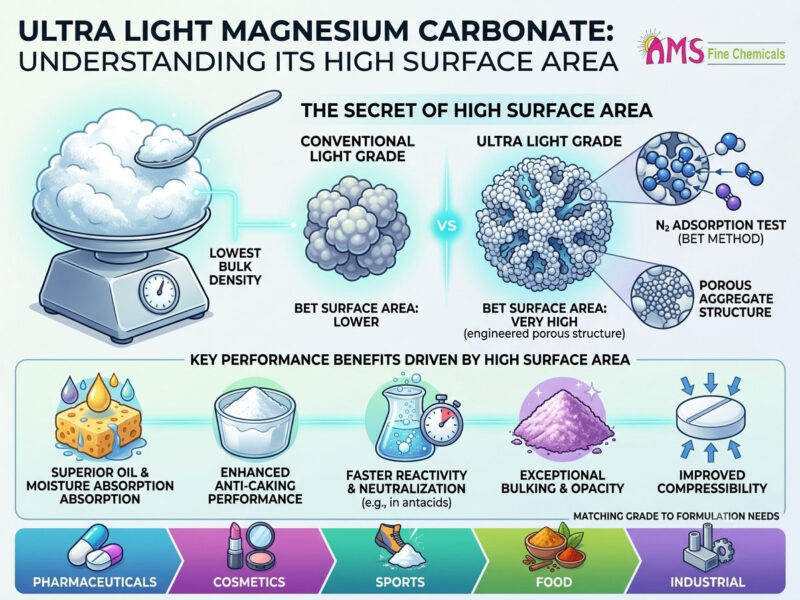
Both Light and Ultra Light Magnesium Carbonate share an identical underlying chemical identity — a basic (hydrated) magnesium carbonate structure, generally represented as a variable combination of magnesium carbonate, magnesium hydroxide, and water of crystallization. Neither grade differs from the other in fundamental molecular composition the way, say, Magnesium Carbonate differs from Magnesium Trisilicate. What separates them is entirely physical: bulk density, particle morphology, and the resulting surface area — the same three interconnected properties covered individually in our dedicated articles on Magnesium Carbonate Bulk Density, How Magnesium Carbonate Particle Morphology Influences Industrial Performance, and How Surface Area Influences Light Magnesium Carbonate Performance.
Ultra Light grade sits at the extreme end of the same structural spectrum Light grade occupies — pushing bulk density even lower and surface area even higher than what standard Light grade production targets. It isn’t a different compound; it’s the same compound engineered toward the far end of the porosity range the precipitation process is capable of producing.
The Numbers: Where Ultra Light Actually Diverges From Light Grade
While exact figures vary by manufacturer and specific process controls, the general distinction across the industry looks like this:
| Property | Light Magnesium Carbonate | Ultra Light Magnesium Carbonate |
|---|---|---|
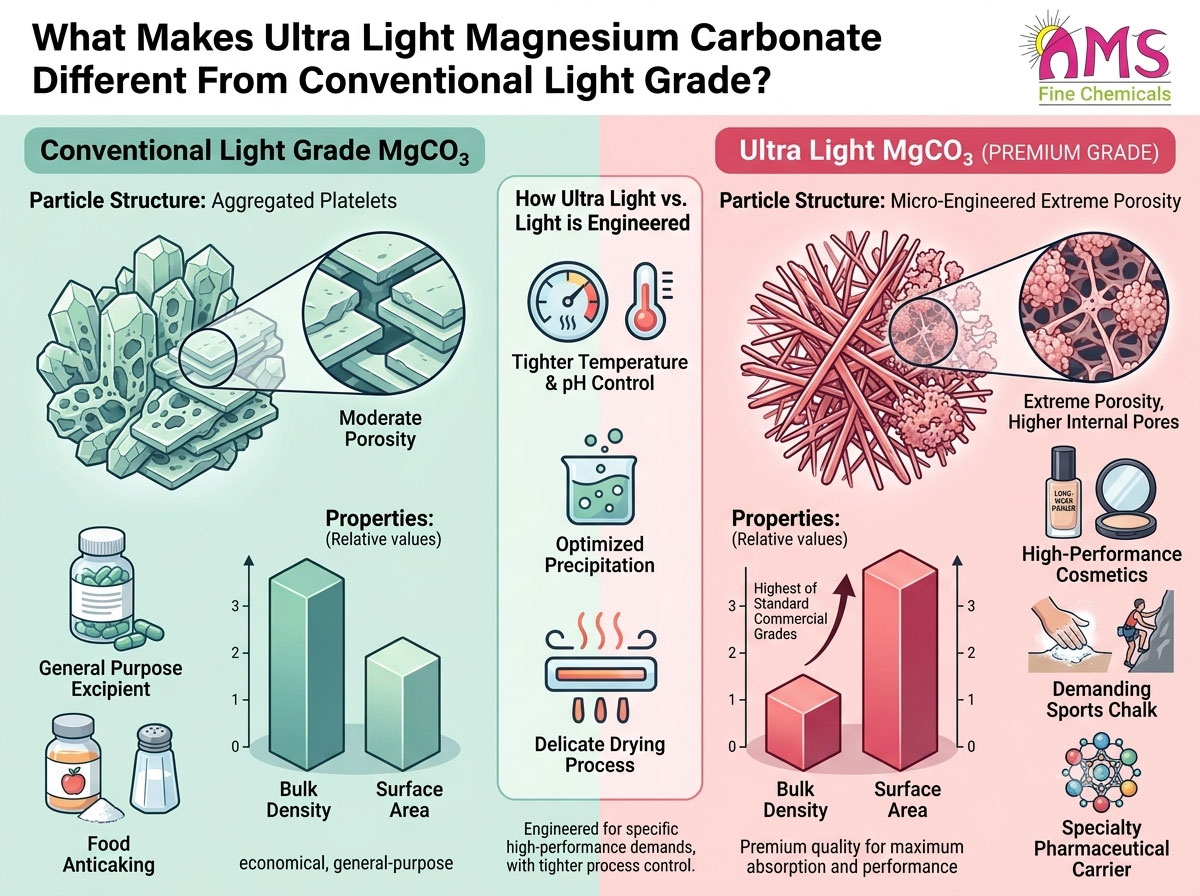
| Bulk density | Roughly 0.10–0.15 g/cm³ | Lower than standard Light, often below the 0.10 g/cm³ range |
| Specific surface area | High | Higher still — the highest of the standard commercial grades |
| Particle porosity | Porous, aggregated plate structure | More extensively porous, looser aggregation |
| Typical positioning | Default general-purpose absorbent/anti-caking grade | Premium grade for maximum-absorbency applications |
The gap between Light and Ultra Light is meaningfully smaller than the gap between Light and Heavy grade — Heavy grade sits at roughly three to five times Light grade’s bulk density, a difference covered in detail in our bulk density article. Ultra Light’s departure from Light grade is a further step in the same direction, not a comparably dramatic structural leap. This is precisely why the Light-versus-Ultra-Light decision requires more nuanced judgment than the more obviously binary Light-versus-Heavy choice.
How This Extra Porosity Is Engineered
Consistent with the manufacturing principles covered in our Complete Guide to Magnesium Carbonate Manufacturing Process, Ultra Light’s structural extreme is achieved through more tightly controlled — and often more precisely tuned — precipitation conditions than standard Light grade production requires.
Precipitation temperature and pH control: Producing Ultra Light grade generally demands narrower tolerance windows on reaction temperature and pH than standard Light grade, since even small deviations toward denser particle formation can pull a batch back toward conventional Light grade’s bulk density range rather than achieving the more extreme porosity Ultra Light requires.
Extended or modified boiling and aging stages: The precipitation and boiling stage duration — discussed as the primary bulk-density-determining step in our manufacturing guide — often requires specific timing adjustments to maximize the loosely aggregated, high-void-space crystal structure that gives Ultra Light grade its exceptional surface area.
Drying methodology sensitivity: Because Ultra Light’s particle structure is inherently more delicate and porous than standard Light grade, drying stage parameters — temperature, airflow, equipment type — require careful calibration to preserve this structure through to the finished product, since aggressive or poorly controlled drying risks collapsing exactly the porosity the grade depends on, a risk covered in general terms in our manufacturing guide but especially acute for this particular grade.
Why this makes Ultra Light inherently more production-sensitive: Because achieving Ultra Light’s more extreme structural target requires tighter process tolerances at multiple manufacturing stages simultaneously, batch-to-batch consistency becomes a genuinely harder manufacturing challenge than it is for standard Light grade — a consideration buyers should factor into supplier evaluation specifically for this grade, discussed further below.
A Historical Note: Why Ultra Light Emerged as a Distinct Grade
Grade differentiation within the Magnesium Carbonate industry didn’t start with three neatly defined tiers — Light and Heavy grade emerged first, as manufacturers recognized that different bulk density targets served genuinely different application needs. Ultra Light emerged later, as a response to a narrower but real gap: certain absorbency-critical applications — particularly in cosmetics and specialty pharmaceutical carrier use — began demanding surface area beyond what standard Light grade’s typical production parameters reliably delivered.
Rather than treating this as a reason to simply push standard Light grade production toward its most extreme achievable porosity as a matter of course, manufacturers established Ultra Light as a distinct, separately specified and separately priced grade — recognizing that most applications don’t need or benefit from that extreme, and that manufacturing every batch to the tightest possible tolerance would raise costs across the entire Light grade customer base rather than only the subset of buyers who actually need it. This is why the three-grade structure (Light, Ultra Light, Heavy) persists industry-wide rather than manufacturers simply offering a single, continuously variable bulk density specification — distinct grades let buyers pay for the performance tier their application actually requires.
Functional Consequences: Where the Difference Actually Shows Up
Absorbency and moisture management: Ultra Light’s higher surface area translates directly into greater moisture- and oil-absorbing capacity than standard Light grade, following the adsorption mechanism covered in our Magnesium Carbonate Moisture Absorption and Light Magnesium Carbonate for Oil Absorption articles. This is the single most commercially relevant difference between the two grades — for applications where absorbency genuinely is the limiting performance factor, Ultra Light delivers a measurable step up.
Acid reactivity: Following the surface-area-driven reactivity principle covered in our Magnesium Carbonate Solubility and Acid Reactivity Explained article, Ultra Light grade generally reacts somewhat faster with acid than standard Light grade, relevant to pharmaceutical antacid applications specifically targeting the fastest possible onset of neutralizing action.
Flowability — where Ultra Light can actually underperform: Counterintuitively, higher surface area and lower bulk density don’t always mean better handling characteristics. As covered in our Magnesium Carbonate Particle Size Distribution article, very fine, highly porous powders can actually flow less predictably than moderately fine ones, since interparticle cohesive forces become proportionally more significant as particle size and density decrease. Ultra Light grade can present real flowability challenges in high-speed tableting or bulk handling equipment that standard Light grade handles more gracefully — a genuine trade-off, not simply a strictly “better” upgrade.
Cost: Given the tighter manufacturing tolerances discussed above, Ultra Light grade commands a price premium over standard Light grade — a premium that’s only worth paying when the absorbency or reactivity benefit genuinely translates into meaningful, measurable performance improvement in the specific application.
When Ultra Light Is Actually Worth the Premium
High-performance cosmetic mattifying products: As covered in our Light Magnesium Carbonate in Cosmetics: Oil Absorption and Texture Benefits article, products specifically marketed around aggressive, long-wear oil control — primers and foundations targeting genuinely oily skin, extended-wear setting powders — are where Ultra Light’s absorbency advantage translates into a real, marketable performance claim rather than a marginal improvement.
Demanding sports chalk formulations: Our Light Magnesium Carbonate in Sports Chalk: Why Porosity Matters article covers this directly — endurance climbing, high-intensity training environments, or athletes with naturally higher perspiration rates represent genuine use cases where Ultra Light’s extended absorption capacity provides a real, felt performance difference before the chalk’s capacity saturates.
Specialty pharmaceutical carrier applications: Formulations specifically depending on maximum surface area for a carrier or adsorbent function — certain research-stage delivery systems, or products requiring the fastest possible acid-neutralization onset — can genuinely benefit from Ultra Light’s structural extreme, where standard Light grade’s surface area falls short of the specific performance target.
Aggressive dry shampoo and hair care formulations: Products designed to manage significant scalp oil production between washes, discussed in our Light Magnesium Carbonate for Moisture Control in Personal Care Products article, represent another category where the absorbency step-up justifies the grade upgrade.
When Standard Light Grade Remains the Better Choice
General pharmaceutical excipient use: As covered in our Light Magnesium Carbonate in Pharmaceutical Powder Formulations and tablet formulation content, most standard tablet excipient functions — bulking, moisture protection for hydrolysis-sensitive APIs, mild pH buffering — are adequately served by standard Light grade’s absorbency and reactivity profile, without the flowability trade-offs Ultra Light can introduce into high-speed tableting operations.
Standard food anti-caking applications: Our Light Magnesium Carbonate as Anticaking Agent in Spices, Salt, and Powdered Foods article describes performance requirements that standard Light grade satisfies reliably — most food anti-caking applications don’t face moisture challenges severe enough to require Ultra Light’s additional capacity, making the cost premium difficult to justify.
General cosmetic bulking and texturizing: Standard face powder, general-purpose foundation, and typical dusting powder applications — covered in our Light Magnesium Carbonate for Face Powders and Loose Powder Formulations article — generally perform well with standard Light grade, reserving Ultra Light specifically for products making an explicit high-performance oil-control claim.
Any application where flow consistency is a priority alongside absorbency: Given Ultra Light’s potential flowability challenges, applications running through automated, high-speed processing equipment should carefully weigh whether the absorbency gain justifies the increased risk of flow-related processing issues — sometimes standard Light grade’s more moderate, more predictable flow behaviour is the safer overall choice even when Ultra Light’s absorbency would technically perform better in isolation.
Storage and Handling Differences Worth Knowing
Because Ultra Light grade’s higher surface area makes it inherently more hygroscopic than standard Light grade, storage and handling discipline — covered generally in our Magnesium Carbonate Storage and Handling: Best Practices for Industrial Buyers guide — matters even more for Ultra Light specifically. A few practical implications:
- Faster moisture uptake if packaging is compromised: Ultra Light’s greater surface area means it will absorb ambient moisture more quickly than standard Light grade if container seals or liners are damaged, making packaging integrity checks at receipt especially important for this grade.
- Shorter practical open-container window: Once a container of Ultra Light grade is opened for use, its higher hygroscopicity means it has comparatively less “buffer” before meaningful moisture pickup begins, reinforcing the value of minimizing open-container dwell time during dispensing operations.
- Greater sensitivity to humid climate storage: Buyers in consistently high-humidity regions — including much of the Indian subcontinent during monsoon season — should apply even more rigorous climate-controlled storage discipline to Ultra Light grade than they might for standard Light or Heavy grade material.
None of this makes Ultra Light impractical to work with — it simply means the storage and handling discipline that benefits all Magnesium Carbonate grades matters with somewhat less margin for lapses when working with this particular grade.
A Practical Decision Framework
Before specifying Ultra Light grade over standard Light grade, work through these questions:
- Is absorbency (moisture or oil) genuinely the limiting factor in your formulation’s performance, or would improving another variable — inclusion rate, particle size, formulation design — achieve the same result more cost-effectively than upgrading grade?
- Does your application involve high-speed automated processing where Ultra Light’s flowability characteristics could introduce production risk that outweighs the absorbency benefit?
- Have you bench-tested both grades side by side in your actual formulation, rather than assuming Ultra Light’s specification advantage will translate proportionally into finished-product performance?
- Does your product’s marketing or therapeutic claim specifically depend on maximum absorbency performance, or would standard Light grade’s performance go unnoticed by the end user in practical use?
If the honest answer to most of these questions favors standard Light grade, the cost premium for Ultra Light likely isn’t justified. If your application specifically depends on pushing absorbency to its practical maximum — and your processing equipment can accommodate the grade’s flow characteristics — Ultra Light earns its premium.
Sourcing Considerations Specific to Ultra Light Grade
Batch-to-batch consistency deserves extra scrutiny: Given the tighter manufacturing tolerances discussed earlier, buyers should specifically verify a supplier’s demonstrated consistency in producing Ultra Light grade at scale — a principle covered in general terms in our Factors That Determine the Quality of Industrial-Grade Magnesium Carbonate article, but especially important for this specific grade given its narrower production tolerance window.
Request full particle size and surface area data, not just bulk density: Since bulk density alone doesn’t fully capture the porosity difference this guide has focused on, requesting BET surface area data alongside standard bulk density and particle size figures — as covered in our surface area article — gives a more complete picture of whether a specific batch genuinely delivers the Ultra Light performance profile your formulation depends on.
Validate with a sample batch before full-scale commitment: Given the real trade-offs discussed throughout this guide — genuine absorbency gains alongside potential flowability challenges — bench-scale validation in your actual formulation and equipment remains the most reliable way to confirm Ultra Light grade delivers a net benefit for your specific application, rather than assuming the specification sheet alone predicts real-world performance.
How AMS Fine Chemicals Manufactures Ultra Light Magnesium Carbonate
AMS Fine Chemicals, based in Bhavnagar, Gujarat, manufactures Ultra Light Magnesium Carbonate with the tightly controlled precipitation temperature, pH, and drying parameters this grade’s more demanding production profile requires, alongside our standard Light and Heavy grades. Every batch undergoes in-house testing for particle size distribution, bulk density, and — on request — surface area characterization, supporting buyers who need to confirm genuine Ultra Light performance before committing to full-scale procurement.
Explore full technical specifications on our Ultra Light Magnesium Carbonate and Light Magnesium Carbonate product pages, or browse our complete Magnesium Carbonate range — including Heavy Magnesium Carbonate — and our broader portfolio of magnesium compounds, including Magnesium Hydroxide and Magnesium Trisilicate, on the Products page.
Frequently Asked Questions
Is Ultra Light Magnesium Carbonate a different chemical compound than Light grade? No — both share the same basic (hydrated) magnesium carbonate chemistry. The difference is entirely physical and structural: bulk density, particle morphology, and surface area, not molecular composition.
Can I substitute Ultra Light for Light grade in an existing formulation without reformulation? Not without validation. Ultra Light’s different bulk density and flow characteristics can affect dosing accuracy and processing behaviour even when the absorbency improvement itself is beneficial, meaning a direct substitution should be bench-tested rather than assumed to be a drop-in upgrade.
Why does Ultra Light grade cost more than standard Light grade? Its more extreme porosity target requires tighter process control tolerances at multiple manufacturing stages — precipitation temperature, pH, and drying — making it inherently more production-sensitive and costly to manufacture consistently at scale than standard Light grade.
Does Ultra Light grade have worse flow properties than Light grade in every case? Generally its flow properties are more challenging, given its higher surface area and lower bulk density, though the practical impact depends on the specific processing equipment and formulation — some applications tolerate this trade-off easily, while high-speed automated processes may find it more disruptive.
How do I confirm a supplier’s Ultra Light grade genuinely meets the higher surface area specification, not just a lower bulk density reading? Request BET surface area data specifically, not just bulk density and particle size figures, since bulk density alone can’t fully confirm the internal porosity that distinguishes genuine Ultra Light performance from a batch that simply reports a lower bulk density number without the corresponding surface area increase.
Final Word
The distinction between Light and Ultra Light Magnesium Carbonate is real but narrower and more application-specific than the more commonly discussed Light-versus-Heavy comparison — both grades share identical chemistry, differing only in how far the same porous particle structure has been pushed during manufacturing. For applications where absorbency genuinely is the limiting performance factor — aggressive cosmetic mattifying products, demanding sports chalk formulations, specialty pharmaceutical carriers — Ultra Light’s structural extreme delivers a real, worthwhile improvement. For the majority of standard pharmaceutical, food, and general cosmetic applications, standard Light grade remains the more practical, more cost-effective, and often more processing-friendly choice. Understanding this trade-off — rather than assuming “Ultra” automatically means “better” — is what leads to the right grade decision for your specific formulation.
To request technical specifications, surface area data, or sample batches of Light or Ultra Light Magnesium Carbonate, visit our Ultra Light Magnesium Carbonate product page or reach out through our Contact Us page.