Open any pressed powder compact, matte foundation, or dry shampoo and the ingredient list usually reads like a quiet negotiation between competing demands. The product has to feel silky, absorb oil without looking chalky, stay stable on a shelf, and still be gentle on skin. Behind many of those formulas sits a modest white mineral powder that does a surprising amount of work: Magnesium Carbonate.
Not every Magnesium Carbonate behaves the same way, though. Grade matters, and in cosmetics few grades matter as much as Ultra Light Magnesium Carbonate. Its extremely low bulk density, high porosity, and fine particle structure make it a functional ingredient rather than a simple filler.
At AMS Fine Chemicals, a manufacturer and exporter of magnesium compounds based in Bhavnagar, Gujarat, we work with formulators who ask a consistent set of questions. Which grade absorbs oil best? How does it affect pressing and flow? What should we check on the Certificate of Analysis? This guide answers those questions in practical terms, from the material’s physical structure to formulation strategy, quality control, and supplier selection.
What Is Ultra Light Magnesium Carbonate?
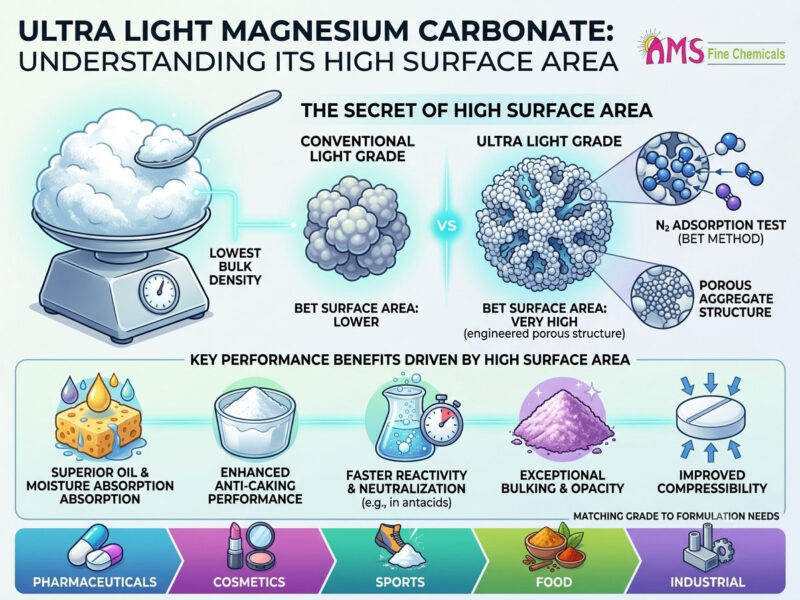
Magnesium Carbonate used in industry is typically a hydrated basic magnesium carbonate rather than pure anhydrous MgCO₃. It is a white, odorless, fine powder that is practically insoluble in water but reacts readily with acids. The “Ultra Light” designation refers to the grade’s very low bulk density. The particles are loosely packed, highly porous, and bulky for their weight.
That structure is what makes the grade interesting for cosmetics. Compared with denser grades, Ultra Light material offers:
- A very high volume per unit weight, which gives bulk and a soft, airy feel
- High surface area and pore volume, which support oil and moisture absorption
- Excellent fineness, which supports smooth application and slip
- A bright white color that contributes to opacity and coverage
If you want the broader context, our guide to the Complete Guide to Magnesium Carbonate Manufacturing Process explains how production conditions shape these physical characteristics. Our article on How Magnesium Carbonate Particle Morphology Influences Industrial Performance explains why particle shape and internal structure matter so much for performance.
Why Cosmetic Formulators Pay Attention to This Grade
Cosmetic formulation is a balancing act between sensory feel, functionality, stability, and cost. Magnesium Carbonate appears in the cosmetic ingredient literature for several functional roles, commonly described as absorbent, anticaking agent, bulking agent, and opacifying agent. The Ultra Light grade amplifies the first and third of these because of its structure.
1. Oil and Sebum Absorption
Shine control is one of the most common claims in color cosmetics and skincare. Ultra Light Magnesium Carbonate has a porous particle architecture that can take up oils and sebum, helping to deliver a matte finish. It sits alongside other absorbent powders such as silica, talc alternatives, starches, and clays. Formulators choose among them based on feel, absorption capacity, compatibility, and positioning.
The benefit is practical. A powder that holds sebum within its pore structure helps a finish look fresher for longer, and a low-density structure means a small weight of ingredient can provide a large effective volume of absorbent surface.
2. Lightweight Bulk and Soft Feel
Low bulk density gives the powder a distinctive soft, cushiony feel. In loose powders, pressed powders, and body powders, this contributes to a fine, silky texture instead of a gritty or dense one. Because the grade is so voluminous, it can help adjust the bulk of a formula without making it feel heavy.
3. Opacity and Brightness
A bright white powder with fine particles contributes to opacity. In foundations, concealers, and face powders, this can help soften the appearance of imperfections and support even coverage. It also helps pigment dispersions look cleaner and more uniform when used as part of a balanced powder phase.
4. Anticaking and Flow Support
Powders that absorb moisture can clump, which causes problems in manufacturing and on the dressing table. Magnesium Carbonate has long been used to keep powders free-flowing and to reduce caking. In cosmetic powders, this supports consistent dispensing, easier mixing, and a more reliable product experience.
5. Gentle, Mineral-Based Positioning
Many brands want ingredient lists that read as mineral-based and straightforward. Magnesium Carbonate fits that positioning well, and it pairs naturally with other mineral components in powder-based products.
Where It Is Used: Key Cosmetic Applications
Pressed and Loose Face Powders
Face powders are a natural home for Ultra Light Magnesium Carbonate. The grade contributes oil absorption, softness, and brightness, while helping the powder blend smoothly over skin. In pressed formats, formulators need to balance the bulky, low-density nature of the grade against the compression behavior of the whole blend. That usually means working with binders and combining the Ultra Light grade with other powders to reach the target hardness and pay-off.
Matte Foundations and Concealers
In powder foundations and some anhydrous or low-water systems, Ultra Light Magnesium Carbonate can help control shine and support coverage. Emulsion-based foundations need more careful handling because the high absorption capacity of the grade will interact with the oil phase. Formulators generally run small-scale trials to find the usage level that gives the desired matte effect without making the formula feel dry or draggy.
Dry Shampoos and Hair Powders
Dry shampoos need to absorb scalp oil quickly and disappear visually on the hair. Absorbent mineral powders are central to these products, and the high pore volume of the Ultra Light grade suits that job. It can contribute to the oil-absorbing base alongside starches or other powders.
Body and Baby-Style Powders
Body powders and talc-free powder concepts rely on absorbency, slip, and a soft feel. Magnesium Carbonate has a long history in this category. Brands pursuing talc-free positioning often evaluate mineral options like this one as part of the blend. Any product intended for sensitive uses should of course be developed and tested to the relevant regional regulatory and safety standards.
Antiperspirant and Deodorant Powders
Moisture and odor management products often use absorbent powders. Magnesium Carbonate can contribute to the moisture-absorbing portion of a formula and help maintain a dry feel.
Skincare Masks and Cleansing Powders
Powder-to-foam cleansers, clay-style masks, and exfoliating powders can use Ultra Light Magnesium Carbonate for absorbency and texture. In water-activated products, the grade’s behavior in the presence of moisture and slightly acidic ingredients needs attention, which is covered in the formulation section below.
How Particle Structure Drives Performance
Understanding why this grade behaves as it does is more useful than memorizing a list of benefits.
Porosity and surface area. Ultra Light Magnesium Carbonate is built from loosely assembled, highly porous particles. The pores and the spaces between particles create a large surface for oils and moisture to adsorb onto. This is why a small quantity can have a large visible effect on shine.
Low bulk density. Bulk density tells you how much space a given weight of powder occupies. A very low value means the powder is voluminous. That has formulation consequences: it affects batch volume, mixer fill levels, pressing behavior, and packaging fill weights. Always check actual bulk density figures on the technical data sheet and Certificate of Analysis for the specific batch you are using.
Fine particle size. Fineness contributes to smooth feel and easy blending. Particle size distribution also influences how the powder behaves when it is sieved, micronized, or mixed with pigments.
Particle shape. Morphology affects packing, flow, and how the powder interacts with other ingredients. This is why two products with similar chemistry can feel very different in a formula.
For a comparison with neighboring grades, see our posts on Light Magnesium Carbonate for Improving Powder Flow and Handling and Heavy Magnesium Carbonate and Powder Flow: Understanding the Processing Advantage. Formulators often choose among Light Magnesium Carbonate, Heavy Magnesium Carbonate, and the Ultra Light grade depending on whether the priority is absorbency and bulk, flow, or density.
Formulation Considerations
Getting the most from Ultra Light Magnesium Carbonate means understanding how it behaves in a real batch.
Managing Low Density in Processing
Because the powder is so bulky, it can generate dust, entrain air, and take up significant mixer volume. Practical steps include:
- Adding it gradually rather than all at once
- Using appropriate dust control and extraction
- Allowing for deaeration in pressed powder processes
- Testing fill weights early, because volume-based packaging will hold less mass than with denser powders
Balancing Absorption With Skin Feel
Absorbency is a benefit until it becomes a drawback. High levels can leave a formula feeling dry or can pull emollients out of a blend. Formulators typically build the powder phase from several ingredients, using Ultra Light Magnesium Carbonate for oil control and bulk, and pairing it with smooth, slip-giving powders to keep the application comfortable.
Pressing and Binder Systems
Pressed powders need cohesion without turning hard or glazed. Because the Ultra Light grade is very low in density, it can be challenging to compress on its own. Typical approaches use a measured proportion of the grade within the powder blend and adjust the binder type and level, pressing pressure, and moisture content. Small-scale trials save time here.
Moisture Behavior
Magnesium Carbonate can take up atmospheric moisture, and the hydration state can influence handling and stability. Our article on Magnesium Carbonate Moisture Absorption: What Formulators Need to Know explains this in detail, and it is worth reading before you set storage and packaging specifications for the raw material.
Compatibility With Acids and Active Ingredients
Magnesium Carbonate reacts with acids, releasing carbon dioxide. In practice, this means formulators should be careful when combining it with acidic actives, low-pH systems, or acid-containing water phases. Gas evolution, pH drift, or changes in texture are possible. Our guide on Magnesium Carbonate Solubility and Acid Reactivity Explained covers the chemistry. For anhydrous powder systems this is rarely an issue, but for water-containing products it should be tested in stability studies.
Thermal Considerations
Magnesium Carbonate decomposes on heating, losing water and carbon dioxide. This matters for hot-process steps and for sterilization or drying operations. It also explains the Loss on Ignition figures you see on a COA. Our article Understanding the Thermal Decomposition of Magnesium Carbonate explains how to interpret them, and it is useful background when setting process temperatures.
Interaction With Pigments and Color
Because it is bright and opaque, the grade can lighten the shade of a pigmented powder. When reformulating or adding the ingredient to an existing shade range, expect to retune the color. Recording shade targets with a spectrophotometer before and after is good practice.
Comparing Ultra Light Magnesium Carbonate With Other Cosmetic Powders
Formulators rarely choose an ingredient in isolation. Here is how Ultra Light Magnesium Carbonate generally compares with some commonly used alternatives. These are general tendencies, and results depend on the specific grade and formulation.
Versus talc. Talc is prized for slip and a silky feel. Magnesium Carbonate offers stronger absorbency and a lighter, airier feel, but less of the characteristic glide. Brands moving to talc-free formulas often combine mineral powders to rebuild the sensory profile.
Versus silica. Silica products can be very strong oil absorbers and can give a soft-focus effect. Magnesium Carbonate offers a different feel and a mineral, carbonate-based ingredient story, and it is often used alongside silica rather than instead of it.
Versus starches. Starches are common in dry shampoos and body powders. They absorb oil and moisture but can support microbial growth in some conditions and can feel different on skin. Magnesium Carbonate is inorganic and offers a different stability profile.
Versus clays. Kaolin and other clays absorb oil and provide mattifying effects, often with a heavier, more matte feel. Ultra Light Magnesium Carbonate tends to feel lighter and softer.
Versus denser Magnesium Carbonate grades. The Light and Heavy grades have higher bulk density and different flow behavior, which can be more convenient in processing but give less bulk and absorbency per unit weight. The Magnesium Carbonate overview page lists the full grade range.
Quality Parameters Cosmetic Buyers Should Check
A cosmetic ingredient is only as good as the batch in front of you. When qualifying Ultra Light Magnesium Carbonate, review these points on the Certificate of Analysis and technical data sheet:
- Appearance and color: a clean, bright white powder, free of specks or discoloration
- Assay (MgO content): confirms the magnesium content of the batch
- Loss on Ignition: reflects hydration state and total volatile content
- Bulk density: the defining characteristic of the Ultra Light grade, so verify it carefully
- Particle size distribution: affects feel, blending, and sieving behavior
- Moisture content: influences handling, caking, and microbiological risk
- Heavy metals and trace impurities: especially important for any product applied to skin, so check against your target market’s limits
- Acid-insoluble matter and other impurity limits: indicators of purity
- Microbiological quality: typically required by cosmetic quality systems
- pH of aqueous suspension: useful for compatibility planning
Specifications differ by market and brand, so confirm which tests and limits your quality system requires and request them in writing. Our guides Magnesium Carbonate COA Explained: Important Parameters Buyers Should Check and Magnesium Carbonate COA: Understanding the Most Important Quality Parameters walk through how to read each line item.
Regulatory and Safety Considerations
Cosmetic ingredients are regulated differently across regions, and compliance is the responsibility of the brand owner and formulator. Magnesium Carbonate is a long-established cosmetic ingredient and appears in major ingredient inventories, but you should always verify the current status, permitted functions, purity requirements, and labeling rules for each market you sell in, such as the EU, the US, India, and others.
A few general practices help:
- Request documentation from your supplier, including COA, technical data sheet, safety data sheet, and any statements your quality system requires
- Confirm that the grade is suitable for the intended cosmetic use and that purity limits match your target market
- Run your own stability, safety, and claims-substantiation testing on the finished product
- Use the standard INCI name, Magnesium Carbonate, on ingredient lists
This article is technical information, not regulatory advice. Always consult your regulatory team or a qualified specialist for final decisions.
Storage and Handling
Good storage protects performance:
- Keep containers tightly sealed in a cool, dry place
- Protect from humidity, since the powder can absorb moisture
- Avoid storing near acids or acidic vapors
- Use clean, dry scoops and tools to avoid contamination
- Handle with dust control and suitable personal protective equipment, because very fine, low-density powders become airborne easily
- Rotate stock using first-in, first-out practice
Packaging for low-density powders often involves larger bag or drum volumes per unit weight, so factor that into logistics planning and freight costs.
Troubleshooting Common Formulation Issues
The powder feels too dry or draggy. The absorbent level may be too high. Reduce the proportion, or add slip-enhancing powders or a small amount of binder oil.
Pressed powder crumbles. Low density makes compression harder. Adjust binder level, pressing pressure, and the ratio of Ultra Light material to denser powders in the blend.
The shade looks lighter or chalkier than expected. The opacity and brightness of the grade can shift pigmented formulas. Retune the pigment load and check dispersion.
Dust and fill-volume problems in manufacturing. Add the powder gradually, use deaeration where possible, and set fill weights based on actual measured bulk density.
Gas or pH drift in a water-containing product. Check for acidic components. Consider whether the formula suits a carbonate, or move to an anhydrous format.
Batch-to-batch variation. Compare COAs carefully, especially bulk density and particle size, and agree acceptance ranges with your supplier.
Choosing a Magnesium Carbonate Supplier for Cosmetic Use
Consistency is often more valuable than a perfect single batch. When evaluating suppliers, look for:
- Reliable control of bulk density and particle size from batch to batch
- Clear, complete documentation with every shipment
- Willingness to provide samples for trials before you commit to volume
- Transparent communication about specifications and any change in process
- Export experience and dependable logistics
- Technical support when questions come up during formulation
Our guide on How to Evaluate a Magnesium Carbonate Supplier for Bulk Procurement offers a detailed checklist you can adapt to your own quality system.
Beyond Cosmetics: Related Applications
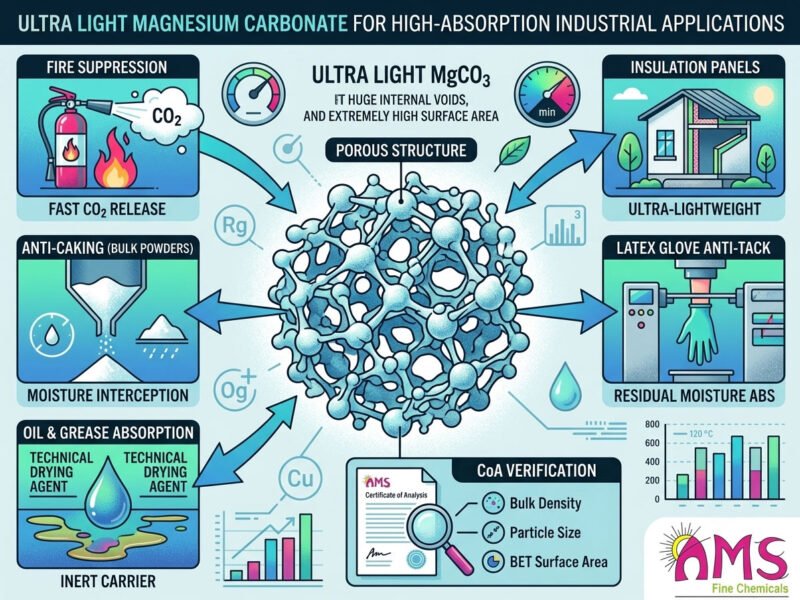
The same structure that makes Ultra Light Magnesium Carbonate valuable in cosmetics also supports other uses. Industrial buyers use the grade where high absorption and low density are needed, which we explore in Ultra Light Magnesium Carbonate for High-Absorption Industrial Applications. You can browse the full set of related articles in our Ultra Light Magnesium Carbonate blog category, our Magnesium Carbonate category, and the Light Magnesium Carbonate category. To see how our products serve different sectors, visit the Industries We Serve and Application pages.
Related Magnesium Compounds
Formulators working across product lines sometimes also use other magnesium compounds from the same family. Magnesium Hydroxide and Light Magnesium Hydroxide are used where controlled alkalinity is needed, and Magnesium Trisilicate is valued for its adsorptive properties in pharmaceutical and personal care settings. You can see the complete range on our Products page.
Frequently Asked Questions
What is Ultra Light Magnesium Carbonate used for in cosmetics?
It is used mainly as an oil-absorbing, bulking, and opacifying powder in face powders, foundations, dry shampoos, body powders, and similar products. Its low density and porous structure support shine control and a soft feel.
How is the Ultra Light grade different from Light and Heavy grades?
The grades differ mainly in bulk density, particle structure, and flow. Ultra Light is the most voluminous and porous, which favors absorbency and bulk. Light and Heavy grades are denser and typically easier to handle and flow. See our Light Magnesium Carbonate and Heavy Magnesium Carbonate pages for comparison.
Can Ultra Light Magnesium Carbonate replace talc?
It can form part of a talc-free powder system, but it does not replicate talc’s slip on its own. Formulators usually combine it with other powders to rebuild the feel they want.
Does it work in water-based cosmetics?
It can, but it reacts with acids and may take up moisture, so compatibility, pH, and stability need testing. It is most straightforward in anhydrous or powder-based formats.
What should I check before buying?
Review bulk density, particle size distribution, moisture, assay, Loss on Ignition, heavy metals, and microbiological data on the COA, and confirm they meet your market’s requirements.
How should it be stored?
Keep it sealed, cool, and dry, away from acids and humidity, and handle it with dust control.
Is it suitable for sensitive-skin products?
Suitability depends on the full formulation and the testing behind it. Always run your own safety and stability assessments and follow the regulations of the market you are selling in.
Can I get a sample?
Yes. You can request technical specifications, a COA, or a sample through our Contact Us page.
Final Word
Ultra Light Magnesium Carbonate earns its place in advanced cosmetic formulations because its physical structure does real work. Its porosity supports oil control, its low density creates a soft, airy feel, its brightness helps with opacity, and its mineral character fits straightforward ingredient stories. Used with a clear understanding of its absorbency, moisture behavior, and acid reactivity, it can help formulators deliver the matte, silky finish that consumers expect.
Success comes down to choosing the right grade, verifying quality through the Certificate of Analysis, testing in your own system, and working with a supplier who delivers consistent batches.
At AMS Fine Chemicals, we manufacture and export Magnesium Carbonate in Light, Ultra Light, and Heavy grades from our facility in Bhavnagar, Gujarat. Explore specifications on our Ultra Light Magnesium Carbonate product page, or request technical data and samples through our Contact Us page. Our team is happy to help you match the right grade to your formulation.