“Magnesium Carbonate” sounds like it should be a single, well-defined raw material — order it, receive it, use it. In practice, the name covers a family of grades that differ enormously in bulk density, particle size, surface area, and functional behaviour, even though the underlying chemistry (MgCO₃, in its various hydrated and basic forms) is broadly similar across all of them. Order the wrong grade, and a pharmaceutical tablet formula won’t compress properly, a rubber compound loses reinforcement strength, or a food powder cakes on the shelf within weeks.
This guide is a practical, engineering-first walkthrough of how to match a Magnesium Carbonate grade to your actual manufacturing process — covering the physical properties that matter, the trade-offs between Light, Ultra Light, and Heavy grades, and the questions your procurement team should be asking suppliers like AMS Fine Chemicals in Bhavnagar, Gujarat, before placing an order.
Start With the Property, Not the Product Name
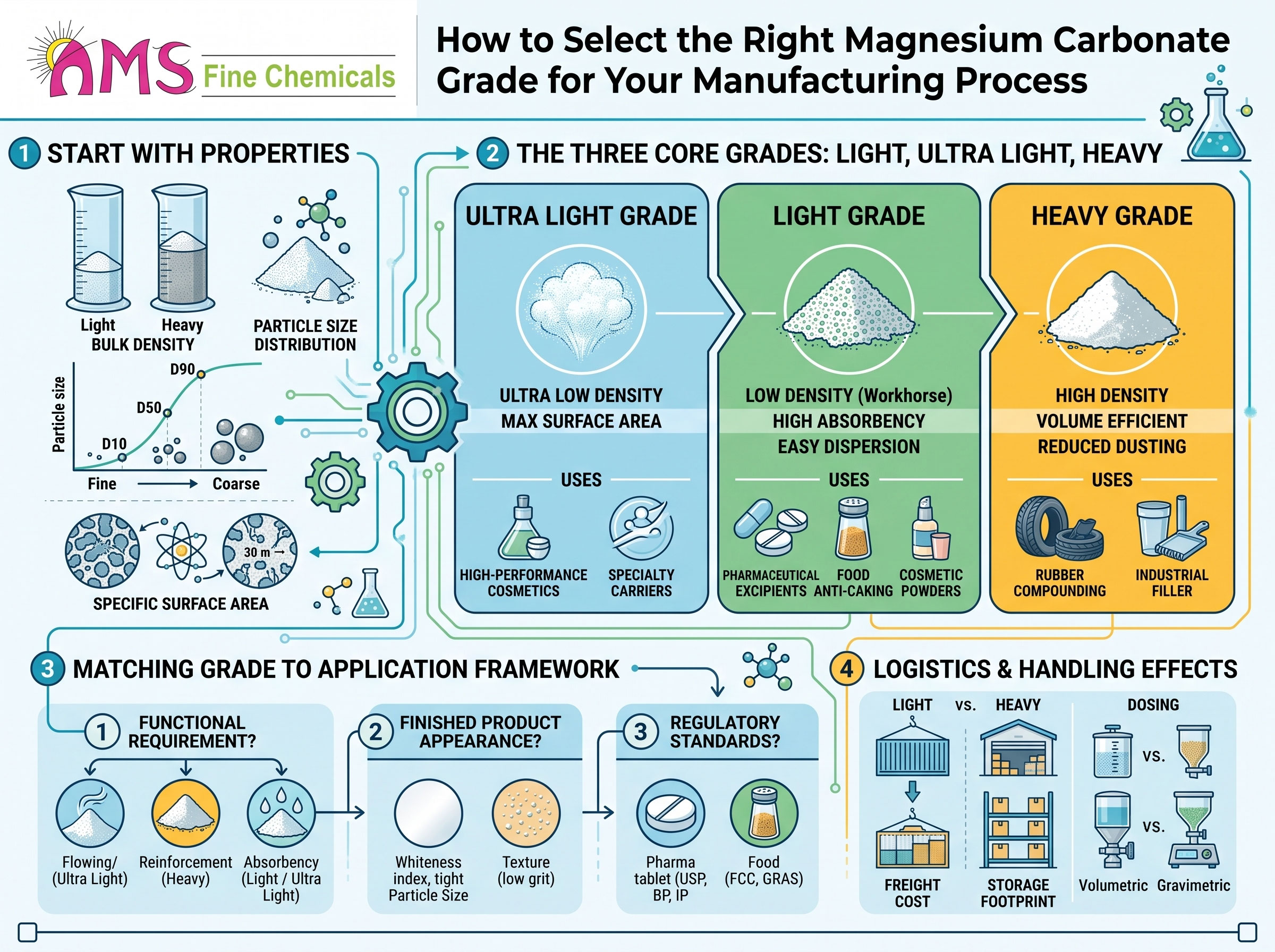
The single biggest sourcing mistake buyers make is asking for “pharma-grade” or “food-grade” Magnesium Carbonate without specifying the physical properties their process actually depends on. Grade names are a shorthand — the real specification lives in a handful of measurable properties:
- Bulk density (loose and tapped)
- Particle size distribution (D10, D50, D90)
- Specific surface area
- Whiteness / brightness index
- Oil or moisture absorption capacity
- Assay and impurity profile
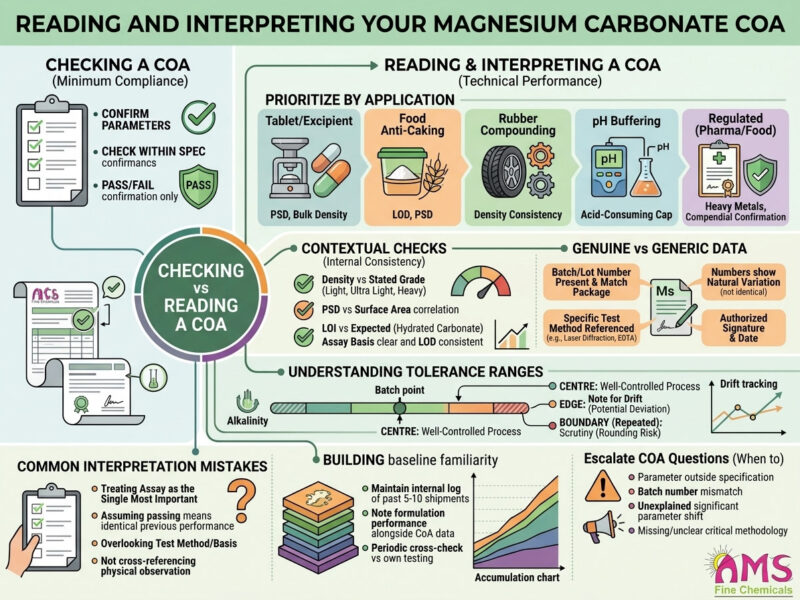
Get these right, and the grade name becomes a formality. Get them wrong, and even a chemically “pure” material can behave completely differently on your production line than the last batch did. For a full breakdown of what a proper Certificate of Analysis should report against each of these properties, see our companion piece, Magnesium Carbonate COA Explained: Important Parameters Buyers Should Check.
The Three Core Grades: Light, Ultra Light, and Heavy
AMS Fine Chemicals manufactures three primary physical grades of Magnesium Carbonate, each engineered through different precipitation and drying parameters to hit a distinct bulk density and surface area target.
Light Magnesium Carbonate
Light Magnesium Carbonate typically carries a loose bulk density in the region of 0.10–0.15 g/cm³, with a correspondingly high specific surface area and strong absorbency. It’s the workhorse grade across pharmaceutical excipient use, cosmetic powders, and food anti-caking applications — anywhere the process benefits from a fine, highly porous powder that disperses easily and absorbs moisture or oils effectively.
Ultra Light Magnesium Carbonate
Ultra Light Magnesium Carbonate pushes bulk density even lower and surface area even higher than the standard Light grade. This grade is generally reserved for the most absorbency-critical applications — high-performance cosmetic powders, specialty pharmaceutical carriers, and processes where maximum surface area per gram is the deciding factor, even at a premium over standard Light grade.
Heavy Magnesium Carbonate
Heavy Magnesium Carbonate sits at the opposite end of the density spectrum, typically in the 0.40–0.50 g/cm³ range. It’s the preferred grade for rubber compounding, industrial filler applications, and any process where volume efficiency, reduced dusting, and easier bulk handling outweigh the need for high surface area.
Our Complete Guide to Magnesium Carbonate Manufacturing Process explains exactly how these density differences are engineered during the precipitation and boiling stages — worth a read if your team wants to understand why bulk density can’t simply be adjusted after the fact through post-processing alone.
Matching Grade to Application: A Working Framework
Rather than starting from the grade name, work backward from your process requirements using this framework.
1. What does the powder need to do mechanically?
- Needs to flow freely and coat evenly (tablet excipients, dusting powders) → Light or Ultra Light grade, fine particle size
- Needs to reinforce or bulk a compound without adding excessive volume (rubber, plastics) → Heavy grade
- Needs to absorb moisture or oil aggressively (anti-caking, cosmetic oil control) → Light or Ultra Light grade, high surface area
2. What does the finished product need to look and feel like?
- Must be visually pure white (cosmetics, coatings, pharmaceutical tablets) → prioritize whiteness/brightness index alongside grade selection
- Must have zero perceptible grit (chewable tablets, face powders) → prioritize tight, small particle size distribution (low D90)
- Visual appearance is not critical (industrial fillers, technical rubber grades) → density and reinforcement performance take priority over whiteness
3. What regulatory or compendial standard applies?
- Pharmaceutical tableting or oral products → confirm compliance with USP, BP, or IP monographs, and request a batch-specific Certificate of Analysis referencing the correct standard
- Food processing → confirm Food Chemicals Codex compliance and GRAS / E504 status where applicable
- Cosmetic use → confirm the grade is manufactured and packed under conditions suitable for personal care applications, with appropriate microbial and heavy metal testing
- Industrial/technical use → compendial compliance is less critical, but consistent bulk density and particle size still matter for process repeatability
Deep Dive: Particle Size and Why It Drives Almost Everything Else
If you can only optimize one property before placing an order, make it particle size distribution. It has downstream effects across nearly every other performance characteristic:
- Flowability: Finer particles generally flow less freely due to increased interparticle friction and static cohesion, which can actually work against high-speed tablet die-filling if the distribution isn’t tightly controlled.
- Dissolution and dispersion: Smaller particle size increases surface area, accelerating dissolution or dispersion in liquid and semi-solid formulations.
- Mouthfeel: In chewable tablets, dusting powders, and toothpaste, particle size directly determines whether the product feels smooth or noticeably gritty — a threshold often sitting somewhere around the low-tens-of-microns range for D90, depending on the specific application.
- Compaction behaviour: Uniform, well-distributed particle sizes support consistent tablet hardness and reduce capping or lamination defects during compression.
A supplier quoting only bulk density without particle size distribution data hasn’t given you enough information to validate fit for a texture-sensitive application. Always request D10, D50, and D90 figures alongside the bulk density spec.
Deep Dive: Surface Area and Absorbency
Surface area and bulk density are closely related but not identical — two grades with similar bulk density can still differ meaningfully in specific surface area (measured in m²/g) depending on the internal porosity of the particles. This matters most in applications where the material’s job is to absorb something:
- Anti-caking in food powders, discussed in more depth in our article on Light Magnesium Carbonate as Anticaking Agent in Spices, Salt, and Powdered Foods, depends on the material’s ability to bind free moisture before it can trigger caking between other powder particles.
- Oil absorption in cosmetics — mattifying powders and dry shampoos rely on high surface area to bind sebum and surface oils without feeling heavy on skin.
- Odor and toxin adsorption in specialty industrial and pharmaceutical applications follows the same surface-area-driven mechanism used by related magnesium compounds — a principle explored from a different angle in our Magnesium Trisilicate BP vs. USP: Understanding Pharmaceutical Grade Specifications guide, where silica surface area governs a comparable adsorbent function.
Deep Dive: Bulk Density and Its Effect on Logistics, Not Just Formulation
Bulk density selection isn’t purely a formulation decision — it has direct commercial consequences that procurement teams often underweight:
- Freight cost per unit of active material. A Light grade shipment occupies significantly more container volume per kilogram than a Heavy grade shipment, which can materially affect landed cost on volume-constrained shipping lanes.
- Storage footprint. Warehousing a low-bulk-density material at scale requires proportionally more storage volume for the same weight of material.
- Dosing and metering equipment compatibility. Volumetric dosing equipment calibrated for one bulk density range can under- or over-dose if a different-density grade is substituted without recalibration — a frequent, avoidable cause of formulation inconsistency when buyers switch suppliers or grades mid-production.
Industry-Specific Selection Guidance
Pharmaceutical Manufacturing
Tablet and capsule manufacturers generally favour Light Magnesium Carbonate for its excipient functionality as a glidant, buffering agent, and moisture scavenger, with tight control over particle size to support consistent compression and content uniformity. Compendial compliance (USP, BP, IP) and full elemental impurity testing via ICP-OES are non-negotiable at this tier. Buyers evaluating related excipients for antacid or buffering formulations may also find our comparison of pharmacopoeial standards for Magnesium Trisilicate directly relevant, since the sourcing logic — matching molecular ratio and assay to compendial requirement — closely parallels Magnesium Carbonate grade selection.
Food Processing
Anti-caking applications in salt, spice, and powdered beverage manufacturing depend on Light grade material with food-grade certification, GRAS status, and E504 compliance where selling into the EU. Whiteness and absence of taste or odor transfer are critical secondary checks alongside the core anti-caking performance.
Cosmetics and Personal Care
Face powders, dusting powders, and dry shampoos typically require Ultra Light or Light grade material with tightly controlled fine particle size and high whiteness index, since both texture and visual appearance are directly scrutinized by end consumers.
Rubber and Industrial Compounding
Heavy Magnesium Carbonate is the standard choice, prioritizing consistent bulk density for volumetric dosing accuracy and reliable reinforcement performance within polymer matrices, with less emphasis on surface area or whiteness compared to pharmaceutical and cosmetic applications.
Refractory and Ceramic Applications
Technical and refractory-grade material generally prioritizes thermal stability and consistent particle size over the fine surface-area characteristics that dominate pharmaceutical and cosmetic selection criteria, aligning more closely with the Heavy grade’s density and handling profile.
Blending and Custom Grade Requests
Not every process fits neatly into “Light,” “Ultra Light,” or “Heavy.” Some formulations benefit from a bulk density or particle size distribution that falls between the standard grades, or from a whiteness index tighter than the general commercial specification. In these cases, established manufacturers can often offer a custom-engineered intermediate grade, adjusting precipitation temperature, stirring rate, and drying/milling parameters to hit a bespoke target rather than forcing the buyer to choose between two standard options that each compromise on a different requirement.
Requesting a custom grade is generally worthwhile when:
- Your process is highly sensitive to a specific bulk density window that falls between the standard Light and Heavy ranges
- You need a particle size distribution tighter than the standard commercial tolerance, for example to eliminate a specific coarse-particle fraction causing tablet defects
- Your whiteness or brightness requirement exceeds the standard commercial specification for cosmetic or coating applications
- You’re scaling up from a lab-validated specification that doesn’t map cleanly onto any single standard grade
Custom grades typically involve minimum order quantities and longer lead times than standard stock grades, so they’re best reserved for established, high-volume production rather than early-stage formulation trials — early trials are usually better served by testing against the closest standard grade first, then requesting customization only once the gap between standard and ideal has been clearly quantified.
Multi-Grade Sourcing Strategies for Complex Manufacturers
Larger manufacturers running multiple product lines — for example, a company producing both pharmaceutical tablets and industrial rubber compounds — often benefit from consolidating Magnesium Carbonate sourcing with a single supplier capable of delivering multiple grades under one qualified vendor relationship, rather than managing separate vendor qualifications for each grade. This approach offers several practical advantages:
- Simplified vendor qualification and audit process, since quality systems, documentation standards, and communication channels are already established
- Consistent CoA formatting and testing methodology across grades, making cross-batch comparison and quality trending easier for internal QC teams
- Better negotiating leverage on freight and packaging, since multiple grades can often be consolidated into shared shipments
- Faster new-grade qualification, since the supplier’s manufacturing process, raw material sourcing, and quality systems are already understood and trusted
The trade-off is reduced flexibility to shop each grade separately for the lowest unit price — a trade-off many manufacturers find worthwhile given the reduction in vendor management overhead and the quality consistency benefits.
A Practical Grade Selection Checklist
Before finalizing a Magnesium Carbonate order, work through this checklist with your supplier:
- Define the functional requirement first — flowability, absorbency, reinforcement, or bulking — before naming a grade.
- Request bulk density (loose and tapped) and confirm it matches the target application’s historical performance range.
- Request particle size distribution (D10, D50, D90), not just a qualitative “fine powder” description.
- Confirm the applicable compendial or regulatory standard (USP, BP, IP, Food Chemicals Codex, or in-house industrial spec) explicitly on the purchase order.
- Request whiteness index data for any visually sensitive end-use application.
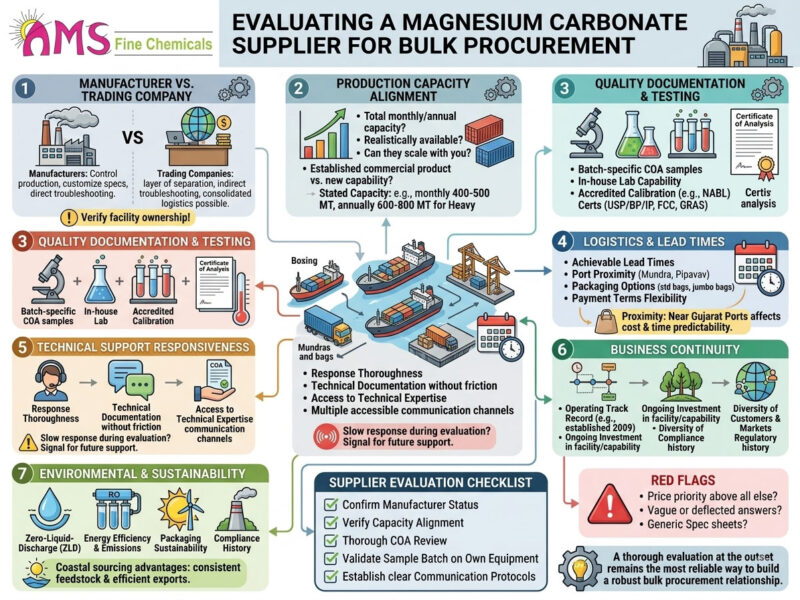
- Ask for a sample batch and run it through your actual process before committing to full-scale procurement, particularly when switching suppliers or grades.
- Retain reference samples from each incoming lot to support future batch-to-batch comparison.
Environmental and Storage Conditions That Affect Grade Performance
Even the correct grade can underperform if storage and handling conditions aren’t matched to its physical characteristics. Light and Ultra Light grades, given their high surface area, are inherently more hygroscopic and more prone to atmospheric carbon dioxide interaction than Heavy grade material. Practical safeguards include:
- Sealed, moisture-proof packaging — food-grade PE liners inside HDPE bags are standard for Light and Ultra Light grades shipped through humid coastal routes.
- Cool, dry warehousing below roughly 30°C, away from direct sunlight and high-humidity storage areas.
- First-in, first-out inventory rotation, since even properly sealed material can gradually pick up ambient moisture once containers are opened and resealed repeatedly.
- Minimizing exposure time during dispensing, particularly for Ultra Light grade material used in cleanroom or controlled-environment pharmaceutical manufacturing, where open-container exposure time is often a documented process parameter.
Buyers relocating production between climates — for instance, shifting a formulation from a temperate manufacturing site to a tropical one — should revalidate moisture pickup behaviour under the new storage conditions rather than assuming performance will remain identical.
Common Mistakes When Switching Grades or Suppliers
- Assuming “Light” and “Ultra Light” are interchangeable. The surface area and absorbency difference between the two can be substantial enough to change dosing requirements in a formulation.
- Reformulating around a supplier’s typical values sheet instead of batch-specific data. Typical values represent an average, not a guarantee — always validate against the actual CoA for the lot being used in scale-up trials.
- Overlooking dosing equipment calibration when switching between Light and Heavy grades, given their significantly different bulk densities.
- Not accounting for humid-climate storage and transit conditions, particularly for hygroscopic Light and Ultra Light grades shipped over long sea-freight routes.
- Selecting on price alone without validating particle size and surface area fit for the specific application — a lower-cost grade that requires reformulation or causes production downtime rarely ends up cheaper overall.
How AMS Fine Chemicals Supports Grade Selection
AMS Fine Chemicals manufactures Light, Ultra Light, and Heavy Magnesium Carbonate from our Bhavnagar, Gujarat facility, with tailored particle size configurations, custom bulk density targets, and grade certifications spanning Industrial, Food, Pure, and Pharma requirements. Every batch is tested in-house across assay, loss on ignition, bulk density, particle size distribution via laser diffraction, whiteness index, and heavy metal content via ICP-OES before release — the same parameter set discussed in detail in our Magnesium Carbonate COA Explained guide.
For buyers still narrowing down their requirements, our technical team can help match your process specifications — flowability, absorbency, compendial standard, or bulk handling requirement — to the correct grade before you commit to a full production order. Explore the complete specification sheets on our Magnesium Carbonate, Light Magnesium Carbonate, Ultra Light Magnesium Carbonate, and Heavy Magnesium Carbonate product pages, or browse our full range of magnesium compounds — including Magnesium Hydroxide and Magnesium Trisilicate — on the Products page.
Frequently Asked Questions
Can I substitute Heavy Magnesium Carbonate for Light Magnesium Carbonate in an existing formulation? Not without revalidation. The two grades differ substantially in bulk density, surface area, and absorbency, which will likely change dosing weight, flow behaviour, and functional performance if substituted directly.
Is Ultra Light Magnesium Carbonate always the better choice for pharmaceutical applications? Not necessarily. While Ultra Light offers the highest surface area and absorbency, standard Light grade is often perfectly suited to typical tablet excipient functions, and Ultra Light is usually reserved for applications specifically requiring maximum absorbency or surface area per gram.
How do I know if my process needs a food-grade or pharma-grade certification, rather than industrial grade? Any product intended for human ingestion, oral pharmaceutical use, or direct food contact requires food-grade or pharmacopoeial (USP/BP/IP) certification with corresponding heavy metal and microbial testing. Industrial and technical applications without direct human contact typically don’t require this level of certification, though consistent physical properties remain important.
Does particle size affect shelf life or storage requirements? Indirectly, yes. Finer, higher-surface-area grades (Light and Ultra Light) tend to be more hygroscopic and can be more sensitive to humid storage and transit conditions than coarser, lower-surface-area Heavy grade material, making moisture-proof packaging especially important for the finer grades.
What’s the best way to validate a new grade or supplier before committing to full-scale production? Request a representative sample batch with a full, batch-specific Certificate of Analysis, run it through a pilot-scale trial on your actual equipment, and compare the results directly against your current material’s known performance benchmarks before scaling up procurement volume.
Final Word
Choosing the right Magnesium Carbonate grade isn’t about picking the “best” option in the abstract — it’s about matching bulk density, particle size, and surface area to the specific mechanical and regulatory demands of your process. Light, Ultra Light, and Heavy grades exist precisely because no single physical form serves pharmaceutical tableting, food anti-caking, cosmetic powders, and rubber compounding equally well.
Getting the grade selection right at the sourcing stage — backed by proper CoA verification and a pilot-scale validation run — is the simplest way to avoid the reformulation costs and production downtime that come from discovering a mismatch after full-scale procurement is already underway.
To request technical guidance on grade selection, a sample batch, or a full Certificate of Analysis, visit our Magnesium Carbonate product page or reach out through our Contact Us page.