Rubber compounding is rarely about selecting a single ingredient. The final performance of a rubber product depends on how polymers, fillers, processing aids, curing agents, stabilizers, pigments, and other functional ingredients interact with one another during mixing, shaping, and vulcanization.
Among the mineral fillers available to rubber manufacturers, Heavy Magnesium Carbonate (MgCO₃) offers a useful combination of density, chemical functionality, physical stability, and filler performance. Although carbon black and silica remain dominant in many highly reinforced rubber formulations, Heavy Magnesium Carbonate can have an important role in selected industrial rubber compounds where formulators need controlled filler loading, dimensional characteristics, processing behaviour, and cost-performance balance.
For rubber manufacturers, however, simply adding Magnesium Carbonate to a formulation is not enough. The grade, particle characteristics, moisture condition, loading level, polymer type, cure system, mixing sequence, and target mechanical properties all influence the final result.
This guide examines Heavy Magnesium Carbonate from a rubber formulator’s perspective—what it is, how it behaves in rubber compounds, where it can be useful, how it compares with lighter Magnesium Carbonate grades, what parameters should be evaluated, and how manufacturers can approach formulation trials systematically.
What Is Heavy Magnesium Carbonate?
Heavy Magnesium Carbonate is a dense form of Magnesium Carbonate characterized by a comparatively higher bulk density and a physical structure different from lighter grades.
Chemically, Magnesium Carbonate is represented by MgCO₃, although commercial materials can exist in hydrated, basic, or structurally complex forms depending on the manufacturing route and specification. In industrial applications, therefore, the name “Magnesium Carbonate” does not automatically describe one identical powder.
The distinction between Light and Heavy grades is particularly important for formulators because physical properties influence processing behaviour just as much as chemical composition.
AMS Fine Chemicals manufactures different Magnesium Carbonate grades for application-specific requirements. The company’s Heavy Magnesium Carbonate is supplied as an industrial-grade material and is identified for applications including Rubber & Plastics, ceramics, refractories, and other industrial uses.
For a broader understanding of the differences between physical grades, formulators can also refer to the AMS Fine Chemicals guide, What Is Heavy Magnesium Carbonate? Density, Particle Structure, and How It Differs from Light Grade.
Why Does Grade Selection Matter in Rubber Compounding?
A common mistake in industrial formulation is to treat all grades of a chemical as interchangeable.
Two Magnesium Carbonate products may have the same general chemical identity but behave differently in a rubber mixer because their:
- Bulk density
- Particle-size distribution
- Particle morphology
- Surface characteristics
- Moisture content
- Surface area
- Packing behaviour
- Flow characteristics
can differ significantly.
These differences affect how quickly the powder incorporates into the polymer, how much volume it occupies in the formulation, how it interacts with other fillers, and how consistently the compound can be processed.
This is why the correct approach is not simply to ask, “Is Magnesium Carbonate suitable for rubber?”
The more useful questions are:
Which grade? At what loading? In which polymer? With which other fillers? Under which mixing conditions? And for which finished-product performance target?
AMS Fine Chemicals discusses this grade-selection principle in detail in its article How to Select the Right Magnesium Carbonate Grade for Your Manufacturing Process.
Role of Heavy Magnesium Carbonate in Rubber Compounds
Heavy Magnesium Carbonate can serve several functions in industrial rubber formulations. Its exact contribution depends strongly on the polymer and formulation design.
1. Mineral Filler
One of the most straightforward applications is its use as a mineral filler.
Fillers are added to rubber compounds for a variety of reasons, including modifying mechanical properties, density, processing behaviour, dimensional stability, and formulation economics.
Heavy Magnesium Carbonate provides a mineral phase within the rubber matrix. When appropriately dispersed, the particles can influence the structure and physical characteristics of the compound.
The objective is not necessarily to replace a highly reinforcing filler completely. Instead, a formulator may use Heavy Magnesium Carbonate as part of a multi-filler system, balancing reinforcement, processing, density, cost, and finished-product requirements.
2. Controlled Filler Loading
Because Heavy Magnesium Carbonate has a higher bulk density than Light Magnesium Carbonate, it can be useful where the formulator needs a more compact mineral filler.
This can be particularly relevant in formulations where powder handling, storage volume, feeding, or compound density are important considerations.
The higher density does not automatically mean better reinforcement. Reinforcement depends on several factors, including particle size, surface chemistry, dispersion, polymer-filler interaction, and loading.
Therefore, Heavy Magnesium Carbonate should be selected because its overall physical profile matches the formulation, rather than because “heavy” implies superior mechanical reinforcement.
3. Modification of Compound Density
Rubber manufacturers sometimes need to achieve a particular density in a finished product.
Applications such as molded industrial components, rubber sheets, profiles, gaskets, mats, seals, and specialized rubber articles may require a carefully controlled density.
A dense mineral filler can contribute to this target while simultaneously becoming part of the compound’s solid filler phase.
The final density, however, depends on the entire formulation. Polymer density, carbon black or silica loading, plasticizer level, mineral filler loading, and processing conditions all contribute.
4. Processing and Compound Handling
The physical form of a filler influences how it is incorporated during mixing.
A dense powder may behave differently from a very low-density material during feeding and charging into an internal mixer or open mill. Powder volume, dust generation, incorporation time, and dispersion can all influence plant-level handling.
For this reason, the bulk density of Heavy Magnesium Carbonate is a processing parameter, not simply a specification-sheet number.
A formulator should evaluate:
- How easily the powder feeds into the mixer
- Whether it tends to bridge or compact in feeding equipment
- How quickly it wets into the polymer
- Whether additional mixing time is required
- Whether the filler disperses uniformly
- Whether it affects compound viscosity
A laboratory formulation that performs well may still require process optimization before being transferred to commercial production.
Heavy Magnesium Carbonate and Polymer-Filler Interaction
The performance of any mineral filler in rubber depends partly on how well it interacts with the polymer matrix.
Rubber polymers such as natural rubber, SBR, NBR, EPDM, CR, and other elastomer systems have different chemical structures and different affinities for fillers.
This means that the same Heavy Magnesium Carbonate grade should not automatically be expected to produce identical results in every elastomer.
For example, an NBR compound designed for oil-resistant seals has a very different formulation objective from an EPDM compound designed for weather-resistant profiles. Likewise, a natural-rubber compound for an industrial mechanical application may prioritize tensile strength and tear resistance differently from a soft rubber mat.
The filler therefore needs to be evaluated in the context of the complete formulation.
Particle Size: A Critical Formulation Parameter
Particle size is one of the first characteristics a rubber formulator should examine when evaluating Heavy Magnesium Carbonate.
Smaller particles generally provide greater available surface area per unit mass, which can increase interactions with the surrounding polymer. However, smaller particle size can also increase the tendency of powders to agglomerate and can influence dusting and dispersion.
Larger or more compact particles may offer different processing characteristics.
The objective is therefore not simply to select the smallest possible particle.
Instead, the formulator should determine the particle-size distribution that provides the best balance between:
- Dispersion
- Processing
- Surface interaction
- Compound viscosity
- Mechanical performance
- Cost
- Production consistency
This is particularly important when Heavy Magnesium Carbonate is used alongside carbon black, silica, calcium carbonate, clay, or other mineral fillers.
Moisture Control Before Rubber Mixing
Moisture is an often-overlooked variable in powder-filled rubber formulations.
Even when the chemical itself is stable, moisture associated with a mineral powder can affect handling, dispersion, storage behaviour, and interactions within the compound.
Magnesium Carbonate can interact with moisture from the surrounding environment, making appropriate storage and handling important for maintaining consistent raw-material characteristics.
AMS Fine Chemicals provides specific storage recommendations for Heavy Magnesium Carbonate, including protection from humid conditions and keeping opened packaging tightly closed.
For a more detailed discussion, see Magnesium Carbonate Storage and Handling: Best Practices for Industrial Buyers.
From a rubber-compounding perspective, the practical lesson is simple:
Do not evaluate a filler only when it arrives from the supplier. Evaluate how the material is stored until it reaches the mixer.
A controlled warehouse environment can help minimize variability caused by environmental exposure.
How Heavy Magnesium Carbonate Fits Into a Typical Rubber Formulation
A simplified industrial rubber formulation may contain:
- Base polymer
- Reinforcing filler
- Mineral filler
- Plasticizer or processing oil
- Zinc oxide
- Stearic acid
- Antioxidant
- Accelerator
- Sulfur or another curing system
- Specialty additives
Heavy Magnesium Carbonate may occupy the mineral-filler portion of such a formulation.
However, the exact formulation should be developed experimentally rather than assuming a fixed percentage.
A useful development strategy is to prepare several trial compounds with progressively different Heavy Magnesium Carbonate loadings while keeping the remaining formulation constant.
For example:
Trial A: Low Heavy Magnesium Carbonate loading
Trial B: Medium loading
Trial C: Higher loading
Trial D: Higher loading with adjusted reinforcing filler
The objective is to identify the point at which the filler provides useful formulation benefits without causing unacceptable changes in processing or mechanical properties.
Recommended Rubber Compounding Evaluation
A formulator evaluating Heavy Magnesium Carbonate should not rely on one test result.
A complete evaluation may include:
Mooney Viscosity
Mooney viscosity provides an indication of compound processing characteristics.
Changes in filler loading can alter viscosity, so comparing different Magnesium Carbonate concentrations can help establish an appropriate processing window.
Cure Characteristics
Rheometer testing should be used to evaluate:
- Minimum torque
- Maximum torque
- Scorch time
- Optimum cure time
- Cure rate
These parameters are especially important when introducing a new mineral filler into an established cure system.
Tensile Strength
Tensile strength helps determine whether the filler concentration is compatible with the target mechanical performance.
Elongation at Break
Elongation can reveal whether increasing mineral filler content is making the compound excessively stiff or brittle.
Hardness
Hardness is often one of the most practical measurements when developing molded rubber products, seals, sheets, mats, profiles, and other industrial components.
Tear Strength
Tear testing can be particularly useful for applications exposed to mechanical damage or repeated deformation.
Compression Set
For sealing applications, compression set can be more important than tensile strength alone. A filler that improves one property but causes unacceptable compression-set behaviour may not be suitable for the final application.
Abrasion Resistance
Where the finished rubber is exposed to friction or repeated contact, abrasion testing should be included in the evaluation.
Heavy Magnesium Carbonate vs. Light Magnesium Carbonate in Rubber
One of the most important decisions for a formulator is choosing between Light and Heavy Magnesium Carbonate.
The two grades should not be considered simply as different packaging versions of the same material.
Light Magnesium Carbonate generally offers a much lower bulk density and different surface/particle characteristics. AMS Fine Chemicals already covers its application in rubber in the article Light Magnesium Carbonate as Rubber Filler: Improving Tensile Strength in Tires and Belts.
Heavy Magnesium Carbonate, by contrast, provides a denser physical form.
A simplified comparison is:
| Property | Light Magnesium Carbonate | Heavy Magnesium Carbonate |
|---|---|---|
| Bulk density | Lower | Higher |
| Powder volume | Higher | Lower |
| Handling characteristics | More voluminous | More compact |
| Surface-area behaviour | Typically higher | Typically lower than very light grades |
| Rubber application | Functional filler/reinforcement applications | Dense mineral filler and formulation applications |
| Selection basis | Surface interaction and reinforcement objectives | Density, processing, filler loading and overall formulation balance |
The important point is that neither grade is universally better.
The correct grade depends on what the rubber manufacturer is trying to accomplish.
Can Heavy Magnesium Carbonate Replace Carbon Black?
In most high-performance rubber formulations, it is not appropriate to think of Heavy Magnesium Carbonate as a direct one-to-one replacement for carbon black.
Carbon black is a highly engineered reinforcing filler with a specific morphology and surface chemistry that provides strong reinforcement in many elastomer systems.
Heavy Magnesium Carbonate behaves differently.
Instead of asking:
“Can Magnesium Carbonate replace carbon black?”
a better formulation question is:
“Can Heavy Magnesium Carbonate complement my existing filler system while maintaining the required performance and improving formulation economics or processing?”
In some industrial compounds, a mixed-filler approach may be worth investigating.
The answer should ultimately come from laboratory and pilot-scale testing.
Compatibility With Other Rubber Ingredients
A rubber compound is a chemically active system.
Heavy Magnesium Carbonate should therefore be evaluated alongside the other ingredients used in the formulation.
This is particularly important when changing filler type or increasing filler loading.
Potential areas for evaluation include:
- Cure accelerators
- Zinc-containing ingredients
- Stearic acid
- Sulfur
- Processing oils
- Antioxidants
- Silica
- Carbon black
- Calcium carbonate
- Other mineral fillers
- Specialty additives
Magnesium Carbonate can participate in acid-base interactions, and its surface properties can influence the behaviour of nearby formulation components.
For a broader technical discussion, see AMS Fine Chemicals’ article Magnesium Carbonate Compatibility With Common Industrial Ingredients.
The practical rule is to validate the complete compound, rather than approving the filler in isolation.
Dispersion: The Difference Between Addition and Performance
A filler only provides its intended function when it is properly incorporated and dispersed.
Poor dispersion can produce:
- Agglomerates
- Weak points
- Surface defects
- Inconsistent hardness
- Variable tensile properties
- Poor tear performance
- Processing instability
The mixing sequence therefore deserves as much attention as the filler specification.
A general development approach may involve:
Step 1: Polymer Mastication
The base polymer is first processed to achieve the desired plasticity.
Step 2: Primary Filler Addition
The main reinforcing and mineral fillers are incorporated under controlled mixing conditions.
Step 3: Processing Aids and Oils
Processing ingredients may then be introduced according to the compound’s formulation strategy.
Step 4: Dispersive Mixing
Adequate shear and mixing time are used to break down filler agglomerates and achieve uniform distribution.
Step 5: Cooling and Final Cure-Ingredient Addition
Curatives and sensitive additives are typically incorporated under controlled temperature conditions to minimize premature curing.
The exact procedure depends on the rubber type, mixer, formulation, filler loading, and manufacturing process.
Heavy Magnesium Carbonate for Industrial Rubber Applications
Heavy Magnesium Carbonate may be considered in a variety of industrial rubber formulations, including selected:
- Rubber sheets
- Gaskets
- Seals
- Rubber mats
- Molded rubber components
- Industrial profiles
- Conveyor-related rubber products
- General-purpose rubber articles
- Rubber and plastic compounds
- Specialized filler-containing elastomer systems
The suitability of the material depends on the required performance.
For example, a manufacturer producing a simple molded rubber component may prioritize hardness, density, dimensional stability, and cost.
A manufacturer producing a high-performance dynamic rubber component may place much greater emphasis on fatigue resistance, heat build-up, tensile behaviour, tear resistance, and abrasion.
The formulation strategy must therefore start with the finished-product specification, not with the filler.
How Much Heavy Magnesium Carbonate Should Be Used?
There is no universal loading percentage that is correct for every rubber formulation.
The correct dosage depends on:
- Polymer type
- Existing filler system
- Target hardness
- Required tensile strength
- Elongation
- Density
- Processing viscosity
- Cure system
- Finished-product geometry
- Cost target
- Required durability
A sensible approach is to conduct a controlled dosage study.
Start with a low trial concentration, establish baseline performance, and then progressively increase the Heavy Magnesium Carbonate level.
At each stage, compare:
Processing → Cure → Mechanical Properties → Physical Properties → Cost
The optimum formulation is normally the point where the total performance-to-cost balance is strongest—not necessarily the formulation with the maximum filler loading.
Quality Parameters Rubber Manufacturers Should Check
When qualifying a Heavy Magnesium Carbonate supplier, procurement teams should request a detailed technical specification and Certificate of Analysis.
Important parameters may include:
Chemical Assay
Confirms the chemical composition and consistency of the material.
Loss on Ignition
Can provide useful information about volatile components and material composition.
Moisture
Important for powder handling and formulation consistency.
Particle Size Distribution
Helps predict dispersion and physical behaviour.
Bulk Density
Especially important when comparing Heavy and Light grades.
Whiteness
Relevant when the finished rubber product has appearance requirements or when the filler is used in light-coloured compounds.
Heavy Metals and Trace Impurities
Important when the application has strict raw-material purity requirements.
Microbiological Parameters
May be relevant depending on the intended end-use and regulatory requirements.
AMS Fine Chemicals states that it operates an in-house physico-chemical and microbiology laboratory and provides technical documentation such as specifications, SDS/MSDS, and COA information for its Heavy Magnesium Carbonate products.
For a broader look at Magnesium Carbonate quality considerations, read Factors That Determine the Quality of Industrial-Grade Magnesium Carbonate.
Why Consistency Matters More Than a Single Good Batch
A rubber compound can be highly sensitive to raw-material variation.
If filler bulk density, particle-size distribution, moisture, or chemical characteristics fluctuate from batch to batch, the compound may show changes in:
- Mixing behaviour
- Filler incorporation
- Mooney viscosity
- Cure characteristics
- Hardness
- Tensile properties
- Finished-product dimensions
This is why industrial buyers should evaluate a supplier’s consistency and quality-control system, not just the price per kilogram.
A reliable Magnesium Carbonate supplier should be able to provide repeatable specifications and supporting documentation for commercial batches.
AMS Fine Chemicals describes its manufacturing and quality-control approach for Magnesium Carbonate in its Complete Guide to Magnesium Carbonate Manufacturing Process.
Storage and Handling Recommendations
Heavy Magnesium Carbonate should be protected from excessive humidity and contamination.
For industrial rubber plants, good warehouse practice includes:
- Keep bags sealed until use.
- Store material in a cool, dry location.
- Protect from humid environments.
- Avoid unnecessary exposure after opening.
- Use clean, dry handling equipment.
- Follow FIFO or the plant’s approved inventory system.
- Inspect packaging before use.
- Check for unusual caking or contamination.
- Maintain batch traceability.
AMS Fine Chemicals recommends storing Heavy Magnesium Carbonate in a well-cooled location away from humid conditions and keeping opened packaging tightly closed.
These procedures are simple, but they can significantly improve raw-material consistency at the production stage.
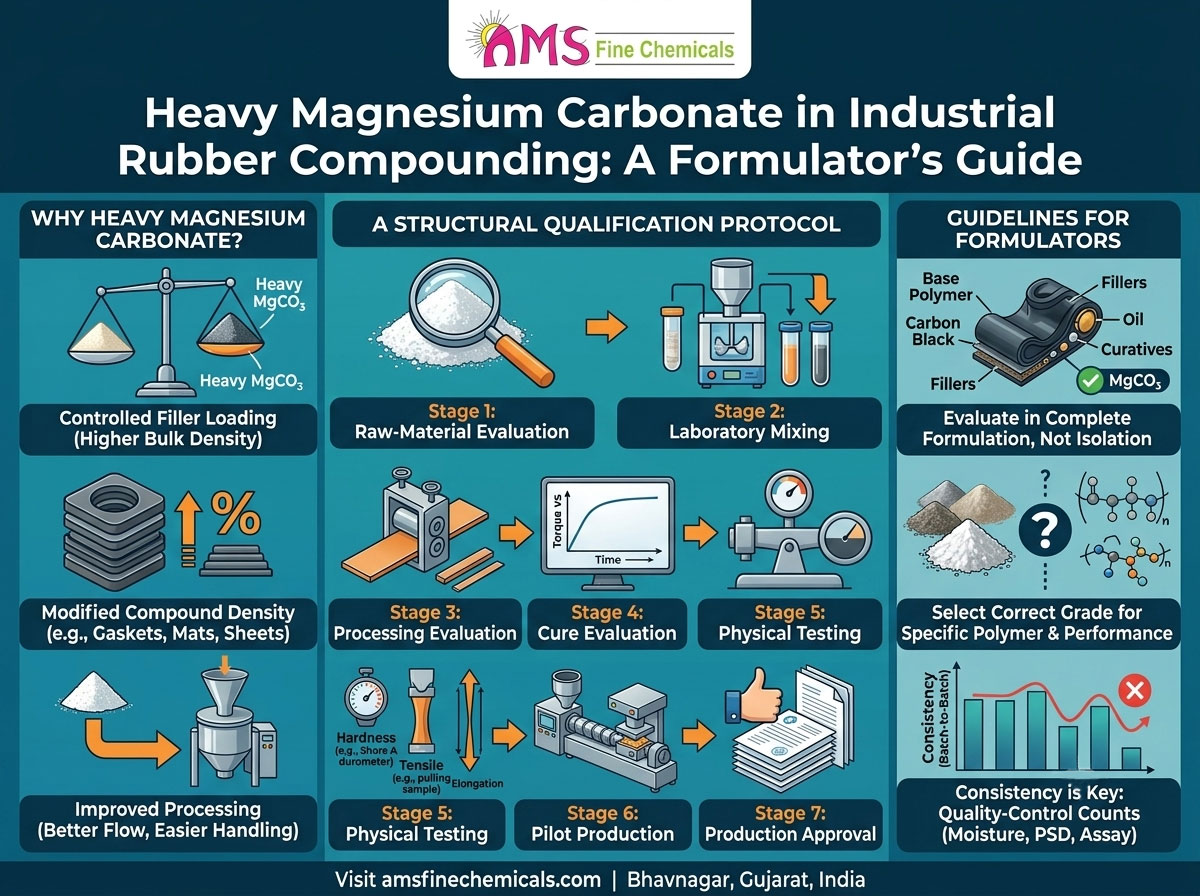
A Practical Qualification Protocol for Rubber Formulators
When a rubber manufacturer receives a new Heavy Magnesium Carbonate sample, a structured qualification program can reduce development time.
Stage 1: Raw-Material Evaluation
Review:
- COA
- SDS/MSDS
- Assay
- Moisture
- Particle size
- Bulk density
- Appearance
- Packaging
- Batch traceability
Stage 2: Laboratory Mixing
Prepare a control compound using the existing filler system.
Prepare additional trials with different Heavy Magnesium Carbonate concentrations.
Maintain all other formulation variables as constant as possible.
Stage 3: Processing Evaluation
Record:
- Mixing time
- Dump temperature
- Power consumption where available
- Dispersion
- Compound appearance
- Mooney viscosity
Stage 4: Cure Evaluation
Perform rheometer testing to identify whether the new filler changes:
- Scorch safety
- Cure time
- Torque development
- Cure rate
Stage 5: Physical Testing
Compare:
- Hardness
- Tensile strength
- Elongation
- Tear strength
- Abrasion
- Compression set
- Density
Stage 6: Pilot Production
Once laboratory results are acceptable, conduct a pilot-scale production run.
This step is important because a filler that performs well in a small laboratory mixer may behave differently in a larger industrial mixer.
Stage 7: Production Approval
Approve the grade only after confirming:
- Product performance
- Process stability
- Batch-to-batch consistency
- Commercial economics
- Supplier documentation
- Supply reliability
Common Formulation Mistakes to Avoid
Mistake 1: Choosing the Lowest-Cost Grade
The cheapest material per kilogram may not produce the lowest cost per finished product.
Always evaluate total formulation economics.
Mistake 2: Assuming Heavy Means More Reinforcing
Higher bulk density does not automatically mean stronger reinforcement.
Reinforcement is governed by particle characteristics, polymer interaction, dispersion, and formulation design.
Mistake 3: Ignoring Moisture
Improper storage can change powder handling and potentially introduce variability into mixing.
Mistake 4: Changing Several Ingredients at Once
If the formulator changes the polymer, filler, oil, and cure system simultaneously, it becomes difficult to determine which change caused the performance difference.
Mistake 5: Evaluating Only Tensile Strength
A rubber compound can have acceptable tensile strength while failing in compression set, abrasion, tear resistance, aging, or dynamic performance.
Mistake 6: Skipping Pilot Trials
Commercial processing conditions can expose problems that are not visible during laboratory formulation.
Heavy Magnesium Carbonate: A Formulator’s Decision Framework
Before selecting Heavy Magnesium Carbonate, ask five questions.
1. What is the primary objective?
Is the purpose:
- Filler addition?
- Density modification?
- Cost optimization?
- Processing improvement?
- Dimensional control?
- A combination of these?
2. What polymer is being used?
Natural rubber, SBR, NBR, EPDM, CR, and other elastomers can respond differently.
3. What other fillers are already present?
The interaction between Heavy Magnesium Carbonate and carbon black, silica, calcium carbonate, or other fillers needs to be evaluated.
4. What physical properties matter most?
Define the priority:
Hardness > Tensile > Elongation > Tear > Abrasion > Compression Set > Dynamic Performance
The ranking will be different for each application.
5. Is the supplier capable of maintaining consistent quality?
A technically suitable filler is only useful when the same quality can be supplied repeatedly.
Why AMS Fine Chemicals for Heavy Magnesium Carbonate?
AMS Fine Chemicals is an India-based manufacturer and supplier of Magnesium Carbonate and related magnesium compounds, with its operations based in Bhavnagar, Gujarat.
The company’s product portfolio includes Magnesium Carbonate, Light Magnesium Carbonate, Ultra Light Magnesium Carbonate, Heavy Magnesium Carbonate, Magnesium Hydroxide, and Magnesium Trisilicate.
For rubber and plastics manufacturers specifically, the Heavy Magnesium Carbonate product page provides information on applications, testing, handling, packaging, production capacity, and technical documentation.
AMS Fine Chemicals states that Heavy Magnesium Carbonate is tested through its in-house physico-chemical and microbiology laboratory, with laboratory instruments calibrated by an NABL-accredited laboratory.
Manufacturers looking at a wider range of industrial applications can also explore the Plastic & Rubber industry section of the AMS Fine Chemicals website.
Frequently Asked Questions
Is Heavy Magnesium Carbonate suitable for rubber compounding?
Yes. Heavy Magnesium Carbonate can be used as a mineral filler and functional ingredient in selected rubber and plastic formulations. Its suitability depends on polymer type, filler loading, particle characteristics, cure system, and required finished-product properties.
Is Heavy Magnesium Carbonate the same as Light Magnesium Carbonate?
No. Both are Magnesium Carbonate grades, but they differ in physical characteristics such as bulk density and particle structure. These differences can significantly influence handling, dispersion, loading, and formulation behaviour.
Can Heavy Magnesium Carbonate replace carbon black?
Not as a universal one-to-one replacement. Carbon black is a highly reinforcing filler with characteristics that differ substantially from Magnesium Carbonate. Heavy Magnesium Carbonate is better evaluated as a mineral filler or as part of a multi-filler formulation strategy.
Does Heavy Magnesium Carbonate increase rubber hardness?
It can influence hardness when incorporated as a mineral filler, but the actual change depends on filler loading, polymer type, plasticizer content, and the rest of the formulation. Laboratory testing should determine the appropriate concentration.
What tests should be performed before using Heavy Magnesium Carbonate?
At minimum, rubber manufacturers should consider raw-material testing, Mooney viscosity, rheometer cure characteristics, hardness, tensile strength, elongation, and application-specific tests such as tear, abrasion, compression set, or aging.
How should Heavy Magnesium Carbonate be stored?
Store it in a cool, dry environment away from excessive humidity and keep opened packaging tightly closed. Proper storage helps preserve consistent powder characteristics.
How can I select the correct Magnesium Carbonate grade?
Start with the application requirement rather than the product name. Compare bulk density, particle size, moisture, assay, surface characteristics, processing behaviour, and final rubber performance. The AMS guide How to Select the Right Magnesium Carbonate Grade for Your Manufacturing Process provides a broader framework.
Final Takeaway for Rubber Formulators
Heavy Magnesium Carbonate should not be viewed simply as another inexpensive mineral powder.
In a well-designed rubber formulation, its value comes from how its physical characteristics and chemical behaviour interact with the complete compound.
For some applications, the higher density of Heavy Magnesium Carbonate can provide practical advantages in filler handling and formulation design. In others, particle characteristics, dispersion, polymer compatibility, and loading level may be more important.
The right formulation strategy is therefore based on testing rather than assumptions.
A successful development program should evaluate:
Grade → Particle Characteristics → Moisture → Dispersion → Processing → Cure → Mechanical Properties → Finished-Product Performance → Cost
When these variables are considered together, Heavy Magnesium Carbonate can become a useful component of an industrial rubber compounding strategy.
For manufacturers looking to evaluate a consistent industrial-grade source, AMS Fine Chemicals supplies Heavy Magnesium Carbonate from Bhavnagar, Gujarat, with technical documentation and application support. Explore the Heavy Magnesium Carbonate product, review the wider Magnesium Carbonate product category, or contact AMS Fine Chemicals to discuss your rubber-compounding requirements.