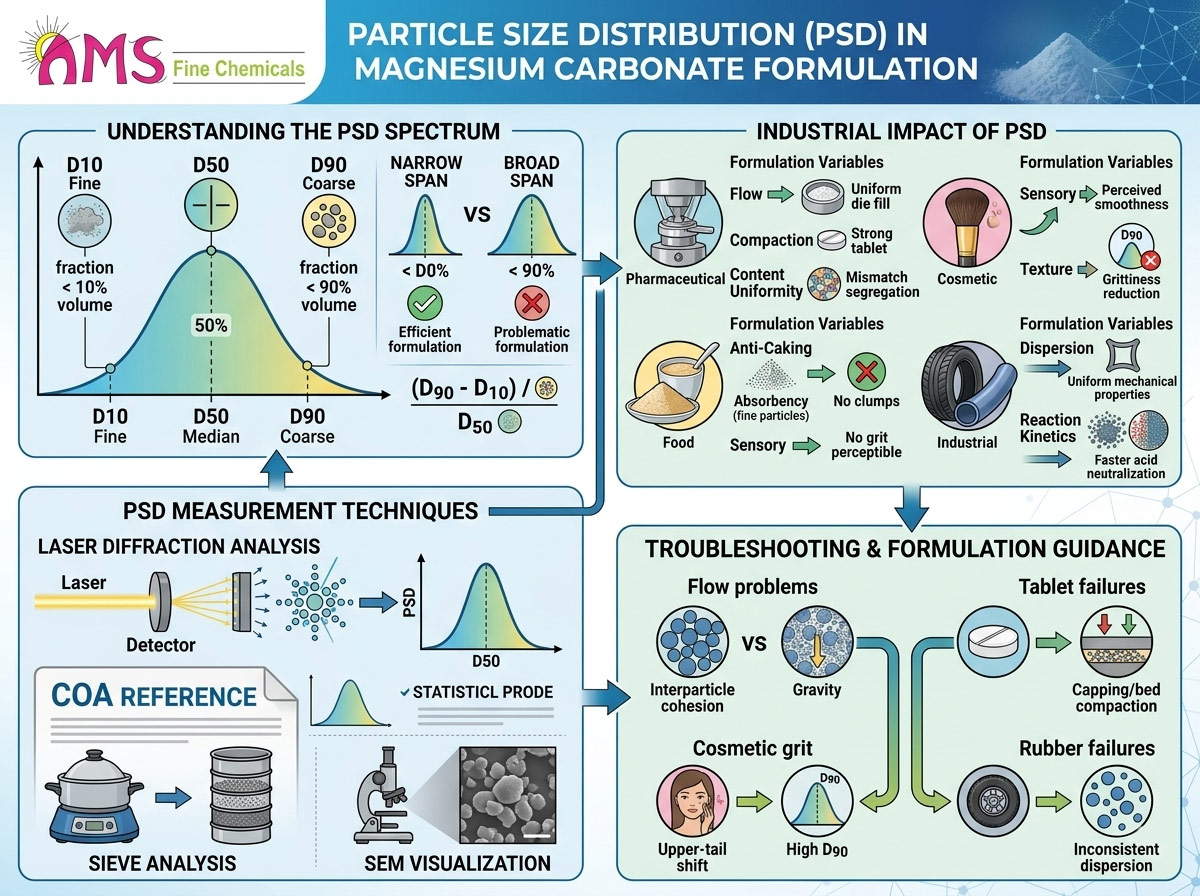
Two numbers rarely tell the whole story, but “D50: 8 microns” comes close to being the single most consequential figure on a Magnesium Carbonate Certificate of Analysis for many formulators. Particle size distribution — the statistical spread of particle diameters within a powder — governs flow, dissolution, mouthfeel, tablet compaction, dispersion in a polymer matrix, and even how a product looks under light. Get it right, and a formulation performs predictably batch after batch. Get it wrong, and problems surface that a passing assay result never would have predicted.
This guide focuses specifically on particle size distribution (PSD) as a formulation variable for Magnesium Carbonate — how it’s measured, what the standard D10/D50/D90 statistics actually mean, and how PSD requirements differ dramatically across pharmaceutical, food, cosmetic, and industrial formulations. For the related question of particle shape rather than size, see our companion article, How Magnesium Carbonate Particle Morphology Influences Industrial Performance; for how particle structure translates into bulk density, see Magnesium Carbonate Bulk Density: Why It Matters in Industrial Processing. This guide sits alongside both, focused specifically on the size-distribution statistics themselves and what formulators should do with them.
Understanding D10, D50, and D90
Particle size distribution is most commonly reported using laser diffraction analysis, which measures the diameters of a representative particle population and reports the results as percentile values:
- D10 — the particle diameter below which 10% of the sample’s volume falls. This describes the fine end of the distribution.
- D50 — the median particle diameter, below which 50% of the sample’s volume falls. This is the single number most often quoted as “the particle size,” though it only describes the midpoint of the distribution, not its full shape.
- D90 — the particle diameter below which 90% of the sample’s volume falls. This describes the coarse end of the distribution, and is often the most operationally important figure for texture-sensitive and dispersion-sensitive applications, since it captures the largest particles a formulator is likely to encounter.
A powder’s span — typically calculated as (D90 − D10) / D50 — describes how narrow or broad the distribution is. Two batches can share an identical D50 while having very different spans: a narrow-span batch is tightly clustered around the median, while a broad-span batch contains a wider mix of both fine and coarse particles even though the “average” particle size looks the same on paper. This distinction matters more than many buyers realize, since a single D50 figure alone can mask meaningful differences in how two batches will actually behave.
Why a Single “Average Particle Size” Number Is Misleading
A Certificate of Analysis that reports only D50 — without D10 and D90 — provides an incomplete picture, and formulators relying on that single number can be caught off guard by real-world performance differences between batches. Consider two hypothetical batches, both reporting a D50 of 8 microns:
- Batch A might show D10 of 3 microns and D90 of 15 microns — a relatively narrow, well-controlled distribution.
- Batch B might show D10 of 1 micron and D90 of 40 microns — a much broader distribution with the same median, but containing both a significant fine fraction (prone to dusting and increased surface reactivity) and a significant coarse fraction (prone to causing grittiness or dispersion problems) that Batch A doesn’t have.
These two batches would behave differently in nearly every downstream application, despite reporting an identical “average particle size.” This is precisely why a proper Certificate of Analysis review — covered in more general terms in our Magnesium Carbonate COA Explained: Important Parameters Buyers Should Check article — should always include the full D10/D50/D90 set, not just a single reported figure.
PSD’s Effect on Powder Flow and Handling
Counterintuitively, finer particles don’t always flow better than coarser ones. As particle size decreases, interparticle cohesive forces (van der Waals forces, electrostatic attraction, and moisture-mediated cohesion) become proportionally more significant relative to gravitational force, which can actually reduce free-flow performance in very fine powders — the opposite of what many formulators initially assume.
This creates a practical trade-off in applications like high-speed tablet manufacturing, where a very fine PSD might improve compaction and content uniformity but simultaneously hurt die-fill consistency due to reduced flowability, unless flow aids or granulation techniques are used to compensate. Formulators need to balance PSD selection against the specific processing equipment and technique being used, rather than assuming “finer is always better” or “coarser is always better” as a universal rule.
PSD’s Effect on Dissolution and Reactivity
For applications depending on Magnesium Carbonate’s acid-neutralizing or reactive behaviour — pharmaceutical antacids, industrial pH correction — particle size directly governs reaction kinetics, since the acid-carbonate reaction occurs at the particle surface. Smaller particles present dramatically more surface area per gram than larger particles of the same mass, translating into faster reaction rates.
Our Magnesium Carbonate Solubility and Acid Reactivity Explained article covers this reaction chemistry in detail — the key formulation takeaway here is that D90, not D50, often matters most for reactivity-critical applications, since the coarsest particles in a distribution are the slowest to fully react and can create a “tail” of incomplete reaction even when the median particle size looks appropriately fine.
PSD’s Effect on Tablet Compaction and Content Uniformity
In pharmaceutical tableting, particle size distribution affects compaction behaviour through several interconnected mechanisms:
- Die-fill consistency: As discussed above, PSD affects flow, which directly affects how consistently each die cavity fills to the same volume during high-speed compression.
- Compaction and bonding: Finer particles generally provide more particle-to-particle contact points during compression, often supporting stronger tablet bonding and hardness at a given compression force, though this needs to be balanced against the flow trade-off described above.
- Content uniformity: For low-dose active ingredients blended with Magnesium Carbonate as an excipient, PSD mismatch between the active ingredient and the excipient can lead to segregation during blending, producing tablets with inconsistent active ingredient content — a critical quality issue in pharmaceutical manufacturing.
Formulators typically address these competing demands through PSD specification tailored to their specific tablet formulation and equipment, sometimes combined with granulation techniques that create larger, more flowable agglomerates from an underlying fine powder without sacrificing the fine powder’s reactivity or dissolution benefits.
PSD’s Effect on Cosmetic Texture and Sensory Perception
In cosmetic powder formulations — face powders, dry shampoos, foundations — particle size distribution is directly, consciously perceptible to the end consumer in a way few other specifications are. The human sense of touch can detect particle sizes well within the range Magnesium Carbonate is typically supplied at, meaning PSD isn’t just a processing variable here — it’s a core sensory product attribute:
- D90 and perceived grittiness: Even a small coarse-particle fraction, if large enough, can be perceived as gritty or rough against skin, even when the median particle size (D50) is comfortably fine. This is a case where D90 control matters more directly to consumer experience than D50 alone.
- D10 and dustiness: A significant very-fine fraction can increase airborne dust generation during application, an attribute cosmetic formulators actively manage for both product experience and workplace safety during manufacturing.
- Overall span and consistency: A tightly controlled, narrow-span PSD generally produces a more consistent, predictable sensory experience across a product’s shelf life and across different production batches than a broad-span distribution.
PSD’s Effect on Optical Properties in Coatings and Cosmetics
Beyond touch, particle size distribution affects how a powder scatters and reflects light — directly relevant to whiteness, opacity, and finish quality in coatings, cosmetics, and printing applications:
- Fine, uniform particles (typically in the low single-digit micron range) generally produce smoother, more uniform light scattering, contributing to a smoother visual finish and more consistent hiding power in coatings.
- A broad PSD span, even with an appropriately fine D50, can produce inconsistent light scattering across a coated surface, since the coarser fraction within the distribution scatters light differently than the finer fraction.
- Particle size relative to the wavelength of visible light matters at a fundamental optical level — particles in certain size ranges scatter light more efficiently than others, which is part of why PSD specifications for optically sensitive applications are often quite narrow and specific rather than a broad general range.
PSD’s Effect on Dispersion in Rubber and Polymer Systems
In rubber compounding and polymer filler applications, PSD affects how uniformly Magnesium Carbonate disperses throughout the polymer matrix during high-shear mixing:
- Fine, well-dispersed particles generally support more uniform mechanical property distribution throughout a cured compound, since localized concentrations of coarser particles can create stress concentration points that reduce overall mechanical performance.
- A significant coarse fraction (high D90) increases the risk of these localized stress concentration points, even in a compound with an otherwise appropriately fine D50, potentially reducing tensile strength or tear resistance below what the median particle size alone would predict.
- Mixing energy and time requirements often scale with how difficult a given PSD is to disperse uniformly, meaning a broader or coarser distribution can require more processing energy to achieve equivalent dispersion quality compared to a tighter, finer distribution.
PSD Requirements Across Industries: A Quick Reference
| Industry/Application | Typical PSD Priority | Why |
|---|---|---|
| Pharmaceutical tableting | Fine D50, controlled span | Compaction, content uniformity, dissolution |
| Antacid/reactive applications | Fine D50 and D90 | Fast, complete acid-neutralization reaction |
| Food anti-caking | Fine D50, controlled D90 | Absorbency without perceptible texture change |
| Cosmetic powders | Fine D50, tight D90 control | Sensory “skin feel,” reduced grittiness |
| Rubber/polymer filler | Application-dependent, often fine for high-performance compounds | Dispersion uniformity, mechanical property consistency |
| Coatings and paints | Fine, narrow span | Smooth finish, consistent hiding power |
| Agricultural/fertilizer | Coarser, broader tolerance acceptable | Slower release rate is often desirable, not a defect |
This table illustrates a broader point: “finer is better” is not a universal rule. Fertilizer applications, for instance, often deliberately favour a coarser PSD specifically because it supports the slower, extended-release magnesium availability that agronomic performance depends on — a point covered in our Magnesium Carbonate in Fertilizer Formulations: Magnesium Source, Soil Benefits & Applications guide.
How PSD Is Actually Measured
Modern particle size distribution testing relies primarily on laser diffraction analysis, which measures how a dispersed particle sample scatters a laser beam and calculates the resulting size distribution from the scattering pattern. This method is fast, reproducible, and provides the full D10/D50/D90 statistical profile in a single measurement, making it the standard technique referenced on most commercial Certificates of Analysis.
Complementary techniques provide additional context where laser diffraction alone isn’t sufficient:
- Sieve analysis provides a simpler, lower-cost cross-check, particularly useful for coarser industrial and agricultural grades where laser diffraction’s higher precision isn’t strictly necessary.
- Scanning Electron Microscopy (SEM) provides direct visual confirmation of particle size and shape together, useful for troubleshooting cases where laser diffraction data alone doesn’t fully explain an observed performance issue — since laser diffraction reports an equivalent spherical diameter that doesn’t directly capture irregular particle shapes, a consideration discussed further in our particle morphology article.
Troubleshooting PSD-Related Formulation Problems
When a formulation underperforms despite passing standard specifications, particle size distribution is often the first place to look, particularly in these common scenarios:
- Unexpected tablet capping or lamination: Often traced to a PSD mismatch between the excipient and active ingredient, or to an unexpectedly broad span introducing inconsistent compaction behaviour across the tablet bed. Requesting a fresh PSD test on the specific lot in use, compared against the lot originally used for formulation validation, is a useful first diagnostic step.
- Inconsistent anti-caking performance between batches: Can indicate a D90 shift even when D50 remains within specification, since the coarse tail of the distribution contributes disproportionately little surface area for moisture absorption relative to its mass, effectively reducing a batch’s real-world absorbency below what its median particle size alone would suggest.
- Gritty texture complaints in a previously smooth cosmetic formulation: Almost always traces back to a D90 or upper-tail shift rather than a D50 change, since consumer perception of grittiness is driven disproportionately by the coarsest particles present, not the average.
- Reduced mechanical performance in a rubber compound after a supplier or grade change: Worth investigating both PSD and morphology together, since a batch can match the previous supplier’s D50 while differing meaningfully in span, morphology, or both — any of which can affect dispersion and reinforcement performance independently.
In each case, the diagnostic value of requesting a full D10/D50/D90 re-test — rather than relying on the original CoA — often reveals a specification drift that a single-point comparison would miss entirely.
Batch-to-Batch Consistency and Statistical Process Control
For manufacturers running continuous, high-volume production, tracking particle size distribution data across successive batches over time — rather than reviewing each Certificate of Analysis in isolation — provides an early warning system for gradual process drift. A single batch might fall comfortably within specification while still representing a small step in a longer trend toward the edge of acceptable tolerance, a pattern only visible when data is tracked and plotted across multiple batches rather than checked one at a time.
Statistical process control techniques — tracking D10, D50, D90, and span over time with control charts — are increasingly used by both manufacturers and larger-volume buyers specifically to catch this kind of gradual drift before it produces an actual out-of-specification batch, rather than reacting only after a formulation problem has already occurred on the production floor.
Practical Guidance for Specifying PSD on a Purchase Order
Buyers evaluating Magnesium Carbonate for a PSD-sensitive application should specify more than just a target D50:
- Request the full D10/D50/D90 profile, not just a single average figure, since span matters as much as median for many applications.
- Specify acceptable tolerance ranges for each percentile, recognizing that some natural batch-to-batch variation is normal and unavoidable.
- Confirm the test method used (typically laser diffraction), since results can vary slightly between different instruments and dispersion protocols if not standardized.
- Request historical batch data where available, to understand a supplier’s typical batch-to-batch consistency before committing to a formulation validated against a single reference sample.
How AMS Fine Chemicals Controls Particle Size Distribution
AMS Fine Chemicals, based in Bhavnagar, Gujarat, manufactures Magnesium Carbonate across Light, Ultra Light, and Heavy grades with particle size distribution tested via laser diffraction as part of our standard batch release protocol. Beyond our standard commercial PSD ranges, we support custom particle size configurations for buyers with tight formulation-specific tolerance requirements — particularly relevant for pharmaceutical, cosmetic, and precision industrial applications where D90 control matters as much as D50.
Explore full technical specifications on our Magnesium Carbonate, Light Magnesium Carbonate, Ultra Light Magnesium Carbonate, and Heavy Magnesium Carbonate product pages, or browse our complete range of magnesium compounds — including Magnesium Hydroxide and Magnesium Trisilicate — on the Products page.
Frequently Asked Questions
Is a smaller D50 always better for my formulation? Not necessarily. Finer particles generally improve reactivity, dissolution, and sensory smoothness, but can also reduce flowability and increase dust generation. The right D50 depends on balancing these trade-offs against your specific application’s priorities.
Why does D90 matter if my D50 already meets specification? D90 captures the coarsest fraction of a distribution, which often drives perceptible grittiness, incomplete reaction, or localized mechanical weak points — issues a passing D50 figure alone won’t reveal, since a batch can have an acceptable median while still containing a problematic coarse tail.
How much batch-to-batch PSD variation should I expect from a reliable supplier? Some variation within a specified tolerance range is normal and expected. Significant, unexplained drift outside that range — particularly in D90 — is worth raising with your supplier, since it can indicate a process control issue at the point of manufacture.
Can particle size distribution be adjusted after the material is manufactured? To a limited extent, through milling or classification (screening), though aggressive milling can also alter particle morphology and introduce a broader distribution than intended. Achieving a specific target PSD generally works best when controlled during the original manufacturing process rather than corrected downstream.
What’s the difference between particle size distribution and particle morphology? Particle size distribution describes the statistical spread of particle diameters (how big the particles are), while morphology describes particle shape and internal structure (what the particles look like). Two batches can share an identical PSD while having very different morphology, and vice versa — both are independently important and neither substitutes for the other on a complete specification sheet.
Does particle size distribution affect shelf-life stability? Indirectly, yes — finer particles with higher surface area tend to be more hygroscopic and more chemically reactive over time than coarser particles, which can influence long-term storage stability depending on the formulation and its storage conditions.
Final Word
Particle size distribution is one of the most operationally consequential — and most frequently under-specified — parameters in Magnesium Carbonate sourcing. A single D50 figure, taken in isolation, tells a formulator far less than the full D10/D50/D90 profile and resulting span, since two batches with an identical median particle size can behave meaningfully differently in flow, reactivity, texture, and dispersion depending on how broad or narrow their distribution actually is. Formulators who specify and monitor the complete PSD profile — not just a single average number — are far better positioned to catch a batch-to-batch shift before it becomes a production or quality problem.
To request detailed particle size distribution data, a sample batch, or a full Certificate of Analysis for any Magnesium Carbonate grade, visit our Magnesium Carbonate product page or reach out through our Contact Us page.