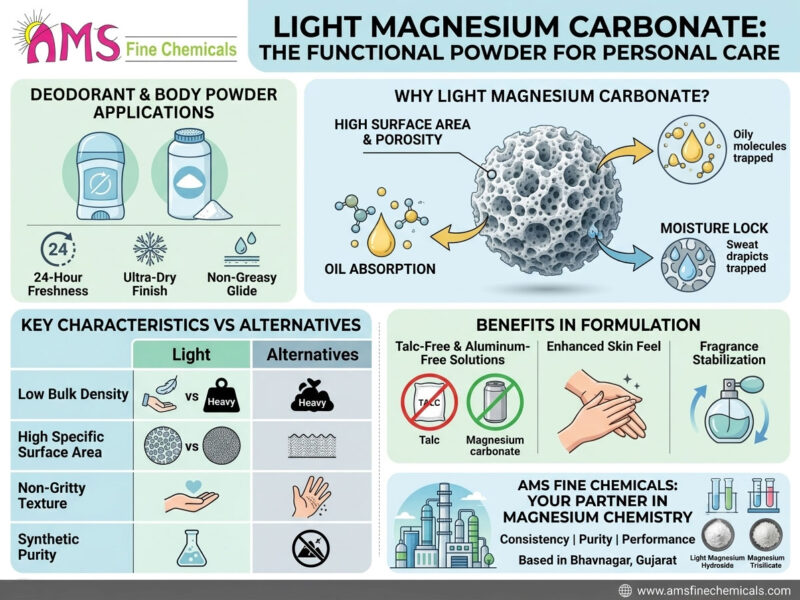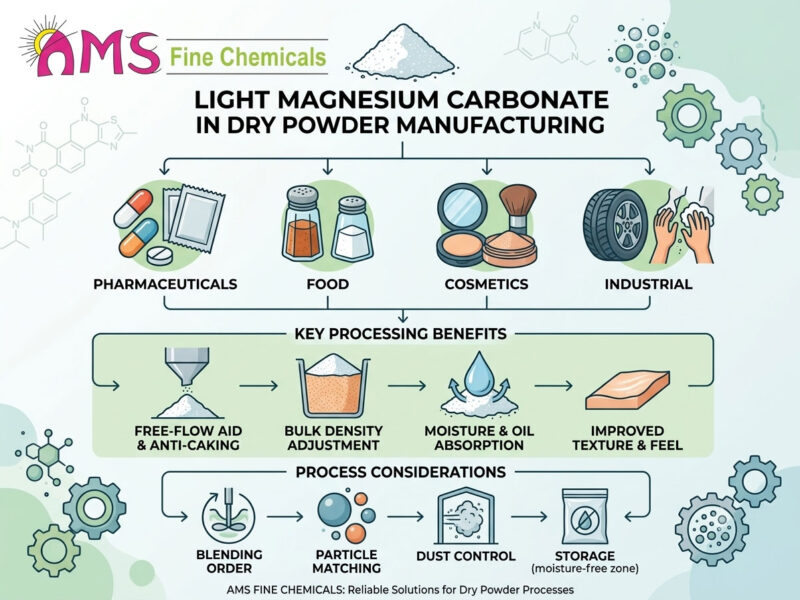
Water and oil behave completely differently once they contact a porous solid, and formulators who treat “absorbency” as a single, undifferentiated property miss an important distinction: Light Magnesium Carbonate‘s ability to adsorb oil follows a genuinely different chemical logic than its moisture-absorption behaviour, even though both draw on the same underlying porous particle structure. Understanding oil absorption specifically — not as a subset of moisture management, but as its own distinct chemistry — matters for applications ranging from pharmaceutical tableting aids to industrial oil-spill remediation to edible oil purification, categories that have little to do with each other on the surface but share an identical dependence on this one material property.
This guide isolates oil absorption specifically: the chemistry behind how a hydrophilic material like Light Magnesium Carbonate takes up oil at all, why oil and water absorption can occur simultaneously without one crowding out the other, and the surprisingly broad range of industrial, pharmaceutical, and environmental applications built around this specific capability.
Why Oil Absorption Isn’t Simply “Moisture Absorption for Oil”
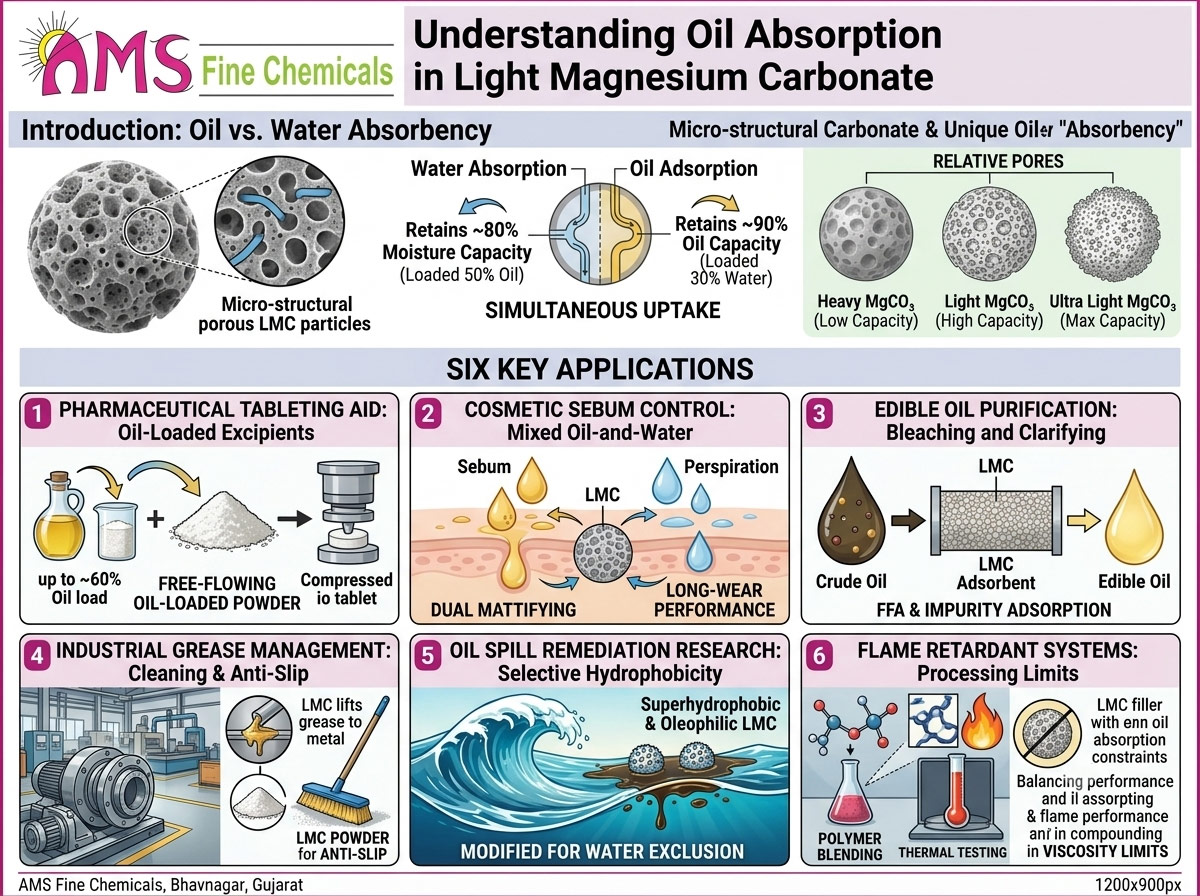
It’s tempting to assume Light Magnesium Carbonate absorbs oil through the identical mechanism covered in our Magnesium Carbonate Moisture Absorption: What Formulators Need to Know article, just substituting oil molecules for water molecules. The reality is more interesting: research has shown that Light Magnesium Carbonate’s porous structure can adsorb oil and water simultaneously, without one significantly displacing the other — studies on mesoporous magnesium carbonate have found the material retains roughly 80% of its moisture-absorption capacity even when already loaded with 50% oil by weight, and correspondingly retains nearly 90% of its oil-absorption capacity when already carrying 30% water by weight.
Why this matters mechanistically: This near-independence between oil and water uptake suggests the two liquids are being adsorbed through at least partially separate pathways within the material’s pore structure, rather than directly competing for the same binding sites. For formulators, the practical implication is significant: a Light Magnesium Carbonate-containing formulation doesn’t need to “choose” between managing oil or managing moisture — under many real-world conditions, it can meaningfully do both at once, which is precisely why it performs so effectively in applications like cosmetic sebum control, where skin surfaces present a genuinely mixed oil-and-moisture environment rather than a purely oily or purely wet one.
The Structural Basis: Surface Area and Pore Accessibility
As covered in our dedicated How Surface Area Influences Light Magnesium Carbonate Performance article, oil absorption capacity correlates directly with the material’s specific surface area and internal pore volume — properties engineered during precipitation and explored structurally in our How Magnesium Carbonate Particle Morphology Influences Industrial Performance article. A denser, lower-surface-area grade like Heavy Magnesium Carbonate offers meaningfully less oil-absorbing capacity than porous Light or Ultra Light grades, for the same structural reasons it offers less moisture-absorbing capacity — less accessible internal void space translates directly into less capacity to draw in and hold either liquid.
Application 1: Pharmaceutical Tableting Aid — Oil-Loaded Excipients
One of the more specialized but well-documented uses of Magnesium Carbonate’s oil-absorption capability is as a tableting aid carrier for oils, allowing liquid or oily active ingredients and flavoring agents to be incorporated into a solid, compressible tablet formulation.
The formulation logic: Certain active pharmaceutical ingredients, flavoring agents, or nutritional oils exist naturally in liquid or oily form, which creates an obvious formulation challenge for solid dosage manufacturing — liquids can’t be directly compressed into a tablet. By pre-loading Light Magnesium Carbonate with the oil at a controlled ratio (patent literature in this space describes ratios in the range of roughly 0.15:1 to 0.6:1, oil to carbonate by weight), formulators convert an otherwise unworkable liquid ingredient into a dry, free-flowing powder that behaves like any other solid excipient during blending and compression — while the Magnesium Carbonate simultaneously contributes its own lubricating function during the tablet-forming process itself.
Why this works specifically because of oil absorption capacity, not just bulk porosity: The technique depends on the carbonate’s ability to hold a meaningful oil load — up to roughly 60% of its own weight in some formulations — while still presenting as a dry, free-flowing powder rather than a wet, clumped paste. This is a direct, practical demonstration of oil absorption capacity translating into genuine formulation utility, distinct from the moisture-management role Light Magnesium Carbonate plays elsewhere in tablet excipient use.
Application 2: Cosmetic Sebum Control — Revisited Through the Oil-Specific Lens
Our Light Magnesium Carbonate in Cosmetics: Oil Absorption and Texture Benefits article covers this application from a formulation and texture perspective — worth revisiting here specifically through the oil-absorption chemistry lens, since it’s the application where the simultaneous oil-and-water absorption capability discussed above matters most directly.
Why simultaneous absorption matters on skin specifically: Human skin surfaces present sebum (oil) and perspiration (water-based moisture) together, not separately. A material that could only manage one or the other would leave a meaningful gap in real-world mattifying performance. Light Magnesium Carbonate’s demonstrated ability to maintain strong absorption capacity for both liquids simultaneously is precisely why it performs so reliably across the varied, mixed moisture-and-oil conditions real skin actually presents throughout a wearing day, rather than only under laboratory conditions testing oil or water in isolation.
Application 3: Edible Oil Purification and Bleaching
Beyond absorbing oil into a formulation, Magnesium Carbonate-family materials play a role in the opposite process: purifying and clarifying edible oils by adsorbing unwanted impurities and free fatty acids out of them.
The mechanism: In edible oil processing, adsorbent minerals — including activated forms of magnesium carbonate and related compounds — are used during the bleaching and purification stage to adsorb color pigments, free fatty acids, oxidation products, and trace metal contaminants from crude or used cooking oils, improving both the oil’s visual clarity and its oxidative stability. This application uses the identical porous adsorption mechanism covered throughout this guide, but directed at purifying the oil itself rather than incorporating oil into a separate formulation.
Relevance to industrial and food processing buyers: This purification role connects Light Magnesium Carbonate’s oil chemistry to a genuinely different industry vertical — edible oil refining and food processing — from the pharmaceutical and cosmetic applications more commonly associated with the ingredient, illustrating the breadth of industries this single functional property touches.
Application 4: Industrial Grease and Lubricant Management
In industrial settings, Light Magnesium Carbonate’s oil-absorbing capacity supports practical grease and lubricant management applications:
- Absorbing excess lubricant residue from machined parts or manufacturing equipment surfaces during cleaning and quality control processes.
- Powder-based industrial cleaning compounds, where the material’s oil-absorbing capacity contributes to lifting grease and oil residue from metal or hard surfaces as part of a broader cleaning formulation.
- Anti-slip flooring treatments, in some specialty applications, where absorbing surface oil contamination helps restore workplace floor safety in industrial environments prone to grease or oil spillage.
These applications draw on the same fundamental adsorption chemistry as the cosmetic and pharmaceutical uses covered above, simply applied at industrial rather than personal-care or pharmaceutical scale.
Application 5: Oil Spill Remediation Research
At the more specialized end of the application spectrum, researchers have explored chemically modified Magnesium Carbonate as a sorbent material for oil spill cleanup in water environments — a genuinely different engineering challenge than the applications covered above, since it requires the material to selectively absorb oil while actively repelling water, the opposite of Light Magnesium Carbonate’s naturally hydrophilic (water-attracting) surface chemistry in its standard commercial form.
How this modification works: Research in this area has explored surface-modifying standard hygroscopic Magnesium Carbonate with fatty acid compounds — palmitic acid among them — to convert its naturally hydrophilic, oil-loving surface into a superhydrophobic (strongly water-repelling) and oleophilic (strongly oil-attracting) surface, specifically engineered to selectively absorb floating oil from an oil-water mixture while rejecting the surrounding water.
Why this matters as a research direction: This work illustrates that Light Magnesium Carbonate’s naturally porous structure serves as a versatile platform for oil-management chemistry, not just a fixed, single-function ingredient — the same underlying porosity that supports simultaneous oil-and-water absorption in its standard form can be chemically redirected toward selective, water-excluding oil capture through targeted surface modification, opening a genuinely different application category (environmental remediation) that standard commercial grades aren’t directly suited to, but that illustrates the platform’s underlying versatility.
Application 6: Flame Retardant Systems and Oil-Sensitive Loading Limits
Beyond direct oil-management applications, oil absorption capacity plays a subtler but genuinely important role in flame-retardant polymer compounding, particularly for hydromagnesite (a related hydrated magnesium carbonate compound) used in this context. Because these materials carry meaningfully high specific surface area, their oil absorption capacity constrains how much filler can be incorporated into a polymer or rubber compound before processing becomes impractical.
Why this matters to formulators: A filler with high oil absorption tends to also absorb processing oils and plasticizers within a polymer compound, which can affect the compound’s viscosity, processing behaviour, and achievable loading level before the mixture becomes too stiff or difficult to process at production scale. This is precisely why formulators developing flame-retardant compounds need to weigh a filler’s oil absorption value alongside its flame-retardant performance and reinforcement contribution — a material with excellent flame-retardant chemistry but excessive oil absorption may still prove impractical at the loading levels required for effective flame retardancy, since oil-hungry fillers can only be incorporated up to the point where the compound remains processable on standard mixing equipment.
Connection to broader Magnesium Carbonate flame-retardant chemistry: Our Understanding the Thermal Decomposition of Magnesium Carbonate article covers the endothermic decomposition chemistry that gives Magnesium Carbonate-family compounds their flame-retardant function — oil absorption value is a separate but equally practical consideration formulators need to evaluate alongside that thermal chemistry when determining realistic compound loading levels.
Measuring Oil Absorption Capacity
Unlike the more commonly reported moisture-related parameters (Loss on Drying, Loss on Ignition) covered in our Magnesium Carbonate COA Explained: Important Parameters Buyers Should Check article, oil absorption capacity isn’t a standard line item on most commercial Certificates of Analysis and typically requires specific testing when an application depends on it directly.
Standard testing approach: Oil absorption value is commonly measured by gradually adding a reference oil (often linseed oil, in line with standard industry testing protocols used across mineral filler industries) to a weighed sample of powder until a specific paste-like endpoint consistency is reached, then calculating the oil absorbed per 100 grams of powder — a methodology historically applied across the broader mineral filler and pigment industry, not unique to Magnesium Carbonate specifically.
Why buyers should request this data directly for oil-critical applications: Since standard particle size and bulk density data only approximately predict oil absorption capacity — following the same logic covered in our surface area article, where surface area (not particle size alone) is the more direct performance driver — formulators developing tableting aid, oil-purification, or industrial grease-management applications benefit from requesting actual oil absorption value testing rather than inferring performance from more generally reported specification parameters.
Comparing oil absorption values across mineral fillers: Industry testing has documented meaningfully different oil absorption values across the broader mineral filler category — calcium carbonate produced through specialized reactive granulation processes has been documented achieving oil absorption values around 100 mL per 100 grams, comparable to or exceeding some standard-grade porous fillers, illustrating that oil absorption capacity, like surface area itself, is a property that can be specifically engineered during manufacturing rather than treated as a fixed characteristic of a given mineral chemistry. This reinforces why buyers evaluating oil-absorption-critical applications should compare actual tested values across specific supplier grades rather than assuming a general chemical category (carbonate fillers, for instance) predicts consistent oil-absorption performance across all suppliers and grades within it.
Grade Selection for Oil-Absorption-Critical Applications
Consistent with the surface-area-driven logic covered throughout our broader Magnesium Carbonate content, oil absorption performance scales with the same grade hierarchy:
Ultra Light Magnesium Carbonate offers the highest oil-absorption capacity in the commercial range, appropriate for applications demanding maximum oil-carrying capacity — high oil-load tableting aid formulations or specialty industrial oil-management applications.
Light Magnesium Carbonate provides strong, reliable oil absorption for the majority of standard applications — general cosmetic sebum control, moderate-oil-load tableting aids, and standard industrial oil-management uses.
Heavy Magnesium Carbonate offers comparatively limited oil-absorption capacity given its lower surface area, making it generally unsuited to oil-absorption-dependent applications regardless of its strong performance in bulk filler and reinforcement roles elsewhere.
How AMS Fine Chemicals Supports Oil-Absorption Applications
AMS Fine Chemicals, based in Bhavnagar, Gujarat, manufactures Light and Ultra Light Magnesium Carbonate with the porous, high-surface-area structure that drives genuine oil-absorption performance across pharmaceutical, cosmetic, food processing, and industrial applications. Our technical team can support specific oil absorption value testing and grade selection guidance for formulators developing tableting aid, purification, or industrial oil-management applications beyond our standard commercial specification panel.
Explore full technical specifications on our Light Magnesium Carbonate and Ultra Light Magnesium Carbonate product pages, or browse our complete Magnesium Carbonate range and our broader portfolio of magnesium compounds — including Magnesium Hydroxide and Magnesium Trisilicate — on the Products page.
Frequently Asked Questions
Does Light Magnesium Carbonate absorb oil and water through the same mechanism? They draw on the same underlying porous structure, but research indicates the two liquids are taken up through at least partially independent pathways, since the material can maintain strong absorption capacity for both simultaneously rather than one displacing the other.
Can standard commercial Light Magnesium Carbonate be used for oil spill cleanup? Not directly in its standard form — its naturally hydrophilic surface chemistry means it will absorb water alongside oil rather than selectively excluding water, unlike the specifically surface-modified, superhydrophobic sorbent materials explored in oil-spill remediation research.
How much oil can Light Magnesium Carbonate typically hold while remaining a dry, workable powder? This varies by grade and application, but pharmaceutical tableting aid formulations have documented oil-to-carbonate ratios in the range of roughly 0.15:1 to 0.6:1 by weight while still maintaining a free-flowing powder consistency — actual capacity should be confirmed through direct oil absorption value testing for any specific formulation.
Is oil absorption capacity reported on a standard Certificate of Analysis? Not typically as a default parameter — it usually requires specific testing on request, since most commercial CoAs focus on the more routinely reported particle size, bulk density, and moisture-related parameters rather than oil absorption value specifically.
Why would a formulator choose Ultra Light over standard Light grade for an oil-absorption application? Ultra Light’s higher surface area generally translates into meaningfully greater oil-carrying capacity, relevant for applications specifically requiring a high oil-to-carrier ratio — standard Light grade remains sufficient for more moderate oil-absorption demands at a more favorable cost point.
Final Word
Oil absorption is a distinct chemical capability within Light Magnesium Carbonate’s broader functional profile — not simply moisture absorption applied to a different liquid, but a related yet independently operating mechanism that allows the material to manage oil and water simultaneously across an unusually broad range of applications, from pharmaceutical tableting aids and edible oil purification to industrial grease management and, through targeted chemical modification, even oil-spill remediation research. For formulators and industrial buyers working with oil-management-critical applications, understanding this specific capability — and requesting direct oil absorption value data rather than inferring it from particle size or bulk density alone — supports more reliable formulation and process outcomes than treating “absorbency” as a single, undifferentiated specification.
To request oil absorption value data, technical specifications, or sample batches of Light or Ultra Light Magnesium Carbonate, visit our Light Magnesium Carbonate product page or reach out through our Contact Us page.