Ask whether Magnesium Carbonate dissolves in water, and the honest answer is: barely. Ask whether it reacts with acid, and the answer flips completely — it reacts readily, visibly, and predictably. This contrast between near-insolubility in neutral water and vigorous reactivity in acidic conditions isn’t a contradiction; it’s the exact chemistry that makes Magnesium Carbonate useful as an antacid, a controlled-release fertilizer component, a pH buffer, and a stable industrial filler all at once.
For formulators, buyers, and quality teams, understanding precisely why Magnesium Carbonate behaves this way — and what factors shift its solubility and reactivity in practice — is essential to predicting how it will actually perform once it leaves the lab and enters a real formulation, soil environment, or industrial process. This guide breaks down the solubility chemistry, the acid-reaction mechanism, and the practical variables that formulators need to account for.
Just How Insoluble Is Magnesium Carbonate in Water?
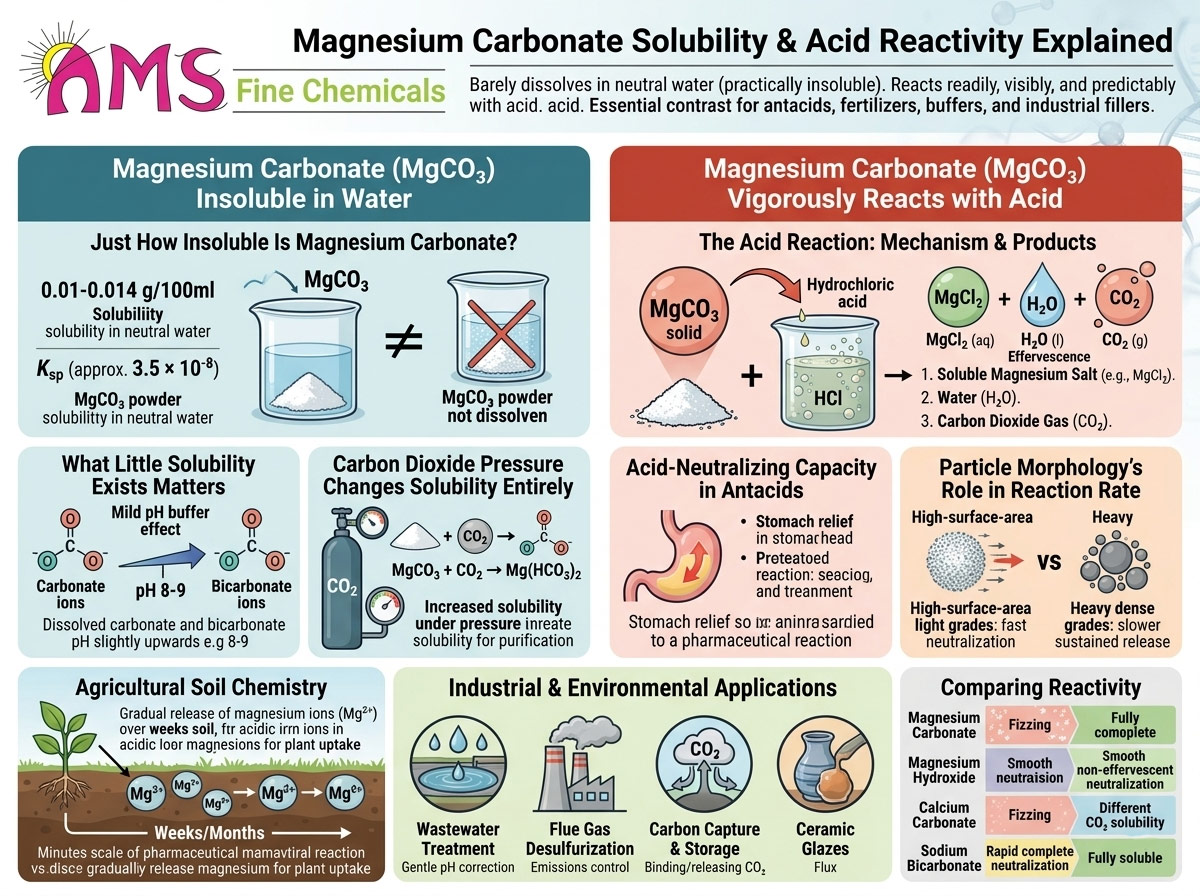
Magnesium Carbonate is classified as practically insoluble in water, though “insoluble” in chemistry is a matter of degree rather than an absolute. At room temperature, anhydrous Magnesium Carbonate’s water solubility is measured in the range of roughly 0.01 to 0.014 grams per 100 milliliters — an extremely small fraction of what would be considered a soluble salt. This low solubility is quantitatively described by its solubility product constant (Ksp), generally cited in the range of approximately 3.5 × 10⁻⁸ for the anhydrous form, though reported values vary somewhat depending on the specific hydrate form and measurement conditions referenced.
This near-insolubility is precisely why Magnesium Carbonate is supplied and used as a solid powder rather than a liquid solution across virtually all of its commercial applications — from pharmaceutical excipients to industrial fillers to agricultural soil amendments. It also explains why formulators working with liquid or suspension-based systems need to treat Magnesium Carbonate as a dispersed solid phase rather than a dissolved ingredient, a distinction with real formulation consequences covered later in this guide.
What Little Solubility Exists — And Why It Matters
Even though the bulk of a Magnesium Carbonate sample remains solid in water, the small fraction that does dissolve produces a mildly alkaline solution. This occurs because the small amount of dissolved carbonate ion undergoes partial hydrolysis with water, generating bicarbonate and hydroxide ions in the process — enough to measurably shift pH upward, even though the overall dissolved concentration remains very low.
This mild alkalinity, produced even from such a small dissolved fraction, is part of why Magnesium Carbonate functions as a gentle pH buffer in applications ranging from soil amendment to industrial process water treatment — a function explored in more application-specific detail in our Magnesium Carbonate in Fertilizer Formulations: Magnesium Source, Soil Benefits & Applications article.
Why Carbon Dioxide Pressure Changes the Solubility Picture Entirely
Here’s where Magnesium Carbonate’s solubility behaviour becomes genuinely interesting for process engineers: its solubility in water increases substantially under elevated carbon dioxide partial pressure. Under standard atmospheric conditions, Magnesium Carbonate remains essentially insoluble, but as CO₂ partial pressure rises — for instance, under a few atmospheres of pressure — solubility increases meaningfully, with documented values showing several grams of MgCO₃ dissolving per 100 grams of saturated solution at elevated CO₂ pressures.
The mechanism behind this is the formation of magnesium bicarbonate, Mg(HCO₃)₂, a considerably more soluble species formed when Magnesium Carbonate reacts with carbon dioxide and water under pressure:
MgCO₃ + CO₂ + H₂O → Mg(HCO₃)₂
This CO₂-pressure-dependent solubility isn’t just a laboratory curiosity — it’s the actual chemistry exploited in certain purification processes. Higher-purity Magnesium Carbonate can be produced by first converting a less pure carbonate feedstock into the more soluble bicarbonate form under controlled CO₂ pressure, then boiling off the excess water and CO₂ to precipitate purified Magnesium Carbonate back out of solution — a purification pathway distinct from, but related to, the precipitation chemistry covered in our Complete Guide to Magnesium Carbonate Manufacturing Process.
The Acid Reaction: Mechanism and Products
Where Magnesium Carbonate’s behaviour shifts dramatically is in the presence of acid. Rather than remaining stubbornly insoluble, it reacts readily and visibly, following a straightforward acid-base neutralization reaction:
MgCO₃ (s) + 2 HCl (aq) → MgCl₂ (aq) + H₂O (l) + CO₂ (g)
Written more generally, Magnesium Carbonate acts as a base, neutralizing the acid while releasing carbon dioxide gas — the visible effervescence characteristic of carbonate-acid reactions across the periodic table, not unique to magnesium. The three products of this reaction are consistent regardless of which acid is involved:
- A soluble magnesium salt, whose specific identity depends on which acid reacted (magnesium chloride from hydrochloric acid, magnesium sulfate from sulfuric acid, and so on).
- Water, formed as the hydrogen ions from the acid combine with the carbonate structure.
- Carbon dioxide gas, released as effervescence — the visible bubbling that distinguishes a carbonate reacting with acid from, for example, magnesium oxide reacting with acid, which produces the salt and water without gas evolution.
This reaction proceeds because, unlike its behaviour with neutral water, Magnesium Carbonate’s carbonate structure is not thermodynamically stable in the presence of excess hydrogen ions — the acid effectively “pulls apart” the carbonate ion, driving the reaction forward and releasing CO₂ as the byproduct escapes the reaction system as a gas.
Why This Reaction Matters Pharmaceutically: Acid-Neutralizing Capacity in Practice
This exact acid-base reaction is what makes Magnesium Carbonate — and its close chemical relative, Magnesium Trisilicate — functionally useful as antacid excipients. When ingested, Magnesium Carbonate reacts with hydrochloric acid in the stomach through precisely this mechanism, neutralizing excess gastric acid and raising stomach pH toward a more comfortable range for individuals experiencing heartburn or acid indigestion.
The rate and completeness of this reaction — measured pharmaceutically as acid-consuming capacity — depends heavily on the material’s particle size and surface area, since a reaction between a solid carbonate and a liquid acid occurs at the solid’s surface. Finer, higher-surface-area particles present more reactive surface area per gram, generally translating into faster acid neutralization kinetics. Our Magnesium Trisilicate BP vs. USP: Understanding Pharmaceutical Grade Specifications guide covers how pharmacopoeial standards formally test and specify this acid-consuming capacity for a closely related magnesium excipient, using the same underlying reaction chemistry.
Particle Morphology’s Role in Reaction Rate
Because the acid-carbonate reaction is fundamentally a surface phenomenon — acid molecules need direct physical contact with the carbonate structure to react — particle morphology and surface area drive reaction rate every bit as much as bulk chemistry does:
- High-surface-area, porous particle structures — typical of Light Magnesium Carbonate and Ultra Light Magnesium Carbonate — expose considerably more reactive surface per gram than an equivalent mass of denser material, generally producing faster acid neutralization.
- Dense, low-surface-area particle structures — typical of Heavy Magnesium Carbonate — react more slowly on a per-gram basis, though this isn’t necessarily a disadvantage; it simply suits different applications, such as slower, extended-release agricultural soil amendment rather than rapid pharmaceutical acid neutralization.
This connection between morphology and reactivity is explored in structural detail in our article, How Magnesium Carbonate Particle Morphology Influences Industrial Performance, which explains how the same crystal structure and porosity that govern surface area also govern this acid-reactivity behaviour.
Solubility and Reactivity in Agricultural Soil Chemistry
The same acid-reaction chemistry that governs pharmaceutical antacid performance also governs Magnesium Carbonate’s behaviour as a soil amendment. Agricultural soils are naturally somewhat acidic in many regions, and Magnesium Carbonate applied to soil undergoes the identical acid-neutralization reaction — reacting with soil acids to gradually raise soil pH while releasing magnesium ions into the soil solution, where they become available for plant root uptake.
Because soil acid concentration is far lower and less concentrated than gastric acid, and because coarser agricultural-grade material generally presents less reactive surface area than pharmaceutical-grade micronized powder, this reaction proceeds far more slowly in a soil environment — releasing magnesium gradually over weeks or months rather than the rapid minutes-scale reaction seen in a stomach. This slow-release behaviour, driven by the same fundamental reactivity chemistry covered in this guide, is discussed in application-specific detail in our Magnesium Carbonate in Fertilizer Formulations article.
Industrial and Environmental Applications of Acid Reactivity
Beyond pharmaceuticals and agriculture, Magnesium Carbonate’s acid-neutralizing reactivity supports several industrial and environmental applications:
- Wastewater and process water treatment, where Magnesium Carbonate’s ability to neutralize acidic effluent streams provides a gentler, more gradual pH correction alternative to fully soluble alkalis like caustic soda, reducing the risk of pH overshoot in sensitive treatment processes.
- Flue gas desulfurization, where magnesium-based compounds react with acidic sulfur oxide emissions, contributing to broader industrial emissions control strategies.
- Carbon capture and storage research, an emerging application area exploring Magnesium Carbonate’s fundamental ability to bind and release carbon dioxide as part of broader greenhouse gas mitigation strategies — an active research area rather than a mature commercial application at present.
- Ceramic and glaze chemistry, where Magnesium Carbonate serves as a flux in ceramic glazes, its acid-reactivity and thermal decomposition behaviour both contributing to how it interacts with and modifies glaze melting characteristics during firing.
Comparing Reactivity Across Related Magnesium and Carbonate Compounds
Formulators working with multiple magnesium-based ingredients, or comparing Magnesium Carbonate against other buffering agents, benefit from understanding how its solubility and reactivity profile stacks up against related compounds:
- Magnesium Hydroxide (Mg(OH)₂) is also poorly water-soluble but reacts with acid through a somewhat different mechanism — direct acid-base neutralization without carbon dioxide evolution, since it contains no carbonate group. This produces a smoother, non-effervescent neutralization reaction, part of why Magnesium Hydroxide suspensions (such as Milk of Magnesia) behave differently in the stomach than a carbonate-based antacid, even though both are magnesium-based and both neutralize acid effectively.
- Calcium Carbonate, the more commonly recognized carbonate antacid ingredient, follows an essentially identical acid-reaction mechanism to Magnesium Carbonate, though the two compounds differ somewhat in their aqueous solubility behaviour under varying carbon dioxide partial pressure, with magnesium carbonate’s solubility under elevated CO₂ pressure generally reported as somewhat higher than calcium carbonate’s under equivalent conditions.
- Sodium Bicarbonate, by contrast, is fully water-soluble and reacts with acid far more rapidly and completely than either magnesium or calcium carbonate, which is part of why it’s used where fast, complete acid neutralization is prioritized over the more gradual, sustained buffering behaviour that low-solubility carbonates like Magnesium Carbonate provide.
Understanding these comparative differences is particularly useful when formulating multi-ingredient antacid or buffering systems that deliberately combine fast-acting and slow-acting components to achieve both rapid initial relief and sustained buffering over a longer period.
What This Means for Formulators Working With Acid-Sensitive Systems
Understanding Magnesium Carbonate’s acid reactivity has direct, practical implications for anyone formulating products that combine it with acidic ingredients:
- Premature reaction risk: In any formulation combining Magnesium Carbonate with an acidic active ingredient or excipient — citric acid in effervescent tablets, for example — the two components will react if given sufficient moisture and contact time, generating CO₂ and altering both ingredients’ functional state before the product ever reaches the end user. Formulators need to control moisture exposure and contact time carefully in these systems, often through granulation or coating strategies that physically separate reactive components until the intended point of use.
- Effervescent product design: Conversely, this same reactivity is deliberately exploited in effervescent tablet and powder formulations, where a carbonate component is intentionally combined with an acid to produce the characteristic fizzing reaction upon dissolution in water — a formulation strategy that depends on precisely controlling when and how quickly the reaction occurs.
- Storage and packaging implications: Because the reaction requires both acid contact and typically some moisture to proceed efficiently, controlling humidity exposure in storage — a topic covered in more depth in our Magnesium Carbonate Moisture Absorption: What Formulators Need to Know article — is directly relevant to preventing unwanted premature acid-carbonate reactions in multi-component formulations during shelf storage.
Common Misconceptions Worth Clearing Up
“Insoluble” doesn’t mean “unreactive.” Magnesium Carbonate’s near-zero water solubility is entirely independent of its acid reactivity — the two properties describe different chemical behaviours (dissolution in a neutral solvent versus reaction with an acid) and shouldn’t be conflated when predicting formulation performance.
Magnesium Oxide and Magnesium Carbonate don’t react with acid identically. While both neutralize acid, only the carbonate releases carbon dioxide gas as effervescence; magnesium oxide reacting with acid produces only the magnesium salt and water, without gas evolution — an easy point of confusion given how visually similar the two powders can be.
Higher CO₂ solubility doesn’t mean Magnesium Carbonate is generally water-soluble. The elevated solubility observed under high CO₂ partial pressure is a specific, pressure-dependent phenomenon relevant mainly to specialized industrial processes — it doesn’t reflect how the material behaves under standard atmospheric conditions in a typical formulation or storage environment.
How Testing Confirms Reactivity Performance
Because acid reactivity is functionally important but not always intuitive from a standard Certificate of Analysis, several testing approaches help formulators and quality teams confirm expected performance before a batch enters production:
- Acid-consuming capacity testing, the pharmacopoeial-standard method for quantifying how much acid a given mass of material can neutralize under controlled conditions, provides the most direct, application-relevant measure of reactivity for antacid and buffering applications.
- Reaction rate studies, sometimes conducted in a research or quality investigation context, track how quickly a material neutralizes a standardized acid solution over time, offering more granular insight than a single-endpoint acid-consuming capacity figure alone.
- Effervescence and gas evolution observation, while qualitative, remains a simple, practical confirmation that a batch is genuinely reacting as a carbonate should — a useful sanity check when troubleshooting unexpected performance, since a batch that fails to visibly effervesce on acid contact may indicate an unexpected compositional issue worth investigating further.
- pH titration curves, generated by gradually adding acid to a Magnesium Carbonate suspension while monitoring pH, provide a detailed picture of buffering capacity and reaction completeness across a range of acid exposure levels, useful for formulations designed to buffer against a range of possible acid exposure scenarios rather than a single fixed acid load.
Combining these methods, rather than relying on a single test, gives the most complete and application-relevant picture of how a specific batch will actually perform once incorporated into a real acid-neutralizing or buffering formulation.
How AMS Fine Chemicals Supports Acid-Reactivity-Dependent Applications
At AMS Fine Chemicals, our Bhavnagar, Gujarat facility manufactures Magnesium Carbonate across Light, Ultra Light, and Heavy grades, with particle size and surface area engineered to support the specific reactivity profile different applications demand — from rapid-reacting pharmaceutical excipient grades to slower-reacting agricultural and industrial grades. Every batch undergoes in-house testing for particle size distribution, bulk density, and assay, with full Certificates of Analysis available to support formulation validation.
Explore full technical specifications on our Magnesium Carbonate, Light Magnesium Carbonate, Ultra Light Magnesium Carbonate, and Heavy Magnesium Carbonate product pages, or browse our complete range of magnesium compounds — including Magnesium Hydroxide and Magnesium Trisilicate — on the Products page.
Frequently Asked Questions
Is Magnesium Carbonate soluble in water at all? Only very slightly — its solubility is generally reported around 0.01 to 0.014 grams per 100 milliliters at room temperature, making it practically insoluble for most formulation and application purposes, though not absolutely zero.
Why does Magnesium Carbonate fizz when it contacts acid? The fizzing (effervescence) is carbon dioxide gas being released as the acid reacts with and breaks down the carbonate structure — a visible confirmation of the underlying acid-base neutralization reaction occurring.
Does Magnesium Carbonate dissolve faster in stronger acid? Generally yes — higher acid concentration and greater hydrogen ion availability typically accelerate the neutralization reaction, though particle size and surface area remain equally important variables governing overall reaction rate.
Can Magnesium Carbonate be used safely alongside acidic ingredients in a formulation? Yes, but formulators need to actively manage contact and moisture exposure between the two components to prevent unwanted premature reaction during storage, typically through physical separation strategies like granulation, coating, or compartmentalized packaging.
Does temperature affect how quickly Magnesium Carbonate reacts with acid? Generally yes — like most chemical reactions, higher temperature typically accelerates the reaction rate between Magnesium Carbonate and acid, though the relationship isn’t always linear and can be influenced by other factors such as particle size and acid concentration acting simultaneously.
Why is Magnesium Carbonate’s water solubility relevant if most applications use it as a dry powder? Even though bulk solubility is low, the small dissolved fraction still produces mild alkalinity relevant to pH-buffering applications, and understanding solubility behaviour under different conditions (such as elevated CO₂ pressure) is directly relevant to certain purification and industrial process applications.
Final Word
Magnesium Carbonate’s dual identity — nearly insoluble in neutral water, yet readily reactive with acid — isn’t a contradiction so much as the defining chemistry that makes it useful across such a wide range of applications. Its resistance to simply dissolving away in water gives it long-term stability as a solid-phase ingredient and filler; its acid reactivity gives it functional value as an antacid, a soil pH buffer, and an industrial neutralizing agent. Formulators and process engineers who understand both halves of this chemistry — and how particle morphology and surface area modulate the reactivity half — are better positioned to predict, control, and troubleshoot how the material will actually behave in a real formulation or process, rather than relying on generic assumptions about “insoluble” or “reactive” materials.
To request technical specifications, reactivity data, or a sample batch of any Magnesium Carbonate grade, visit our Magnesium Carbonate product page or reach out through our Contact Us page.