When a process engineer evaluates a magnesium hydroxide grade, the first questions are usually about purity and reactivity. The questions that decide whether the material runs smoothly on the plant floor come later, and they are about physical behavior. Does the slurry settle quickly or stay suspended? Does the sludge filter cleanly or blind the cloth? Does the powder pour from the bag, or does it dust, bridge and cake in the hopper?
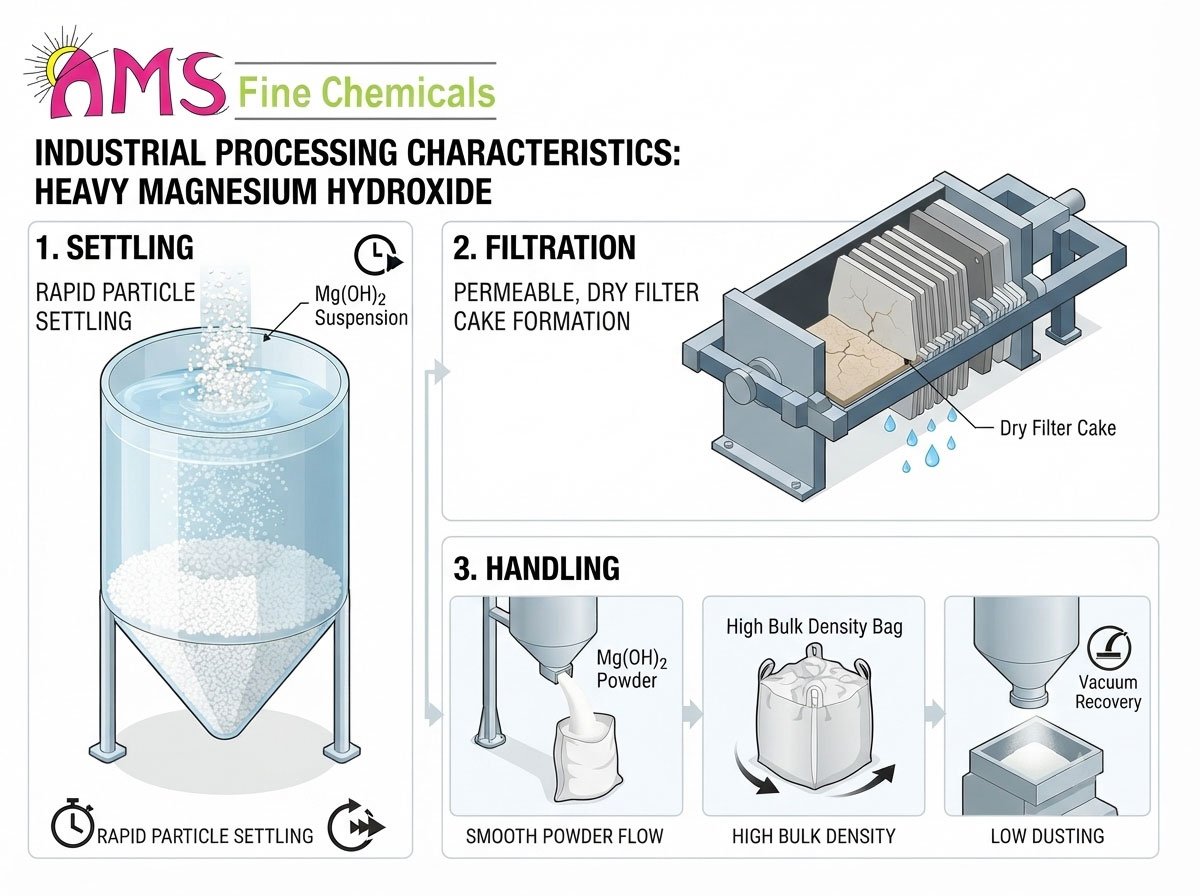
These three characteristics, settling, filtration and handling, are where Heavy Magnesium Hydroxide earns its place in industrial use. This guide explains how each one works, why the heavy grade behaves the way it does, and what buyers and plant teams should specify. It is written by AMS Fine Chemicals, a manufacturer and exporter of magnesium compounds based in Bhavnagar, Gujarat, India.
If you are new to the material, start with our Heavy Magnesium Hydroxide product page. For the wider family, see the Magnesium Hydroxide page and our complete Products range.
What Makes Heavy Magnesium Hydroxide Different
Magnesium hydroxide, Mg(OH)2, is a white, sparingly soluble alkali. Its low solubility is what makes it useful as a controlled neutralizing agent: it releases alkalinity gradually, and the pH it produces tends to level off in the mild alkaline range rather than overshooting the way a strong caustic can. We explain that chemistry in detail in Why Magnesium Hydroxide Provides Controlled Alkalinity Compared With Strong Bases.
The same chemistry is shared by every grade. What changes between grades is the physical form of the particles. The heavy grade is produced to have a higher bulk density and a denser, more compact particle structure than the light grade. In practical terms, that means:
- Higher bulk density, so more material fits in each bag, drum or silo, and storage and freight efficiency improve.
- Faster settling in water, because denser particles and agglomerates fall faster under gravity.
- Easier solid-liquid separation, because the sludge is more compact and more permeable to water.
- Better flow and lower dusting as a dry powder, because the material is less fluffy and less prone to airborne dust.
The light grade is designed for different jobs, such as suspension stability in liquid products, which we cover in Light Magnesium Hydroxide in Oral Suspension Stability: A Formulation Guide. The heavy grade is built for the opposite priority: it should separate, drain and handle easily. Neither is better in the abstract. The right choice depends on what the process needs.
Settling Behavior: Why Heavy Grades Drop Out of Suspension Quickly
The physics in plain language
Settling in a tank is governed by a few simple factors. The classic relationship, Stokes’ law, says that for a single small particle in still water, settling velocity rises with the square of the particle diameter and with the density difference between the particle and the liquid, and falls as the liquid becomes more viscous. Two points follow directly:
- Bigger or denser particles settle faster. A small increase in effective particle size produces a large increase in settling speed.
- Agglomerates count as particles. In a slurry, fine primary crystals often cluster into larger, denser agglomerates. The structure of those agglomerates is shaped during manufacturing, and it is a major reason heavy grades settle differently from light ones.
Hindered settling in real slurries
Stokes’ law describes a single particle. A real slurry at several percent solids behaves differently. Particles crowd each other, the displaced water has to flow upward past them, and the whole mass settles as a zone with a visible interface between clear liquid above and sludge below. This is called hindered settling, and it is the behavior you actually see in clarifiers and settling tanks.
For heavy magnesium hydroxide, hindered settling is usually favorable. The compact agglomerates form a sludge bed that consolidates quickly, so the clear zone appears sooner and the settled volume is smaller. Plant teams benefit in several ways:
- Shorter retention time in clarifiers or settling tanks for a given clarity target.
- Smaller sludge volume for the same mass of solids, which reduces disposal handling.
- Less carryover of fine solids into the clarified overflow.
Factors that change settling in practice
The grade is only one input. These variables also influence how a magnesium hydroxide slurry settles:
- Particle size distribution. A tight distribution with few fines settles more cleanly than a broad one, because fine particles can remain suspended long after the bulk has dropped. Our article on magnesium carbonate particle size distribution explains D10, D50 and D90 in detail, and the same logic applies to magnesium hydroxide.
- Slurry concentration. Higher solids loading increases hindered settling. Very dilute slurries settle by free fall, while concentrated slurries settle as a zone.
- Temperature. Warmer water is less viscous, which generally supports faster settling.
- Dissolved salts and pH. The ionic environment and the pH change surface charge on the particles, which affects how readily they clump.
- Flocculant use. In wastewater service, a small dose of polymer flocculant can bind particles into larger flocs and speed clarification further. The dose should be tested at lab scale, because overdosing can make the sludge sticky and harder to dewater.
- Agitation history. Aggressive mixing or high-shear pumping can break agglomerates apart and temporarily increase fines. Gentle make-down and transfer help preserve the settling character of the material.
A simple jar test that tells you a lot
Before committing to a grade, many plants run a basic jar or cylinder test. Prepare slurries at the intended solids loading, stir for a fixed time, then let them stand in graduated cylinders. Record the height of the clear-water interface at fixed time intervals, and the final settled sludge volume after a set period. Comparing two grades side by side under identical conditions gives a direct, practical view of settling performance that a datasheet cannot. If you would like help designing a test or a sample for it, our team can assist through the Contact Us page.
Filtration Characteristics: Building a Cake That Drains
After settling, many processes need to separate the solids from the water. This is where magnesium hydroxide sludge gets tested hardest, because a cake that holds water drives up disposal cost, and a filter that blinds stops the line.
How filtration resistance builds
In cake filtration, solids deposit on the filter medium and form a bed through which the filtrate must pass. The resistance to flow depends on two properties of that bed:
- Permeability. Beds made from larger, more uniform particles have wider flow channels, so water passes through more easily.
- Compressibility. Some cakes compact under pressure and close their own channels. A relatively rigid, incompressible cake keeps its pores open and filters faster throughout the cycle.
Fine particles hurt both. They pack into the gaps between larger particles, reduce permeability, and can migrate into the filter cloth. Dense, compact heavy-grade particles generally form a more open, more permeable cake than very fine, fluffy material, which is why heavy magnesium hydroxide is often the preferred choice where dewatering matters.
Practical benefits on the filter
When the particle structure is favorable, plants typically see these advantages:
- Faster filtration rates and shorter cycle times on filter presses and vacuum filters.
- Lower residual moisture in the cake, which cuts the weight, volume and cost of sludge disposal.
- Cleaner filtrate, because fewer fine particles pass through the medium.
- Less cloth blinding, so filter media last longer and cleaning is less frequent.
- Better cake release, which speeds discharge from plate-and-frame presses and belt filters.
Equipment considerations
Heavy magnesium hydroxide suits the common dewatering equipment used in effluent and process plants:
- Plate-and-frame and recessed-chamber filter presses, where a permeable cake shortens press cycles.
- Belt presses and vacuum belt filters, where cake release and drainage speed are important.
- Centrifuges, where solids settle and compact well under high g-force.
- Gravity thickeners ahead of filtration, where fast settling reduces the load on downstream equipment.
The best combination of grade, flocculant, filter medium and pressure is plant-specific. A small pilot run is usually worth the effort before full-scale adoption.
Washing the cake
In processes where magnesium hydroxide is produced or used as part of a precipitation step, cake washing removes soluble salts that would otherwise remain in the solids. A permeable cake washes more evenly and with less wash water, since the liquid passes uniformly through the bed rather than channeling through cracks. Here too, the denser particle structure of the heavy grade helps.
Handling Characteristics: From Bag to Process
Settling and filtration describe how the material behaves in water. Handling describes how it behaves before it ever reaches water, and it affects safety, housekeeping and dosing accuracy every day.
Bulk density and storage efficiency
Bulk density is the weight of powder per unit volume as it sits loose in a container. Because the heavy grade packs more mass into the same space, it reduces the number of bags, drums or silo fills needed for a given dose. Warehouse space, internal transport and freight cost per tonne all benefit. We cover this property in depth for a related product in Magnesium Carbonate Bulk Density: Why It Matters in Industrial Processing, and the same reasoning applies here.
Flow, feeding and dosing
Very fine, fluffy powders tend to hold air, form bridges in hoppers and flood unpredictably through feeders. Denser powders usually flow more steadily and feed more consistently, which supports accurate, repeatable dosing. If you handle a range of magnesium compounds, the flow advantages of dense grades are discussed further in Heavy Magnesium Carbonate and Powder Flow: Understanding the Processing Advantage, and the fluffier end of the range is covered in Light Magnesium Carbonate for Improving Powder Flow and Handling.
To keep feeding smooth:
- Use hoppers with steep walls and smooth surfaces to avoid bridging and rat-holing.
- Keep the powder dry, since moisture is the most common cause of lumping and sticking.
- Use screw or rotary feeders sized for the density of the heavy grade rather than for a light powder.
Dust control
Heavy grades generate less airborne dust than light grades, but magnesium hydroxide is still a fine powder and should be handled with normal industrial dust controls:
- Local exhaust ventilation at bag-opening and charging points.
- Closed transfer systems or bulk bag dischargers where volumes justify them.
- Suitable respiratory and eye protection for operators, in line with the safety data sheet.
- Regular wet cleaning or vacuuming rather than dry sweeping.
Moisture, caking and air exposure
Magnesium hydroxide is not strongly hygroscopic, but poor storage can still cause lumping when bags sit in damp areas or packaging is damaged. Over long periods, exposed powder can also slowly take up carbon dioxide from the air, forming a small amount of magnesium carbonate on the surface. This is rarely a problem in normally stored material, but it is one more reason to keep bags sealed and stored properly. Practical storage rules include:
- Store in a cool, dry, well-ventilated area, off the floor on pallets.
- Keep bags and drums tightly closed after opening.
- Use older stock first (first-in, first-out).
- Keep away from strong acids, since magnesium hydroxide reacts with them by design.
Slurry make-down and pumping
Many plants do not use the powder dry. They make a slurry and dose that. Heavy grades are well suited to this, but they need correct slurry management:
- Keep the slurry agitated. The same fast settling that helps clarification means the solids will drop out in a storage tank if mixing stops.
- Choose the right pump. Slurry-rated pumps with suitable internals handle dense solids better than clean-water designs.
- Avoid dead legs in piping. Settled solids in low-flow sections can build up and block lines.
- Use sensible velocities. The line velocity should be high enough to keep solids moving but not so high that it causes unnecessary erosion.
- Flush after shutdowns. Clearing lines prevents hard sediment from setting.
How Settling, Filtration and Handling Connect
These three characteristics are not independent. They all come from the same underlying property: the size, density and structure of the particles and agglomerates formed during manufacturing.
A denser agglomerate settles faster. A denser, more uniform agglomerate also forms a more permeable filter cake. And a denser powder is easier to store, feed and dose. When a supplier controls the manufacturing process tightly, all three benefits arrive together. When the process is loose, a batch may be acceptable on assay but disappointing in all three areas at once. That is why a full specification should include physical parameters, not only chemical purity. Our guide to magnesium carbonate particle morphology shows how particle shape and structure drive performance across the magnesium family.
Heavy vs. Light Magnesium Hydroxide: A Quick Comparison
| Characteristic | Heavy Magnesium Hydroxide | Light Magnesium Hydroxide |
|---|---|---|
| Bulk density | Higher | Lower |
| Settling in water | Faster, compact sludge | Slower, stays suspended longer |
| Filtration and dewatering | Generally easier, more permeable cake | Generally slower, higher cake moisture |
| Dry powder flow | More free-flowing, less dusty | Fluffier, more prone to dusting and bridging |
| Storage and freight efficiency | More mass per volume | Less mass per volume |
| Typical strengths | Effluent treatment, neutralization, processes that need solids to separate | Suspensions, liquid formulations that need solids to stay dispersed |
If your process needs the solids to stay suspended, the Light Magnesium Hydroxide grade may fit better. If you need solids to settle, filter and handle easily, the heavy grade is usually the stronger choice.
Where These Characteristics Matter Most
Acidic effluent and wastewater treatment
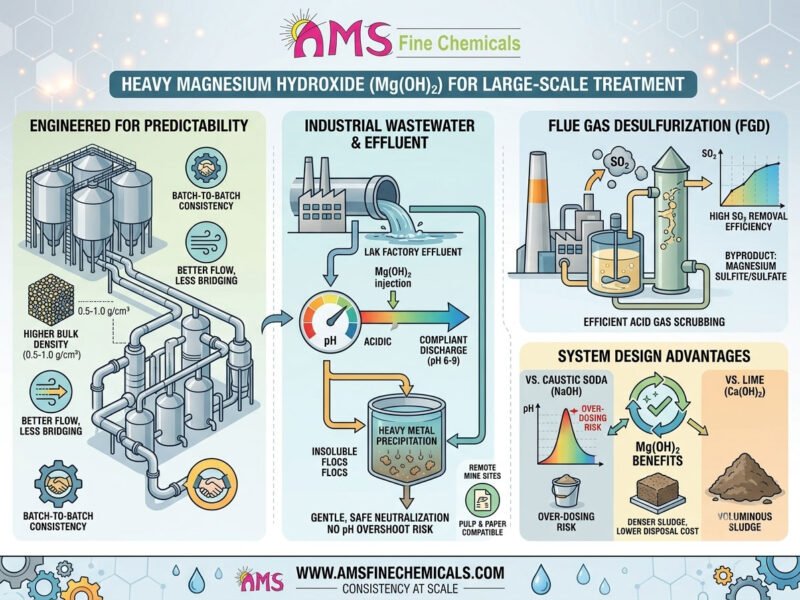
This is the largest industrial use of heavy magnesium hydroxide, and the one where settling and filtration matter most. The material neutralizes acidic streams gradually, and the resulting sludge, including precipitated metal hydroxides, has to be separated and dewatered. Fast settling and good filterability reduce clarifier size, shorten press cycles and lower disposal volume. Our guide Heavy Magnesium Hydroxide for Acidic Effluent Treatment covers dosing and process design for this application in detail. Because the reaction rate also depends on particle size, read it together with Magnesium Hydroxide Particle Size and Reaction Rate: A Technical Comparison.
Process pH control
Chemical, metal-finishing, textile and mining operations use magnesium hydroxide to raise and hold pH without the sharp swings associated with strong caustic. A heavy grade that disperses on make-down, then settles and filters cleanly afterward, keeps the downstream steps simple.
Industrial neutralization and bulk use
When consumption runs to tonnes per month, handling economics become significant. Higher bulk density, lower dust and steadier feeding all translate into lower labor, less housekeeping and more predictable dosing. You can browse the full list of end uses on our Application page and the sectors we supply on Industries We Serve.
Troubleshooting Common Problems
| Symptom | Likely cause | What to check or try |
|---|---|---|
| Slurry settles too slowly | Excess fines, very low solids loading, cold water, high shear in transfer | Review particle size distribution, raise solids loading, test a flocculant, reduce shear |
| Cloudy clarifier overflow | Fines carryover or overdosed or underdosed flocculant | Jar-test flocculant dose, check for hydraulic surges |
| Filter cycles getting longer | Cloth blinding or a change in particle size between batches | Inspect and clean the media, compare batch particle size data |
| High cake moisture | Fine, compressible cake or insufficient pressing time | Test a heavier grade, adjust press time and pressure, review flocculant dose |
| Solids settling in the slurry tank | Inadequate agitation | Increase mixing, check impeller design, avoid long idle periods |
| Pipe or pump blockages | Dead legs, low velocity, or no flush after shutdown | Redesign dead legs, raise line velocity, add flushing steps |
| Lumps or caking in bags | Moisture ingress during storage | Improve storage conditions, keep packaging sealed, rotate stock |
| Dusting at the charging point | Open handling of fine powder | Add local exhaust, closed transfer, or bulk bag discharge |
In many of these cases, the quickest diagnostic step is to compare the current lot against a previous good lot on particle size distribution and bulk density.
What to Specify When You Buy
A strong purchase specification for heavy magnesium hydroxide goes beyond the assay. Include these items:
- Bulk density range, so the material you receive matches the density your feeders and storage were designed for.
- Particle size distribution, ideally D10, D50 and D90, with tolerances, not just a single average.
- Moisture content, since excess moisture drives caking and affects dosing accuracy.
- Purity and key impurities, with limits relevant to your end use.
- Packaging format, such as bags, bulk bags or drums, matched to your handling system.
- Batch-to-batch consistency data, to confirm that physical behavior stays stable over time.
- Test method references, so your incoming checks use the same methods the supplier used.
For guidance on reading supplier documents, see Magnesium Carbonate COA Explained: Important Parameters Buyers Should Check, and for a framework on selecting and auditing suppliers, read How to Evaluate a Magnesium Carbonate Supplier for Bulk Procurement. Both articles are written about magnesium carbonate, but the principles apply equally to magnesium hydroxide purchasing.
How AMS Fine Chemicals Supports Your Process
AMS Fine Chemicals is a manufacturer and exporter of magnesium carbonate, magnesium hydroxide and magnesium trisilicate, based at Shanti Square, Bhavnagar, Gujarat. We supply industrial, pharmaceutical and specialty buyers, and we understand that a material is only as useful as its behavior in your plant.
For heavy magnesium hydroxide, our team can help you:
- Select between heavy and light grades based on your settling, filtration or suspension needs.
- Share specifications, certificates of analysis and sample quantities for pilot trials.
- Discuss packaging and logistics for domestic and export shipments.
- Review process issues with you if your current material is not performing as expected.
Explore the complete Heavy Magnesium Hydroxide range, compare it with Light Magnesium Hydroxide, or browse related materials such as Heavy Magnesium Carbonate and Magnesium Carbonate. You can also read more technical articles in our Heavy Magnesium Hydroxide and Magnesium Hydroxide blog categories.
Frequently Asked Questions
Why does heavy magnesium hydroxide settle faster than the light grade? Settling speed depends strongly on particle size and density. The heavy grade forms denser, more compact particles and agglomerates, which fall faster through water and consolidate into a smaller sludge volume.
Does faster settling mean the slurry is harder to keep suspended? Yes. In dosing tanks, the solids will drop out if agitation stops. Keep the slurry mixed and avoid dead legs in the piping. If you need a product that stays suspended, a light grade is the better match.
Is heavy magnesium hydroxide easier to filter? In most cases, yes. A denser, more uniform particle structure generally forms a more permeable cake with lower resistance to water flow. Results still depend on particle size distribution, flocculant use, filter medium and operating pressure, so a pilot test is recommended.
Do I still need a flocculant? Often a flocculant is unnecessary for the magnesium hydroxide itself, but wastewater streams contain other solids and dissolved species. A small, tested flocculant dose can improve clarity and cake quality in those cases. Overdosing should be avoided.
How should I store heavy magnesium hydroxide? Store it in a cool, dry, well-ventilated area, off the floor, with bags or drums tightly closed after use. Keep it away from strong acids and use older stock first.
Is heavy magnesium hydroxide dusty? It is less dusty than light grades, but it is still a fine powder. Use normal dust control and protective equipment, and follow the safety data sheet.
Can the physical properties change between batches? Some natural variation is normal. Significant swings in bulk density or particle size can change settling and filtration. Ask your supplier for batch data and monitor incoming lots.
Can AMS Fine Chemicals supply samples and documentation? Yes. You can request samples, specifications and a certificate of analysis through our Contact Us page or by writing to info@amsfine.com.
Final Word
Heavy magnesium hydroxide is chosen for more than its chemistry. Its denser, more compact particle structure gives it three practical advantages: it settles quickly, it filters and dewaters well, and it handles easily as a powder and as a slurry. Those advantages shorten cycle times, shrink sludge volumes, reduce housekeeping and improve dosing consistency, which together lower the true cost of using the material.
The key is to treat physical behavior as a specification item, not an afterthought. Ask for bulk density and particle size data, run a simple settling and filtration trial, and design slurry handling around the fact that dense solids settle fast. With those steps in place, heavy magnesium hydroxide becomes one of the most dependable alkalis in an industrial process.
To discuss grades, request a sample or get a certificate of analysis, visit the Heavy Magnesium Hydroxide page or contact the AMS Fine Chemicals team through Contact Us, or call +91 70433 38890.