Moisture is one of the quietest formulation risks in industrial and consumer chemistry. It doesn’t announce itself the way a failed assay or an out-of-spec pH reading does — it works slowly, through caking, clumping, texture changes, and gradual potency loss, often not becoming visible until a product has already sat on a shelf or in a warehouse for weeks. Magnesium Carbonate is one of the most widely used tools formulators reach for to manage exactly this kind of risk — and understanding precisely how and why it absorbs moisture is what separates an effective anti-caking or desiccant formulation from one that underperforms despite using the “right” ingredient.
This guide covers the mechanism behind Magnesium Carbonate’s moisture absorption behaviour, what drives its capacity, how it compares to other desiccant and moisture-management materials, and the practical formulation and sourcing decisions that determine whether it performs as expected in a real product.
The Mechanism: How Magnesium Carbonate Actually Absorbs Moisture
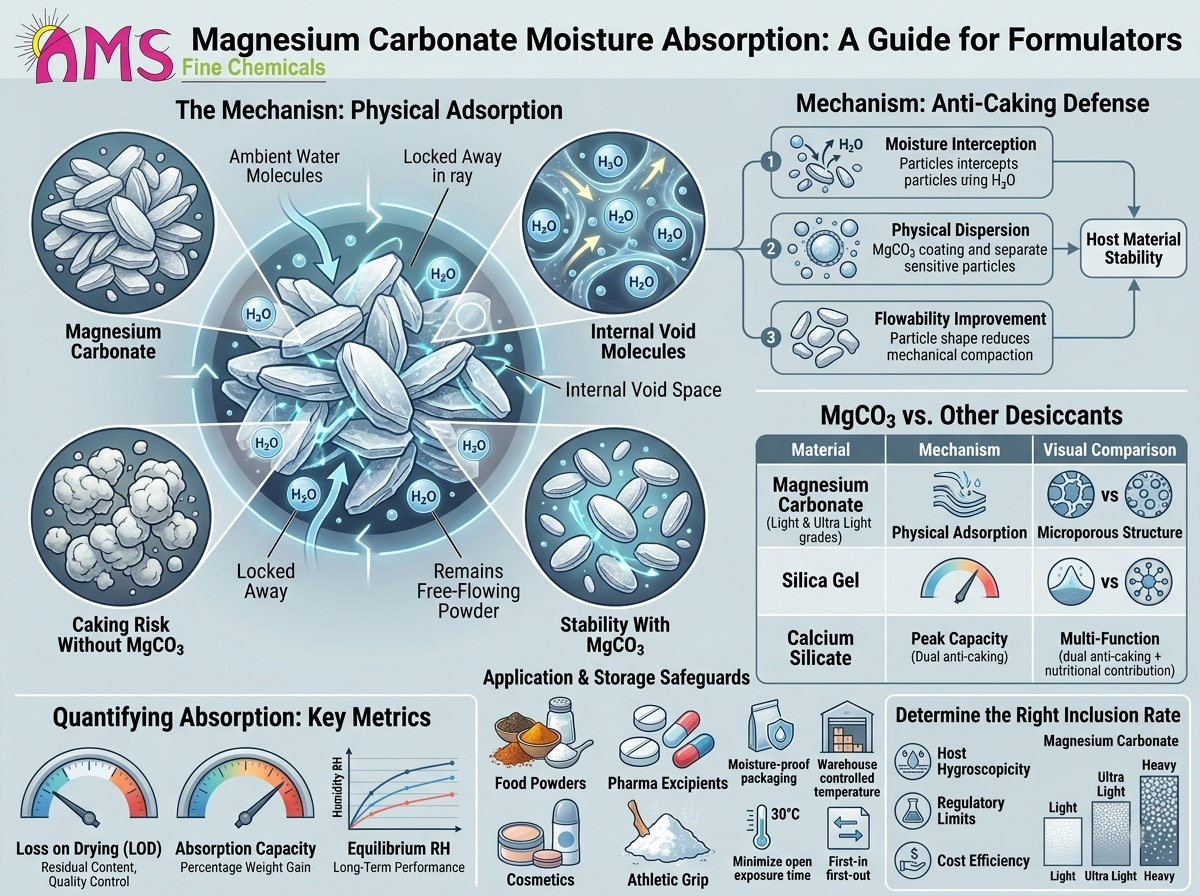
Magnesium Carbonate’s moisture-absorbing behaviour is fundamentally a physical adsorption process rather than a chemical reaction with water. The material’s characteristic porous, high-surface-area particle structure — built from loosely aggregated plate-like crystals — contains extensive internal void space that draws in and holds ambient water molecules within its pore network.
This distinction matters: because the mechanism is primarily physical adsorption rather than chemical bonding or dissolution, Magnesium Carbonate can absorb a meaningful percentage of its own weight in moisture without visibly turning wet, sticky, or losing its free-flowing powder characteristics — up to a point. This is the property that makes it so effective as an anti-caking agent: rather than preventing moisture from entering a system, it intercepts and “locks away” that moisture within its own particle structure before it can reach and destabilize more hygroscopic ingredients nearby.
For a detailed look at how this pore structure forms during manufacturing, and how it differs across particle morphologies, see our companion article, How Magnesium Carbonate Particle Morphology Influences Industrial Performance, which explains the crystal-structure basis for the porosity discussed here.
Why Porosity and Surface Area Drive Absorption Capacity
Not all Magnesium Carbonate absorbs moisture equally well. Absorption capacity correlates directly with specific surface area and internal pore volume — properties that trace back to particle morphology and grade, not to bulk chemical assay:
- High-surface-area, porous grades — the structure typical of Light Magnesium Carbonate and especially Ultra Light Magnesium Carbonate — offer substantially more internal pore volume per gram, translating directly into higher moisture-holding capacity.
- Dense, low-surface-area grades — the structure typical of Heavy Magnesium Carbonate — offer comparatively limited internal void space, and are correspondingly less effective as a moisture-management ingredient, even though they may still provide some surface-level absorption.
This is precisely why grade selection is the single most important decision a formulator makes when incorporating Magnesium Carbonate specifically for its moisture-management function — a general “Magnesium Carbonate” purchase order without a specified grade risks delivering material that technically matches the name but not the functional performance the formulation depends on. Our guide on How to Select the Right Magnesium Carbonate Grade for Your Manufacturing Process covers this decision in more depth.
The Anti-Caking Mechanism in Detail
Caking occurs when moisture-sensitive powder particles absorb ambient humidity, causing their surfaces to partially dissolve or soften and form sticky connections — often called liquid bridges — with neighbouring particles. As moisture subsequently evaporates or the product is compressed during storage and transport, these liquid bridges can solidify into rigid crystal bridges, transforming a free-flowing powder into a clumped or solid mass.
Magnesium Carbonate interrupts this process through several complementary mechanisms:
- Moisture interception: By adsorbing ambient moisture into its own pore structure before it reaches more hygroscopic particles, it delays or prevents the liquid-bridge formation that initiates caking.
- Physical dispersion: Its fine, high-surface-area particles physically separate and coat the particles of the primary ingredient, reducing direct particle-to-particle contact points where bridges would otherwise form.
- Flowability improvement: Beyond moisture management, its particle shape and size contribute independently to improved bulk flow characteristics, reducing the mechanical compaction that can also contribute to caking under storage pressure.
- Inert compatibility: Its low chemical reactivity means it can perform this function across a wide range of host materials — food powders, pharmaceutical actives, industrial powders — without introducing unwanted chemical interactions.
This combined mechanism has been specifically documented in hygroscopic amino acid powder formulations, where Magnesium Carbonate’s moisture absorption and physical dispersion properties work together to meaningfully improve storage stability, with performance dependent on particle size, inclusion rate, and the ambient humidity conditions the product will actually face.
Quantifying Absorption Capacity: What the Numbers Actually Mean
Formulators evaluating Magnesium Carbonate for moisture-management applications should understand a few distinct measurements that describe absorption behaviour, since they aren’t interchangeable:
- Loss on Drying (LOD): Measures the material’s own residual moisture content at the point of testing — a quality control parameter, not a measure of absorption capacity. A full breakdown of how this figure is tested and why it matters for incoming material quality is covered in our Magnesium Carbonate COA Explained: Important Parameters Buyers Should Check article.
- Moisture absorption capacity: Typically measured as the percentage of the material’s own weight it can adsorb under defined humidity and temperature conditions, often assessed at multiple relative humidity levels since absorption behaviour isn’t linear across the full humidity range.
- Equilibrium relative humidity (ERH) behaviour: Describes how the material’s moisture content changes as a function of surrounding relative humidity, useful for predicting long-term behaviour in a specific storage or packaging environment rather than a single-point capacity figure.
Specialized engineered forms — mesoporous Magnesium Carbonate variants developed specifically for dehumidification applications — have demonstrated substantially enhanced moisture absorption capacity compared to conventional commercial grades, with some engineered nanostructured forms reported to absorb meaningfully more moisture by weight than standard material. These specialty forms remain a distinct product category from standard commercial Light, Ultra Light, and Heavy grades, generally reserved for dedicated desiccant and dehumidification applications rather than general-purpose anti-caking use.
Application-Specific Moisture Absorption Considerations
Food Powders
In spices, salt, and powdered food ingredients, Magnesium Carbonate’s ability to absorb a significant percentage of its own weight in moisture without becoming wet to the touch is what allows it to protect naturally hygroscopic ingredients from clumping, without introducing perceptible taste, odor, or texture changes when used at appropriate inclusion rates. Our detailed guide on Light Magnesium Carbonate as Anticaking Agent in Spices, Salt, and Powdered Foods covers formulation-specific guidance for this application, including particle size considerations for maintaining acceptable mouthfeel.
Pharmaceutical Excipients
In tablet and capsule formulations, moisture management plays a dual role: protecting moisture-sensitive active ingredients from hydrolytic degradation, and maintaining the flow and compaction properties required for consistent tablet manufacturing. Because pharmaceutical formulations often operate under tighter tolerances than food or industrial applications, particle size and surface area consistency between batches becomes especially important — inconsistent absorption behaviour between lots can translate into inconsistent tablet hardness, dissolution, or stability performance over shelf life.
Cosmetics and Personal Care
Face powders, dry shampoos, deodorants, and other personal care formulations rely on Magnesium Carbonate’s moisture- and oil-absorbing properties to regulate sebum, provide a smooth, matte finish, and prevent product caking within its packaging over the product’s shelf life. Fine, high-surface-area grades are generally preferred here, since both absorption performance and tactile “skin feel” depend on a similarly fine, uniform particle structure.
Industrial Powders and Fine Chemicals
Beyond consumer-facing applications, industrial powder blends — pigments, fine chemical intermediates, specialty additives — can benefit from Magnesium Carbonate’s moisture-management properties to maintain consistent flow and metering accuracy through automated dosing equipment, where even modest caking can disrupt production line throughput.
Athletic and Sports Applications
Climbing chalk and sports grip powders represent perhaps the most direct, unmediated demonstration of Magnesium Carbonate’s moisture absorption in action — applied directly to skin, it rapidly adsorbs sweat to increase surface friction and reduce slippage, a function entirely dependent on the same porous, high-surface-area structure that drives every other application in this guide.
Comparing Magnesium Carbonate to Other Moisture-Management Materials
| Material | Mechanism | Typical Advantage | Typical Limitation |
|---|---|---|---|
| Magnesium Carbonate | Physical adsorption into porous structure | Non-toxic, food/pharma-safe, dual anti-caking + mild alkaline function | Lower peak capacity than dedicated desiccants like silica gel |
| Silica Gel | Physical adsorption into microporous structure | Very high absorption capacity, widely available | Not typically used as a direct food/formulation additive; used as a separate packaging desiccant |
| Calcium Silicate | Physical adsorption, similar mechanism to Magnesium Carbonate | High absorbency, common food-grade anti-caking alternative | Different mineral profile; doesn’t provide magnesium nutritional contribution |
| Engineered Mesoporous Magnesium Carbonate | Enhanced physical adsorption via engineered pore structure | Substantially higher capacity than conventional grades | Specialty product, not standard commercial grade; higher cost |
Standard commercial Magnesium Carbonate occupies a practical middle ground: strong enough moisture-management performance for the vast majority of food, pharmaceutical, cosmetic, and industrial anti-caking applications, combined with the added benefits of mild alkaline buffering and — in food and pharmaceutical contexts — a nutritionally relevant magnesium contribution that purely inert desiccant materials don’t offer.
Storage and Handling: Protecting the Material’s Own Moisture Performance
A frequently overlooked consideration is that Magnesium Carbonate’s moisture-absorbing capacity is itself a finite resource — a batch that has already adsorbed significant ambient moisture during storage or transit has correspondingly less remaining capacity to protect a host formulation once incorporated. Practical safeguards include:
- Sealed, moisture-proof packaging with food-grade or pharmaceutical-grade liners, particularly important for high-surface-area Light and Ultra Light grades shipped through humid coastal routes or long sea-freight transit.
- Controlled warehouse storage, generally below roughly 30°C and away from high-humidity storage areas, to prevent gradual moisture pickup before the material even reaches the formulator’s production line.
- Minimizing open-container exposure time during dispensing and weighing, particularly for high-surface-area grades used in moisture-sensitive pharmaceutical or cosmetic manufacturing environments.
- First-in, first-out inventory rotation, since even properly sealed containers can accumulate some moisture over extended storage periods once opened and resealed multiple times.
Buyers should also confirm Loss on Drying figures on the incoming Certificate of Analysis specifically to verify the material hasn’t already absorbed a significant portion of its usable capacity before it reaches formulation — a batch with elevated LOD relative to typical values has effectively less “room” left to protect the finished product.
Testing Methods for Evaluating Moisture Absorption Performance
Formulators validating Magnesium Carbonate’s moisture-management performance for a specific application typically rely on a combination of standard and application-specific test methods:
- Dynamic Vapor Sorption (DVS): Measures how much moisture a material adsorbs and desorbs as relative humidity is systematically varied, providing a detailed sorption isotherm rather than a single-point capacity figure. This is the most rigorous method for characterizing absorption behaviour across the full range of humidity conditions a product might encounter.
- Accelerated stability testing: Places the finished formulation — not just the raw Magnesium Carbonate in isolation — under elevated temperature and humidity conditions for a defined period, measuring caking, flowability, or other relevant quality attributes over time. This approach captures the real interaction between Magnesium Carbonate and the specific host formulation, which isolated raw material testing alone cannot fully predict.
- Flow function and angle of repose testing: Provides a practical, production-relevant measure of whether moisture absorption is successfully preventing the flow degradation that leads to caking and handling problems, complementing more academic sorption capacity data with direct process-relevant performance metrics.
- Visual and tactile caking assessment: Despite being qualitative, remains a standard, practical benchmark in food and consumer product quality control, since ultimately the functional goal is a product that looks and feels appropriately free-flowing to the end user or downstream processor.
Combining raw material characterization (DVS, LOD) with finished-formulation stability testing gives the most complete picture of how Magnesium Carbonate will actually perform in a specific product, since raw material capacity data alone doesn’t account for interactions with the rest of the formulation.
Determining the Right Inclusion Rate
Moisture-management performance in a formulation isn’t simply a matter of adding more Magnesium Carbonate — inclusion rate needs to be balanced against several factors:
- The host material’s own hygroscopicity and expected moisture exposure, since more hygroscopic ingredients or higher-humidity end-use environments generally require a higher relative inclusion rate to achieve equivalent protection.
- Regulatory and labeling limits, particularly in food applications where maximum permitted inclusion levels for anti-caking agents are defined by the applicable food safety framework.
- Sensory and functional trade-offs, since excessive inclusion can affect taste, texture, tablet hardness, or cosmetic product feel even when the added material itself is inert and food- or pharma-safe.
- Cost efficiency, since moisture-management performance typically shows diminishing returns beyond a certain inclusion threshold specific to each formulation.
Bench-scale stability testing under the formulation’s actual anticipated storage humidity and temperature conditions remains the most reliable way to determine the appropriate inclusion rate for a specific product, rather than relying solely on general industry rule-of-thumb ranges.
Humidity Zones and Regional Formulation Considerations
Moisture-management requirements aren’t uniform across geographies, and formulators supplying products into multiple regional markets should account for this when specifying Magnesium Carbonate grade and inclusion rate:
- High-humidity coastal and tropical regions — including much of South and Southeast Asia, and coastal areas of India near ports like Bhavnagar — present sustained high ambient relative humidity for much of the year, generally demanding higher-capacity grades (Light or Ultra Light) and more conservative inclusion rates to maintain product stability through extended shelf life and distribution chains.
- Monsoon-season variability in regions like western India introduces a distinct seasonal humidity spike, meaning a formulation validated for stability under average annual conditions may still face challenges during peak monsoon months unless stability testing specifically accounts for that seasonal extreme.
- Arid and temperate regions generally present lower ambient humidity loads, meaning standard Light grade inclusion rates validated for humid markets may be more conservative than strictly necessary — though formulators supplying both humid and arid markets from a single production line often standardize on the higher-humidity specification for consistency rather than maintaining separate regional formulations.
- Cold-chain and refrigerated storage introduces its own moisture dynamics, since temperature fluctuations during transport between refrigerated and ambient conditions can cause condensation cycles that behave differently than steady-state ambient humidity exposure, a consideration relevant to certain pharmaceutical and food cold-chain products.
Manufacturers operating from humid coastal manufacturing hubs — as many Indian chemical and pharmaceutical producers do — benefit from validating their own raw material storage and handling practices against these same regional humidity challenges, since the Magnesium Carbonate itself is subject to the same environmental exposure risks before it ever reaches the formulation stage.
How AMS Fine Chemicals Supports Moisture-Sensitive Formulations
AMS Fine Chemicals, based in Bhavnagar, Gujarat, manufactures Magnesium Carbonate across Light, Ultra Light, and Heavy grades, with particle size and surface area specifically engineered to support the moisture-management performance formulators depend on for food, pharmaceutical, cosmetic, and industrial applications. Every batch undergoes in-house testing for particle size distribution, bulk density, and Loss on Drying, with full Certificates of Analysis issued to confirm the material’s incoming moisture status and functional specification before it reaches your production line.
Explore full technical specifications on our Magnesium Carbonate, Light Magnesium Carbonate, Ultra Light Magnesium Carbonate, and Heavy Magnesium Carbonate product pages, or browse our complete range of magnesium compounds — including Magnesium Hydroxide and Magnesium Trisilicate — on the Products page.
Frequently Asked Questions
Does Magnesium Carbonate chemically react with the water it absorbs? Primarily no — its moisture-absorbing behaviour is mainly a physical adsorption process into its porous particle structure, rather than a chemical hydration reaction, which is part of why it can absorb significant moisture without becoming visibly wet.
Is Ultra Light Magnesium Carbonate always the best choice for moisture management? For applications demanding maximum absorption capacity, yes — its higher surface area generally outperforms standard Light grade. However, standard Light grade is often perfectly adequate and more cost-effective for moderate humidity environments, making Ultra Light more appropriate for applications facing particularly aggressive moisture exposure.
Can Magnesium Carbonate lose its moisture-absorbing effectiveness over time? Yes — once its internal pore structure has adsorbed moisture up to or near capacity, its remaining ability to protect a host formulation diminishes. This is why proper sealed storage of the raw material itself, prior to use, matters as much as its inherent absorption capacity.
How does Magnesium Carbonate’s moisture absorption compare to silica gel? Silica gel generally offers higher peak absorption capacity and is the standard choice for dedicated packaging desiccants, but it isn’t typically incorporated directly into food, pharmaceutical, or cosmetic formulations the way Magnesium Carbonate is, making the two materials suited to different roles rather than being directly interchangeable.
What’s the best way to confirm a supplier’s Magnesium Carbonate will perform well for my specific moisture-management application? Request particle size distribution and surface area data alongside the standard Certificate of Analysis, and run a bench-scale stability trial under your formulation’s actual anticipated storage conditions before committing to full-scale procurement, since real-world performance depends on the interaction between the material’s properties and your specific host formulation and environment.
Final Word
Magnesium Carbonate’s reputation as a reliable moisture-management ingredient is well earned, but its actual performance in any given formulation depends heavily on grade selection, particle morphology, and proper handling — not simply on the fact that “Magnesium Carbonate” appears on the ingredient list. Formulators who understand the physical adsorption mechanism behind its anti-caking behaviour, and who match grade and inclusion rate to their specific hygroscopicity and humidity challenges, get consistent, predictable protection. Those who treat it as a generic commodity ingredient risk exactly the kind of quiet, slow-developing moisture failure it was meant to prevent.
To request technical specifications, moisture absorption data, or a sample batch of any Magnesium Carbonate grade, visit our Magnesium Carbonate product page or reach out through our Contact Us page.