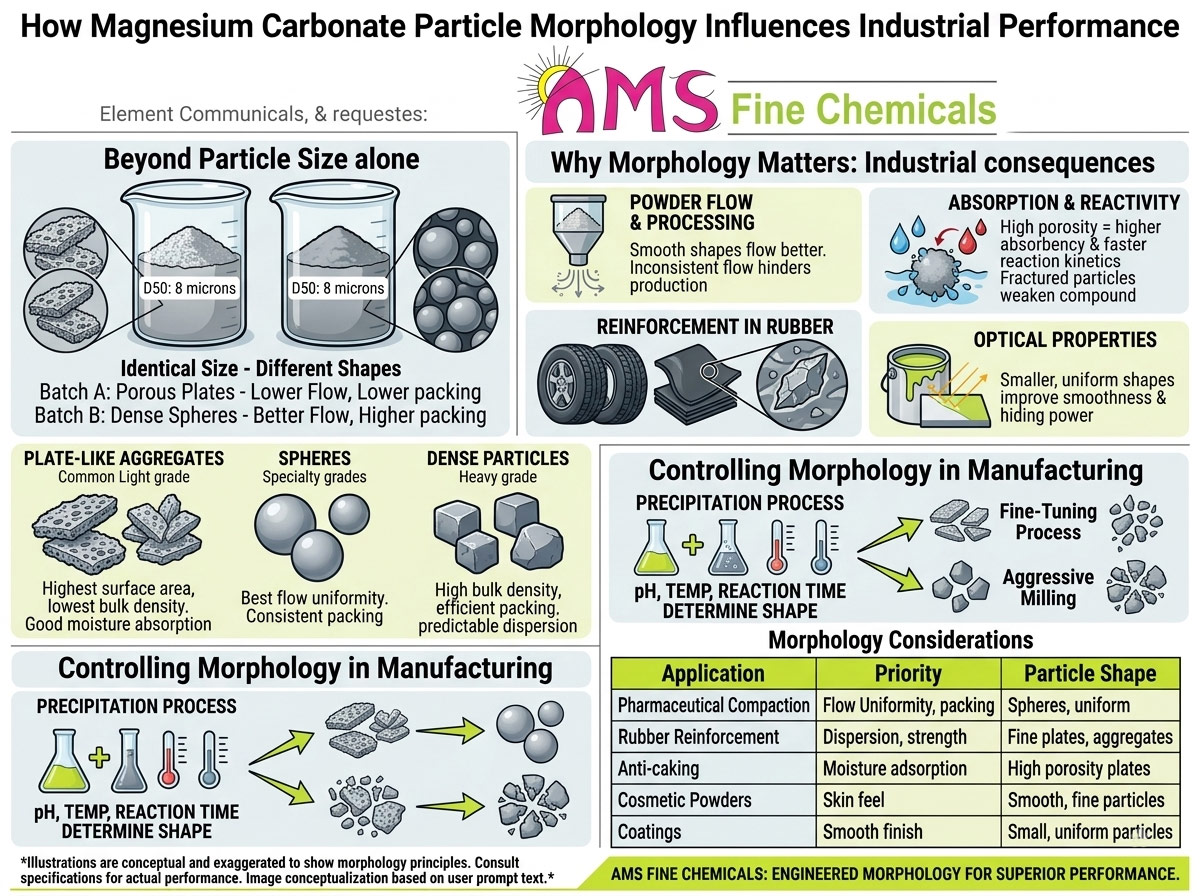
Two batches of Magnesium Carbonate can share an identical chemical assay, pass the same impurity limits, and still perform completely differently on a production line. The variable that explains this gap is rarely visible on a standard specification sheet: particle morphology — the actual three-dimensional shape, crystal habit, and internal architecture of the individual particles, as opposed to just their size.
Most buyers are used to thinking about Magnesium Carbonate in terms of bulk density and particle size distribution (D10/D50/D90). Those numbers matter, but they describe the statistical envelope of a powder, not the shape of the particles inside it. Two powders with identical D50 values can consist of very differently shaped particles — plates, needles, spheres, or irregular aggregates — and those shapes drive real differences in flow, dispersion, reinforcement, and reactivity. This guide is a deeper technical look at morphology itself: how it forms during manufacturing, why it matters more than most specification sheets suggest, and how to evaluate it when sourcing material for a demanding application.
What “Morphology” Actually Means, Beyond Particle Size
Particle morphology describes the geometric shape and surface architecture of individual particles, along with how those particles associate with one another. For Magnesium Carbonate specifically, commercial and research-grade material has been documented in several distinct crystal habits, depending on precipitation conditions:
- Plate-like (lamellar) crystals, often aggregating into porous, loosely bound clusters — the structure most commonly associated with commercial basic magnesium carbonate.
- Tubular aggregates formed from flaky fine crystals physically assembled into hollow tube-like structures, a specialized morphology studied for enhanced functional performance in certain formulations.
- Spherical or near-spherical particles, achievable under controlled hydration-carbonation conditions, prized in applications where flow uniformity and packing behaviour matter more than surface area.
- Cubic and diamond-like crystals, more typical of anhydrous magnesium carbonate synthesized under specific hydrothermal conditions, generally found in specialty and research-stage material rather than standard commercial grades.
- Irregular, agglomerated aggregates, common in less tightly controlled precipitation processes, where crystal growth isn’t uniformly directed.
For a technical explanation of how the precipitation and carbonation process determines which of these morphologies actually forms, see our Complete Guide to Magnesium Carbonate Manufacturing Process, which covers the reaction-stage controls that shape both particle size and crystal structure.
Why Morphology Matters More Than Particle Size Alone
Particle size distribution tells you the statistical range of particle diameters in a powder. It does not tell you:
- How particles pack together under compression or vibration
- How much internal porosity exists within each particle, independent of its outer diameter
- How particles orient and interact with a surrounding matrix — polymer, liquid, or another powder
- How mechanically robust individual particles are under shear or grinding forces during processing
Two batches with an identical D50 of, say, 8 microns can behave completely differently if one consists of porous, loosely aggregated plate clusters and the other consists of dense, individually solid near-spherical particles. The first will generally show higher surface area, higher absorbency, and lower effective bulk density; the second will generally flow more freely, pack more densely, and disperse more predictably in a liquid or polymer matrix.
This is precisely why a Certificate of Analysis showing acceptable particle size and bulk density numbers doesn’t always predict formulation performance — a point covered from the buyer’s-checklist side in our Magnesium Carbonate COA Explained: Important Parameters Buyers Should Check article, and from the grade-selection side in How to Select the Right Magnesium Carbonate Grade for Your Manufacturing Process.
How Morphology Forms During Manufacturing
Magnesium Carbonate’s final particle morphology is determined primarily during the precipitation and carbonation stages of production, governed by a handful of controllable process variables:
- Reaction temperature: Research on hydration-carbonation methods has shown that specific temperature windows favour regular, uniform spherical morphology, while extending reaction time or raising temperature beyond that window tends to produce irregular, less uniform particle shapes.
- pH during precipitation: Crystal nucleation and growth behaviour shift measurably with reaction pH, influencing whether particles tend toward diamond-like, cube-like, or plate-like habits.
- Reaction time: Longer reaction and aging times generally allow more complete crystal growth and can shift particle size and agglomeration state, sometimes converting an initially uniform morphology into a more fragmented or coarser structure if extended too far.
- Presence of crystal modifiers: Certain organic acids and surface-active compounds can be introduced during synthesis specifically to direct crystal growth toward a target morphology — a technique used in specialty and research-grade material production to achieve morphologies not easily obtained through temperature and pH control alone.
- Post-precipitation processing: Drying method and any subsequent milling or micronization step can further modify particle morphology, sometimes fracturing larger aggregates into smaller, more irregular fragments.
Because morphology is locked in during these early manufacturing stages, it cannot be corrected downstream through simple screening or classification — a batch with the wrong crystal habit for a target application generally needs to be reprocessed or sourced differently, not just re-sieved to a different size cut.
Morphology’s Effect on Bulk Density and Powder Flow
Bulk density — the property that distinguishes Light Magnesium Carbonate, Ultra Light Magnesium Carbonate, and Heavy Magnesium Carbonate grades — is itself a downstream consequence of particle morphology, not an independently adjustable parameter:
- Porous, loosely aggregated plate structures trap significant air and void space within and between particles, producing the very low bulk densities characteristic of Light and Ultra Light grades.
- Dense, well-formed spherical or cubic particles pack more efficiently with less trapped void space, producing the higher bulk densities characteristic of Heavy grade material.
- Irregular, broken aggregate fragments — sometimes a byproduct of aggressive milling — can produce inconsistent bulk density readings between sub-samples of the same nominal batch, since fragment shape and packing behaviour becomes less uniform than in a well-controlled precipitation process.
This relationship also explains why powder flowability doesn’t always correlate simply with particle size. A batch of relatively coarse but irregular, interlocking aggregate particles can flow worse than a batch of finer but smoother, more rounded particles — which is why flow function testing (measuring angle of repose or flow index) sometimes reveals problems that a particle size report alone would miss.
Morphology’s Effect on Surface Area and Reactivity
Specific surface area — measured in square meters per gram via gas adsorption (BET) techniques — is driven far more by internal porosity and crystal habit than by particle diameter alone. Research on basic magnesium carbonate has documented specific surface areas in the range of roughly 10 to 70 m²/g depending on how the plate-crystal aggregates are formed, with smaller average particle size generally correlating with a greater volume of fine internal pores.
This matters directly for two of Magnesium Carbonate’s most important functional roles:
- Anti-caking and moisture absorption: A higher internal surface area gives the material more capacity to adsorb free moisture before it can migrate to particle-particle contact points and trigger caking — the mechanism explored in application terms in our Light Magnesium Carbonate as Anticaking Agent in Spices, Salt, and Powdered Foods article.
- Acid-neutralizing and buffering reactivity: More exposed surface area generally means faster reaction kinetics when the material contacts an acidic environment, a principle discussed from the pharmaceutical excipient angle in our Magnesium Trisilicate BP vs. USP: Understanding Pharmaceutical Grade Specifications guide, where the same surface-area-driven reactivity principle governs a closely related magnesium compound’s performance.
Morphology’s Effect on Polymer and Rubber Reinforcement
In rubber compounding and polymer filler applications, particle shape directly affects how mechanical stress transfers between the filler and the surrounding matrix:
- Plate-like or lamellar particles can provide directional reinforcement benefits, distributing stress across a broader contact plane than an equivalent-volume spherical particle would, though they can also introduce anisotropic (direction-dependent) mechanical behaviour if not uniformly oriented during compounding.
- Well-dispersed, uniformly shaped particles — whether spherical or plate-like — generally produce more predictable, uniform mechanical properties than a blend containing a wide mix of irregular shapes and sizes, since inconsistent particle geometry creates localized stress concentration points within the cured compound.
- Aggregate structure integrity matters during compounding: particles that fracture unpredictably under the high shear forces of mixing equipment can generate a broader, less controlled particle size and shape distribution in the finished compound than what was measured in the raw material, complicating quality control.
Fine particle grades in the 1–10 micron range are generally favoured in high-performance rubber compounds specifically because their higher surface area improves dispersion and reinforcement efficiency, particularly in nitrile and neoprene rubber systems where mechanical property consistency is critical.
Morphology’s Effect on Optical and Visual Properties
For coatings, cosmetics, and paper applications, particle morphology governs light-scattering behaviour and therefore visual appearance:
- Smaller, more uniform particles (roughly 1–3 microns) tend to produce smoother finishes, more consistent pigment distribution, and better hiding power in coatings and paints, since more uniform particle geometry scatters light more predictably across a coated surface.
- Coarser or more irregular particles can create rough surface texture and are more prone to settling in liquid coating formulations, since larger, unevenly shaped particles don’t remain as readily suspended.
- Fine, smooth particle morphology in cosmetic powders (typically under 5 microns) improves both oil absorption and the tactile “skin feel” quality that formulators and consumers evaluate directly.
- Paper manufacturing applications rely on fine, well-dispersed particle morphology to enhance brightness and printability when used as a filler within the paper matrix.
Morphology and Process-Induced Attrition
Even when a supplier delivers material with a well-controlled, target morphology, the buyer’s own downstream processing can alter it before it ever reaches the finished product. This is a frequently overlooked source of formulation inconsistency:
- High-shear mixing and compounding equipment, common in rubber and polymer processing, can fracture porous aggregate particles into smaller, more irregular fragments — sometimes improving dispersion, but sometimes generating unwanted fines that behave differently than the bulk material was characterized to perform.
- Pneumatic conveying systems, used to move powder between storage and processing stages in many industrial facilities, can cause particle attrition through repeated collision with pipe walls and other particles, gradually shifting morphology and particle size distribution over the course of a production run.
- Repeated handling and transfer between multiple processing stages compounds this effect, meaning material tested for morphology at the point of receipt may no longer perfectly represent the material’s state by the time it’s incorporated into a finished formulation.
Manufacturers running morphology-sensitive processes benefit from characterizing material both as-received and after it passes through their own handling and processing equipment, rather than assuming the supplier’s CoA remains fully representative all the way through to the point of use. This is particularly relevant for high-shear rubber compounding and pneumatic bulk-handling systems, where attrition effects are most pronounced.
The Research Frontier: Engineered Morphologies
Beyond standard commercial grades, ongoing materials science research continues to explore purpose-engineered Magnesium Carbonate morphologies for specialized applications:
- Tubular aggregate structures, built from physically assembled flaky fine crystals, have been studied for their potential to deliver functional advantages beyond what conventional plate-aggregate or spherical morphologies offer, though these remain largely at the research and specialty-material stage rather than mainstream commercial production.
- Mesoporous magnesium carbonate, engineered specifically for high internal pore volume and surface area, has been investigated as a carrier substrate for controlled-release applications, as referenced in our broader discussion of Magnesium Carbonate’s functional roles in Magnesium Carbonate in Modern Chemical Formulations: A Technical Guide for Manufacturers.
- Surface-modified morphologies, where crystal growth is directed using organic modifiers to achieve hydrophobic or otherwise functionally tailored particle surfaces, represent an active area of process research aimed at expanding Magnesium Carbonate’s compatibility with non-polar polymer systems and other applications where its naturally hydrophilic surface would otherwise limit performance.
While most commercial buyers won’t need engineered morphologies for standard applications, awareness of this research direction is useful for formulation teams exploring next-generation product development where conventional grades reach a performance ceiling.
Practical Ways to Evaluate Morphology When Sourcing
Because standard commercial Certificates of Analysis typically report bulk density and particle size distribution but not morphology directly, buyers evaluating material for morphology-sensitive applications should consider requesting additional characterization:
- SEM (Scanning Electron Microscopy) imaging: Provides direct visual confirmation of particle shape, aggregation state, and surface texture — the most reliable way to actually see what the particles look like, rather than inferring shape indirectly from size and density data.
- BET surface area analysis: Quantifies specific surface area independent of particle size distribution, helping distinguish a porous, high-surface-area morphology from a dense, low-surface-area one even when both show similar D50 values.
- XRD (X-Ray Diffraction): Confirms the specific crystalline phase present, useful for distinguishing between basic carbonate structures that can behave differently despite similar bulk chemistry.
- Flow function testing: Directly measures how a powder actually flows under realistic handling conditions, capturing morphology-driven flow behaviour that particle size data alone doesn’t fully predict.
Most standard commercial applications don’t require this level of characterization on every batch, but it becomes valuable when troubleshooting an unexpected performance issue, qualifying a new supplier for a demanding application, or developing a novel formulation where morphology is expected to play a defining role.
Most standard commercial applications don’t require this level of characterization on every batch, but it becomes valuable when troubleshooting an unexpected performance issue, qualifying a new supplier for a demanding application, or developing a novel formulation where morphology is expected to play a defining role.
When to Escalate Beyond Standard Specification Testing
Not every formulation needs full morphology characterization, and requesting it unnecessarily adds cost and lead time without proportional benefit. A practical guideline for deciding when the extra step is worthwhile:
- Escalate when troubleshooting an unexplained performance gap. If a formulation underperforms despite every standard CoA parameter passing, morphology characterization is often the fastest way to identify a root cause that bulk density and particle size data alone can’t reveal.
- Escalate when qualifying a new supplier for an existing, validated formulation. Since morphology can differ even between two suppliers reporting identical particle size and bulk density figures, direct comparison via SEM or BET analysis before switching suppliers reduces the risk of an unexpected reformulation need later.
- Escalate for genuinely novel or high-performance applications — specialty rubber compounds, advanced pharmaceutical carriers, precision coatings — where the margin for functional variability is narrow enough that standard specification data isn’t sufficient to predict performance with confidence.
- Don’t escalate for routine, well-established applications where a supplier has a proven track record of consistent batch-to-batch performance and standard CoA parameters have reliably predicted formulation outcomes over time.
Morphology Considerations Across Key Applications
| Application | Morphology Priority |
|---|---|
| Pharmaceutical tableting | Uniform particle shape for consistent compaction and content uniformity |
| Rubber/polymer reinforcement | Well-dispersed, mechanically robust aggregates; fine particles for high-performance compounds |
| Anti-caking / food powders | High-porosity, high-surface-area morphology for maximum moisture absorption |
| Cosmetic powders | Smooth, fine, uniform morphology for tactile feel and oil absorption |
| Coatings and paints | Small, uniform particles for smooth finish and consistent hiding power |
| Agricultural soil amendment | Coarser, less porous morphology for slower, extended-release magnesium supply — a principle discussed in our Magnesium Carbonate in Fertilizer Formulations guide |
How AMS Fine Chemicals Controls Morphology in Production
At AMS Fine Chemicals, our Bhavnagar, Gujarat manufacturing facility maintains close control over precipitation temperature, pH, and reaction time throughout the Magnesium Carbonate production process, ensuring consistent particle morphology batch after batch rather than relying solely on post-production screening to hit a target particle size distribution. This process-level control is what allows us to deliver Light, Ultra Light, and Heavy grades with genuinely differentiated functional performance, not just differentiated bulk density numbers on a specification sheet.
Every batch is tested in-house for particle size distribution via laser diffraction, bulk density, and surface characteristics, with additional characterization available on request for buyers evaluating material for morphology-sensitive or specialty applications. Explore full technical specifications on our Magnesium Carbonate, Light Magnesium Carbonate, Ultra Light Magnesium Carbonate, and Heavy Magnesium Carbonate product pages, or browse our complete range of magnesium compounds — including Magnesium Hydroxide and Magnesium Trisilicate — on the Products page.
Frequently Asked Questions
Can two batches with identical particle size distribution have different morphology? Yes. Particle size distribution measures diameter statistics, not shape. Two batches can share an identical D10/D50/D90 profile while consisting of differently shaped particles — plate-like versus spherical, for example — that behave differently in flow, dispersion, and reactivity.
Does morphology affect shelf life or storage stability? Yes, indirectly. Higher-porosity, higher-surface-area morphologies tend to be more hygroscopic and more chemically reactive over time than denser, lower-surface-area morphologies, which can influence long-term storage behaviour and caking tendency.
Is spherical morphology always better than plate-like morphology? No — it depends entirely on the application. Spherical morphology tends to favour flow uniformity and predictable packing, useful in tableting and bulk handling. Plate-like, porous morphology tends to favour high surface area and absorbency, useful in anti-caking and adsorbent applications. Neither shape is universally superior.
How can I tell if a supplier is controlling morphology consistently? Consistent bulk density, particle size distribution, and functional performance across multiple batches over time is the most practical indirect indicator. For critical applications, requesting periodic SEM imaging or BET surface area data alongside the standard CoA provides more direct confirmation.
Does milling or micronization change particle morphology? Yes, often significantly. Mechanical milling can fracture aggregate structures into smaller, more irregular fragments, changing both the effective particle size distribution and the underlying morphology compared to the material’s as-precipitated state.
Final Word
Particle size and bulk density remain the most commonly checked specifications when sourcing Magnesium Carbonate, but they only describe part of the picture. Morphology — the actual shape, porosity, and crystal structure of individual particles — is what ultimately governs how a powder flows, disperses, absorbs, and reinforces once it enters a real production process. For buyers working on demanding or performance-critical applications, understanding morphology as a distinct variable from particle size is often the difference between a formulation that performs consistently and one that requires repeated troubleshooting despite every number on the Certificate of Analysis technically passing.
To request technical specifications, morphology characterization data, or a sample batch of any Magnesium Carbonate grade, visit our Magnesium Carbonate product page or reach out through our Contact Us page.