Most people meet magnesium hydroxide as a chalky white liquid in a brown glass bottle. Few think about where that powder came from, and fewer still realise that two batches of chemically identical Mg(OH)₂ — same assay, same certificate, same CAS number — can behave completely differently once they hit stomach acid.
One neutralises briskly and settles into a smooth, pourable suspension. The other reacts sluggishly, cakes at the bottom of the bottle, and fails a dissolution specification that the first one passed comfortably.
Nothing on a standard certificate of analysis explains the difference. The explanation lies upstream, in how the material was manufactured.
This article looks at Light Magnesium Hydroxide from the producer’s side of the fence — what happens during precipitation, washing, drying and milling, and how each of those steps quietly decides whether the finished powder will work as an antacid active ingredient. It is written for formulation scientists, QA teams and procurement managers who need to know what to specify and what to ask for, rather than for end consumers.
Why “light” grade is the antacid grade
Magnesium hydroxide is sold in light and heavy grades. The chemistry is identical. The physics is not, and in antacid applications the physics is what matters.
Heavy grade is dense, coarse and free-flowing. Bulk density typically sits well above 0.5 g/cm³, particles are larger, and surface area is comparatively low. That profile suits industrial dosing — wastewater neutralisation, flame retardancy, flue gas treatment — where you want mass throughput, easy handling and slow, controlled release of alkalinity. If that is your application, Heavy Magnesium Hydroxide is the correct grade.
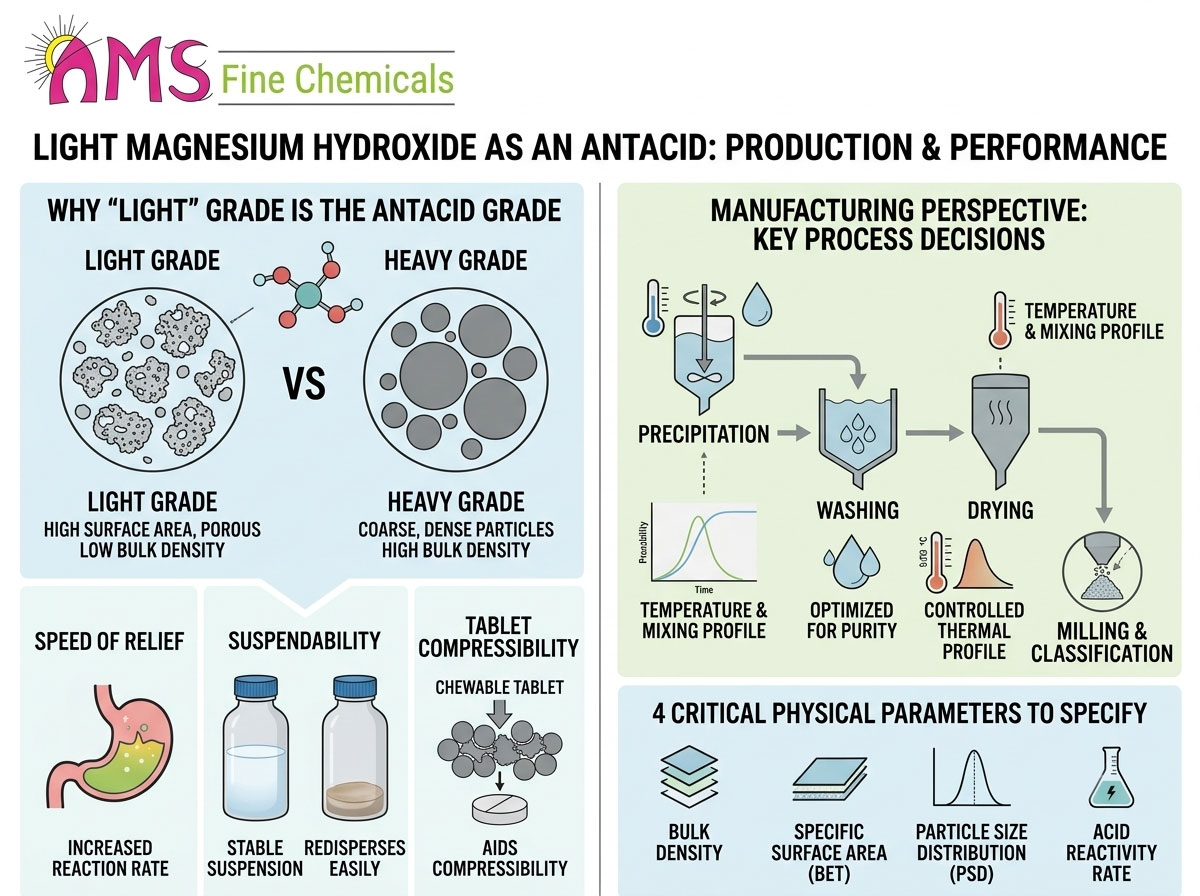
Light grade is the opposite: low bulk density, fine particles, high specific surface area, a fluffy and voluminous powder that occupies far more volume per kilogram. In an antacid, that structure does three things at once.
It accelerates the reaction. Neutralisation of gastric acid is a surface phenomenon. Acid can only attack the solid where solid and liquid meet. Double the available surface area and you materially increase how fast the powder can consume hydrogen ions — which is what a patient experiences as speed of relief.
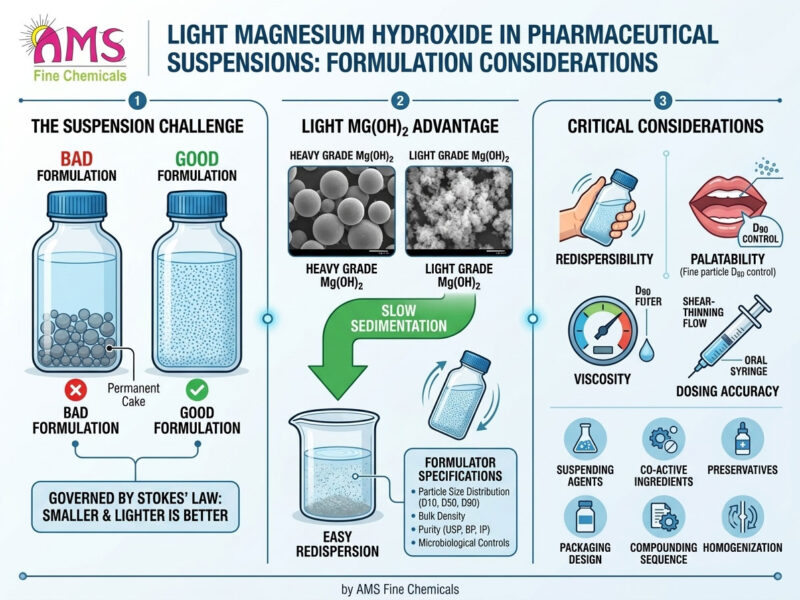
It improves suspendability. Fine, low-density particles resist gravitational settling far better than coarse dense ones. That single property is the difference between a suspension that redisperses with a shake and one that forms a hard cake no amount of shaking will recover.
It aids compressibility in solid dosage forms. Porous, irregular particles interlock under compression in a way smooth dense particles do not, which matters in chewable tablet formulations where you are already fighting a high API load.
This is the same structure-function logic that governs Light Magnesium Carbonate as a functional excipient. In both cases, the grade name refers to bulk density, and bulk density is a proxy for the particle architecture that actually drives performance.
The practical takeaway: specifying “magnesium hydroxide IP” without specifying the grade leaves the most important variable undefined.
The neutralisation chemistry, briefly
The reaction is simple:
Mg(OH)₂ + 2HCl → MgCl₂ + 2H₂O
One mole of magnesium hydroxide consumes two moles of hydrochloric acid. On a mass basis, the theoretical acid neutralising capacity is roughly 34.3 mEq per gram — among the highest of any common antacid base, and substantially better per gram than calcium carbonate or aluminium hydroxide.
The more interesting property is what magnesium hydroxide does not do. Because it is only sparingly soluble in water, it cannot dump alkalinity all at once. It dissolves only as acid is consumed, holding the system in a self-limiting band and stopping well short of the pH overshoot that a strongly soluble base would produce. That behaviour is why it neutralises stomach acid without driving the stomach alkaline, and why acid rebound is less of a concern than with some alternatives.
We have covered the underlying equilibrium in more depth in our article on magnesium hydroxide neutralization capacity, and the same self-limiting mechanism is what makes the compound useful in industrial pH control.
The point for this article is narrower. That 34.3 mEq/g figure is theoretical capacity — the total alkalinity available if the reaction runs to completion. It is set by chemistry and is the same for every grade.
What differs between grades, and between suppliers, is reactivity rate: how much of that capacity is delivered within a clinically meaningful window. A material may possess full theoretical capacity and still perform poorly because it releases that capacity too slowly. Manufacturing controls the rate. It does not control the total.
That distinction is the single most useful thing a buyer can understand about this ingredient.
How Light Magnesium Hydroxide is actually made
There are several industrial routes to Mg(OH)₂. For pharmaceutical grades the dominant approach is wet precipitation, and the reason is control: a precipitation reactor lets you engineer particle characteristics that a mined or calcined route cannot reliably deliver.
Our detailed process walkthrough is available in our complete guide to the magnesium hydroxide manufacturing process. Here we focus specifically on the decision points that affect antacid suitability.
Step 1 — Raw material selection
Precipitation begins with a soluble magnesium source, typically a magnesium salt solution, reacted with an alkali. The purity of both streams sets a ceiling on the purity of everything downstream.
This is unglamorous but decisive. Calcium, iron, heavy metals and chloride carried in with the raw materials do not disappear during precipitation — they are either co-precipitated into the crystal lattice, adsorbed onto particle surfaces, or trapped in mother liquor within the filter cake. Removing them later is difficult and expensive. Preventing them from entering is cheap.
Any manufacturer serious about pharmaceutical grades controls incoming raw material specifications as tightly as finished goods.
Step 2 — Precipitation, and the variables that matter
This is where the product is really made. The powder’s entire physical identity is established in the reactor, and four parameters govern it.
Reaction temperature. Higher temperatures promote crystal growth and yield larger, more crystalline, denser particles with lower surface area. Lower temperatures favour rapid nucleation over growth, producing finer, more numerous, more amorphous particles with higher surface area. Light grade sits toward the low-temperature end of that spectrum.
Reagent addition rate and supersaturation. Fast addition drives high supersaturation, which triggers a burst of nucleation and a fine particle population. Slow, controlled addition keeps supersaturation low, allowing existing crystals to grow rather than new ones to form. Controlling supersaturation is effectively controlling particle size distribution.
Agitation and mixing profile. Poor mixing creates local concentration gradients — pockets of high supersaturation and pockets of low. The result is a broad, inconsistent particle size distribution and reactivity that varies unpredictably within a single batch. Reactor design and impeller configuration are not incidental details here.
pH trajectory and endpoint. The pH path during precipitation influences crystal habit — the characteristic shape particles adopt. Plate-like, needle-like and equant crystal habits differ substantially in how they pack, how they flow, how they settle in suspension and how much surface they expose to acid.
Two producers running the same overall stoichiometry with different settings on these four variables will deliver chemically identical, functionally different products. This is the core reason a formulator cannot safely treat magnesium hydroxide as a commodity and substitute one source for another without revalidation.
Step 3 — Washing
The precipitated slurry carries mother liquor containing soluble by-product salts. Washing removes them.
Under-washing leaves residual soluble chlorides and sulfates, which will fail pharmacopoeial limits and can cause taste problems and stability issues in the finished dosage form. Over-washing wastes water and can begin to affect particle integrity. The number of wash stages, water quality and countercurrent design all get engineered, and for pharmaceutical grades the wash water specification itself becomes a controlled parameter.
Step 4 — Filtration and dewatering
Magnesium hydroxide filter cakes are notoriously difficult to dewater, precisely because the fine, high-surface-area particles that make light grade useful also hold water tenaciously. Filtration equipment selection and cake handling directly affect the energy cost of drying and, indirectly, how much thermal stress the product experiences.
Step 5 — Drying
This step is easy to get wrong.
Excessive drying temperature begins to convert magnesium hydroxide to magnesium oxide through dehydroxylation. Even partial conversion is a problem: it lowers assay, raises loss on ignition in unexpected ways, and introduces a more aggressive, faster-dissolving species that changes the neutralisation profile. MgO also behaves differently on the tongue, which matters in chewable products.
Drying can also cause hard agglomeration, where fine particles fuse into clusters that mill poorly and reduce effective surface area. The porous structure you carefully created in the reactor can be partially destroyed in the dryer.
Controlled, moderate-temperature drying with attention to residence time is what preserves the material you made.
Step 6 — Milling and classification
Final particle size distribution is set here. For antacid applications, the objective is a narrow, consistent distribution with a D₅₀ appropriate to the dosage form — finer for suspensions where sedimentation resistance dominates, somewhat coarser where mouthfeel and grittiness in chewables become the limiting factor.
Over-milling is a real failure mode. It generates excessive fines that harm flow properties, create dusting problems in the customer’s plant, and can cause content uniformity issues during blending.
The four physical parameters buyers should specify
If you take nothing else from this article, take these four. They are the parameters that determine antacid performance and the ones most often missing from a purchase specification.
1. Bulk density
The defining characteristic of light grade and the single best quick indicator that you have received the right material. Specify both loose and tapped bulk density, with a defined range rather than a maximum. A supplier who can hold bulk density within a tight band across batches is demonstrating genuine process control, because bulk density is downstream of everything that happens in the reactor.
2. Specific surface area (BET)
The most direct predictor of neutralisation rate. Higher surface area means more solid-liquid interface and faster acid consumption. If your product claims rapid onset of relief, this is the number underwriting that claim.
Many pharmacopoeial monographs do not require BET surface area. That does not make it unimportant — it makes it your responsibility to specify. The same principle applies across our magnesium range, as discussed in how surface area influences Light Magnesium Carbonate performance.
3. Particle size distribution
Specify D₁₀, D₅₀ and D₉₀, not just a mean. Two materials with identical D₅₀ can have completely different distributions — one narrow and predictable, one broad with a coarse tail that produces grittiness and a fine tail that produces dust.
For suspensions, the fine end governs sedimentation behaviour. For chewables, the coarse end governs mouthfeel. Both matter.
4. Acid reactivity rate
Distinct from acid neutralising capacity, and far more informative. A rate test measures how quickly the material consumes acid under defined conditions — typically by monitoring pH or titrating over a set interval.
Two materials at 98% assay can differ by a wide margin in how fast they get to work. If speed of onset matters to your product, put a reactivity specification in your purchase agreement. Suppliers who cannot meet it will tell you so, which is itself useful information.
Impurity control and pharmacopoeial compliance
Pharmaceutical use imposes a purity discipline that industrial grades do not. The parameters that require active manufacturing control:
Assay. Typically not less than 95.0% and not more than 100.5% as Mg(OH)₂ on a dried basis, depending on the monograph. Both ends of the range matter — high assay can indicate MgO formation from over-drying.
Calcium oxide. Calcium is the most common co-precipitated contaminant, arriving from raw materials. It reduces effective magnesium content and can cause gritty texture.
Heavy metals — lead, arsenic, cadmium, mercury. Controlled at parts-per-million levels and increasingly governed by elemental impurity frameworks such as ICH Q3D rather than the older wet colourimetric limit tests. A modern supplier should be producing ICP-OES or ICP-MS data, not just passing a legacy limit test.
Soluble salts — chloride and sulfate. A direct measure of washing adequacy.
Acid-insoluble matter. Indicates silicaceous or other insoluble contamination from raw materials or equipment wear.
Loss on ignition. Reflects both moisture and bound hydroxyl content, and reads across to drying control.
Carbonate content. Magnesium hydroxide slowly absorbs atmospheric CO₂ to form basic magnesium carbonate on the particle surface. Excess carbonate alters reactivity and can generate carbon dioxide on contact with acid — meaningful in a chewable tablet, where evolved gas affects the eating experience.
Microbial limits. Required for pharmaceutical grades, with total aerobic count, yeast and mould count, and absence of specified pathogens.
Material intended for antacid use should be manufactured to the relevant monograph — IP, BP, EP or USP as your market requires — and the supplier should be able to state which, and supply batch data against it rather than typical values.
What this means for each dosage form
Oral suspensions
The classic milk of magnesia format, and the one where light grade is least substitutable. Sedimentation rate, redispersibility, viscosity behaviour and mouthfeel all trace back to particle size distribution and bulk density.
We have written separately on the formulation side of this in Light Magnesium Hydroxide in pharmaceutical suspensions, which covers suspending agent selection and stability considerations in detail.
The manufacturing-side summary: a caking problem in a finished suspension is frequently an API particle problem wearing a formulation disguise. Before reformulating the suspending system, check whether your API’s particle size distribution has drifted.
Chewable tablets
Here the constraints pull against each other. You need high API loading, acceptable compressibility, and a texture that does not feel like chalk. Particle size that is too coarse produces grittiness. Too fine produces poor flow and content uniformity problems. Light grade’s porous particles help with compaction, but the distribution has to be right.
Powder sachets and effervescent formats
Flow properties, bulk volume and moisture sensitivity dominate. Low bulk density is a mixed blessing — it improves dispersion but increases the sachet volume required for a given dose.
Combination antacid products
Magnesium hydroxide is frequently formulated alongside other actives, most commonly aluminium hydroxide and magnesium trisilicate. The pairing logic is complementary kinetics: magnesium hydroxide reacts fast, while trisilicate acts more slowly and provides a gel-forming protective layer. Combining them gives both rapid onset and sustained duration.
That complementary behaviour is explored further in our article on magnesium trisilicate in pharmaceutical formulations, and you can browse everything we have published on the compound in our Magnesium Trisilicate category.
Sourcing both actives from a single qualified manufacturer simplifies vendor management, audit burden and documentation considerably.
Batch-to-batch consistency: the specification you cannot write
Every parameter above can be written into a purchase specification. Consistency cannot — at least not directly. Yet it is what pharmaceutical customers care about most, because a validated process depends on the inputs behaving the same way every time.
Consistency comes from process discipline: controlled raw materials, instrumented reactors with logged temperature and pH trajectories, defined agitation profiles, validated drying parameters, and analytical testing on every batch rather than periodic sampling.
What a buyer can do is test for it indirectly. Ask for retained COA data across the last twelve to twenty-four batches and look at the spread, not the mean. A supplier whose assay always reads exactly 98.5% is probably reporting a typical value rather than a measured one. A supplier showing a tight but genuinely varying distribution across real batches is showing you a controlled process.
This kind of evaluation applies across the magnesium compound range. Our guide on how to evaluate a supplier for bulk procurement sets out a fuller qualification framework, most of which transfers directly to hydroxide grades.
Packaging, storage and shelf life
Two environmental factors degrade magnesium hydroxide in storage.
Carbon dioxide. Surface carbonation proceeds slowly but continuously on exposure to air, progressively altering reactivity. Packaging must provide a genuine barrier — multi-layer bags with an inner liner, properly sealed.
Moisture. High-surface-area light grade is hygroscopic in practice. Absorbed moisture promotes agglomeration, which reduces effective surface area and therefore reactivity. It also compromises flow properties in the customer’s plant.
Practical guidance: store in a cool, dry area, keep bags sealed, use opened bags promptly, and rotate stock on a first-in-first-out basis. For pharmaceutical use, re-test material approaching its retest date rather than relying on the original COA.
Why AMS Fine Chemicals
AMS Fine Chemicals has manufactured magnesium compounds since 2009 from our production complex in Bhavnagar, Gujarat, India, supplying Light Magnesium Hydroxide and a full range of magnesium products to pharmaceutical, nutraceutical, cosmetic and industrial customers across North America, Europe, the Middle East and Southeast Asia.
What we bring to antacid applications specifically:
Grade engineering rather than grade selection. We adjust precipitation conditions to target the bulk density, surface area and particle size distribution your dosage form needs, rather than offering a single grade and asking you to work around it.
Analytical depth. In-house testing covering assay, trace metals at ppm level, particle size distribution, bulk density and loss on ignition, with batch-specific certificates of analysis rather than typical-value sheets.
Full magnesium range from one source. Magnesium Hydroxide in light and heavy grades, Magnesium Trisilicate, and Light Magnesium Carbonate — which simplifies qualification for combination products.
Export logistics. Proximity to Pipavav and Mundra ports, with both full-container and LCL shipments to suit trial quantities and commercial volumes.
You can review the sectors we supply on our Industries We Serve page, or browse our full technical library in the Light Magnesium Hydroxide and Magnesium Hydroxide blog categories.
Frequently asked questions
Is light magnesium hydroxide chemically different from heavy grade? No. Both are Mg(OH)₂. The difference is physical — bulk density, particle size and specific surface area — and those physical differences change reaction rate, suspension stability and compressibility significantly.
Why does light grade react faster if both grades have the same neutralising capacity? Total capacity is fixed by stoichiometry. Rate is governed by available surface area. Light grade exposes far more surface per gram, so it delivers its capacity faster.
Can I substitute one supplier’s light grade for another’s without revalidation? It is not advisable. Two light grades can differ meaningfully in particle size distribution and surface area while meeting the same monograph. Treat a source change as a formulation change and run comparative reactivity and stability testing.
Which pharmacopoeial standard should I specify? Whichever governs your target market — IP for India, BP or EP for Europe and much of the Commonwealth, USP for the United States. Confirm your supplier manufactures and tests against that specific monograph.
Why is carbonate content on the specification? Magnesium hydroxide absorbs atmospheric CO₂ over time, forming surface carbonate that changes reactivity and can generate CO₂ on contact with acid — noticeable in chewable formats.
Can I get trial quantities before committing to bulk? Yes. We supply sample and trial quantities for formulation development and pilot batches. Contact us through our contact page or write to info@amsfine.com.
In closing
The useful mental shift for anyone specifying this ingredient is this: magnesium hydroxide’s chemistry is settled and identical everywhere, but its performance is manufactured. Precipitation temperature, supersaturation, agitation, wash efficiency and drying control together determine whether a given batch neutralises quickly and suspends cleanly, or merely satisfies an assay figure.
That is why the specification you write matters more than the monograph you cite, and why a supplier’s ability to hold physical parameters steady across batches is worth more than a marginally better price per kilogram.
If you are developing or reformulating an antacid product and want to discuss grade requirements, request a technical data sheet, or arrange trial material, we would be glad to help.
AMS Fine Chemicals Manufacturer and exporter of magnesium compounds since 2009 Survey No. 439, Near Modern Salt, Village Avania, Taluka Ghogha, District Bhavnagar, Gujarat, India 📧 info@amsfine.com | 📞 +91 70433 38890 | 🌐 www.amsfine.com