Magnesium Hydroxide (Mg(OH)₂) is a highly valued inorganic compound with critical functional roles across multiple global sectors. Known commonly in dilute pharmaceutical suspensions as “Milk of Magnesia,” it also serves as an indispensable, eco-friendly flame retardant in polymers, a powerful neutralizing agent in industrial wastewater treatment, and an essential additive in marine scrubbers.
As an industry-leading manufacturer, exporter, and supplier, AMS Fine Chemicals delivers high-purity Magnesium Hydroxide tailored to stringent global standards. In this comprehensive technical guide, we break down the chemistry, raw materials, industrial manufacturing pathways, quality control measures, and core industrial applications involved in producing premium-grade magnesium hydroxide.
1. Introduction to Magnesium Hydroxide
Magnesium hydroxide occurs naturally as the mineral brucite. However, natural brucite deposits frequently carry significant structural defects and heavy metal impurities (such as iron, manganese, and excess calcium). For advanced applications in pharmaceuticals, food processing, and specialized polymer compounding, synthetic manufacturing pathways are required to achieve reliable, high-purity crystalline profiles.
Chemical Properties & Structure
Magnesium hydroxide is a white, odorless crystalline powder with a hexagonal crystal structure similar to cadmium iodide. It exhibits unique chemical properties that dictate its industrial handling:
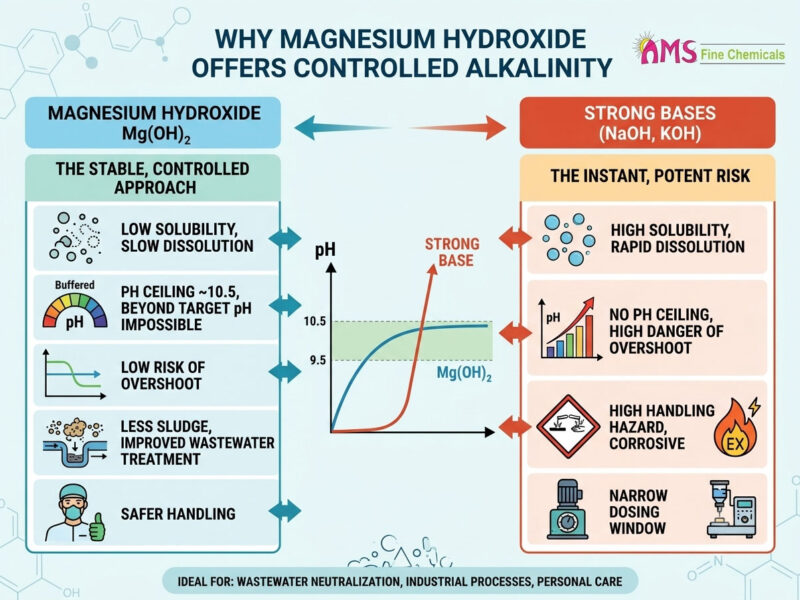
- Low Water Solubility: It is practically insoluble in water (Ksp ≈ 5.61 × 10⁻¹²), which allows it to function as a safe, non-corrosive, slow-releasing base.
- Thermal Decomposition: At temperatures above 330°C, it undergoes an endothermic decomposition, breaking down into magnesium oxide and water vapor. This specific temperature threshold is what makes it an elite flame retardant for plastics.
2. Primary Raw Materials and Sourcing Channels
The choice of raw materials directly influences the physical morphology, particle size distribution, and overall purity matrix of the finished Mg(OH)₂. At AMS Fine Chemicals, we process raw streams through three primary industrial matrices:
Magnesium-Bearing Inputs
- Magnesium Chloride Brine / Sea Bittern: Highly concentrated MgCl₂ streams sourced from marine salt works. This is a highly sustainable, ion-rich source ideal for direct precipitation.
- Dolomite (CaMg(CO₃)₂): A abundant double carbonate mineral that must be calcined to isolate the magnesium component from calcium.
- Magnesium Sulfate (MgSO₄): Often derived from industrial mineral processing, utilized in specialized high-purity chemical reactions.
Precipitating and Alkaline Agents
- Sodium Hydroxide (Caustic Soda, NaOH): Used for rapid, high-purity direct precipitation where precise particle size control is required.
- Ammonia Gas / Ammonium Hydroxide (NH₄OH): Favored in high-purity loops because the byproduct (ammonium chloride) is highly soluble and easily washed away or recycled.
- Lime / Hydrated Lime (Ca(OH)₂): A cost-effective precipitant utilized primarily for high-volume industrial and technical-grade production.
3. Industrial Manufacturing Pathways: Step-by-Step
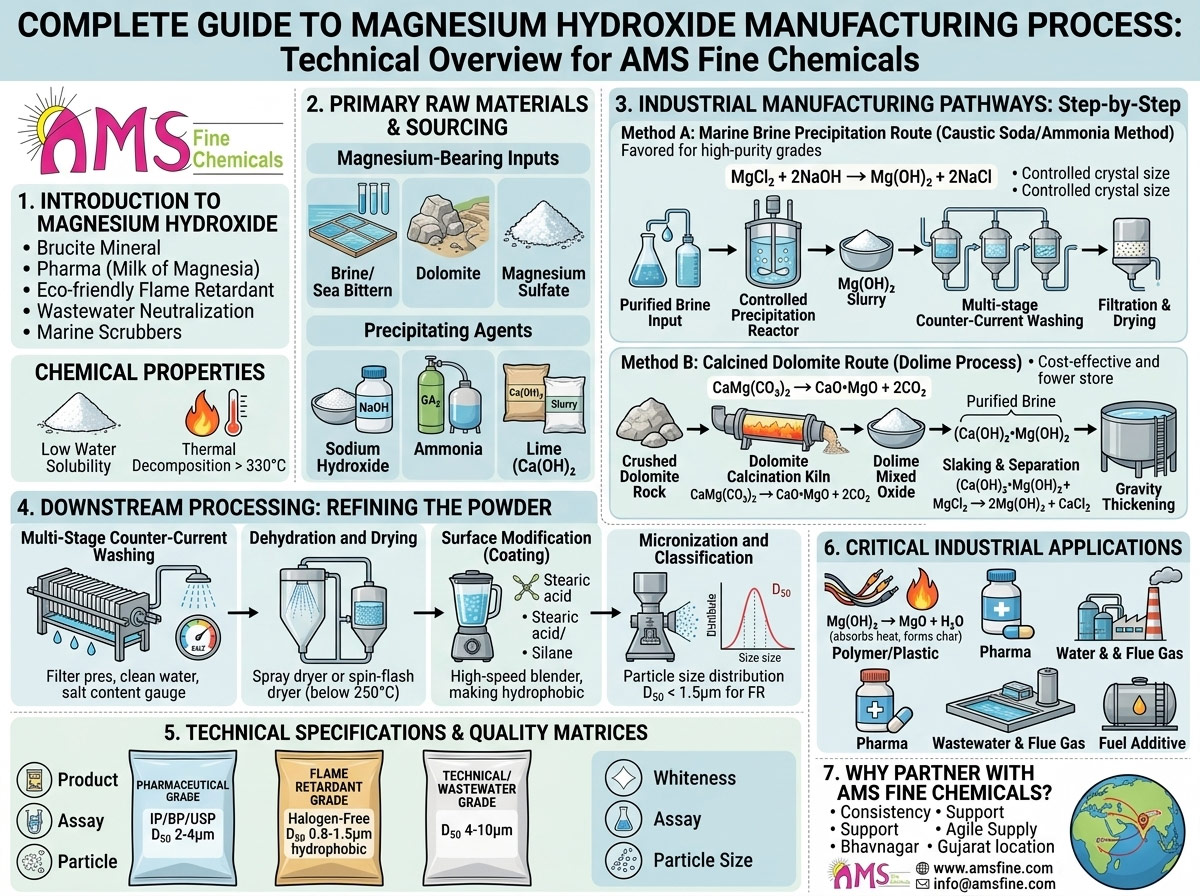
There are two predominant commercial methods for manufacturing synthetic magnesium hydroxide: The Marine Brine Precipitation Route and The Calcined Dolomite Route.
Method A: The Marine Brine Precipitation Route (Caustic Soda/Ammonia Method)
This method is highly favored by AMS Fine Chemicals for producing ultra-pure pharmaceutical, food, and flame-retardant grades, as it permits meticulous control over the crystalline shape and ionic purity.
[Purified MgCl2 Brine] + [Sodium Hydroxide Solution]
                         │
                         ▼
             [React in Agitated Vessel]
                         │
                         ▼
        [Precipitation of Mg(OH)2 Slurry]
                         │
                         ▼
     [Multi-Stage Counter-Current Washing]
                         │
                         ▼
     [Filtration ➔ Drying ➔ Jet Micronization]
Step 1: Brine Purification and Filtration
Raw marine bittern or magnesium chloride brine is collected and treated with oxidizing agents to precipitate out trace iron, manganese, and heavy metal impurities. The brine is then passed through micro-filtration units to ensure a perfectly clear, contaminant-free ionic solution.
Step 2: Controlled Precipitation Reaction
The purified magnesium chloride solution is fed into a continuous stirred-tank reactor (CSTR) or a high-shear batch reactor. Concurrently, a precise stoichiometric stream of Sodium Hydroxide (NaOH) or Ammonium Hydroxide is introduced under automated temperature and pH monitoring:
MgCl₂ + 2NaOH → Mg(OH)₂↓ + 2NaCl
To engineer specific particle shapes (such as plate-like or needle-like crystals), parameters like agitation speed, temperature (typically maintained between 60°C and 90°C), and reactant feeding rates are tightly regulated.
Step 3: Nucleation and Aging (Digestion)
The precipitated slurry is transferred to aging tanks where it is held at elevated temperatures for several hours. This “digestion” phase allows smaller, irregular crystals to redissolve and recrystallize into larger, more stable, well-defined hexagonal plates. Proper crystal aging is vital for reducing oil absorption profiles in flame-retardant applications.
Method B: The Calcined Dolomite Route (Dolime Process)
This chemical route is highly efficient for generating heavy industrial, technical, and environmental grades of magnesium hydroxide by leveraging abundant dolomite rock.
Step 1: Dolomite Calcination
Crude dolomite rock is crushed and thermally calcined in vertical or rotary kilns at temperatures ranging from 950°C–1100°C. This drives off carbon dioxide, converting the minerals into a mixed oxide compound known as dolime:
CaMg(CO3)2 ➔ CaO·MgO + 2CO2↑
Step 2: Slaking and Separation
The dolime is mixed with hot water to convert the oxides into their respective hydroxides, yielding a heavy slurry of Ca(OH)₂ and Mg(OH)₂. To separate the magnesium from the calcium, the slaked slurry is reacted with a purified magnesium chloride brine. The dissolved MgCl₂ reacts selectively with the calcium hydroxide, converting it into highly soluble calcium chloride (CaCl₂) while precipitating out pure magnesium hydroxide:
(Ca(OH)₂ · Mg(OH)₂) + MgCl₂ → 2Mg(OH)₂↓ + CaCl₂
Step 3: Gravity Thickening
The resulting suspension is sent to large gravity thickeners where the heavy magnesium hydroxide settles to the bottom as a concentrated sludge, while the liquid calcium chloride overflow is drawn off for secondary industrial applications.
4. Downstream Processing: Refining the Powder
Once the magnesium hydroxide slurry is formed via either synthesis route, it must undergo extensive downstream modification to turn it into a high-performance commercial powder.
Multi-Stage Counter-Current Washing
The slurry contains soluble reaction byproducts like Sodium Chloride (NaCl) or Calcium Chloride (CaCl₂). It is passed through a series of counter-current washing decanters or automated plate-and-frame filter presses. The filter cake is repeatedly washed with demineralized water until the electrical conductivity of the filtrate reaches near-zero levels, confirming the complete removal of trace salts.
Dehydration and Drying
The washed filter cake is sent to advanced industrial dryers.
- For technical and flame-retardant grades, Spray Dryers or Spin-Flash Dryers are deployed to instantly atomize the slurry into fine particles, preventing hard agglomeration.
- The drying profile is kept below 250°C to ensure the material remains well below its thermal decomposition point, preventing any accidental conversion into magnesium oxide.
Surface Modification (Coating)
For application in the plastics and cable industries, magnesium hydroxide must be compatible with hydrophobic polymers (like PP, PE, or EVA). In this step, the dried powder is treated in high-speed blenders with surface modifiers like stearic acid, silane coupling agents, or fatty acids. This organic coating shifts the material from hydrophilic to hydrophobic, improving dispersion and mechanical binding when mixed into plastics.
Micronization and Classification
Finally, the powder is processed through air-jet mills or pin mills to achieve a highly uniform particle size distribution (PSD). For flame retardants, the median particle size (D₅₀) is typically engineered down to 0.8–1.5 µm, while technical grades may range from 2.0–5.0 µm.
5. Technical Specifications & Quality Matrices
At AMS Fine Chemicals, our advanced analytical laboratories test every batch of Magnesium Hydroxide to ensure flawless compliance with domestic and international industrial standards:
| Parameter Evaluated | Pharmaceutical Grade (IP/BP/USP) | Flame Retardant Grade | Technical / Wastewater Grade |
| Physical Appearance | Ultra-White, Odorless Powder | Pure White Free-Flowing Powder | Fine Off-White Powder |
| Assay [as Mg(OH)₂] | 95.0%–100.5% | ≥ 98.5% | 92.0%–95.0% |
| Whiteness Index | ≥ 98% | ≥ 96% | ≥ 90% |
| Median Particle Size (D₅₀) | 2.0–4.0 µm | 0.8–1.5 µm | 4.0–10.0 µm |
| Loss on Drying (LOD) | ≤ 2.0% | ≤ 0.3% | ≤ 1.5% |
| Loss on Ignition (LOI) | 30.0%–32.5% | 30.5%–32.0% | 28.0%–31.5% |
| Calcium Content (Ca) | ≤ 0.5% | ≤ 0.1% | ≤ 1.5% |
| Heavy Metals (as Pb) | ≤ 10 ppm | ≤ 5 ppm | ≤ 30 ppm |
6. Critical Industrial Applications
Plastics and Polymer Flame Retardants
Magnesium Hydroxide is a premier halogen-free flame retardant (HFFR) used heavily in wire and cable insulation, automotive interiors, and electronic housings. When a polymer heats up, Mg(OH)₂ absorbs massive amounts of heat energy (1.3 kJ/g) to decompose:
Mg(OH)₂ —(Δ > 330°C)→ MgO + H₂O
The released water vapor dilutes combustible gases, while the resulting magnesium oxide (MgO) layer forms a robust, non-combustible char barrier on the plastic surface that blocks oxygen and puts out the flame.
Pharmaceuticals & Daily Antacids
In medical chemistry, pharma-grade magnesium hydroxide is formulated into liquid antacid suspensions and chewable tablets. It acts as an efficient gastric neutralizer and an effective osmotic laxative. It is also used as a safe magnesium source in prenatal vitamins and mineral supplements.
Wastewater and Flue Gas Remediation
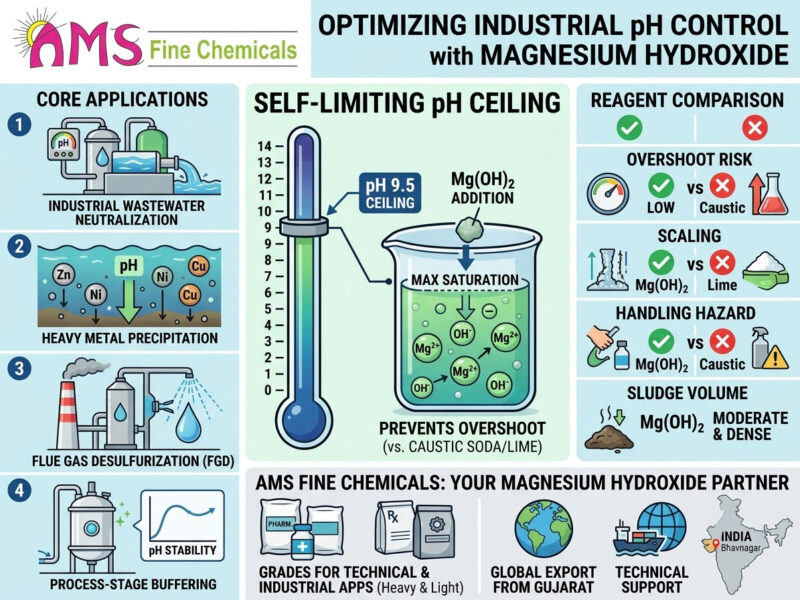
Unlike caustic soda (NaOH) or lime (Ca(OH)₂), magnesium hydroxide is a buffered base with a maximum self-limiting pH of around 9.5. In industrial wastewater treatment, it safely neutralizes acidic effluents without risking dangerous pH spikes that can harm biological treatment systems. It also acts as an effective heavy metal precipitant and is used as a scrubbing agent in marine vessels and coal plants to eliminate toxic sulfur dioxide (SO₂) emissions.
Fuel Oil Additive
In heavy industrial boilers and gas turbines running on residual fuel oils, magnesium hydroxide is added to the fuel stream. It reacts with corrosive vanadium and sulfur contaminants during combustion, raising the melting point of the ash to prevent high-temperature corrosion on turbine blades and boiler tubes.
7. Why Partner with AMS Fine Chemicals?
Sourcing premium inorganic chemicals requires uncompromised batch consistency, transparent technical support, and an agile supply chain.
AMS Fine Chemicals, headquartered in Bhavnagar, Gujarat, is a trusted manufacturer and global exporter of high-purity Magnesium Hydroxide. Operating state-of-the-art chemical synthesis infrastructure, we customize physical particle dimensions, oil absorption capacities, and surface coatings to perfectly match your specific formulation requirements.
Our Core Capabilities:
- Advanced cleanroom manufacturing for food and pharmaceutical-grade supplies.
- Precision air-jet milling setups capable of delivering sub-micron particle distributions.
- Strategic proximity to major Indian transport networks and marine shipping ports (including Pipavav and Mundra), ensuring streamlined global delivery.
- Comprehensive batch traceability backed by independent Certificates of Analysis (COA) and complete MSDS documentation.
8. Frequently Asked Questions (FAQs)
Q1: Why is magnesium hydroxide preferred over aluminum trihydrate (ATH) in some plastics?
While both are eco-friendly flame retardants, Aluminum Trihydrate (ATH) begins to decompose at 200°C. Magnesium Hydroxide is thermally stable up to 330°C, allowing it to be safely processed in high-temperature polymers like polypropylene (PP), nylon (PA), and engineering plastics without breaking down prematurely during extrusion.
Q2: What does the “Loss on Ignition” (LOI) value indicate?
The LOI value for pure magnesium hydroxide sits between 30% and 32.5%. This represents the exact percentage of chemically bound water weight that is driven off as vapor when the compound is heated to high temperatures—a critical metric for verifying product purity and flame-retardant capacity.
Q3: Can AMS Fine Chemicals provide surface-treated magnesium hydroxide?
Yes, we provide custom surface treatment options using stearic acid, silane coupling agents, or customized fatty acids to ensure smooth blending into various polymer and elastomer matrices.
Get in Touch for Bulk Requirements
Are you seeking a reliable manufacturing partner for high-purity Magnesium Hydroxide? Let the engineering team at AMS Fine Chemicals optimize your industrial chemical supply chain.
- Company Name: AMS Fine Chemicals
- Official Web Portal: www.amsfine.com
- Corporate Email Address: info@amsfine.com
Contact our technical sales department today to request samples, regulatory documentation, or a customized quote for your manufacturing needs.