Walk down the antacid aisle of any pharmacy and you’ll find dozens of brands promising relief from heartburn, acidity, and indigestion. Behind many of these formulations sits a quiet workhorse ingredient that rarely gets the spotlight: Magnesium Trisilicate. Unlike fast-acting antacids that neutralize stomach acid in seconds and fade just as quickly, Magnesium Trisilicate has earned its place in pharmaceutical formulation for a very different reason — it acts slowly, steadily, and for longer.
For formulators, regulatory teams, and procurement managers sourcing raw materials, understanding why Magnesium Trisilicate behaves the way it does — and where it fits best in a formulation — matters just as much as knowing that it works. This article looks closely at the chemistry, physicochemical properties, and real-world pharmaceutical applications of Magnesium Trisilicate, and what to look for when selecting a pharmaceutical-grade supplier.
What Is Magnesium Trisilicate?
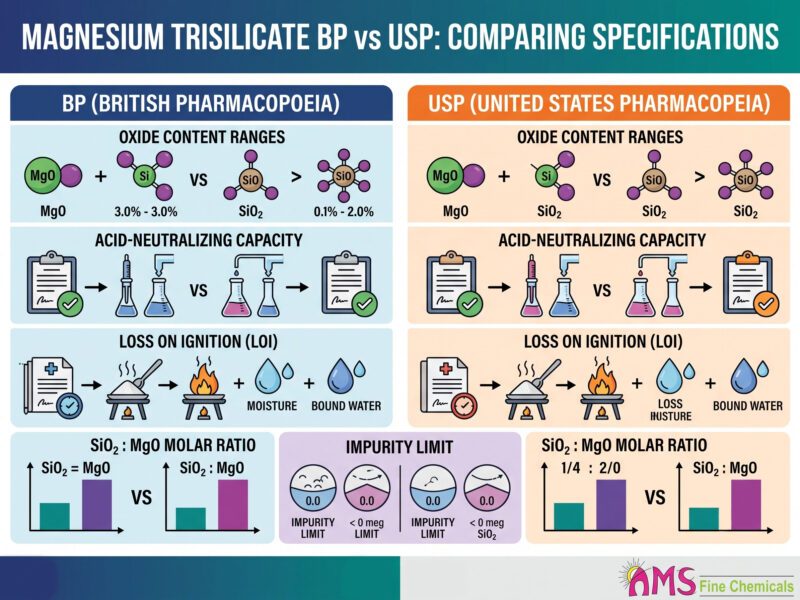
Magnesium Trisilicate is an inorganic compound with the approximate formula 2MgO·3SiO₂·nH₂O (CAS No. 14987-04-3). It is not a single, precisely defined molecule in the way a small-molecule API is; rather, it is a hydrated magnesium silicate complex whose exact magnesium oxide-to-silica ratio and water content can vary depending on the manufacturing process. Pharmacopoeial monographs (USP, BP, and EP) define acceptable ranges for MgO and SiO₂ content specifically to keep this variability within limits that ensure consistent pharmaceutical performance.
Physically, it presents as a fine, white, odorless, and tasteless powder, free from grit when properly processed. It is practically insoluble in water and alcohol, which is precisely what allows it to function inside the gastrointestinal tract without being absorbed into systemic circulation. This combination — chemical inertness in most conditions, but reactivity specifically toward acid — is what makes Magnesium Trisilicate pharmaceutically interesting.
If you’re evaluating raw material specifications, it helps to look at the compound in the same category as its close relatives — Magnesium Hydroxide and Magnesium Carbonate — since all three are alkaline magnesium compounds used in antacid and excipient roles, but each brings a distinct reaction profile to a formulation.
The Chemistry Behind Its Antacid Action
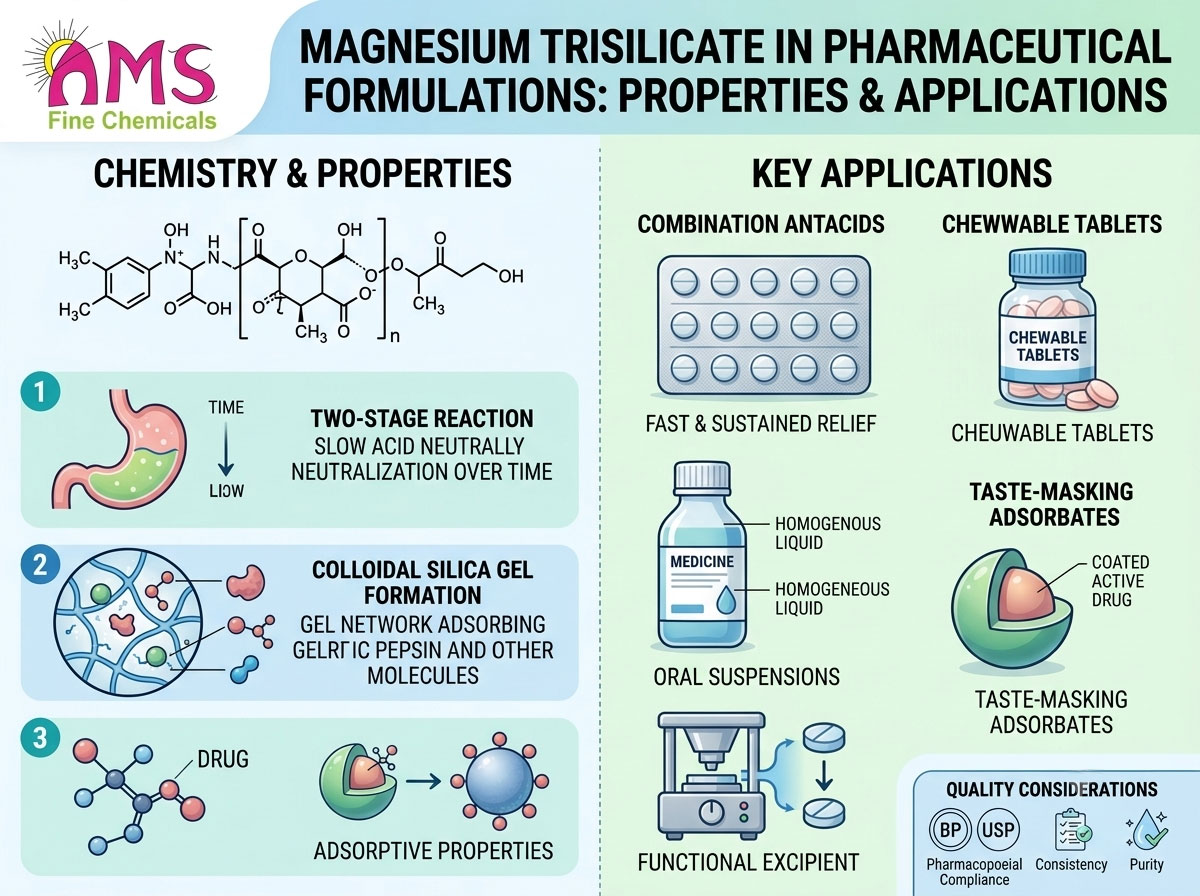
The therapeutic logic of Magnesium Trisilicate is built around a two-stage acid-neutralizing mechanism. When the compound reaches the stomach, hydrochloric acid reacts with it to form magnesium chloride and colloidal silicon dioxide (silica gel). Unlike Magnesium Hydroxide, which reacts with acid almost immediately and produces a sharp, short-lived neutralization spike, Magnesium Trisilicate reacts far more gradually.
This slower reactivity has been documented as one of the compound’s defining pharmacological characteristics: it neutralizes gastric acid effectively over time, though the reaction is generally too slow for it to work well as a fast, standalone, non-prescription antacid on its own. In practical formulation terms, this means Magnesium Trisilicate is rarely used alone as a rapid-relief antacid — it is far more commonly blended with faster-acting alkalis such as Magnesium Hydroxide or Aluminium Hydroxide to combine an immediate neutralizing effect with a sustained one.
The colloidal silica generated during the reaction has a secondary benefit that formulators value: it possesses adsorptive properties that allow it to bind pepsin and other irritants, and some formulations rely on this to provide a soothing, coating effect on the esophageal and gastric mucosa alongside acid neutralization.
For a deeper technical breakdown of how magnesium-based alkalis interact with gastric acid — including neutralizing capacity calculations that formulators use to design combination antacids — see our related post on Magnesium Hydroxide Neutralization Capacity: Understanding the Chemistry.
Physicochemical Properties That Matter in Formulation
Choosing the right Magnesium Trisilicate grade is rarely just about the acid-neutralizing capacity number on a Certificate of Analysis. Several physical parameters directly determine how the material behaves once it’s inside a tablet press, a suspension tank, or a powder blender.
Particle Size and Surface Area
Particle size distribution controls the rate at which the material reacts with acid, how well it disperses in a liquid suspension, and how it flows during tablet compression. A finer particle size generally increases surface area and reaction rate, but it can also complicate powder flow and increase the risk of capping or lamination during tableting if not managed with the right glidants and lubricants.
Higher surface area grades — sometimes exceeding several hundred square meters per gram — have also been used specifically as adsorbents in medicament adsorbate technology, where a flake-like, highly porous magnesium trisilicate structure is used to adsorb bitter-tasting drug actives, masking unpleasant flavor in chewable tablets and liquid suspensions while keeping the drug bioavailable once it reaches stomach acid. This is a specialized but well-documented pharmaceutical use case that goes beyond simple antacid action.
The same underlying principle — that surface area governs functional performance — shows up across the magnesium compound family. We’ve covered this in detail for a related excipient in How Surface Area Influences Light Magnesium Carbonate Performance, and the logic largely holds for Magnesium Trisilicate as well: a higher surface area means more reactive sites, faster adsorption, and different bulk density behavior on the production line.
Bulk Density and Flow Properties
Bulk and tapped density affect how much material fits into a given tablet die or capsule shell, and how consistently it feeds through hoppers and blenders. Low bulk density grades tend to be bulkier per unit weight — useful for anti-caking and dusting applications — while denser grades are often preferred where formulators want to minimize tablet or sachet volume without compromising acid-neutralizing capacity.
Moisture Content
Because Magnesium Trisilicate is a hydrated compound, its water content (commonly expressed as loss on drying) is tightly specified in pharmacopoeial monographs. Excess moisture can affect tablet hardness, promote microbial growth in finished formulations, and cause caking during storage — a concern shared across most alkaline magnesium excipients, whether in tablets or in bulk powder form ahead of packing.
pH and Alkalinity
Even though Magnesium Trisilicate is far less alkaline in aqueous suspension than Magnesium Hydroxide, its pH profile still needs to be controlled and reproducible from batch to batch, particularly in combination antacid products where the total alkalinity of the formulation is calculated precisely to match label claims.
How Magnesium Trisilicate Is Manufactured
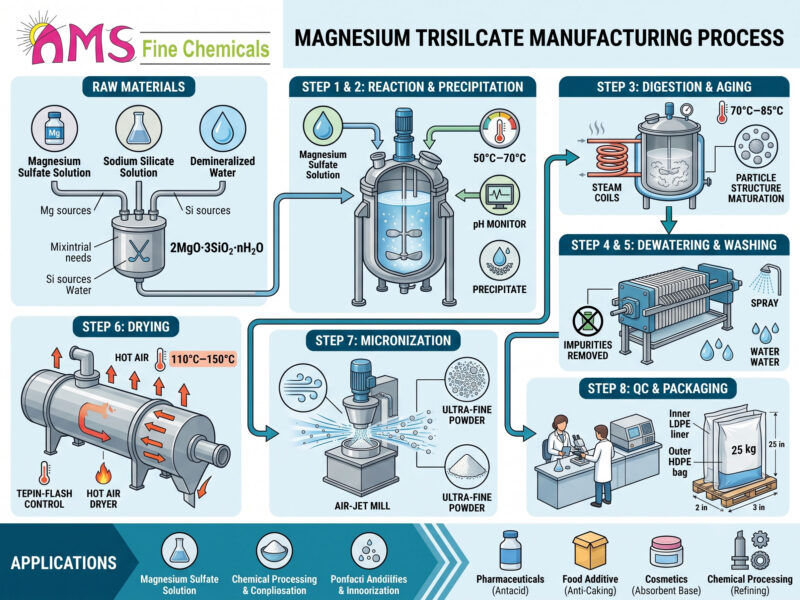
Commercial Magnesium Trisilicate is typically produced by reacting a soluble magnesium salt with a soluble silicate under controlled pH and temperature conditions, followed by filtration, washing, drying, and milling to the target particle size. The precise conditions during precipitation — reaction temperature, addition rate, aging time, and pH endpoint — determine the resulting particle morphology, whether the material forms a dense, globular structure or a lighter, flake-like, high-surface-area structure.
This is why two suppliers’ “Magnesium Trisilicate” can behave quite differently in a formulation even when both meet the same pharmacopoeial assay limits. A material with a compact, low-surface-area structure will react more slowly and pack more densely, while a flake-like, high-surface-area material will adsorb faster and behave very differently in a fluid bed or tablet press. Understanding this manufacturing-to-performance link is one reason experienced formulators request particle size distribution and surface area data alongside the standard Certificate of Analysis, rather than relying on assay percentage alone.
Drying and milling stages also determine the final moisture content and particle size distribution, both of which cascade into how the powder flows, compresses, and disperses downstream — the same manufacturing variables that influence bulk density and reactivity in related magnesium compounds, as we’ve discussed for particle size control in Magnesium Carbonate Particle Size Distribution and Its Impact on Formulation.
Magnesium Trisilicate vs. Other Alkaline Excipients
Formulators rarely choose Magnesium Trisilicate in isolation — it’s usually evaluated alongside Magnesium Hydroxide, Magnesium Carbonate, and Aluminium Hydroxide when designing an antacid or GI-protectant product. A quick comparison of how these compounds typically behave:
| Property | Magnesium Trisilicate | Magnesium Hydroxide | Magnesium Carbonate |
|---|---|---|---|
| Onset of acid neutralization | Slow, sustained | Fast, immediate | Moderate |
| Duration of action | Extended | Shorter, unless buffered | Moderate |
| Adsorbent/taste-masking use | Strong (high surface area grades) | Limited | Moderate |
| Typical dosage forms | Chewable tablets, suspensions, powders | Suspensions (“Milk of Magnesia”), tablets | Tablets, powders, effervescent formats |
| Laxative tendency at high dose | Mild | Pronounced | Mild to moderate |
This is precisely why combination antacid products so often pair Magnesium Trisilicate with a faster-acting alkali: the fast component addresses the immediate burning sensation, while Magnesium Trisilicate extends relief over a longer window without adding disproportionately to the total alkaline load. Readers evaluating Magnesium Carbonate as an alternative or complementary excipient may also find it useful to review how its solubility and acid reactivity compare, covered in Magnesium Carbonate Solubility and Acid Reactivity Explained.
Frequently Asked Questions
Is Magnesium Trisilicate the same as Magnesium Hydroxide? No. Although both are alkaline magnesium compounds used in antacid formulations, Magnesium Trisilicate (2MgO·3SiO₂·nH₂O) reacts much more slowly with gastric acid than Magnesium Hydroxide, and it additionally functions as an adsorbent due to its silica content — a property Magnesium Hydroxide does not share to the same degree.
Why is Magnesium Trisilicate rarely used alone as an antacid? Its acid-neutralizing reaction is too gradual to provide the fast symptomatic relief patients expect from a standalone antacid, which is why it is almost always formulated in combination with a faster-acting alkali.
What grades of Magnesium Trisilicate are available for pharmaceutical use? Grades are typically differentiated by particle size, surface area, and purity level, with Food/FCC, food supplement, and cosmetic grades commonly available depending on the intended application and regulatory market.
Does Magnesium Trisilicate cause the same laxative effect as Magnesium Hydroxide? Generally, its laxative effect is milder, though excessive or prolonged use of any magnesium-based antacid can loosen stool due to the osmotic effect of unabsorbed magnesium salts in the intestine.
Applications in Pharmaceutical Formulations
1. Antacid Tablets and Chewables
This remains the flagship pharmaceutical application. Magnesium Trisilicate is formulated into chewable and compressed antacid tablets, frequently alongside Magnesium Hydroxide, Aluminium Hydroxide, or Calcium Carbonate, to deliver both quick symptomatic relief and extended acid control. Its bland taste and smooth mouthfeel also make it a preferred choice in chewable formats where palatability directly affects patient compliance.
2. Oral Antacid Suspensions
In liquid antacid suspensions, Magnesium Trisilicate contributes sustained-release neutralizing action while also acting as a suspending and texturizing agent that helps keep the formulation homogeneous between doses. Formulators working with liquid magnesium-based antacids face very similar suspension-stability, sedimentation, and viscosity challenges regardless of which magnesium salt anchors the formula — we’ve explored these formulation considerations in depth in Light Magnesium Hydroxide in Pharmaceutical Suspensions: Formulation Considerations, and many of the same principles around particle wetting, redispersibility, and preservative compatibility apply when Magnesium Trisilicate is the active alkaline component.
3. Adsorbent for Taste Masking and GI Protection
Beyond acid neutralization, Magnesium Trisilicate’s porous, flake-like structure gives it genuine adsorbent capability. Pharmaceutical technologists have used high-surface-area grades to prepare “medicament adsorbates” — complexes where a bitter or irritating drug is adsorbed onto the magnesium trisilicate particle, masking taste in the mouth while still releasing the active ingredient once the adsorbate reaches gastric acid. It is also used, in some formulations, to adsorb excess gas and irritants in the gastrointestinal tract, contributing a mild protective, coating-like effect alongside its primary antacid role.
4. Tableting and Solid-Dosage Excipient
Because of its fine particle size, low reactivity outside acidic conditions, and compressibility, Magnesium Trisilicate is sometimes used as a functional excipient — a diluent, glidant aid, or anti-adherent — in solid-dosage formulations beyond antacids. This overlaps considerably with how other alkaline magnesium powders are used as functional excipients across the industry; our post on Light Magnesium Carbonate as a Functional Excipient: What Manufacturers Should Know covers the excipient-selection logic that applies broadly across this family of compounds, and our review of Light Magnesium Carbonate in Pharmaceutical Powder Formulations is a useful companion read for teams formulating powders, sachets, or effervescent products where flow and anti-caking behavior are equally important.
5. Anti-Caking and Free-Flow Aid in Powdered Products
In powdered pharmaceutical and nutraceutical products — sachets, effervescent granules, and oral powders — Magnesium Trisilicate’s fine, non-hygroscopic texture helps prevent particle agglomeration, keeping the powder free-flowing during both manufacturing and end use. This functional role mirrors the anti-caking applications more commonly associated with light magnesium carbonate grades in food and pharmaceutical powders.
6. Cosmetic and Personal Care Adjacent Uses
While outside the strict definition of a pharmaceutical formulation, Magnesium Trisilicate’s fine texture and moisture-absorbing character also make it useful in dusting powders and topical formulations that sit at the intersection of pharma and personal care, particularly where a smooth, non-gritty absorbent powder base is required.
Regulatory and Quality Considerations
Pharmaceutical-grade Magnesium Trisilicate must meet pharmacopoeial specifications (USP/NF, BP, EP, or IP depending on the target market), which typically define acceptable limits for:
- MgO and SiO₂ content ratio — ensuring the acid-neutralizing capacity stays within a validated range
- Loss on drying / water content — controlling hydration state and preventing caking
- Heavy metals and arsenic limits — critical given the material’s route of administration
- Acid-neutralizing capacity (ANC) — measured against pharmacopoeial reference methods
- Particle size distribution — to guarantee reproducible dissolution and reaction behavior
- Microbial limits — since the material is used in oral dosage forms
Because Magnesium Trisilicate’s identity and performance depend heavily on how it was manufactured — precipitation conditions, drying method, and milling — sourcing from a manufacturer with in-house physico-chemical and microbiology testing capability, rather than relying solely on third-party certificates, gives formulators far more confidence in batch-to-batch reproducibility. This is particularly important for combination antacid products, where even small shifts in neutralizing capacity from one raw material lot to the next can affect whether a finished batch meets its label claim.
Grade Selection: Matching the Material to the Formulation
Not every application calls for the same grade of Magnesium Trisilicate. A chewable antacid tablet formulator prioritizing mouthfeel and compressibility has very different requirements from a manufacturer preparing a bulk powder for a taste-masking adsorbate application, where surface area and porosity take precedence. The broader question of how to match a magnesium compound’s grade to a specific end-use is one we address in more general terms in How to Select the Right Magnesium Carbonate Grade for Your Application — many of the same evaluation criteria (particle size, bulk density, reactivity, and intended dosage form) apply directly when selecting between food/FCC, food supplement, and cosmetic grades of Magnesium Trisilicate as well.
Working closely with your raw material supplier during formulation development — rather than treating the excipient as an interchangeable commodity — typically shortens the path to a stable, reproducible finished product, especially when scaling from lab batches to commercial production.
Handling, Storage, and Shelf Life
Like other hydrated magnesium compounds, Magnesium Trisilicate should be stored in tightly closed containers in a cool, dry area away from humidity, since moisture uptake can affect both its physical handling properties and its long-term stability. Under proper storage conditions, pharmaceutical-grade material typically carries a shelf life of around five years from the date of manufacture. Once a container is opened, using the material promptly or resealing it carefully helps preserve its flow properties and prevents unwanted caking before it reaches the formulation line.
Why Sourcing Quality Magnesium Trisilicate Matters
Because Magnesium Trisilicate’s performance in a formulation is so closely tied to its physical characteristics — not just its chemical purity — small variations in manufacturing process can translate into real differences in acid-neutralizing capacity, adsorption behavior, and tableting performance. This makes supplier selection a formulation decision, not just a procurement one.
At AMS Fine Chemicals, Magnesium Trisilicate is manufactured with a focus on batch-to-batch consistency across acid-neutralizing capacity, particle size distribution, and adsorption efficacy — the same parameters formulators rely on to keep finished antacid, adsorbent, and excipient products performing predictably. Every batch is tested in-house through NABL-accredited physico-chemical and microbiology laboratories, and the material is available across Food/FCC, food supplement, and cosmetic grades to match different formulation needs.
With a manufacturing base in Bhavnagar, Gujarat, and direct access to Mundra and Pipavav ports, AMS Fine Chemicals supports both domestic pharmaceutical manufacturers and international buyers with standard 25 kg HDPE bag packing as well as customized bulk and jumbo bag options for larger production runs.
Common Formulation Challenges and How They’re Addressed
Even experienced formulation teams run into a handful of recurring issues when working with Magnesium Trisilicate, and most trace back to the same root causes discussed above:
- Inconsistent acid-neutralizing capacity between batches is usually a sign of variable MgO:SiO₂ ratio or hydration state from lot to lot. The fix lies upstream, at the supplier’s process control, not in the finished formulation — which is why requesting a full Certificate of Analysis with ANC data for every batch is standard practice for serious pharmaceutical buyers.
- Poor tablet hardness or friability often points to particle size or moisture content that’s out of the expected range for the compression equipment being used. Adjusting binder levels or requesting a narrower particle size specification from the supplier typically resolves this faster than reformulating from scratch.
- Sedimentation or caking in suspension products can usually be traced to particle size distribution and surface charge interactions with the suspending agent, echoing the same considerations formulators face with other magnesium-based suspensions.
- Grittiness in chewable tablets is a direct particle size and milling issue, and is one of the easier problems to solve simply by specifying a finer, well-milled grade at the sourcing stage.
None of these are unusual or difficult to manage — but they underline why raw material specification sheets deserve as much scrutiny as the formulation itself.
Conclusion
Magnesium Trisilicate occupies a distinctive niche in pharmaceutical formulation — not as the fastest antacid on the shelf, but as a dependable, slow-and-steady neutralizer with genuine adsorptive versatility. From chewable antacid tablets and oral suspensions to taste-masking adsorbates and anti-caking powder applications, its value comes from a combination of chemical mildness and physical adaptability that few other excipients match.
For formulators, the real work lies in matching the right grade — particle size, surface area, and reactivity profile — to the specific dosage form and function required. And for that, working with a manufacturer that understands both the chemistry and the formulation context makes all the difference.
Explore our full range of magnesium-based pharmaceutical excipients on the AMS Fine Chemicals product page, or browse more formulation insights on our blog.
For technical specifications, MSDS/SDS, or a customized quotation for Magnesium Trisilicate, get in touch with our team.