Open the excipient section of almost any solid-dosage formulation file and you will find a shortlist of unglamorous materials doing most of the quiet work — flow aids, anti-caking agents, diluents, and pH-modifying fillers that never make it onto the front of the pack but decide whether a tablet presses cleanly or a powder cakes in the jar. Light Magnesium Carbonate belongs squarely in that shortlist. It is not a novel material and it will not headline a marketing claim, but for tablet manufacturers, powder-mix formulators, and nutraceutical producers, it is one of the more dependable multi-functional excipients available — provided the grade, particle characteristics, and supplier quality are right.
This article looks at Light Magnesium Carbonate specifically through the lens of pharmaceutical and nutraceutical manufacturing: what it is, why its physical form matters more than its chemistry alone, where it earns its place in a formulation, and what manufacturers should verify before they commit it to a production batch.
What Light Magnesium Carbonate Actually Is
Light Magnesium Carbonate is a basic magnesium carbonate — chemically related to standard Magnesium Carbonate but produced and processed to yield a much lower bulk density and higher surface area. Both materials share the same underlying chemistry, so it is worth first understanding the parent compound before looking at what makes the “light” grade different. If you want the broader chemical picture, our detailed overview of Magnesium Carbonate covers the base compound and its general industrial uses.
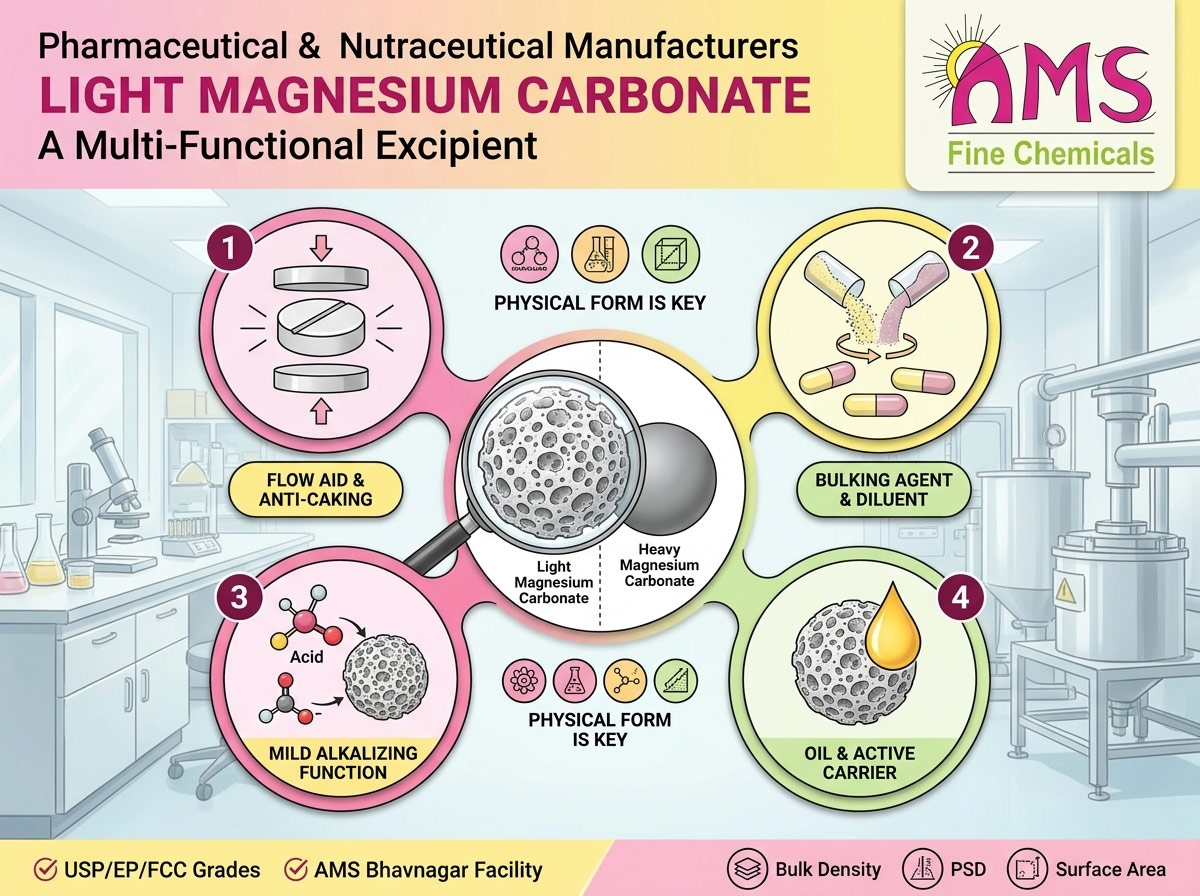
What sets the light grade apart is physical form, not molecular structure. The precipitation and drying conditions used during manufacture control the crystal habit and particle porosity, and this, in turn, determines bulk density. Light Magnesium Carbonate typically has a bulk density in the range of roughly 0.15 to 0.30 g/mL — dramatically lower than heavy or standard grades — along with a high specific surface area and an open, porous particle structure. That porosity is precisely what makes it valuable as an excipient: it is what gives the powder its absorbent capacity, its free-flow behavior, and its ability to carry oils and moisture without clumping.
For manufacturers comparing grades, it helps to look at Ultra Light, Light, and Heavy variants side by side rather than assuming “magnesium carbonate” is a single interchangeable input. AMS Fine Chemicals produces the full spectrum — Ultra Light Magnesium Carbonate, Light Magnesium Carbonate, and Heavy Magnesium Carbonate — each engineered for a different bulk density and application profile. Choosing the wrong grade rarely causes a chemical failure; it causes a processing failure, which is often harder to diagnose because the certificate of analysis still reads “pass.”
Why Physical Form Matters More Than Purity Alone
It is tempting to treat excipient qualification as primarily a purity exercise — check the assay, check the heavy metals, check the microbial limits, and move on. Purity matters, but for a functional excipient like Light Magnesium Carbonate, physical characteristics drive performance just as much as chemical composition. Two lots that both pass assay specifications can behave very differently on a tablet press or in a powder blend if their particle size distribution, bulk density, or surface area diverge.
This is a theme we’ve covered in more general terms in our post on the factors that determine the quality of industrial-grade Magnesium Carbonate, and it applies just as directly — arguably more so — to the light grade used in pharmaceutical and nutraceutical work. Three physical parameters deserve particular attention:
Bulk and tapped density. Low bulk density is the defining trait of the light grade, but “low” needs a number attached to it. A batch that is lower or higher than the qualified range will change fill weights on volumetric filling equipment and can shift the compression behavior of a tablet formulation, even when the chemical assay is unchanged.
Particle size distribution (PSD). PSD affects flow, blend uniformity, and dissolution behavior. A drift in PSD between lots — even within a nominally acceptable range — can be enough to change how a powder blend segregates during hopper filling or how consistently it compresses.
Surface area and porosity. This is what gives Light Magnesium Carbonate its absorbent capacity — its ability to take up oils, flavor concentrates, or moisture without becoming sticky or lumpy. Surface area is rarely listed on a standard specification sheet, but for oil-absorption applications it is often the single most predictive parameter.
If you want a deeper technical grounding in how these parameters are documented and verified, our article on Magnesium Carbonate COA: understanding the most important quality parameters walks through what a Certificate of Analysis should — and often does not — tell you.
Core Functional Roles in Pharmaceutical and Nutraceutical Formulations
1. Diluent and Bulking Agent
In low-dose tablet and capsule formulations, where the active ingredient may make up only a few milligrams of a much larger total fill weight, a diluent is needed to bring the dosage form to a workable, handleable size. Light Magnesium Carbonate’s low bulk density makes it useful where formulators need volume without adding significant weight, and its inert, well-characterized chemistry means it rarely interacts unfavorably with common actives.
2. Glidant and Flow-Aid Behavior
Powder flowability is one of the most persistent headaches in solid-dosage manufacturing — inconsistent flow through hoppers and feed frames translates directly into weight variation, capping, and lost batches. The fine, porous particles of Light Magnesium Carbonate can improve the flow characteristics of a powder blend, helping reduce bridging and arching in hoppers. This effect is concentration-dependent and formulation-specific, so it is always worth confirming with a flow test (Carr’s Index or Hausner Ratio) on the actual blend rather than assuming performance from the raw material data alone.
3. Anti-Caking and Moisture Management
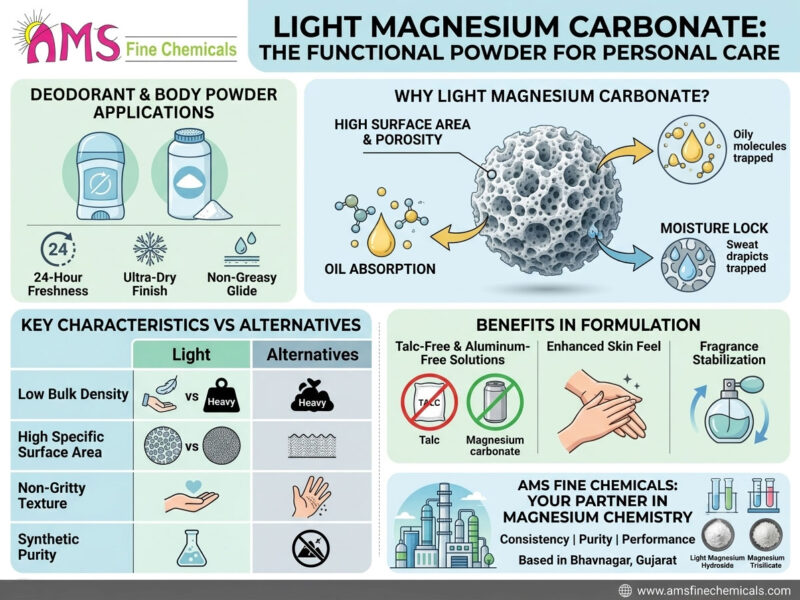
Because of its high surface area, Light Magnesium Carbonate can adsorb a meaningful amount of atmospheric moisture relative to its weight, which sounds counterintuitive for an anti-caking agent until you consider the mechanism: by taking up moisture within its own porous structure, it prevents that moisture from migrating between other particles in the blend and causing them to bridge and cake. This same mechanism is what makes it effective well beyond pharmaceuticals — we’ve written in more depth about how it performs as a moisture-control ingredient in personal care formulations, and the underlying physical chemistry translates directly to powder-based nutraceutical and pharmaceutical products stored in humid climates or tropical distribution markets.
4. Oil and Active Absorption Carrier
For formulations that combine a liquid or semi-solid active — an oil-soluble vitamin, an essential oil, a flavor concentrate — with a dry powder base, Light Magnesium Carbonate’s absorbent capacity allows it to take up a proportionally large quantity of liquid while remaining a dry, free-flowing powder. This makes it a practical carrier or absorption base in effervescent formulations, powder sachets, and certain chewable or dispersible tablet systems. We cover this application in detail in our post on Light Magnesium Carbonate in pharmaceutical powder formulations, which looks specifically at antacid powders, effervescent granules, and related dosage forms.
5. Mild Alkalizing and Antacid Function
Light Magnesium Carbonate reacts with gastric acid to form magnesium chloride, water, and carbon dioxide, giving it a genuine — if usually secondary — antacid function in certain formulations. In products where a mild, buffered alkalizing effect is desirable alongside its physical excipient roles, this dual character is a practical advantage rather than an incidental side effect.
6. Tableting and Compression Support
In direct-compression and wet-granulation processes alike, the flow and density characteristics of Light Magnesium Carbonate can influence tablet weight uniformity, hardness, and disintegration behavior. Because it is relatively soft and non-abrasive, it also tends to be gentle on punches and dies compared with harder, more crystalline mineral fillers — a consideration worth weighing against alternative fillers, which we compare more broadly in Magnesium Carbonate vs. other mineral fillers: key performance considerations.
How Manufacturing Process Shapes Functional Performance
It is worth spending a moment on why Light Magnesium Carbonate behaves so differently from standard or heavy grades, because the explanation is directly useful when troubleshooting a formulation issue. Basic magnesium carbonate is typically produced through a precipitation reaction — reacting a magnesium source with a carbonating agent under controlled temperature and concentration conditions — followed by filtration, washing, drying, and milling. The “light” character of the material comes almost entirely from how the precipitation and drying stages are controlled.
Slower, more dilute precipitation tends to produce smaller, more porous crystal aggregates with a loose, open structure. Drying conditions then lock that structure in place: gentle, well-controlled drying preserves the porosity, while aggressive or poorly controlled drying can collapse pore structure and quietly push bulk density higher than the specification allows, even though the chemical assay looks identical to a compliant lot. This is precisely why two suppliers’ “Light Magnesium Carbonate” can perform differently on the same tablet press despite passing the same assay and heavy-metal limits — the difference lives in process control that a basic COA rarely captures in full.
For manufacturers, the practical implication is simple: a supplier’s process consistency matters as much as their chemistry. Batch-to-batch reproducibility in bulk density, particle size, and surface area is a manufacturing discipline, not a raw-material property that can be assumed from a single qualification batch. This is one of the reasons we recommend reviewing a prospective supplier’s in-house testing capability and production controls before committing to bulk procurement, a topic covered in more depth in our guide on evaluating a Magnesium Carbonate supplier for bulk procurement.
Testing Methods Manufacturers Should Ask About
Beyond the standard pharmacopoeial assay, heavy metals, and microbial limit tests, several additional test methods are particularly relevant to Light Magnesium Carbonate’s functional performance as an excipient, and manufacturers qualifying a new lot or a new supplier should ask whether these are available:
- Bulk and tapped density (USP <616> or equivalent) — the single most direct indicator of whether a lot matches the “light” designation in practice, not just on paper.
- Loss on drying / moisture content — critical given the material’s hygroscopic tendency, and a strong early indicator of storage or transit issues before the material ever reaches the production floor.
- Particle size distribution by laser diffraction or sieve analysis — especially important for direct-compression tableting and for dissolution-sensitive dosage forms.
- Oil absorption value — a practical, often-overlooked test for formulations that rely on the material’s absorbent carrier function, since assay and purity data alone say nothing about absorbency.
- Flow property testing (Carr’s Index, Hausner Ratio, or angle of repose) — run on the actual powder blend rather than the raw excipient alone, since flow behavior is a property of the mixture, not just the individual ingredient.
None of these tests are exotic, but they are also not always run as a matter of routine, particularly by suppliers focused primarily on industrial rather than pharmaceutical customers. Building them into an incoming-goods testing protocol — rather than relying solely on the supplier’s Certificate of Analysis — is a reasonable safeguard for any manufacturer using Light Magnesium Carbonate in a validated pharmaceutical or nutraceutical process.
Frequently Asked Questions
Is Light Magnesium Carbonate the same as Magnesium Carbonate? They share the same basic chemistry, but Light Magnesium Carbonate is manufactured to have a much lower bulk density and higher surface area than standard or heavy grades. The difference is physical, not chemical, and it is this physical difference that determines suitability for excipient use. See our full comparison of grades on the Magnesium Carbonate product page.
What bulk density range should I qualify against? This depends on the formulation and equipment, but Light Magnesium Carbonate typically falls in a low bulk density range compared with standard grades. Always qualify against the specific range confirmed on the technical datasheet for the lot you intend to use, rather than a generic industry figure.
Can Light Magnesium Carbonate replace other alkaline excipients like Magnesium Trisilicate or Magnesium Hydroxide? Not automatically. Each material has a different solubility profile, alkalizing strength, and functional character. Magnesium Trisilicate and Magnesium Hydroxide are worth evaluating alongside Light Magnesium Carbonate during early formulation work rather than assuming interchangeability.
How should I store Light Magnesium Carbonate to protect its functional properties? Cool, dry conditions, in a tightly sealed container, away from humidity and direct sunlight — full handling guidance is provided in the storage section below.
Grade Selection: Matching the Material to the Dosage Form
Not every formulation calls for the same magnesium carbonate grade, and treating “Light Magnesium Carbonate” as a single fixed specification across projects is a common — and avoidable — formulation mistake.
- Ultra Light grades offer even lower bulk density and higher surface area, useful where maximum absorbency or maximum volume-per-gram is the priority, such as certain effervescent or highly porous powder systems. See our Ultra Light Magnesium Carbonate product page for specification ranges.
- Standard Light grades — the subject of this article — offer a balance of flow improvement, moderate absorbency, and bulking function suited to most tablet and powder-fill applications. Full specifications are available on our Light Magnesium Carbonate product page.
- Heavy grades are denser and lower in surface area, better suited to applications where high bulk density and reduced dusting matter more than absorbency — more common in industrial than pharmaceutical contexts, but worth understanding for comparison. Details are on the Heavy Magnesium Carbonate page.
It is also worth remembering that magnesium-based excipients are not limited to the carbonate family. Depending on the desired pH behavior, solubility profile, and function in the formulation, Magnesium Hydroxide, Light Magnesium Hydroxide, or Magnesium Trisilicate may be more appropriate for a given dosage form, particularly where a stronger antacid effect or a different rheology modifier is required. A short conversation with a technical team before finalizing a formulation can save a great deal of rework later — see our full product range for the complete portfolio.
Compatibility Considerations
Light Magnesium Carbonate is chemically stable and broadly compatible with a wide range of active ingredients and excipients, but “broadly compatible” is not the same as “universally compatible,” and manufacturers should not skip compatibility testing on the assumption that an inert-sounding mineral filler cannot interact with an active.
Because it is alkaline, Light Magnesium Carbonate can interact with acid-sensitive or pH-dependent actives, potentially affecting stability or dissolution behavior in formulations where pH control is critical. It can also form complexes with certain classes of active pharmaceutical ingredients — this is well documented for some antibiotic classes, for example, where magnesium ions can reduce bioavailability through chelation. Compatibility studies — typically accelerated stability testing of the API-excipient blend — remain the only reliable way to confirm suitability for a specific formulation. Our article on Magnesium Carbonate compatibility with common industrial ingredients provides a useful starting framework, though pharmaceutical-grade compatibility testing should always be formulation-specific and conducted under your own quality protocols.
Regulatory and Grade Documentation
For pharmaceutical and nutraceutical use, Light Magnesium Carbonate is typically manufactured and supplied against pharmacopoeial monographs — commonly USP/NF and Ph. Eur. (EP) specifications — alongside food-grade and FCC designations for supplement and food-adjacent applications. Manufacturers should confirm, in writing, which monograph a given lot is manufactured and tested against, since specifications for parameters such as loss on drying, heavy metals, arsenic, and assay differ between pharmacopoeias and between grades.
AMS Fine Chemicals produces Light Magnesium Carbonate against a range of grade designations, including Food/FCC, Food Supplement, EP, USP, and pharmaceutical/cosmetic-grade specifications, alongside more specialized grades for latex and rubber applications. Full documentation — including MSDS/SDS, technical datasheets, and Certificates of Analysis — is available on request through our product page or by contacting our technical team directly.
It is also worth building supplier qualification into your sourcing process from the start rather than treating it as an afterthought once a formulation is already locked. Our guide on how to evaluate a Magnesium Carbonate supplier for bulk procurement sets out the practical checkpoints — manufacturing consistency, documentation completeness, testing infrastructure, and supply reliability — that matter most when qualifying a source for pharmaceutical-grade material.
Storage, Handling, and Shelf Life
Because of its high surface area and moisture-adsorbing capacity, Light Magnesium Carbonate is sensitive to storage conditions in a way that denser mineral fillers are not. Left in a partially opened bag in a humid warehouse, it will pick up moisture from the surrounding air — a property that makes it useful as an anti-caking agent in a formulation, but a liability if it happens before the material is even weighed out.
Practical handling guidance for manufacturers includes:
- Store in a cool, dry area away from direct humidity exposure.
- Keep containers tightly sealed once opened; do not leave bags open between uses.
- Avoid storing near sources of moisture ingress, temperature cycling, or direct sunlight.
- Use material within a reasonable window after opening rather than drawing from a partially sealed bag over an extended period.
- Verify loss-on-drying or moisture content on receipt if the material has been in transit or storage for an extended period, particularly for humid-climate shipping routes.
Under proper sealed storage conditions, Light Magnesium Carbonate typically carries a shelf life of around five years, though manufacturers should always confirm the specific shelf-life claim against the Certificate of Analysis and datasheet for the lot in question rather than assuming a blanket figure applies universally.
Practical Checklist Before Committing a Grade to Production
Before finalizing Light Magnesium Carbonate in a formulation and scaling to commercial production, manufacturers should typically confirm:
- Pharmacopoeial grade alignment — USP, EP, FCC, or the specific monograph relevant to the target market and dosage form.
- Bulk and tapped density range, qualified against the specific formulation and equipment (tablet press, filling line, blender).
- Particle size distribution, especially where dissolution or content uniformity is a critical quality attribute.
- Compatibility data with the active ingredient(s) and any other alkaline-sensitive excipients in the formulation.
- Moisture content on receipt, particularly for shipments from humid ports or extended transit times.
- Supplier documentation completeness — COA, MSDS/SDS, and technical datasheet available for every lot, not just on initial qualification.
- Supply consistency and capacity, particularly for manufacturers scaling from pilot batches to full commercial volumes.
Each of these points connects back to the broader theme running through this article: Light Magnesium Carbonate’s value as an excipient comes from a combination of chemistry and physical engineering, and both need to be verified — not assumed — before it goes into a validated formulation.
Final Thoughts
Light Magnesium Carbonate earns its place in pharmaceutical, nutraceutical, and personal care formulations by doing several jobs at once — bulking, flow improvement, moisture management, and mild alkalizing function — without demanding a complicated handling regime or an unusual supply chain. Its main formulation risk is not toxicity or reactivity; it is variability in physical form between lots and suppliers, which is why manufacturers should treat particle characteristics, not just chemical assay, as core specification parameters.
For manufacturers evaluating or re-qualifying a Light Magnesium Carbonate source, AMS Fine Chemicals manufactures the full range of magnesium carbonate and magnesium hydroxide grades — from Ultra Light to Heavy — at our Bhavnagar, Gujarat facility, tested in-house through an NABL-accredited testing framework. You can review full technical specifications on our Light Magnesium Carbonate product page, browse our complete product range, or get in touch with our technical team for a Certificate of Analysis, MSDS, or a formulation-specific consultation.