Magnesium Hydroxide (Mg(OH)₂) is widely recognized as a controlled, efficient, and versatile alkaline material for applications where acid neutralization, pH adjustment, and process stability are important. From industrial wastewater treatment and flue gas treatment to chemical processing, pulp and paper, pharmaceuticals, and specialty formulations, the ability of Magnesium Hydroxide to neutralize acids is one of its most important functional properties.
However, simply knowing that Magnesium Hydroxide is an alkaline compound is not enough for industrial formulation or process design. Engineers and formulators need to understand neutralization capacity, stoichiometry, solubility, reaction kinetics, particle size, surface area, pH behavior, and dosing requirements.
This guide explains the chemistry behind Magnesium Hydroxide neutralization capacity, how theoretical and practical neutralization capacities differ, how to calculate acid requirements, and why the physical characteristics of Magnesium Hydroxide can significantly influence real-world performance.
For industries evaluating different grades and applications, AMS Fine Chemicals supplies Magnesium Hydroxide for industrial and specialty applications. You can explore the company’s Magnesium Hydroxide product range for more information.
What Is Magnesium Hydroxide?
Magnesium Hydroxide is an inorganic compound with the chemical formula:
Mg(OH)₂
It consists of one magnesium ion, Mg²⁺, and two hydroxide ions, OH⁻.
Magnesium Hydroxide occurs naturally as the mineral brucite, although industrial products can also be manufactured through controlled precipitation and other processes. It is generally encountered as a white powder or, in certain applications, as an aqueous slurry.
One of its most important characteristics is its low solubility in water. Unlike highly soluble strong alkalis such as sodium hydroxide, Magnesium Hydroxide does not rapidly dissolve and release a very large concentration of hydroxide ions.
This difference is central to understanding its neutralization behavior.
The AMS Fine Chemicals Magnesium Hydroxide product page describes Magnesium Hydroxide as a fine white powder or aqueous slurry with alkaline properties and low water solubility. The company supplies different grades for applications including wastewater treatment, flame retardants, paper, food, agriculture, and other industrial uses.
What Does “Neutralization Capacity” Mean?
Neutralization capacity refers to the amount of acid that a material can chemically neutralize.
In simple terms:
Neutralization capacity tells us how much acidity can be consumed by a given quantity of alkaline material.
For Magnesium Hydroxide, the basic neutralization reaction can be represented as:
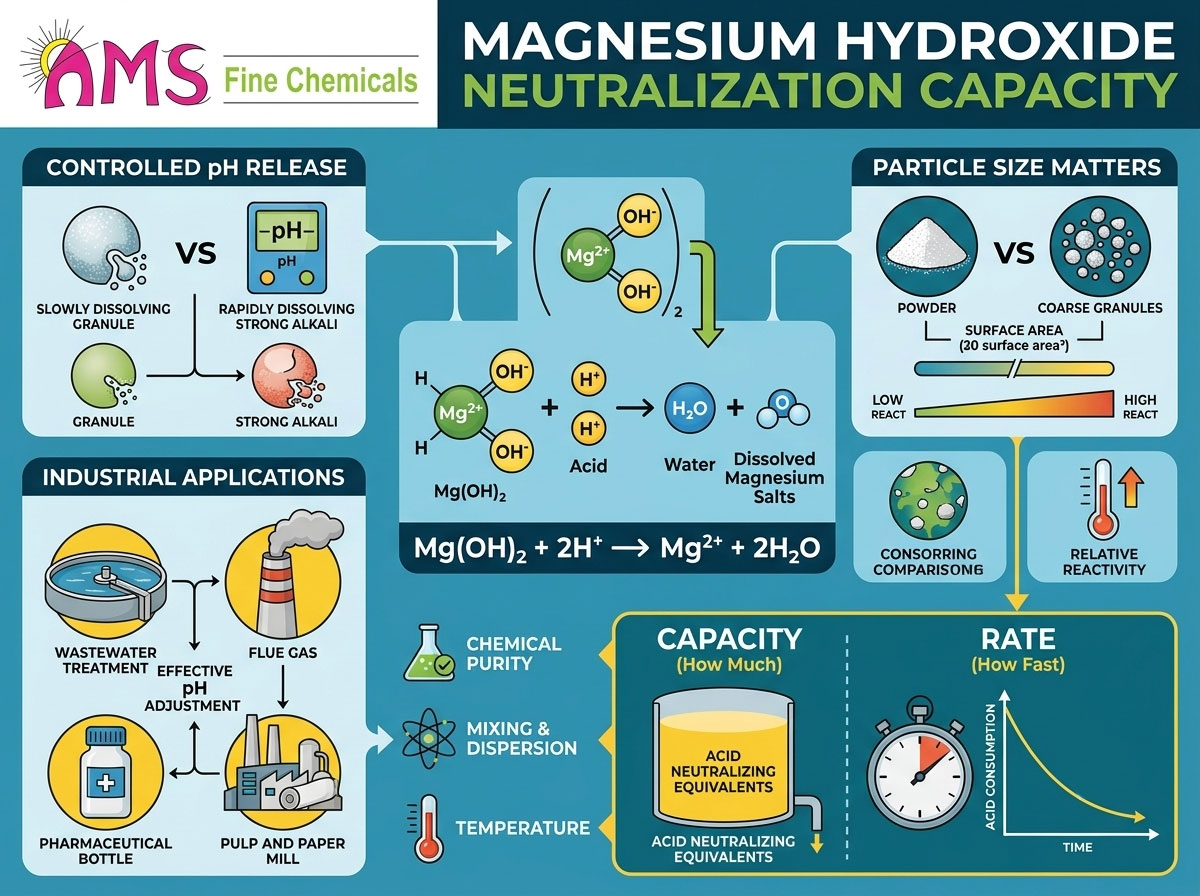
Mg(OH)₂ + 2H⁺ → Mg²⁺ + 2H₂O
This equation provides the foundation for calculating the theoretical acid-neutralizing capacity of Magnesium Hydroxide.
Each mole of Magnesium Hydroxide contains two hydroxide groups. Therefore, one mole of Mg(OH)₂ can theoretically neutralize two moles of hydrogen ions (H⁺).
This is why the chemical equivalent weight of Magnesium Hydroxide is important when calculating dosing requirements.
The Molecular Chemistry Behind Magnesium Hydroxide Neutralization
The molecular weight of Magnesium Hydroxide is approximately:
Mg(OH)₂ = 58.32 g/mol
The reaction with a strong acid such as hydrochloric acid can be written as:
Mg(OH)₂ + 2HCl → MgCl₂ + 2H₂O
The stoichiometry shows that:
- 1 mole Mg(OH)₂ reacts with
- 2 moles HCl.
Therefore:
58.32 g Mg(OH)₂ → 2 moles HCl
Since one mole of HCl corresponds to approximately 36.46 g:
58.32 g Mg(OH)₂ can theoretically neutralize approximately 72.92 g HCl.
On a mass basis:
1 kg Mg(OH)₂ can theoretically neutralize approximately 1.25 kg HCl, assuming pure material and complete reaction.
This is a theoretical stoichiometric calculation. Actual industrial dosing can differ because neutralization is affected by purity, particle size, dispersion, temperature, acid concentration, mixing, residence time, and other process variables.
Theoretical Neutralization Capacity of Magnesium Hydroxide
Another useful way of expressing neutralization capacity is through acid-neutralizing equivalents.
Because one mole of Mg(OH)₂ provides two equivalents of basic neutralizing capacity:
Equivalent weight = Molecular weight / Number of equivalents
Therefore:
58.32 / 2 = 29.16 g/equivalent
This means approximately 29.16 g of pure Mg(OH)₂ represents one equivalent of neutralizing capacity.
For industrial comparison, acid-neutralizing capacity is frequently expressed in terms of calcium carbonate equivalent (CaCO₃ equivalent).
The equivalent weight of CaCO₃ is approximately:
100.09 / 2 = 50.05 g/equivalent
Therefore, theoretically:
50.05 / 29.16 ≈ 1.72
So, on a purely stoichiometric basis:
1 kg of pure Magnesium Hydroxide has a theoretical neutralization capacity of approximately 1.72 kg as CaCO₃ equivalent.
This number is useful for comparing alkaline materials, but it should not automatically be interpreted as the actual field dosage.
Why?
Because chemical capacity and reaction availability are not always the same thing.
Neutralization Capacity vs. Neutralization Rate
One of the most important concepts in Magnesium Hydroxide chemistry is the difference between capacity and rate.
Neutralization Capacity
Capacity describes the total amount of acid that the Magnesium Hydroxide can theoretically neutralize.
Neutralization Rate
Rate describes how quickly that neutralization occurs under specific operating conditions.
A material may have excellent theoretical neutralization capacity but react relatively slowly if its dissolution or surface reaction is limited.
This distinction is particularly important for industrial wastewater treatment.
Magnesium Hydroxide has low water solubility. When acid is present, however, the dissolved Mg(OH)₂ is continuously consumed by the neutralization reaction. This encourages additional material to dissolve.
The simplified sequence is:
Solid Mg(OH)₂ → Dissolved Mg²⁺ + OH⁻ → Acid neutralization → Mg²⁺ remains in solution
Because dissolution is coupled with acid consumption, Magnesium Hydroxide can provide a controlled release of alkalinity.
This characteristic is one of the reasons it behaves differently from highly soluble strong bases.
AMS Fine Chemicals discusses this controlled neutralization behavior in its detailed article on Magnesium Hydroxide for Industrial Wastewater Treatment, Heavy Metal Precipitation and pH Neutralization.
Why Magnesium Hydroxide Does Not Behave Like Caustic Soda
Sodium hydroxide (NaOH) is highly soluble in water.
When added to an aqueous system, it can rapidly increase the concentration of hydroxide ions. This makes NaOH extremely effective when rapid pH adjustment is required, but it also means that overdosing can cause a rapid increase in pH.
Magnesium Hydroxide behaves differently.
Because its solubility is comparatively low, its alkalinity is released more gradually.
This creates several practical advantages:
- Controlled alkalinity release
- Lower risk of extreme pH overshoot
- Better suitability for continuous pH control
- Reduced handling concerns compared with highly caustic materials
- Potentially more stable neutralization in variable wastewater streams
- Useful buffering behavior around its effective operating range
The important point is that Magnesium Hydroxide should not be evaluated solely on the basis of how quickly it changes pH.
For industrial processes, the desired objective may be controlled acid neutralization rather than the fastest possible pH increase.
Why pH and Neutralization Capacity Are Not the Same
A common misunderstanding is:
“If a material has a high neutralization capacity, it must produce a very high pH.”
This is not necessarily true.
Neutralization capacity measures how much acid can ultimately be consumed.
pH measures the activity of hydrogen ions in the solution at a particular moment.
These are different parameters.
For example, a material can possess substantial total acid-neutralizing capacity while maintaining a relatively controlled equilibrium pH because its solubility limits the concentration of hydroxide available in solution.
This is an important reason Magnesium Hydroxide can be attractive for wastewater applications.
AMS Fine Chemicals notes that Magnesium Hydroxide can be used for pH neutralization and heavy-metal precipitation in industrial wastewater treatment.
Factors That Influence Practical Magnesium Hydroxide Neutralization Capacity
The theoretical value assumes pure Magnesium Hydroxide and complete reaction.
Industrial conditions are more complicated.
Several factors can influence actual neutralization performance.
1. Chemical Purity
The first consideration is Mg(OH)₂ content.
If a product contains 95% active Magnesium Hydroxide, the theoretical capacity based on pure Mg(OH)₂ must be adjusted accordingly.
For example:
If theoretical capacity = approximately 1.72 kg CaCO₃ equivalent/kg pure Mg(OH)₂
then for a 95% active product:
1.72 × 0.95 = approximately 1.63 kg CaCO₃ equivalent/kg product
Actual results can still vary because of reaction efficiency.
Therefore, industrial buyers should evaluate the assay or Mg(OH)₂ content, not simply the product name.
2. Particle Size
Particle size can have a major influence on reaction behavior.
Smaller particles generally provide a greater surface area per unit mass.
Higher surface area can improve contact between the solid Magnesium Hydroxide and acidic water.
This can influence:
- Dissolution behavior
- Reaction rate
- Dispersion
- Slurry stability
- Mixing efficiency
- Process response time
However, smaller particle size is not automatically better for every application.
Very fine powders can introduce handling, dust, feeding, and slurry-management considerations.
The correct particle-size distribution should therefore be selected according to the process.
For applications requiring enhanced dispersion and fine particle characteristics, AMS Fine Chemicals offers Light Magnesium Hydroxide.
3. Surface Area
Surface area is closely related to particle size.
Consider two samples containing exactly the same mass of Magnesium Hydroxide.
If Sample A contains larger particles and Sample B contains finer particles, Sample B can expose a greater total surface area to the surrounding acidic solution.
This can increase the rate at which the acid comes into contact with reactive Mg(OH)₂ surfaces.
Therefore:
Chemical capacity determines how much acid can theoretically be neutralized.
Surface area and physical characteristics influence how efficiently and rapidly that capacity can be utilized.
This distinction is particularly important when selecting Magnesium Hydroxide for continuous industrial processes.
4. Mixing and Dispersion
Even a high-quality Magnesium Hydroxide product cannot perform efficiently if it is poorly dispersed.
In wastewater systems, inadequate mixing can create local zones where the material is concentrated while other parts of the tank remain acidic.
Good process design should consider:
- Tank geometry
- Agitator design
- Slurry concentration
- Injection point
- Flow rate
- Residence time
- Recirculation
- Solids settling
The objective is to maximize contact between Magnesium Hydroxide and the acidic stream.
For powder-based dosing, the feeding system should also minimize bridging and ensure consistent delivery.
5. Acid Type
Different acids react with Magnesium Hydroxide according to their chemical composition.
For hydrochloric acid:
Mg(OH)₂ + 2HCl → MgCl₂ + 2H₂O
For sulfuric acid:
Mg(OH)₂ + H₂SO₄ → MgSO₄ + 2H₂O
For nitric acid:
Mg(OH)₂ + 2HNO₃ → Mg(NO₃)₂ + 2H₂O
The basic stoichiometric principle remains the same: the hydroxide groups react with hydrogen ions.
However, the actual process behavior can differ depending on acid concentration, temperature, salts present, precipitation reactions, and other components in the system.
6. Temperature
Temperature can affect reaction kinetics, dissolution behavior, viscosity, mixing, and other physical properties of the process.
A wastewater treatment system operating at one temperature may therefore require a different practical dosing strategy from a laboratory experiment conducted under controlled conditions.
For this reason, plant-scale dosing should ideally be established through representative testing rather than relying solely on theoretical calculations.
7. Residence Time
Magnesium Hydroxide is particularly interesting in processes where controlled neutralization is desirable.
If the reaction tank provides sufficient residence time, the material has more opportunity to dissolve and react with the available acidity.
A short residence time may require:
- Better dispersion
- Finer particle size
- Optimized slurry concentration
- Improved mixing
- More strategically positioned dosing points
The optimum combination depends on the process.
How to Calculate Magnesium Hydroxide Dosage
A simplified theoretical calculation can be used as a starting point.
Suppose a wastewater stream contains hydrochloric acid.
The reaction is:
Mg(OH)₂ + 2HCl → MgCl₂ + 2H₂O
Molecular weights:
- Mg(OH)₂ = 58.32 g/mol
- HCl = 36.46 g/mol
One mole of Mg(OH)₂ neutralizes two moles of HCl.
Therefore:
58.32 g Mg(OH)₂ neutralizes 72.92 g HCl
or approximately:
1 kg Mg(OH)₂ neutralizes 1.25 kg HCl theoretically.
Example
Suppose a process contains:
1,000 kg of wastewater
and the wastewater contains:
1% HCl by weight
The acid quantity is:
1,000 × 0.01 = 10 kg HCl
Theoretical Magnesium Hydroxide requirement:
10 / 1.25 = 8 kg Mg(OH)₂
Therefore, approximately 8 kg of pure Mg(OH)₂ would be required theoretically.
But an actual industrial process should not simply dose exactly 8 kg.
The real requirement may be influenced by:
- Product purity
- Acid concentration
- Other acids
- Buffering substances
- Reaction kinetics
- Mixing
- Particle size
- Temperature
- Desired final pH
- Process losses
Therefore, laboratory titration or pilot-scale testing should be used to establish the actual operating dosage.
Magnesium Hydroxide Neutralization Capacity in Wastewater Treatment
One of the most important industrial applications of Magnesium Hydroxide is wastewater treatment.
Industrial wastewater can contain acidic streams generated by:
- Metal finishing
- Mining
- Chemical processing
- Battery manufacturing
- Metallurgy
- Fertilizer production
- Surface treatment
- Pharmaceutical manufacturing
- Other chemical industries
Neutralization is often required before wastewater can proceed to subsequent treatment stages or discharge.
Magnesium Hydroxide can provide controlled alkalinity while also contributing magnesium ions to the treated water.
Its use can be particularly useful where operators want to avoid the aggressive nature of strong caustic chemicals.
For more information, see AMS Fine Chemicals’ existing article:
Magnesium Hydroxide for Industrial Wastewater: Heavy Metal Precipitation and pH Neutralization
Magnesium Hydroxide and Heavy Metal Precipitation
Neutralization is not the only benefit of Magnesium Hydroxide in wastewater treatment.
Many dissolved metals form less-soluble hydroxides as pH increases.
For example, under suitable conditions, metals such as:
- Copper
- Zinc
- Nickel
- Lead
- Chromium
can undergo precipitation reactions.
A simplified representation is:
M²⁺ + 2OH⁻ → M(OH)₂(s)
The actual optimum pH depends on the individual metal, its oxidation state, complexing agents, competing ions, temperature, and wastewater chemistry.
This means that wastewater treatment with Magnesium Hydroxide may provide two related functions:
1. Acid neutralization
2. pH adjustment that promotes metal hydroxide precipitation
This combination can make Magnesium Hydroxide a useful reagent in integrated treatment systems.
Magnesium Hydroxide vs. Lime for Neutralization
Calcium hydroxide, commonly called hydrated lime, is another widely used alkaline material.
Both lime and Magnesium Hydroxide can neutralize acidic streams, but they have different physical and chemical characteristics.
Magnesium Hydroxide
- Controlled solubility
- Controlled alkalinity release
- Useful pH control
- Magnesium source
- Suitable for various industrial wastewater applications
- Available in powder and specialty grades
Calcium Hydroxide
- Widely available
- Economical in many applications
- Higher solubility than Magnesium Hydroxide
- Commonly used for large-scale neutralization
- Can generate significant calcium-containing solids depending on the process
The best choice depends on the wastewater chemistry, required pH, operating cost, sludge characteristics, safety requirements, and equipment.
Magnesium Hydroxide vs. Sodium Hydroxide
Sodium Hydroxide offers extremely rapid neutralization because of its high water solubility.
Magnesium Hydroxide provides a more controlled alkalinity profile because of its limited solubility.
This difference can be summarized as:
| Property | Magnesium Hydroxide | Sodium Hydroxide |
|---|---|---|
| Chemical formula | Mg(OH)₂ | NaOH |
| Solubility in water | Low | Very high |
| Neutralization behavior | Controlled | Rapid |
| Risk of pH overshoot | Lower when properly applied | Higher |
| Physical form | Powder/slurry | Solid/solution |
| Handling | Generally less caustic | Highly caustic |
| Typical role | Controlled neutralization | Rapid pH adjustment |
This does not mean Magnesium Hydroxide is universally superior to NaOH.
Instead, the selection should be based on process requirements.
For systems where rapid pH correction is essential, sodium hydroxide may be appropriate.
For applications where controlled alkalinity and operational stability are priorities, Magnesium Hydroxide can be an attractive alternative.
Role of Magnesium Hydroxide Grade in Neutralization
Not every Magnesium Hydroxide product behaves identically.
Two materials can have the same chemical formula but different physical characteristics.
Important grade parameters may include:
- Mg(OH)₂ purity
- Particle-size distribution
- Bulk density
- Surface area
- Moisture
- Dispersion characteristics
- Impurity profile
- Slurry behavior
For example, Light Magnesium Hydroxide generally has a lower bulk density and finer physical structure than heavier grades. AMS Fine Chemicals describes its Light Magnesium Hydroxide as a fine, lower-density grade designed for applications where surface area and dispersion are important.
For applications where higher bulk density, flowability, and reduced dusting are preferred, Heavy Magnesium Hydroxide may be considered.
AMS Fine Chemicals describes Heavy Magnesium Hydroxide as a higher-density form with controlled particle size and industrial applications including flame retardancy, rubber and plastics, agriculture, and refractory applications.
Therefore, choosing a Magnesium Hydroxide grade should involve more than comparing chemical formulas.
Neutralization Capacity in Pharmaceutical Applications
Magnesium Hydroxide is also widely associated with antacid formulations.
In this application, the chemistry is straightforward:
Mg(OH)₂ + 2HCl → MgCl₂ + 2H₂O
The hydrochloric acid represents stomach acid.
The neutralization reaction reduces acidity.
However, pharmaceutical formulations have very different requirements from industrial wastewater treatment.
Important characteristics may include:
- Purity
- Particle size
- Specific surface area
- Heavy-metal limits
- Microbiological quality
- Dispersion
- Regulatory compliance
AMS Fine Chemicals also manufactures Light Magnesium Hydroxide for pharmaceutical, food, cosmetic, and specialty applications.
The company’s existing article What Is Magnesium Hydroxide? Properties, Grades and Safety Advantages Over Caustic Soda provides additional background on the chemistry and different grades of Mg(OH)₂.
Magnesium Hydroxide in Industrial Formulations
Neutralization chemistry also matters in formulations where acidic ingredients, processing conditions, or degradation products may influence pH.
Depending on the formulation, Magnesium Hydroxide can contribute:
- Alkalinity
- Acid neutralization
- pH adjustment
- Thermal stability
- Magnesium content
Its multifunctional behavior is one reason Magnesium Hydroxide is used across different industries.
For example, Magnesium Hydroxide is used as a non-halogenated flame-retardant mineral in polymer and rubber systems. AMS Fine Chemicals has previously discussed this application in Magnesium Hydroxide as an Eco-Friendly Flame Retardant in Plastics, Rubber, and Wire/Cable Compounds.
In such applications, neutralization capacity is not necessarily the primary reason for using the material, but its chemical stability and thermal behavior remain important.
Why Theoretical Calculations Should Be Confirmed by Titration
Theoretical calculations are essential for understanding Magnesium Hydroxide chemistry.
However, industrial process engineers should confirm the actual requirement through acid-base titration or representative process testing.
A titration can help determine:
- Total acid load
- Buffering capacity
- Required Mg(OH)₂ dosage
- pH response
- Reaction rate
- Chemical consumption
- Optimum operating range
For example, a wastewater sample can be titrated using a known concentration of Magnesium Hydroxide slurry.
The amount required to reach the target pH provides a more realistic estimate than simply calculating from the measured concentration of one acid.
This is especially important when wastewater contains multiple acidic species or buffering compounds.
Practical Dosing Strategy for Industrial Users
A practical Magnesium Hydroxide dosing program should consider the following sequence.
Step 1: Characterize the Waste Stream
Measure:
- Initial pH
- Acidity
- Alkalinity
- Temperature
- Total dissolved solids
- Heavy metals
- Major ions
- Flow rate
Step 2: Determine Acid Demand
Use titration to establish how much neutralizing capacity is required to reach the target pH.
Step 3: Select the Magnesium Hydroxide Grade
Evaluate:
- Purity
- Particle size
- Bulk density
- Surface area
- Powder or slurry form
- Required reaction rate
Step 4: Conduct Jar or Laboratory Testing
Test different dosages under realistic mixing conditions.
Step 5: Optimize Mixing
Ensure that the Magnesium Hydroxide is adequately dispersed throughout the wastewater.
Step 6: Establish Automatic pH Control
For continuous processes, pH sensors and controlled dosing can help maintain the desired operating range.
Step 7: Monitor Performance
Regularly check:
- Chemical consumption
- Outlet pH
- Sludge characteristics
- Metal removal
- Process stability
This approach reduces the risk of over-dosing and improves overall chemical efficiency.
Common Mistakes When Calculating Magnesium Hydroxide Neutralization
Mistake 1: Using pH Alone
A wastewater sample with pH 3 does not necessarily have the same acid demand as another sample with pH 3.
Why?
Because pH measures hydrogen-ion activity, whereas total acidity and buffering capacity determine how much alkaline material is actually required.
Mistake 2: Assuming 100% Utilization
The theoretical neutralization capacity assumes complete reaction.
Industrial systems may experience incomplete utilization because of:
- Poor mixing
- Settling
- Inadequate residence time
- Particle agglomeration
- Impurities
- Process losses
Mistake 3: Ignoring Product Purity
A product containing less active Mg(OH)₂ cannot be treated as if it were 100% pure.
Always adjust calculations according to the actual assay.
Mistake 4: Ignoring Particle Size
Particle size can influence reaction rate and dispersion.
A grade selected purely on price may not deliver the same process performance as a grade optimized for the application.
Mistake 5: Confusing Neutralization Capacity With pH
A material’s total acid-neutralizing capacity and the final equilibrium pH are different concepts.
Understanding this distinction is fundamental to proper chemical dosing.
How to Select the Right Magnesium Hydroxide Supplier
When purchasing Magnesium Hydroxide for an industrial neutralization application, buyers should evaluate more than the price per kilogram.
Important supplier-selection criteria include:
Consistent Chemical Purity
Consistent Mg(OH)₂ content helps make dosing predictable.
Controlled Particle Size
Particle-size consistency can support repeatable dispersion and reaction performance.
Reliable Quality Control
A strong quality-control system should monitor chemical and physical characteristics.
Technical Documentation
Depending on the application, buyers may require:
- Technical Data Sheet
- Certificate of Analysis
- Safety Data Sheet
- Product specifications
- Packaging information
- Regulatory documentation
Supply Reliability
Industrial users often require stable supply over long production cycles.
AMS Fine Chemicals manufactures and supplies Magnesium Hydroxide from Gujarat, India, with product options covering different industrial and specialty requirements. The company states that its Magnesium Hydroxide production is supported by in-house physico-chemical and microbiology testing facilities.
AMS Fine Chemicals: Magnesium Hydroxide for Industrial Applications
AMS Fine Chemicals is an India-based manufacturer and supplier of Magnesium Hydroxide and other magnesium compounds.
Its Magnesium Hydroxide range covers applications including wastewater treatment, flame retardants, paper, agriculture, food, cosmetics, and other industrial uses.
For applications requiring different physical characteristics, AMS Fine Chemicals also offers:
The company also manufactures other magnesium-based products, including Magnesium Carbonate and related grades.
For customers evaluating Magnesium Hydroxide for neutralization, the correct grade should be selected according to the actual process requirements rather than using a one-size-fits-all approach.
Frequently Asked Questions About Magnesium Hydroxide Neutralization Capacity
1. What is the neutralization capacity of Magnesium Hydroxide?
Pure Magnesium Hydroxide has a theoretical acid-neutralizing capacity of approximately 1.72 kg CaCO₃ equivalent per kg of Mg(OH)₂.
Actual industrial performance depends on purity, particle size, surface area, mixing, temperature, residence time, and wastewater chemistry.
2. How much HCl can Magnesium Hydroxide neutralize?
Theoretically, approximately 1 kg of pure Mg(OH)₂ can neutralize about 1.25 kg of HCl.
The calculation is based on:
Mg(OH)₂ + 2HCl → MgCl₂ + 2H₂O
Actual dosage should be determined through process testing.
3. Is Magnesium Hydroxide a strong base?
Magnesium Hydroxide is chemically a base, but its low solubility makes its behavior different from highly soluble strong alkalis such as sodium hydroxide.
Its limited solubility contributes to controlled alkalinity release.
4. Does Magnesium Hydroxide increase pH?
Yes. Magnesium Hydroxide can increase the pH of acidic solutions and is used for pH adjustment and neutralization.
However, the final pH depends on the amount added, solubility, acid demand, buffering capacity, and other components in the solution.
5. Why is Magnesium Hydroxide used in wastewater treatment?
It can neutralize acidic wastewater and help create pH conditions favorable for precipitation of certain dissolved metals.
Its controlled alkalinity release can also make pH management easier in certain applications.
6. Is Light Magnesium Hydroxide more reactive than Heavy Magnesium Hydroxide?
Not necessarily in terms of total chemical neutralization capacity.
Both are Mg(OH)₂ chemically, but physical characteristics such as particle size, bulk density, and surface area can influence dispersion and reaction rate.
The appropriate grade depends on the process.
7. How is Magnesium Hydroxide dosage calculated?
A theoretical dosage can be calculated from the acid concentration and stoichiometry.
However, industrial dosage should ideally be confirmed using titration and representative process testing because wastewater often contains multiple acids and buffering substances.
8. Can Magnesium Hydroxide replace caustic soda?
In some applications, yes.
However, the two chemicals behave differently. NaOH is highly soluble and provides rapid alkalinity, while Mg(OH)₂ provides more controlled alkalinity due to its lower solubility.
The correct choice depends on process requirements.
Conclusion: Understanding Capacity Leads to Better Chemical Dosing
Magnesium Hydroxide neutralization capacity is fundamentally based on a simple chemical principle:
Mg(OH)₂ + 2H⁺ → Mg²⁺ + 2H₂O
Each mole of Magnesium Hydroxide can theoretically neutralize two moles of hydrogen ions. With a molecular weight of approximately 58.32 g/mol, pure Magnesium Hydroxide has a theoretical acid-neutralizing capacity of approximately 1.72 kg CaCO₃ equivalent per kg of material.
But industrial chemistry is more complex than stoichiometry alone.
Actual performance depends on:
- Mg(OH)₂ purity
- Particle size
- Surface area
- Solubility
- Mixing
- Dispersion
- Temperature
- Residence time
- Acid concentration
- Buffering capacity
- Target pH
- Process design
This is why experienced formulators and process engineers evaluate both the chemical capacity and physical characteristics of Magnesium Hydroxide.
For industrial wastewater treatment and other neutralization applications, Magnesium Hydroxide can provide a useful combination of acid-neutralizing capacity and controlled alkalinity. For specialty formulations, the selection of Light, Heavy, or another suitable grade can further influence handling, dispersion, and process performance.
If your application requires Magnesium Hydroxide for pH neutralization, wastewater treatment, formulation, or another industrial process, explore the AMS Fine Chemicals Magnesium Hydroxide range or contact the technical team to discuss the appropriate grade and specification.
AMS Fine Chemicals — Magnesium Hydroxide Manufacturer & Supplier from Gujarat, India.