Almost every industrial chemical process eventually runs into the same question: how do you control pH without creating a bigger problem than the one you started with? Acidic effluent has to be neutralized before discharge. Flue gases carry acidic sulfur compounds that need scrubbing. Metal-bearing wastewater has to be brought into a pH window where heavy metals precipitate out as solids instead of staying dissolved. In nearly all of these situations, the reagent doing the neutralizing is just as important as the neutralization itself — because the wrong pH control agent can overshoot, corrode equipment, generate hazardous byproducts, or simply cost more to manage than the problem it solves.
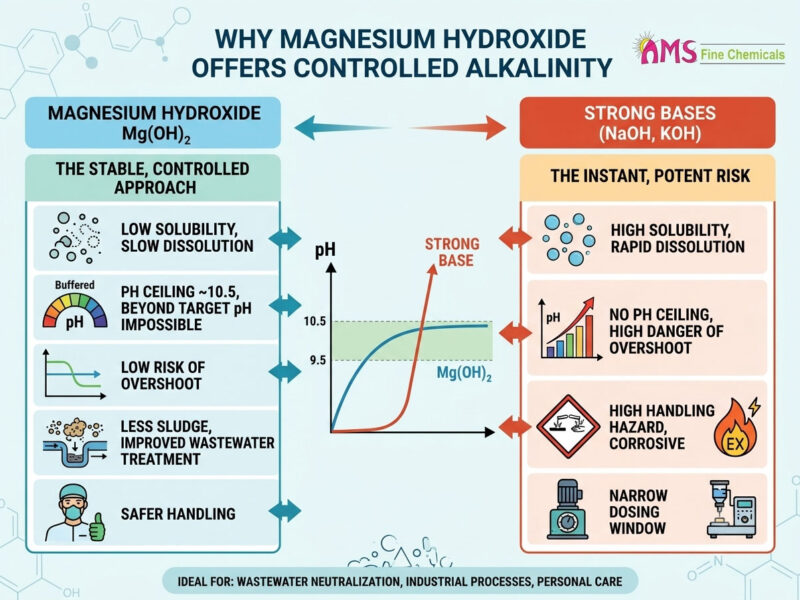
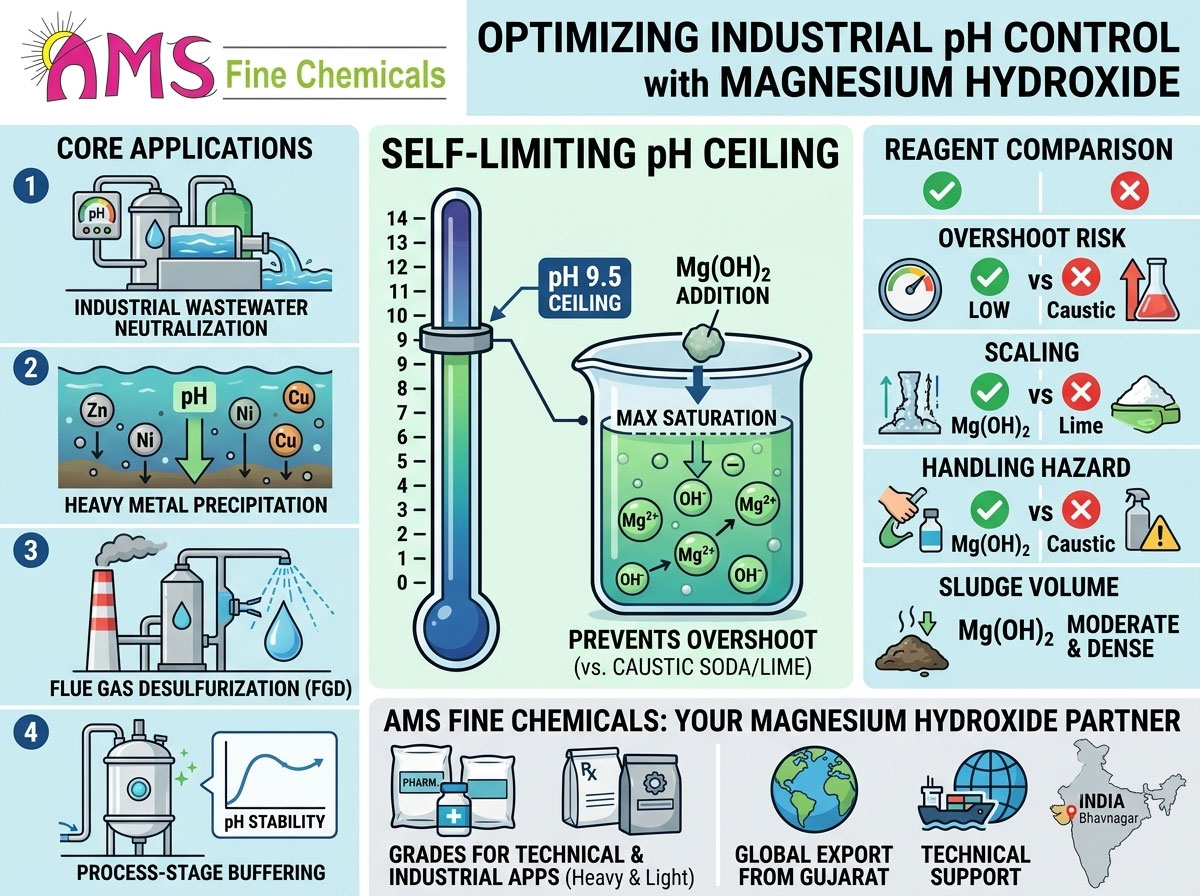
This is where Magnesium Hydroxide has quietly become the preferred alkali in a growing number of industrial pH control applications. Unlike sodium hydroxide (caustic soda) or hydrated lime, magnesium hydroxide has a chemical property that makes it almost uniquely suited to neutralization work: it is a self-limiting base. It cannot push a solution’s pH past roughly 9.5, no matter how much excess is dosed. For process engineers who have dealt with a caustic soda overdose event or a lime scaling problem, that single property changes how an entire neutralization system is designed.
At AMS Fine Chemicals, based in Bhavnagar, Gujarat, we manufacture and export Magnesium Hydroxide across pharmaceutical, flame-retardant, and industrial-technical grades, and pH control is one of the most common reasons customers come to us for the Heavy Magnesium Hydroxide grade in particular. This article breaks down exactly how magnesium hydroxide performs as a pH control agent, why its chemistry behaves differently from other alkalis, and how to think about grade selection and dosing when you’re designing or troubleshooting a neutralization system.
1. Why pH Control Matters in Industrial Chemical Processes
Before comparing reagents, it’s worth being precise about what “pH control” actually means in an industrial context, because it isn’t one single task — it’s several different jobs that happen to use the same lever.
- Effluent neutralization — bringing acidic or alkaline wastewater into a dischargeable pH range (commonly 6–9) before it leaves a site or enters a biological treatment system.
- Heavy metal precipitation — raising pH to the point where dissolved metal ions (zinc, copper, nickel, chromium, lead) convert into insoluble metal hydroxides that can be settled and filtered out.
- Flue gas desulfurization (FGD) — scrubbing acidic sulfur dioxide (SO₂) out of combustion exhaust, typically in marine engines, power plants, and industrial boilers.
- Process-stage pH buffering — maintaining a stable pH band during a reaction, fermentation, or extraction step where drift in either direction would compromise yield or product quality.
Each of these has different tolerance for pH overshoot, different reaction kinetics, and different cost sensitivities — which is exactly why the choice of alkali reagent is not a commodity decision. It’s a process design decision.
2. The Core Problem With Traditional Alkalis
For decades, the default answer to “how do we raise pH” was either sodium hydroxide (caustic soda) or hydrated lime (calcium hydroxide). Both work. Both also carry the same structural weakness: they are strong, fully dissociating bases with no built-in ceiling.
Sodium hydroxide (NaOH) dissociates completely and instantly in water. That makes it fast-acting, but it also means there is no natural buffering — if dosing control lags even slightly behind influent variability, pH can spike well past the target range within seconds. In a wastewater system, an overshoot into the 11–12 pH range doesn’t just fail a discharge permit; it can re-dissolve certain metal hydroxides that had already precipitated, effectively undoing the treatment step it was supposed to complete.
Hydrated lime (Ca(OH)₂) is cheaper on a per-kilogram basis, but it has its own operational headache: low solubility combined with a tendency to form calcium carbonate and calcium sulfate scale on pipes, pumps, and diffusers. Over time, that scaling increases maintenance costs and can silently degrade dosing accuracy as flow paths narrow.
Magnesium hydroxide was adopted specifically because it avoids both failure modes — at a chemistry level, not just as a marketing claim.
3. Why Magnesium Hydroxide Behaves Differently
The reason magnesium hydroxide self-limits at roughly pH 9.5 comes down to solubility. Mg(OH)₂ has a very low solubility product constant (Ksp ≈ 5.61 × 10⁻¹²), meaning only a small amount of it actually dissolves into Mg²⁺ and OH⁻ ions in water at any given time. As acid in the process stream consumes the available hydroxide ions, more solid Mg(OH)₂ dissolves to replace them — but only up to the point where the solution’s own pH prevents further dissociation. Once the equilibrium point near pH 9.5 is reached, additional solid magnesium hydroxide simply remains undissolved rather than continuing to push pH higher.
In practical terms, this means:
- Overshoot risk is dramatically reduced. Even if you dose more Mg(OH)₂ than a given batch of acidic water strictly needs, the pH will not run away past the ~9.5 ceiling. This is a major advantage in systems with variable influent, intermittent dosing control, or manual operation.
- The reaction is gentler and more gradual, which some processes actually prefer over the sharp, fast neutralization of caustic soda — particularly where a controlled reaction rate matters for downstream flocculation or settling steps.
- Excess reagent is far more forgiving. Operators dosing magnesium hydroxide have more margin for error than operators dosing caustic soda, where a slightly miscalibrated pump can turn into a compliance incident.
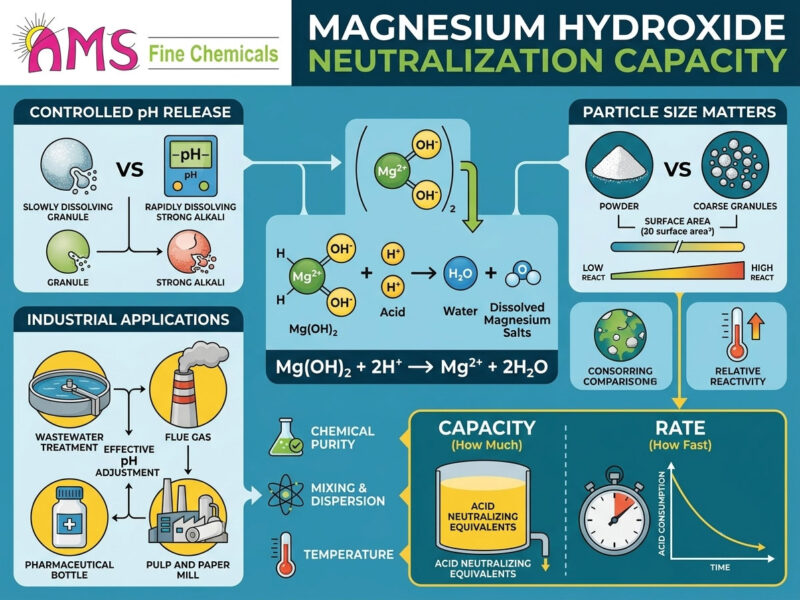
We’ve gone into the underlying reaction chemistry of this buffering behavior in more depth in a previous technical post — see Magnesium Hydroxide Neutralization Capacity: Understanding the Chemistry if you want the full derivation of how the self-limiting equilibrium works.
4. Comparing pH Control Agents Side by Side
| Property | Magnesium Hydroxide | Sodium Hydroxide (Caustic Soda) | Hydrated Lime (Ca(OH)₂) |
|---|---|---|---|
| Maximum achievable pH | Self-limits near 9.5 | No natural ceiling — can exceed pH 13 | Can exceed pH 12 |
| Overshoot risk | Very low | High, especially with dosing lag | Moderate |
| Solubility in water | Very low (slow-release) | Fully soluble | Low, but reacts faster than Mg(OH)₂ |
| Scaling / fouling tendency | Low | Low | High (carbonate/sulfate scale) |
| Handling hazard | Low — mild, non-corrosive slurry | High — corrosive, requires PPE and containment | Moderate — caustic dust, respiratory hazard |
| Sludge volume generated | Moderate, generally denser and more compact | Low (fully soluble reagent) | High |
| Typical use case fit | Variable/acidic effluent, metal precipitation, flue gas scrubbing | Fast, precise pH correction in controlled systems | High-volume, cost-driven bulk neutralization |
This isn’t a case of one reagent being universally “better” — it’s about matching the reagent’s behavior to the process’s tolerance for variability. Where a plant can guarantee tight, continuously monitored dosing control, caustic soda’s speed is an asset. Where influent is inconsistent, staffing is leaner, or the consequence of overshoot is expensive (re-dissolved metals, permit violations, corroded downstream equipment), magnesium hydroxide’s built-in ceiling removes an entire category of operational risk.
5. Key Industrial Applications of Magnesium Hydroxide pH Control
Industrial Wastewater Neutralization
This is the largest and most common application. Acidic effluent from metal finishing, textile dyeing, chemical manufacturing, and mining operations is neutralized with magnesium hydroxide slurry before discharge or before entering biological treatment. Because Mg(OH)₂ cannot push pH into the alkaline extremes that damage biological treatment cultures, it’s particularly well suited as a pre-treatment step ahead of activated sludge or other biological processes that are sensitive to pH swings.
We’ve written a dedicated deep-dive on this exact use case — see Heavy Magnesium Hydroxide for Industrial Wastewater Neutralization — covering dosing ratios, slurry preparation, and reaction time considerations specific to wastewater streams.
Heavy Metal Precipitation
Many dissolved heavy metals (zinc, nickel, copper, chromium III, cadmium, lead) become insoluble hydroxides at specific pH thresholds, typically between pH 8 and 10. Magnesium hydroxide’s stable operating range sits almost exactly where most of these metals precipitate most completely, which makes it a natural fit for metal recovery and effluent polishing steps in electroplating, metal finishing, and mining wastewater treatment. The self-limiting ceiling also prevents the common failure mode of over-dosing past the point where certain amphoteric metals (like zinc) begin to re-dissolve at very high pH — a real risk with caustic soda.
Flue Gas Desulfurization (FGD) and Marine Scrubbers
In marine engine exhaust scrubbers and industrial boiler flue gas treatment, magnesium hydroxide slurry is used to absorb and neutralize sulfur dioxide (SO₂), converting it into magnesium sulfite/sulfate compounds. Its lower reactivity compared to caustic soda is actually an advantage here — it reduces the risk of over-alkaline scrubber effluent while still achieving the SO₂ removal efficiency required under IMO and regional marine emissions regulations.
Pulp and Paper Industry Process Water
In pulping and bleaching operations, pH control is essential both for process chemistry and for the treatment of process water before reuse or discharge. Magnesium-based alkalis are also used elsewhere in pulping chemistry beyond simple neutralization — we cover that broader relationship in Magnesium Hydroxide in Paper & Pulp Industry: The Ultimate Technical Guide.
Flue Gas and Acid Gas Scrubbing in Chemical Plants
Beyond combustion flue gas, magnesium hydroxide slurries are used in scrubber systems handling acidic process off-gases from chemical manufacturing — particularly where the treated gas or scrubber blowdown has downstream pH sensitivity that a stronger alkali like caustic soda would complicate.
6. Grade Selection: Light vs. Heavy Magnesium Hydroxide for pH Control
Not all magnesium hydroxide is created equal for pH control duty, and grade selection has a real, measurable effect on reaction rate and dosing efficiency.
Heavy Magnesium Hydroxide is the grade most commonly specified for large-volume industrial neutralization and wastewater treatment. Its denser particle structure and settling characteristics make it well suited to high-throughput continuous treatment systems, slurry handling, and applications where sludge dewatering downstream is part of the process design.
Light Magnesium Hydroxide, with its higher surface area and finer particle structure, reacts faster in solution — a meaningful advantage in applications where reaction speed matters more than sludge density, such as smaller batch-treatment systems or where residence time in the reactor is limited.
The general rule of thumb: higher surface area means faster acid-neutralizing reaction kinetics, because more of the solid’s surface is in contact with the acidic solution at any given moment. If your process has short retention times or handles sudden acid spikes, a finer particle grade will neutralize more quickly per unit dosed. If your process runs continuously with longer retention and downstream solids handling, the settling and handling characteristics of the heavier grade often make more practical sense.
If you’re unsure which grade fits your specific flow rate, influent pH range, and retention time, our technical team can review your process parameters and recommend a grade and dosing rate — you can browse our full magnesium compound range on the Products page.
7. Dosing and Process Design Considerations
Getting the chemistry right is only half the job — the other half is designing the dosing system around magnesium hydroxide’s specific behavior, which differs from a fully soluble reagent like caustic soda in a few important ways.
Slurry concentration. Magnesium hydroxide is typically dosed as a 40–60% slurry rather than a dry powder, and slurry concentration affects both pumpability and reaction consistency. Too dilute, and you’re pumping unnecessary water volume; too concentrated, and you risk settling or line blockages if agitation isn’t maintained.
Retention time. Because Mg(OH)₂ is far less soluble than NaOH, it needs meaningfully more contact time to fully react — often measured in minutes rather than seconds. Reactor or neutralization tank sizing needs to account for this, particularly in continuous-flow systems where a caustic soda system might have been designed around near-instantaneous reaction.
Agitation. Since undissolved solid particles are doing the ongoing neutralization work (not a fully dissolved ion pool), maintaining suspension through adequate mixing is critical — settled Mg(OH)₂ at the bottom of a tank isn’t contributing to neutralization.
Temperature. Reaction rate increases moderately with temperature, which is worth factoring into system design for processes running heated effluent streams.
Monitoring. Even though overshoot risk is much lower than with caustic soda, continuous pH monitoring with feedback-controlled dosing still produces the most consistent results, especially where influent acidity varies significantly hour to hour.
8. Safety and Handling Advantages
Beyond the chemistry itself, magnesium hydroxide slurry offers real operational safety benefits that matter to plant EHS teams:
- Non-corrosive to skin and eyes compared to concentrated caustic soda solutions, reducing PPE burden and chemical burn risk during handling and dosing pump maintenance.
- Lower transport and storage hazard classification in many jurisdictions compared to concentrated NaOH solutions, which can simplify logistics and on-site storage permitting.
- Reduced risk of thermal reaction hazards. Diluting concentrated caustic soda generates significant exothermic heat; magnesium hydroxide slurry preparation does not carry the same risk profile.
- Lower fume/dust exposure risk relative to hydrated lime powder handling, when supplied and handled as a pre-made slurry.
These factors often matter as much as raw reagent cost once a plant totals up PPE, containment infrastructure, and incident risk over the life of a neutralization system.
9. A Practical Example: Metal Finishing Effluent
Consider a metal finishing operation discharging acidic rinse water containing dissolved zinc and nickel, with influent pH typically ranging between 2 and 4 depending on the production line running that shift. Using caustic soda here creates two live risks: an operator or automated system slightly over-dosing during a low-acidity period can spike effluent pH well above 11, at which point zinc — an amphoteric metal — can begin re-dissolving instead of staying precipitated as a solid.
Switching the same system to a magnesium hydroxide slurry dosed to target pH 9–9.5 removes that failure mode almost entirely. Even with imprecise dosing or influent variability, the reaction cannot push past the self-limiting ceiling, keeping both zinc and nickel hydroxides precipitated and out of the discharge stream. The trade-off is a slightly longer required retention time and a marginally higher reagent cost per unit of acid neutralized — a trade most metal finishing operations consider worthwhile given what a discharge permit violation costs in comparison.
10. Why Source Magnesium Hydroxide From AMS Fine Chemicals
pH control performance is only as reliable as the consistency of the reagent behind it. Batch-to-batch variation in particle size, reactivity, or purity translates directly into dosing inconsistency on the plant floor — which is exactly the kind of variability a self-limiting alkali is supposed to eliminate in the first place.
AMS Fine Chemicals, headquartered in Bhavnagar, Gujarat, manufactures and exports Magnesium Hydroxide across pharmaceutical, flame-retardant, and industrial/technical grades, including both Light Magnesium Hydroxide and Heavy Magnesium Hydroxide suited to pH control and neutralization duty. We supply:
- Consistent particle size distribution and reactivity across batches, backed by independent Certificates of Analysis
- Technical support for dosing rate and grade selection based on your specific influent chemistry and flow parameters
- Full MSDS documentation for safety and regulatory compliance
- Strategic proximity to Pipavav and Mundra ports for efficient export logistics to international customers
You can explore our complete range of magnesium compounds, including our broader Magnesium Carbonate line, on the Products page, or see how our materials are applied across sectors on the Industries We Serve and Application pages.
11. Frequently Asked Questions
Q1: What is the maximum pH magnesium hydroxide can achieve, and why does it stop there?
Magnesium hydroxide’s low solubility product means it self-limits at approximately pH 9.5. Past that point, the equilibrium between solid Mg(OH)₂ and dissolved hydroxide ions prevents further dissociation, so additional dosing does not push pH higher — unlike fully soluble alkalis such as caustic soda.
Q2: Is magnesium hydroxide slower to react than caustic soda?
Yes, generally. Because it doesn’t fully dissolve instantly, magnesium hydroxide requires longer retention time and adequate agitation to achieve complete neutralization. This is usually an acceptable trade-off given the reduced overshoot risk, but it does need to be factored into reactor sizing.
Q3: Which grade is better for wastewater treatment — Light or Heavy Magnesium Hydroxide?
It depends on your system’s retention time and downstream solids handling. Heavy Magnesium Hydroxide is typically preferred for high-volume continuous treatment with settling/dewatering steps, while Light Magnesium Hydroxide’s higher surface area suits applications needing faster reaction kinetics with shorter contact time.
Q4: Can magnesium hydroxide replace lime in flue gas desulfurization?
Yes, and it’s increasingly common in marine scrubber applications specifically because its controlled reactivity reduces the risk of over-alkaline scrubber discharge water, which is subject to its own regulatory limits.
Q5: Does magnesium hydroxide produce more sludge than caustic soda?
Generally yes, since it introduces additional solid mass into the system compared to a fully soluble reagent, but the resulting sludge is often denser and settles more efficiently, which can offset handling costs in systems designed for it.
12. Conclusion
pH control in industrial chemical processes is rarely just a matter of picking “the strongest available base.” The reagent’s chemical behavior — how it dissociates, whether it has a natural ceiling, how it interacts with the specific contaminants in your process stream — has a direct effect on process safety, compliance reliability, and long-term operating cost. Magnesium hydroxide’s self-limiting buffering behavior near pH 9.5 is precisely why it has become the preferred alkali for wastewater neutralization, heavy metal precipitation, and acid gas scrubbing applications where consistency and overshoot protection matter more than raw reaction speed.
If your operation is evaluating a switch from caustic soda or lime, or you’re specifying reagent grade for a new neutralization system, the AMS Fine Chemicals technical team can help match particle size, reactivity, and dosing strategy to your specific process. Get in touch through amsfine.com or reach out directly at info@amsfine.com for samples, a Certificate of Analysis, or a technical consultation.