Switching Magnesium Carbonate suppliers, or qualifying a first-time source for bulk-volume procurement, is a decision with consequences that extend well past the invoice. The right supplier delivers consistent quality, predictable lead times, and documentation that holds up under audit. The wrong one introduces exactly the kind of raw material variability, delivery risk, and quality gaps that eventually surface as production problems — sometimes months after the purchase order was placed.
This guide is a practical framework for evaluating a Magnesium Carbonate supplier specifically for bulk, recurring procurement — the questions to ask, the documentation to request, and the red flags that distinguish a genuinely capable manufacturer from one that merely looks capable on a sales page.
Start With Manufacturer vs. Trading Company
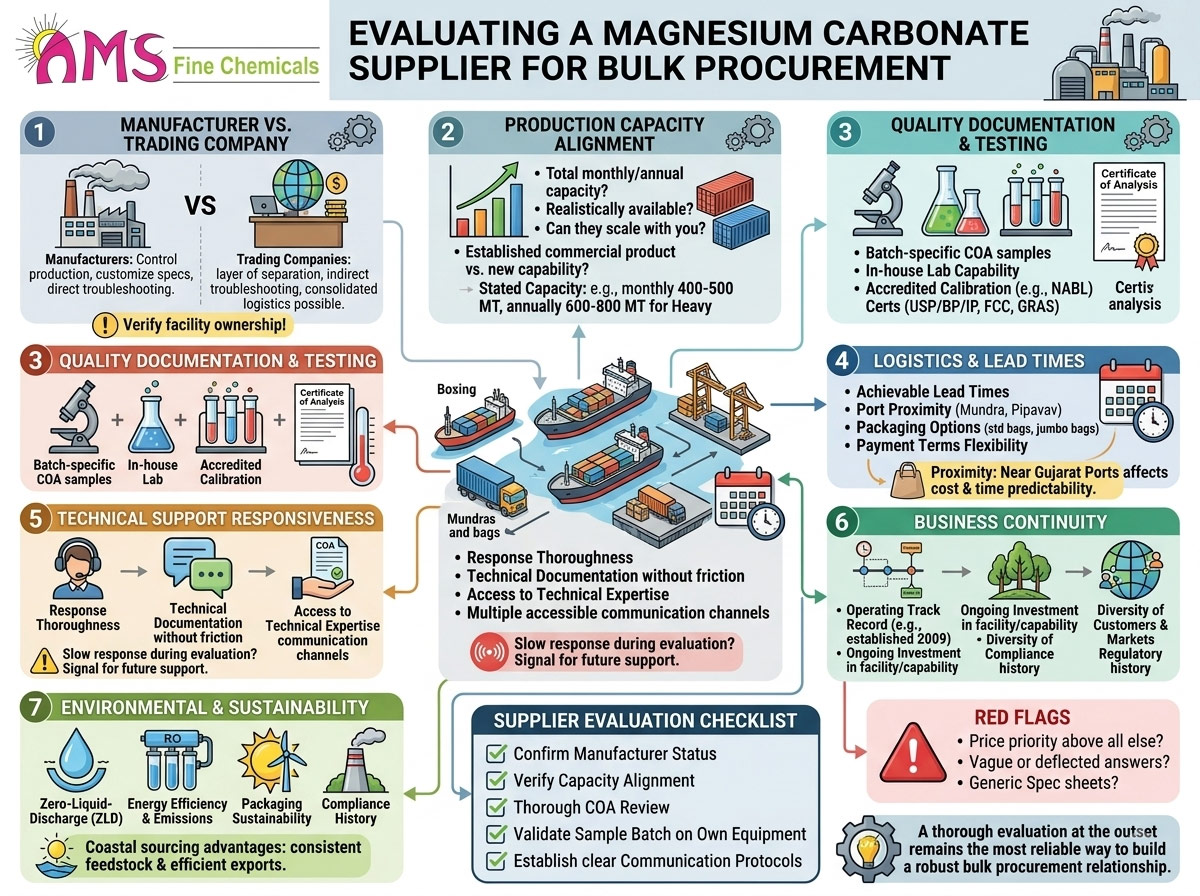
One of the first, and most consequential, distinctions to establish is whether you’re evaluating an actual manufacturer or a trading company (distributor/reseller) presenting itself as a direct source.
Why this matters:
- Manufacturers control the full production process — raw material sourcing, precipitation, washing, drying, and testing — giving them direct influence over consistency, the ability to customize specifications, and typically more transparent, timely troubleshooting when a quality question arises.
- Trading companies add a layer of separation between you and the actual production process, which can mean longer response times for technical questions, less ability to influence specification customization, and reduced visibility into the actual manufacturing conditions your material was produced under.
- Pricing structure differs, since trading companies necessarily add a margin on top of manufacturer pricing, though this isn’t automatically disqualifying — some trading companies provide genuine value through consolidated logistics or smaller minimum order quantities that suit certain buyers.
How to verify: Ask directly whether the company operating your point of contact owns and operates the production facility, and request a facility location or, where feasible, a facility visit or virtual tour. A manufacturer should be able to speak in specific technical detail about their own precipitation process, testing infrastructure, and production capacity — vague or deflected answers to specific process questions are a signal worth taking seriously.
Production Capacity and Capability Alignment
Before evaluating quality, confirm the supplier’s production capacity genuinely aligns with your actual volume requirements, both current and reasonably anticipated future growth.
Key questions to ask:
- What is the supplier’s total monthly or annual production capacity for the specific grade you need, and what percentage of that capacity is realistically available to a new customer relationship rather than already committed to existing contracts?
- Can the supplier scale with your growth, or are you likely to outgrow their capacity within a foreseeable timeframe, requiring a disruptive supplier transition just as your own business scales?
- Does the supplier manufacture the specific grade you need at commercial scale already, or would your order require them to develop new capability — a meaningfully higher-risk scenario than sourcing an already-established product line?
A supplier’s stated production capacity — for reference, AMS Fine Chemicals operates with a monthly production capacity in the range of 400 to 500 metric tons of Magnesium Carbonate, with installed capacity for 600 to 800 metric tons annually of Heavy Magnesium Carbonate specifically — provides a useful benchmark for buyers to compare against their own volume requirements and growth projections when evaluating capacity fit with any prospective supplier.
Quality Documentation and Testing Infrastructure
Once manufacturer status and capacity are confirmed, quality documentation and testing capability deserve the closest scrutiny, since this is where the actual functional performance of the material you’ll receive is determined.
What to request and evaluate:
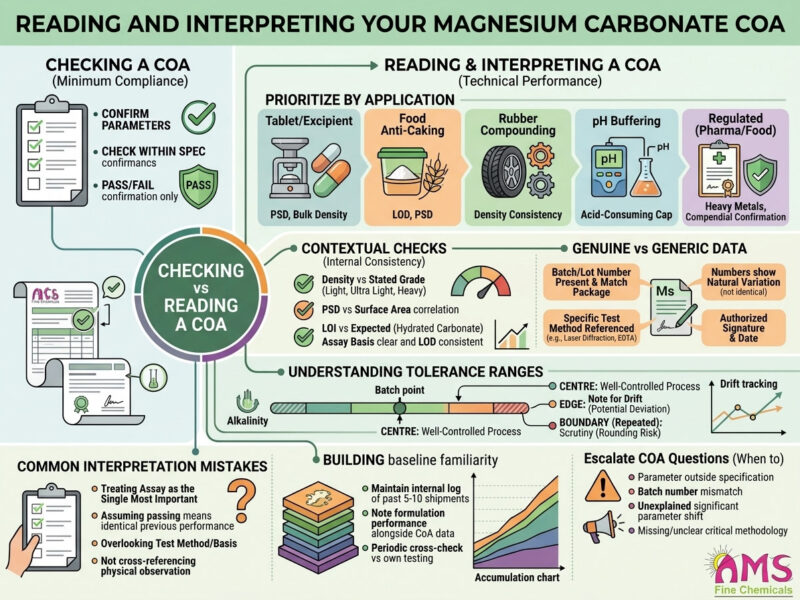
- Sample Certificates of Analysis from recent, real production batches — not generic specification sheets — covering the full parameter set relevant to your application. Our Magnesium Carbonate COA Explained: Important Parameters Buyers Should Check article covers exactly what a complete CoA should include.
- In-house testing laboratory capability, since manufacturers with comprehensive in-house analytical capability generally provide faster, more responsive quality support than those relying entirely on external testing.
- Instrument calibration standards, confirming testing equipment is calibrated against accredited standards — NABL accreditation in the Indian context, or equivalent international accreditation bodies elsewhere.
- Compendial and regulatory certifications relevant to your application — USP/BP/IP compliance for pharmaceutical use, Food Chemicals Codex and GRAS/E504 status for food use, appropriate certifications for cosmetic applications.
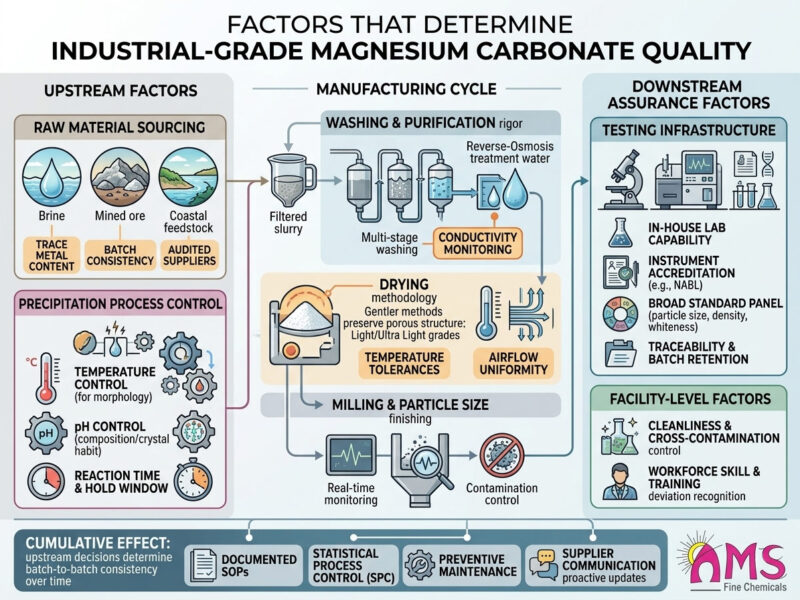
Our Factors That Determine the Quality of Industrial-Grade Magnesium Carbonate article covers the full range of upstream manufacturing factors worth probing during this evaluation stage, from raw material sourcing through to testing infrastructure.
Grade Range and Customization Capability
Bulk buyers, particularly those with evolving or multi-application requirements, benefit from evaluating whether a supplier offers meaningful grade range and customization flexibility, rather than a single fixed specification.
Questions worth asking:
- Does the supplier offer the full range of grades relevant to your industry — Light, Ultra Light, and Heavy Magnesium Carbonate — or only a narrow subset that might not accommodate future formulation changes?
- Can the supplier customize particle size, bulk density, or whiteness specifications beyond their standard commercial offerings, relevant for buyers with tight, application-specific tolerance requirements?
- What minimum order quantities apply to customized specifications, since custom grade development often carries higher minimums and longer lead times than standard commercial grades?
Our guides, How to Select the Right Magnesium Carbonate Grade for Your Manufacturing Process and How to Select the Right Magnesium Carbonate Grade for Your Application, can help you define your own grade and specification requirements clearly before entering supplier evaluation conversations, so you’re evaluating suppliers against a precise requirement rather than a vague general need.
Logistics, Lead Time, and Export Capability
For bulk procurement specifically, logistics performance deserves evaluation as rigorously as product quality, since a technically excellent product delivered unreliably still disrupts your production planning.
Key logistics factors to evaluate:
- Typical lead time from confirmed purchase order to shipment, and whether that lead time is realistic and consistently achievable rather than an optimistic best-case figure — a supplier’s honest disclosure of typical versus best-case lead times is itself a useful signal of transparency.
- Proximity to major shipping ports, particularly relevant for international buyers, since port proximity affects both cost and transit time predictability. Manufacturers located near established export infrastructure — such as Gujarat’s Mundra and Pipavav ports, both within reasonable distance of the Bhavnagar industrial region — generally offer more efficient, cost-predictable export logistics than facilities requiring longer inland transport to reach a port.
- Packaging options and minimum order flexibility, including standard bag formats versus bulk jumbo bag options for genuinely large-volume orders, and whether packaging can be customized to your specific handling and storage requirements.
- Payment terms flexibility, since established manufacturers typically offer standard international trade payment mechanisms — letter of credit, telegraphic transfer, documents against payment or acceptance — providing buyers appropriate payment security appropriate to the size and novelty of the relationship.
Our Magnesium Carbonate Storage and Handling: Best Practices for Industrial Buyers guide covers what happens after material arrives — worth reviewing alongside supplier logistics evaluation, since packaging and handling discipline at the point of shipment directly affects what condition material arrives in.
Communication and Technical Support Responsiveness
A supplier relationship for recurring bulk procurement is fundamentally ongoing, not transactional — and how a supplier communicates and provides technical support during the evaluation process is often a reliable early indicator of what the ongoing relationship will actually look like.
What to observe during evaluation:
- Response time and thoroughness to initial technical inquiries, since a supplier slow or vague in responding during a sales-stage evaluation is unlikely to become more responsive once the relationship is established and less actively courted.
- Willingness to provide detailed technical documentation without excessive friction, including sample CoAs, technical data sheets, and answers to specific process questions.
- Availability of genuine technical expertise, not just sales personnel, since questions about grade selection, particle size requirements, or formulation compatibility are best answered by someone with real technical depth rather than a generalized sales response.
- Multiple accessible communication channels, since bulk procurement relationships often benefit from having more than one reliable contact method (email, phone, direct messaging) for time-sensitive questions or order updates.
Financial Stability and Business Continuity
For recurring bulk procurement relationships, particularly ones your own production depends on, evaluating the supplier’s business stability and continuity planning is a legitimate, important due diligence step often overlooked in favor of purely product-focused evaluation.
Factors worth considering:
- Years in operation and business track record, since an established operating history — AMS Fine Chemicals, for reference, was founded in 2009 — provides more confidence in long-term supply reliability than a very recently established operation, all else equal.
- Evidence of ongoing investment in facility and capability, such as recent equipment upgrades, laboratory expansion, or new product development, signaling a business actively reinvesting rather than one at risk of stagnation or decline.
- Diversity of customer base and markets served, since a supplier heavily dependent on a small number of large customers or a single geographic market may carry higher business continuity risk than one with a more diversified customer and market base.
- Regulatory and certification compliance history, since a track record of maintaining required certifications and passing regulatory audits over time indicates sustained operational discipline rather than a one-time compliance achievement.
Environmental and Sustainability Credentials
Increasingly, bulk buyers — particularly those supplying end markets with their own environmental sourcing commitments — evaluate suppliers on environmental practice alongside traditional quality and reliability factors.
Relevant considerations:
- Wastewater and effluent treatment practices, since manufacturing processes generating byproduct streams require responsible treatment before discharge — zero-liquid-discharge (ZLD) systems and reverse osmosis treatment represent a meaningfully higher standard of environmental practice than facilities without dedicated effluent treatment infrastructure.
- Energy efficiency and emissions practices, particularly relevant given the energy-intensive nature of drying and, where applicable, calcination processes in Magnesium Carbonate manufacturing.
- Compliance history with environmental regulations, since a track record of environmental compliance reduces both ethical sourcing risk and the practical business continuity risk associated with potential regulatory enforcement action against a supplier.
- Packaging sustainability practices, including any recyclable or reduced-material packaging options a supplier may offer for buyers with their own sustainability packaging targets.
For buyers whose own customers or end markets increasingly ask about supply chain environmental practices, having this information documented and readily available from a supplier — rather than needing to request it reactively — is itself a signal of a supplier’s broader operational maturity and transparency.
Evaluating Suppliers for Multi-Product Sourcing Consolidation
Many bulk buyers source more than just Magnesium Carbonate from their chemical raw material suppliers, and evaluating whether a prospective supplier offers a broader relevant product range can meaningfully simplify vendor management, even when Magnesium Carbonate itself is the primary procurement driver.
Worth considering:
- Does the supplier also manufacture related magnesium compounds — Magnesium Hydroxide, Magnesium Trisilicate — relevant to your broader raw material needs, potentially allowing consolidated vendor qualification and shipment logistics across multiple products?
- Does consolidating multiple products with a single supplier create acceptable concentration risk, or does your risk management approach favor maintaining supplier diversity even at the cost of some logistics simplification?
- Does the supplier’s broader product range indicate deeper overall technical and manufacturing capability, potentially signaling stronger process discipline than a narrower, single-product operation?
This consolidation question doesn’t have a universally correct answer — it depends on your organization’s specific risk tolerance, procurement complexity, and the relative importance of Magnesium Carbonate within your broader raw material sourcing strategy.
A Practical Supplier Evaluation Checklist
Before finalizing a bulk Magnesium Carbonate supplier relationship, work through this consolidated checklist:
- Confirm manufacturer vs. trading company status, and verify direct production capability through specific technical conversation or facility visit where feasible.
- Verify production capacity genuinely aligns with your current volume needs and reasonably anticipated growth.
- Request and thoroughly review sample Certificates of Analysis from real, recent production batches, not generic specification sheets.
- Confirm relevant compendial and regulatory certifications for your specific application.
- Evaluate grade range and customization flexibility against your current and potential future formulation needs.
- Clarify realistic lead times, packaging options, and payment terms, and confirm export logistics capability if sourcing internationally.
- Assess communication responsiveness and technical support depth during the evaluation process itself.
- Review business track record and continuity indicators, particularly for relationships your own production will depend on long-term.
- Request a sample batch and run bench-scale validation on your own equipment before committing to full-volume procurement.
- Establish clear escalation and communication protocols for quality questions before the relationship moves into regular ongoing procurement.
Common Supplier Evaluation Mistakes
Prioritizing price above all other factors. The lowest quoted price rarely accounts for total cost of ownership — quality-driven reformulation risk, delivery reliability, and technical support responsiveness all carry real cost even when they don’t appear on the initial quote.
Skipping sample validation before committing to volume. Even a supplier with strong documentation and reputation should be validated against your own specific formulation and equipment before committing to full-scale procurement — general supplier quality doesn’t guarantee fit for your specific application.
Treating supplier evaluation as a one-time event. Ongoing monitoring of batch consistency, communication quality, and delivery performance over the life of the relationship matters as much as the initial evaluation, since supplier performance can shift over time even after a strong initial qualification.
Underestimating the value of a manufacturer relationship over a trading company for critical applications. While trading companies serve some buyers well, particularly those needing smaller volumes or consolidated multi-product sourcing, buyers with critical, high-volume, or highly specification-sensitive needs generally benefit from the direct process visibility and customization capability a manufacturer relationship provides.
How AMS Fine Chemicals Supports Bulk Procurement Evaluation
AMS Fine Chemicals, based in Bhavnagar, Gujarat, has operated as a direct manufacturer of Magnesium Carbonate and related magnesium compounds since 2009, with in-house Physico-Chemical and Microbiology testing laboratories, NABL-calibrated instrumentation, and production capacity supporting Industrial, Food, Pure, and Pharma grade certifications across Light, Ultra Light, and Heavy Magnesium Carbonate. Our location near Mundra and Pipavav ports supports efficient export logistics for international bulk buyers, with standard and jumbo bag packaging options and flexible payment terms (LC, TT, D/P, D/A) suited to established and new buyer relationships alike.
We welcome direct technical conversations, facility information requests, and sample provision as part of a thorough supplier evaluation process — reach out through our Contact Us page to begin that conversation. Explore full technical specifications on our Magnesium Carbonate, Light Magnesium Carbonate, Ultra Light Magnesium Carbonate, and Heavy Magnesium Carbonate product pages, or browse our complete range of magnesium compounds — including Magnesium Hydroxide and Magnesium Trisilicate — on the Products page.
Frequently Asked Questions
Is it always better to source directly from a manufacturer rather than a trading company? For critical, high-volume, or specification-sensitive applications, generally yes, given the direct process visibility and customization capability manufacturers offer. For buyers needing smaller volumes, consolidated multi-product sourcing, or simplified logistics, a well-established trading company can still serve as a reasonable sourcing option.
How much lead time should I expect for a new bulk Magnesium Carbonate supplier relationship? This varies by supplier and order specifics, but as a general benchmark, established manufacturers with available capacity often quote production and shipment timelines in the range of 10 to 15 days following a confirmed purchase order for standard grades, with custom specifications or very large orders potentially requiring longer lead times.
Should I request a facility visit before committing to a bulk supplier relationship? Where feasible, yes, particularly for large-volume or long-term commitments — an in-person or virtual facility visit provides direct insight into process control and quality culture that documentation alone can’t fully convey, though it’s not always practical, especially for smaller initial orders or geographically distant suppliers.
How many sample batches should I evaluate before committing to full-scale procurement? At minimum, one representative sample batch validated through your own bench-scale trial is standard practice; for critical or high-risk applications, requesting samples from two or three different production runs provides additional confidence in the supplier’s batch-to-batch consistency before committing to volume procurement.
What’s the most overlooked factor in supplier evaluation? Business continuity and long-term relationship fit — track record, financial stability, and communication responsiveness — often receive less attention than product specification during initial evaluation, despite being equally important for a procurement relationship your production will depend on over time.
Final Word
Evaluating a Magnesium Carbonate supplier for bulk procurement is a multi-dimensional decision that extends well beyond comparing quoted prices or specification sheets. Manufacturer status, production capacity alignment, quality documentation depth, grade flexibility, logistics reliability, communication responsiveness, and business continuity together determine whether a supplier relationship will genuinely support your production needs reliably over time, or introduce risk that only becomes apparent after the relationship is already underway. A thorough, structured evaluation process at the outset — including sample validation before committing to volume — remains the most reliable way to build a bulk procurement relationship that holds up under real production demands.
To request technical documentation, sample batches, or to begin a supplier evaluation conversation, visit our Magnesium Carbonate product page or reach out through our Contact Us page.