Ask any process engineer who has dealt with a pH overshoot what their least favorite word is, and “caustic” is a strong contender. Strong bases like Sodium Hydroxide (NaOH) or Potassium Hydroxide (KOH) neutralize acid fast — sometimes too fast, and often past the target pH before an operator can react. Magnesium Hydroxide (Mg(OH)₂) takes a fundamentally different approach to alkalinity, and that difference is exactly why it has become the preferred neutralizing agent across wastewater treatment, industrial processing, and specialty formulation where control matters more than speed.
This guide breaks down the chemistry behind that difference, compares Magnesium Hydroxide directly against strong bases across the properties that matter to formulators and process engineers, and covers where controlled alkalinity translates into real operational and safety advantages.
What “Controlled Alkalinity” Actually Means
Alkalinity, in a practical sense, is a base’s capacity to neutralize acid and raise pH. But how a base delivers that alkalinity matters as much as how much it delivers. Strong bases like Sodium Hydroxide dissociate completely and instantly in water, releasing hydroxide ions (OH⁻) all at once. That gives you a fast, powerful reaction — and very little room for error.
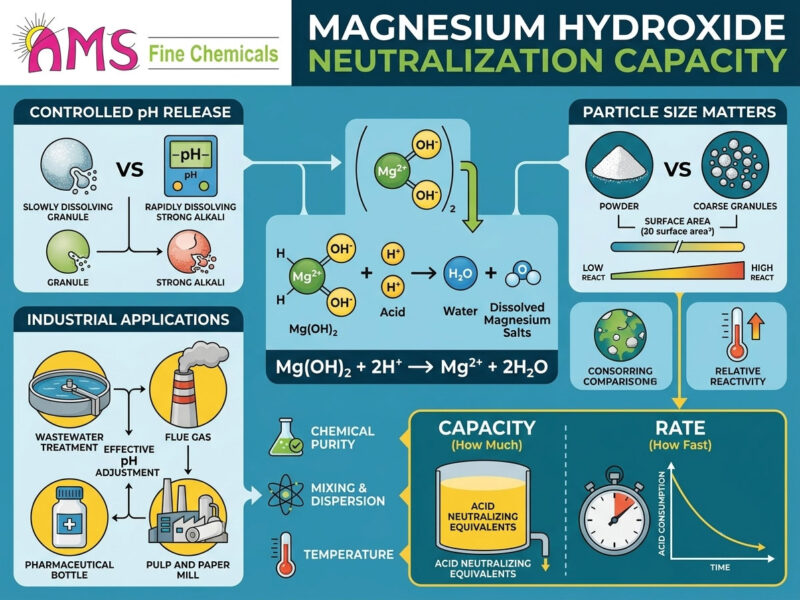
Magnesium Hydroxide behaves differently because of one defining property: it has low water solubility. Rather than fully dissociating on contact with water, Mg(OH)₂ releases hydroxide ions only as they are consumed by reacting acid, following the solubility equilibrium:
Mg(OH)₂ ⇌ Mg²⁺ + 2OH⁻
As acid consumes the available OH⁻ ions, more Mg(OH)₂ dissolves to replace them — but only enough to maintain equilibrium, not in one uncontrolled burst. This self-regulating release is the entire basis of what the industry calls “controlled alkalinity,” and it’s the mechanism behind nearly every practical advantage discussed below.
Magnesium Hydroxide vs. Strong Bases: A Direct Comparison
| Property | Magnesium Hydroxide Mg(OH)₂ | Sodium Hydroxide NaOH | Potassium Hydroxide KOH |
|---|---|---|---|
| Water solubility | Low | Very high | Very high |
| Dissociation | Partial, equilibrium-driven | Complete, instantaneous | Complete, instantaneous |
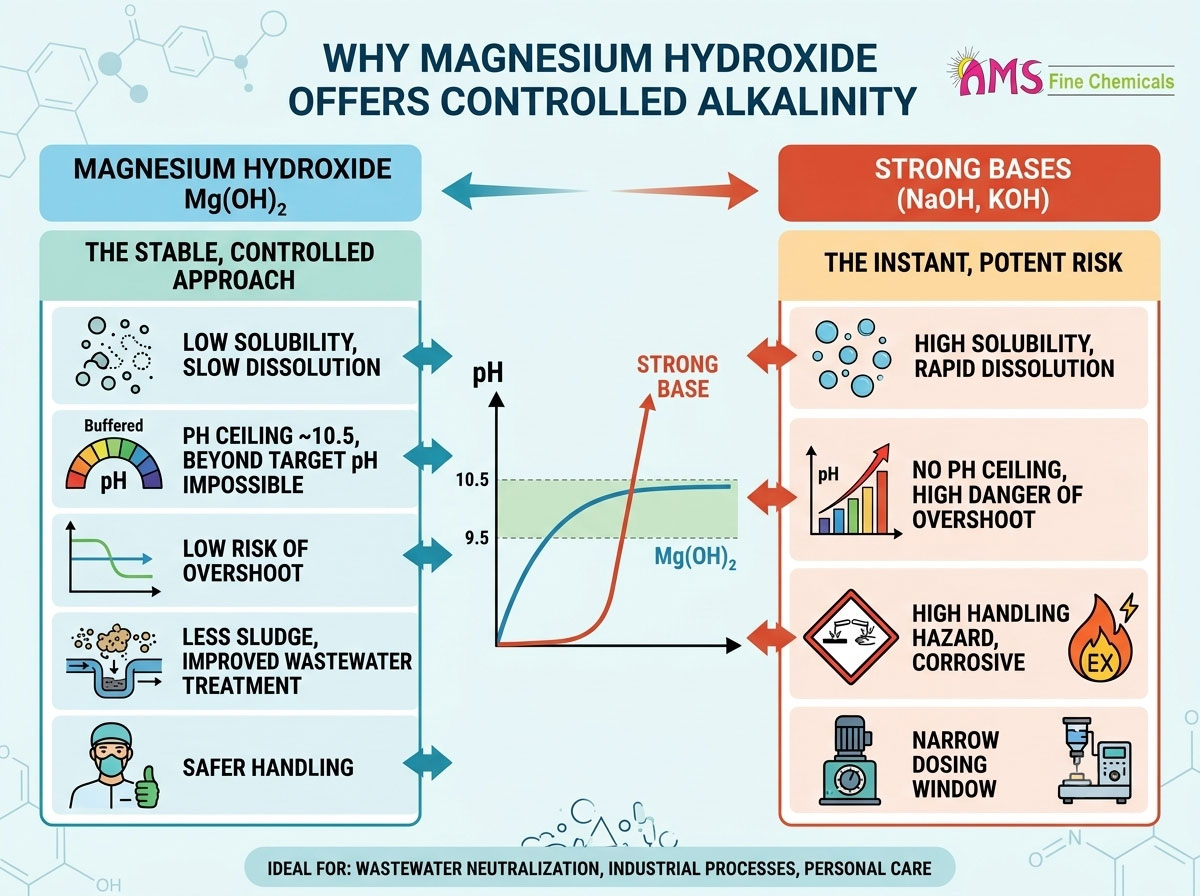
| pH ceiling in water | Buffers around pH 9.5–10.5 | Can exceed pH 13–14 | Can exceed pH 13–14 |
| Risk of overshoot | Low — self-limiting | High — requires precise dosing control | High — requires precise dosing control |
| Handling hazard | Mild, low-corrosivity solid | Highly corrosive, exothermic in solution | Highly corrosive, exothermic in solution |
| Heat of reaction | Low, gradual | High, can generate significant heat | High, can generate significant heat |
| Byproduct in neutralization | Magnesium salts (often beneficial, e.g., MgSO₄, MgCl₂) | Sodium salts (can increase effluent sodium/TDS) | Potassium salts |
| Typical dosing tolerance | Wide — hard to overdose | Narrow — easy to overdose | Narrow — easy to overdose |
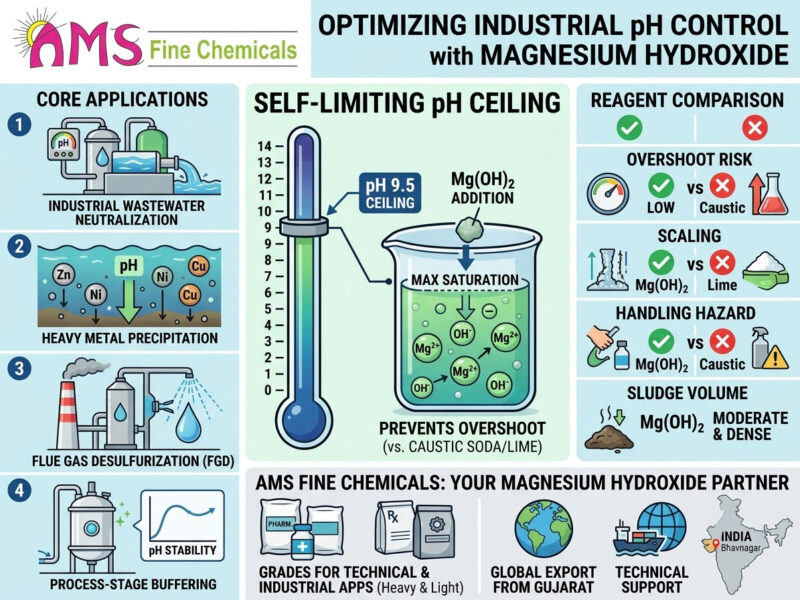
The pH ceiling row deserves emphasis: because Magnesium Hydroxide’s solubility is limited, a saturated aqueous suspension naturally plateaus around pH 9.5–10.5 and essentially cannot push higher, regardless of how much excess Mg(OH)₂ is present. Strong bases have no such built-in ceiling — add more than needed, even briefly, and pH will keep climbing past the target, often into a range that violates discharge limits or damages downstream equipment.
Why This Matters in Wastewater and Effluent Treatment
Wastewater neutralization is where controlled alkalinity earns its reputation. Most discharge permits specify a pH range — commonly 6 to 9 — and both under- and over-correction carry consequences: under-correction fails compliance, while over-correction with a strong base can push effluent pH high enough to trigger its own violation, on the opposite side of the scale.
Magnesium Hydroxide’s self-limiting equilibrium makes overshoot far less likely even with imprecise dosing, which matters enormously in continuous-flow systems where influent acidity fluctuates and manual correction isn’t always fast enough. Operators running Mg(OH)₂-based neutralization systems typically report fewer pH excursions and less need for constant recalibration compared to caustic soda dosing systems.
There’s a secondary benefit specific to heavy metal removal. Magnesium Hydroxide’s gradual pH rise produces denser, more settleable metal hydroxide flocs than the rapid, localized pH spikes strong bases can cause near the point of injection — spikes that sometimes redissolve already-precipitated metals before the solution fully mixes. For a deeper look at large-scale neutralization performance, see our guide on Heavy Magnesium Hydroxide in Large-Scale Chemical Treatment Systems, which covers dosing behaviour and sludge characteristics at industrial volumes.
Industrial pH Control Beyond Wastewater
The same controlled-release chemistry applies wherever a process needs steady, moderate alkalinity rather than an aggressive pH jump:
- Flue gas desulfurization (FGD): Magnesium Hydroxide neutralizes sulfur dioxide gradually, and the magnesium sulfite/sulfate byproducts are generally easier to manage than the sodium salts generated by caustic-based scrubbing.
- Pulp and paper processing: Controlled alkalinity supports specific pulping and bleaching chemistry stages without the aggressive causticity that can degrade fiber quality.
- Chemical manufacturing neutralization steps: Where a reaction requires holding pH within a moderate band rather than maximizing it, Mg(OH)₂’s buffering behaviour reduces the risk of driving a reaction past its intended endpoint.
- Textile and dye effluent treatment: Similar to municipal wastewater, textile effluent often carries variable acidity, and a self-limiting base reduces the operator burden of constant pH monitoring.
We’ve covered the broader industrial pH control picture in more depth in Magnesium Hydroxide pH Control in Industrial Chemical Processes, including dosing considerations across different process types.
The Safety and Handling Case
Controlled alkalinity isn’t just a process chemistry advantage — it’s a workplace safety one. Sodium Hydroxide and Potassium Hydroxide are both severely corrosive to skin, eyes, and mucous membranes, and dissolving them in water is strongly exothermic, meaning improper handling (adding water to solid caustic, rather than the reverse) can cause dangerous splattering and heat generation.
Magnesium Hydroxide, by contrast, is classified as a mild irritant at worst in most handling contexts, with a comparatively low heat of reaction when suspended in water. This matters directly for:
- Operator safety: Reduced PPE burden and lower risk of severe chemical burns during dosing, transfer, and cleanup.
- Storage requirements: Strong bases typically demand more stringent containment, ventilation, and corrosion-resistant storage infrastructure. Magnesium Hydroxide’s lower corrosivity simplifies bulk storage and material handling.
- Transport classification: Depending on concentration and form, Magnesium Hydroxide generally carries a less restrictive hazard classification than concentrated caustic solutions, which can simplify logistics for manufacturers and distributors alike.
None of this eliminates the need for standard industrial hygiene practices — Magnesium Hydroxide should still be handled per its Safety Data Sheet — but the risk profile is meaningfully lower across nearly every handling scenario.
Formulation Advantages Outside Heavy Industry
Controlled alkalinity isn’t only a large-scale industrial story. The same chemistry explains why Magnesium Hydroxide shows up in personal care, pharmaceutical, and specialty chemical formulations where a strong base would simply be too aggressive:
- Antacid formulations: Magnesium Hydroxide neutralizes stomach acid gradually rather than causing a sharp pH spike, which is part of why it remains a staple antacid active ingredient. Our related post on Light Magnesium Hydroxide as an Antacid Ingredient: Manufacturing Perspective covers this application in more manufacturing detail.
- Cosmetic and personal care pH adjustment: Formulators use Magnesium Hydroxide to nudge pH into a target range without the risk of overshooting into skin-irritating territory — something far harder to control precisely with sodium or potassium hydroxide at small batch scale.
- Flame retardant and filler applications: While this is a separate mechanism from acid neutralization, it’s worth noting Magnesium Hydroxide’s dual utility — the same low-solubility, thermally stable structure that provides controlled alkalinity in aqueous systems also makes it valuable as a flame-retardant filler in polymers, since it decomposes endothermically at high temperatures rather than reacting like a base at all.
Grade Selection: Light vs. Heavy Magnesium Hydroxide
Controlled alkalinity is a property of the compound itself, but how effectively that alkalinity is delivered depends heavily on physical grade:
- Light Magnesium Hydroxide has higher surface area and reacts faster within its controlled range — useful where a quicker (but still buffered) response is needed, such as antacid formulations or fast-cycle process neutralization.
- Heavy Magnesium Hydroxide has higher bulk density and is often preferred for large-volume industrial dosing systems, bulk handling, and applications where flow characteristics through dosing equipment matter more than reaction speed.
Choosing the wrong grade for a given system doesn’t just affect efficiency — it can also negate some of the controlled-release advantage if particle size is so fine (or so coarse) that it behaves atypically in suspension. Buyers evaluating grades at scale should request particle size distribution and surface area data alongside a standard Certificate of Analysis.
Dosing and Process Design Considerations
Switching a system from a strong base to Magnesium Hydroxide isn’t a drop-in replacement — the equilibrium-driven chemistry changes how a process should be designed:
- Slurry preparation: Magnesium Hydroxide is typically dosed as an aqueous slurry rather than a dry solid or concentrated solution, and slurry concentration affects reaction rate.
- Residence time: Because Mg(OH)₂ releases hydroxide ions as they’re consumed rather than all at once, systems generally need adequate contact/residence time for the reaction to reach completion — a shift from the near-instantaneous neutralization strong bases provide.
- Mixing design: Effective agitation ensures fresh Mg(OH)₂ particle surface stays in contact with the acidic solution, since reaction occurs at the solid-liquid interface rather than in a homogeneous dissolved state.
- Dosing equipment: Slurry-handling pumps and metering equipment differ from those used for concentrated caustic solutions, and this is often the main capital consideration when evaluating a switch.
These aren’t drawbacks so much as trade-offs: the same properties that eliminate overshoot risk also mean the reaction isn’t instantaneous, and process design needs to account for that.
Environmental and Byproduct Considerations
The neutralization byproducts differ meaningfully between Magnesium Hydroxide and strong bases, and this increasingly factors into treatment plant design:
- Sodium and potassium loading: Neutralizing with NaOH or KOH adds sodium or potassium ions to the effluent stream, which can contribute to total dissolved solids (TDS) and, in some agricultural or sensitive-discharge contexts, sodium adsorption ratio concerns.
- Magnesium as a byproduct: Magnesium salts formed during Mg(OH)₂ neutralization (magnesium sulfate, magnesium chloride, etc.) are generally considered more environmentally benign, and in some agricultural or land-application discharge scenarios, residual magnesium can even be agronomically beneficial rather than a disposal concern.
- Sludge characteristics: As noted earlier, the denser, more settleable flocs typical of Magnesium Hydroxide-based metal precipitation can reduce downstream sludge dewatering costs compared to the sometimes gelatinous hydroxide flocs produced under rapid strong-base dosing.
When a Strong Base Is Still the Right Choice
Controlled alkalinity is an advantage, not a universal rule — strong bases remain the correct choice in specific situations:
- When maximum pH is required: Processes needing pH well above 10.5 (some saponification, certain chemical synthesis steps) exceed what Magnesium Hydroxide’s equilibrium can deliver.
- When reaction speed is critical: Emergency or rapid-response neutralization scenarios sometimes require the near-instantaneous action only a fully soluble strong base provides.
- When sodium/potassium byproducts are unproblematic or even desired: Some processes are specifically designed around sodium or potassium salt outputs.
A well-designed treatment or formulation strategy sometimes uses both — Magnesium Hydroxide for baseline, steady-state control, with a strong base reserved for rapid correction in edge cases.
How AMS Fine Chemicals Supports Magnesium Hydroxide Applications
AMS Fine Chemicals, based in Bhavnagar, Gujarat, manufactures and exports Magnesium Hydroxide across Light and Heavy grades, with full in-house testing covering assay, particle size distribution, bulk density, and reactivity — the technical parameters that determine how consistently a grade performs in controlled-alkalinity applications. Our coastal location in Gujarat provides efficient access to major seaports, supporting bulk export to wastewater treatment, industrial processing, and formulation customers across South and Southeast Asia, the Middle East, and beyond.
For manufacturers and treatment plant operators evaluating a shift from strong-base neutralization to Magnesium Hydroxide, our technical team can help match grade and particle size specifications to your specific dosing system and target pH range. Review full technical specifications on our Magnesium Hydroxide, Light Magnesium Hydroxide, and Heavy Magnesium Hydroxide product pages, or explore our complete range of magnesium compounds — including Magnesium Carbonate and Magnesium Trisilicate — on the Products page.
Frequently Asked Questions
Is Magnesium Hydroxide a strong or weak base? Magnesium Hydroxide is technically classified as a strong base in terms of its hydroxide chemistry, but its low water solubility means it behaves functionally like a much milder, self-limiting alkali in practice — this is the source of the “controlled alkalinity” behaviour discussed throughout this guide.
Can Magnesium Hydroxide fully replace Sodium Hydroxide in wastewater treatment? In many neutralization applications, yes — particularly where the target pH falls within Magnesium Hydroxide’s buffering range (roughly 9.5–10.5) and overshoot risk or effluent sodium content is a concern. Processes requiring pH above that range, or requiring near-instant reaction, may still need a strong base.
Why does Magnesium Hydroxide react slower than Sodium Hydroxide? Because it doesn’t fully dissolve in water, Magnesium Hydroxide releases hydroxide ions only as fast as the solid-liquid equilibrium and reacting acid demand — a self-regulating process, compared to Sodium Hydroxide’s complete, instantaneous dissociation.
Does Magnesium Hydroxide grade (Light vs. Heavy) affect its alkalinity behaviour? Grade affects reaction speed — Light grades, with higher surface area, react faster within the controlled range — but not the underlying pH ceiling, which is governed by the compound’s solubility equilibrium regardless of particle size.
Is Magnesium Hydroxide safe to handle compared to caustic soda? Magnesium Hydroxide is significantly less corrosive and generates far less reaction heat than Sodium Hydroxide or Potassium Hydroxide, making it a lower-hazard option for storage, dosing, and general handling, though standard industrial hygiene practices still apply.
Final Word
The core advantage Magnesium Hydroxide offers over strong bases isn’t raw neutralizing power — it’s restraint. Its low solubility turns alkalinity delivery into a self-regulating process rather than an all-at-once reaction, which is precisely why it shows up wherever precision, safety, and consistency matter more than speed: wastewater compliance, industrial pH control, antacid formulation, and personal care pH adjustment alike.
For process engineers and formulators evaluating a switch, the trade-off is straightforward: slightly slower reaction kinetics in exchange for a dramatically wider margin for error, lower handling risk, and generally more favorable byproducts. For most controlled-pH applications, that trade is a clear win.
To request technical specifications, a sample batch, or a full Certificate of Analysis for Magnesium Hydroxide, visit our Magnesium Hydroxide product page or reach out through our Contact Us page.