A powder that won’t flow is one of manufacturing’s most expensive small problems. The hopper bridges, the feeder surges, the filling head under-doses, and someone ends up tapping the bin with a mallet. In food, pharmaceutical, cosmetic and technical powder plants, the cause is rarely dramatic. It’s usually a little moisture, very fine particles, or too many weeks under load in a drum.
Light Magnesium Carbonate is one of the most practical fixes. Its fine, porous, low-density particles coat and separate other powders, take up surface moisture, and turn sticky or oily ingredients into dry, free-flowing blends. It is also a powder that needs its own handling care, because low bulk density brings its own quirks.
At AMS Fine Chemicals, a Bhavnagar, Gujarat-based manufacturer and exporter of magnesium compounds, we supply Light Magnesium Carbonate to buyers across food, pharma, cosmetics, rubber and other industries. This guide explains how it improves powder flow, how to use it, how to measure the result, and how to handle it well.
Why Poor Powder Flow Is So Costly
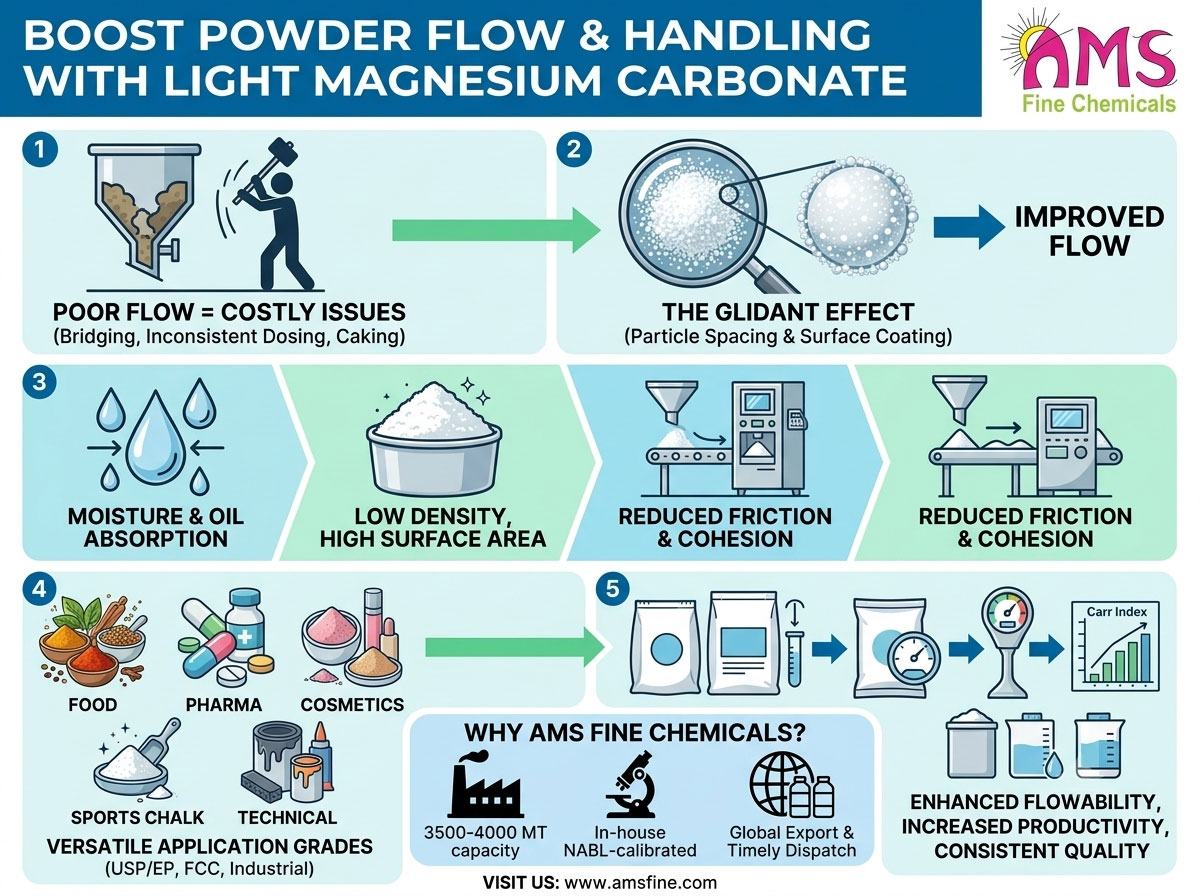
Flow problems rarely announce themselves as “flow problems.” They show up as:
- Bridging and rat-holing in hoppers, where the powder arches over the outlet or flows only through a narrow channel
- Inconsistent dosing and fill weights, leading to giveaway or rejected packs
- Caking in storage, from soft lumps to hard blocks after humid transit
- Dust and product loss at transfer points
- Downtime and cleaning, plus customer complaints about lumpy sachets or pouches
For exporters, the problem is sharper. A blend that flows perfectly in a dry plant in January can arrive as a brick after weeks of sea freight through humid ports.
What Actually Controls Powder Flowability
Before choosing a flow aid, it helps to know what you’re fighting. Flow is a contest between forces that hold particles together and forces that let them slide past each other.
- Interparticle cohesion: As particles get finer, surface forces such as van der Waals attraction become larger relative to particle weight. Very fine powders behave “sticky” for this reason.
- Moisture: Even small amounts of water form liquid bridges between particles. When the water dries or salts recrystallise, those bridges become solid and the powder cakes.
- Particle size distribution: A wide distribution, or a lot of fines, generally worsens flow.
- Shape and surface roughness: Irregular, rough particles interlock and resist movement.
- Electrostatic charge: Dry, fine powders can pick up charge and cling to surfaces.
- Consolidation: Weight in a silo, drum or bag compacts the powder, and longer storage increases the effect.
- Temperature and humidity cycling: Swings during transport drive moisture migration and caking.
A good flow aid tackles one or more of these at low addition levels without changing the product’s character.
What Is Light Magnesium Carbonate?
Light Magnesium Carbonate (MgCO₃) is a fine, white, odourless and tasteless powder. Its defining features are low bulk density and high surface area, which make it an effective absorbent, anti-caking agent and bulking agent. Because the particles are so light and voluminous, a small mass of additive can cover a large number of host particles.
We produce it in application-specific grades, including:
- Food / FCC and food supplements
- EP and USP grades
- Cosmetic grade
- Mouth freshener (pan masala)
- Sports (climbing chalk)
- Rubber, latex condoms and gloves
- Agriculture and animal feed
- Technical / industrial, paints, printing ink and paper
For the specification parameters that matter when you qualify a grade, see our guide to key specifications for Light Magnesium Carbonate: purity, whiteness and moisture absorption. To understand why the light grade behaves so differently from the heavy grade, read Light Magnesium Carbonate vs Heavy: bulk density, particle size and application differences.
How Light Magnesium Carbonate Improves Powder Flow
1. Surface Coating and Particle Spacing (Glidant Action)
When blended into a host powder, fine magnesium carbonate particles distribute onto the surfaces of larger particles. They act as microscopic spacers, reducing direct contact between host particles and lowering the friction and cohesion between them. The powder pours more freely because fewer particle-to-particle contacts are actually “sticky.”
This is why surface area matters so much. More surface means more coverage at a given dose. Our post on how surface area influences Light Magnesium Carbonate performance goes deeper into this relationship.
2. Moisture Uptake at Particle Surfaces
The porous structure of light magnesium carbonate lets it take up surface moisture that would otherwise form liquid bridges between host particles. Reducing those bridges helps prevent soft lumps and the hard caking that follows drying. It’s worth being realistic here: this is a supporting effect, not a replacement for proper drying, sealed packaging and humidity control. For the moisture side of the story in a different industry, see Light Magnesium Carbonate for moisture control in personal care products.
3. Absorbing Oils and Liquids
Some ingredients, such as fragrances, oils, liquid actives and tacky extracts, turn a blend sticky. Light magnesium carbonate can carry these liquids on its porous surface, converting a clumpy mix into a dry-feeling, flowable powder. We explain the mechanism in Light Magnesium Carbonate for oil absorption: mechanism and applications.
4. Bulking and Dilution of Cohesive Ingredients
A small quantity of a very cohesive active can be diluted into a flowable carrier, making it easier to meter and blend evenly. In pharmaceutical work, this dual filler and flow role is one reason the material appears as an excipient. See Light Magnesium Carbonate as a functional excipient: what manufacturers should know.
Choosing the Right Grade: Light, Ultra Light or Heavy
Grade selection changes both the flow benefit and the handling experience.
| Grade | Character | Typical role for flow and handling |
|---|---|---|
| Light | Low bulk density, high surface area | Balanced choice as a flow aid, anti-caking agent and absorbent |
| Ultra Light | Even higher surface area and bulk | Maximum coverage and absorption where volume is not a constraint |
| Heavy | Denser, less bulky | Easier to meter and store, suited to high-loading formulations |
Explore the full range on our product pages: Magnesium Carbonate, Light Magnesium Carbonate, Ultra Light Magnesium Carbonate and Heavy Magnesium Carbonate. For the reasoning behind each, read Ultra Light Magnesium Carbonate: understanding its high surface area and Heavy Magnesium Carbonate for high-loading formulations. You can also browse all posts in our Light Magnesium Carbonate blog category, Ultra Light category and Heavy category.
Where Better Flow Matters Most
Food, Spices, Salt and Powdered Mixes
Salt, spice blends, seasoning premixes and powdered beverages absorb moisture and cake easily. Food grade Light Magnesium Carbonate is used as an anti-caking agent to keep them pourable through storage and distribution. The regulatory position varies by market and product category, so always confirm the permitted additive and level for your destination. Our detailed guide covers this: Light Magnesium Carbonate as anticaking agent in spices, salt and powdered foods.
Pharmaceutical and Nutraceutical Powders
Antacid sachets, effervescent granules and powder blends for tablets and capsules all depend on consistent flow for accurate dosing and uniform fill. Available in EP and USP grades, Light Magnesium Carbonate supports these formulations as both a functional excipient and a flow aid. Read more in Light Magnesium Carbonate in pharmaceutical powder formulations and using Light MgCO3 in effervescent tablets and suspensions.
Cosmetics and Personal Care Powders
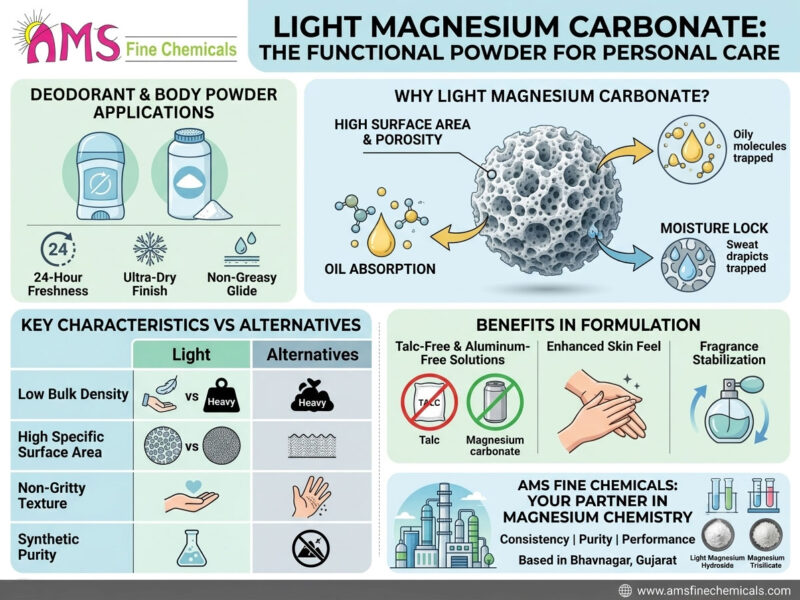
Loose powders, pressed powders, dusting powders and deodorant bases need a smooth feel, good spreadability and resistance to clumping. Light Magnesium Carbonate adds absorbency and slip while keeping the powder loose. Related reading: Light Magnesium Carbonate for face powders and loose powder formulations, Light Magnesium Carbonate in cosmetics: oil absorption and texture benefits and Light Magnesium Carbonate in deodorant and body powder formulations.
Sports Chalk
Climbing and gymnastics chalk must stay loose and absorb sweat evenly. Porosity is central to both, as explained in Light Magnesium Carbonate in sports chalk: why porosity matters.
Technical and Industrial Powders
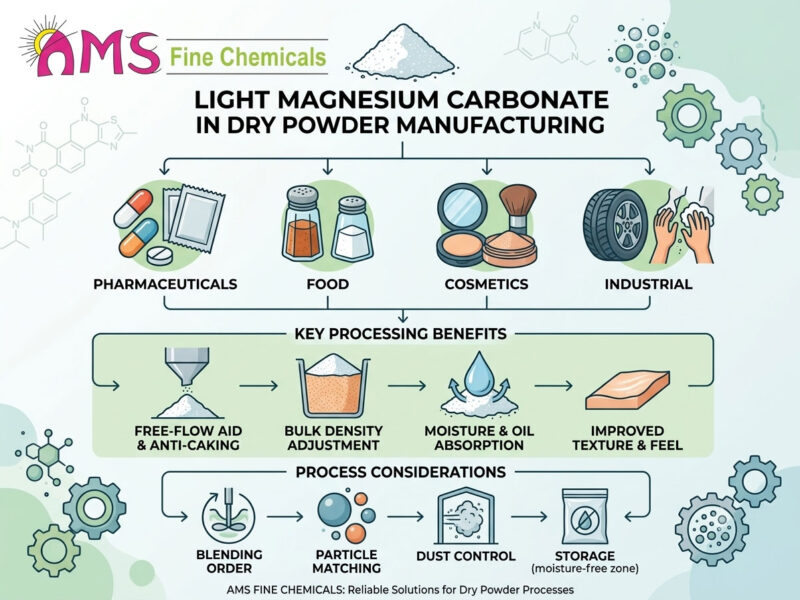
In rubber, paints, printing ink, paper and technical blends, consistent flow keeps dosing and dispersion predictable. For the process view across dry blending, mixing and drying, see Light Magnesium Carbonate in dry powder manufacturing processes. To see all the sectors we support, visit Industries We Serve and Applications.
How to Use It: A Practical Method
There is no universal dose, because the right amount depends on your host powder, particle size, humidity exposure and target regulation. This method gives you a disciplined starting point.
- Dry your host material first. A flow aid can’t undo a powder that’s already wet or caked. Confirm moisture content before you start.
- Start low. Trials commonly evaluate additions somewhere around 0.5% to 2% by weight, then move up or down based on measured results. For food and pharma, confirm the permitted level for your grade and market before you finalise.
- Pre-blend for even distribution. Mix the additive with a small portion of the host powder first, then add that pre-mix to the main batch. This avoids pockets of neat additive.
- Blend long enough to coat, not so long you waste time. Coating depends on mixing intensity and time. Use a trial to find the point where flow stops improving.
- De-lump where necessary. If the host powder contains agglomerates, sieve or mill them before the flow aid goes in.
- Test under realistic conditions. Measure fresh, then again after humidity and storage exposure similar to your real supply chain.
How to Measure the Improvement
“It seems to flow better” isn’t enough for a quality system. Use numbers.
| Test | What it tells you |
|---|---|
| Angle of repose | Lower angles indicate freer flow |
| Bulk and tapped density | Used to calculate Carr’s index and Hausner ratio |
| Orifice or funnel flow rate | Whether the powder discharges steadily, or at all |
| Shear cell testing | Flow behaviour under consolidation, useful for hopper design |
| Moisture content | Tracks the driver behind most caking |
| Caking or humidity storage test | Whether the benefit holds over time |
A commonly used flow scale (as in USP general chapter on powder flow) helps you interpret the numbers:
| Flow character | Carr’s index (%) | Hausner ratio | Angle of repose (°) |
|---|---|---|---|
| Excellent | ≤10 | 1.00–1.11 | 25–30 |
| Good | 11–15 | 1.12–1.18 | 31–35 |
| Fair | 16–20 | 1.19–1.25 | 36–40 |
| Passable | 21–25 | 1.26–1.34 | 41–45 |
| Poor | 26–31 | 1.35–1.45 | 46–55 |
| Very poor | 32–37 | 1.46–1.59 | 56–65 |
| Very, very poor | >38 | >1.60 | >66 |
Record your baseline first, add the flow aid, then retest. If a dose change doesn’t move these numbers, it isn’t doing the job.
Handling Light Magnesium Carbonate Itself
Here is the honest part. Light Magnesium Carbonate helps other powders flow, but as a low-density, high-surface-area powder it needs care in its own right.
- Plan for volume. A kilogram of light grade occupies far more space than a kilogram of heavy grade. Size bags, hoppers, blenders and storage accordingly, and check the bulk density on your technical data sheet.
- Control dust. Light powders become airborne easily. Use closed transfer where possible, minimise drop heights, provide dust extraction and wear appropriate PPE (dust mask, gloves, eye protection). Follow the Safety Data Sheet.
- Test your feeder with the real grade. Aerated, low-density powders can behave differently from denser ones, sometimes flushing through a feeder when fluffed and packing when settled. Trial screw feeders, agitation and hopper geometry with the actual material.
- Keep it dry. Store in a cool, dry place away from humidity, ideally in a shed protected from weather. Keep containers tightly closed once opened and use the material as soon as practical.
- Mind the shelf life. Our documentation gives a shelf life of 5 years for sealed, undamaged packs.
- Keep away from acids. Carbonates react with acids to release carbon dioxide. That is useful in effervescent products and unwanted in most others, so keep it apart from acidic materials in storage and processing.
- Know the packing. Standard packs are 20 kg or 25 kg HDPE bags with an inner LDPE liner, loaded on fumigated, shrink-wrapped ISPM Euro pallets. Jumbo bags and custom packing are available for bulk quantities.
Troubleshooting Quick Guide
| Problem | Likely cause | What to try |
|---|---|---|
| Hard lumps after humid transit | Moisture pickup and recrystallisation | Dry host material, add or increase flow aid, improve liner and sealing |
| Still bridging in the hopper | Consolidation, hopper geometry | Test with shear cell, review outlet size and wall angle, then re-dose |
| Uneven flow after blending | Poor additive distribution | Use pre-blend method, extend mixing slightly, check for agglomerates |
| Blend became too bulky | High-volume light grade at high dose | Lower the dose or evaluate a denser grade |
| Excess dust at charging | Fine, low-density powder | Closed charging, extraction, lower drop height |
| Dosing drifts over a shift | Air entrainment, feeder unsuited | Change feeder type, add agitation, deaerate |
Why Source From AMS Fine Chemicals
Flow performance depends on consistency from batch to batch, and that starts with the manufacturer.
- Manufacturer and exporter of magnesium carbonate, magnesium hydroxide and magnesium trisilicate from Bhavnagar, Gujarat
- Installed capacity of 3,500 to 4,000 MT of Light Magnesium Carbonate annually
- Application-specific grades from food and pharma to rubber, ink and chalk
- In-house physico-chemical and microbiological laboratory, with instruments calibrated by a NABL-accredited lab
- Export-ready packing and loading from Mundra and Pipavav ports, with dispatch usually within 10 to 15 days of a confirmed purchase order
- Documents on request: technical datasheet, COA, MSDS/SDS and packing photographs
Looking for something beyond magnesium carbonate? Our range also includes Magnesium Hydroxide, Light Magnesium Hydroxide, Heavy Magnesium Hydroxide and Magnesium Trisilicate. See the complete list on our Products page, or learn more about us.
Frequently Asked Questions
How does light magnesium carbonate improve powder flow?
Its fine particles coat the surfaces of larger particles and act as spacers, reducing friction and cohesion. Its porous structure also takes up surface moisture and can carry small amounts of oils, which helps prevent clumping and stickiness.
How much should I add?
Trials commonly begin at around 0.5% to 2% by weight, adjusted based on measured flow results. The permitted and effective level depends on your host powder, grade and destination regulation, so verify it for your application.
Is light or heavy magnesium carbonate better for flow?
Light grade offers more surface area and coverage per gram, so it’s usually preferred as a flow aid, anti-caking agent or absorbent. Heavy grade is denser and easier to meter, and suits high-loading formulations. See our comparison of light and heavy grades.
Can it replace proper drying and packaging?
No. It supports moisture management but cannot fix a wet powder or a poorly sealed pack. Dry the host, use suitable liners and control storage conditions.
Is light magnesium carbonate dusty?
It can be, given its low density. Use dust extraction, closed transfers and PPE, and follow the SDS.
Can I get samples and documents before ordering?
Yes. Contact us for samples, a technical datasheet, COA, SDS and a quotation.
Conclusion
Good powder flow isn’t luck. It comes from understanding the forces at work, choosing the right additive and grade, dosing it sensibly, measuring the result, and handling the material properly. Light Magnesium Carbonate is a well-proven tool for that job, working through particle spacing, moisture uptake and liquid absorption. Used with discipline, it can reduce caking, stabilise dosing and make powder handling easier from the plant floor to the customer’s warehouse.
Ready to test it in your process? Contact AMS Fine Chemicals at info@amsfine.com or WhatsApp +91 70433 38890, or use our contact page to request a sample, technical datasheet or quote for Light Magnesium Carbonate.