An adhesive is judged by what it holds together, but its performance is built from the ingredients that make up the bulk of the formula. The polymer or resin does the bonding. The fillers decide how the adhesive flows, how it sags on a vertical surface, how much it costs per kilogram, how it behaves in a fire and how it ages in storage. Mineral fillers are therefore among the most consequential decisions a formulator makes, even though they rarely get the attention that resins do.
Heavy Magnesium Carbonate is a dense, free-flowing mineral filler that suits several adhesive systems. It disperses easily, it demands little from the binder, and it brings useful secondary functions such as flame retardancy and mild pH buffering. This guide explains how it behaves in adhesive formulations, where it fits, how to work with it and how to choose a supplier. It comes from the technical team at AMS Fine Chemicals, a manufacturer and exporter of magnesium compounds based in Bhavnagar, Gujarat.
What Is Heavy Magnesium Carbonate?
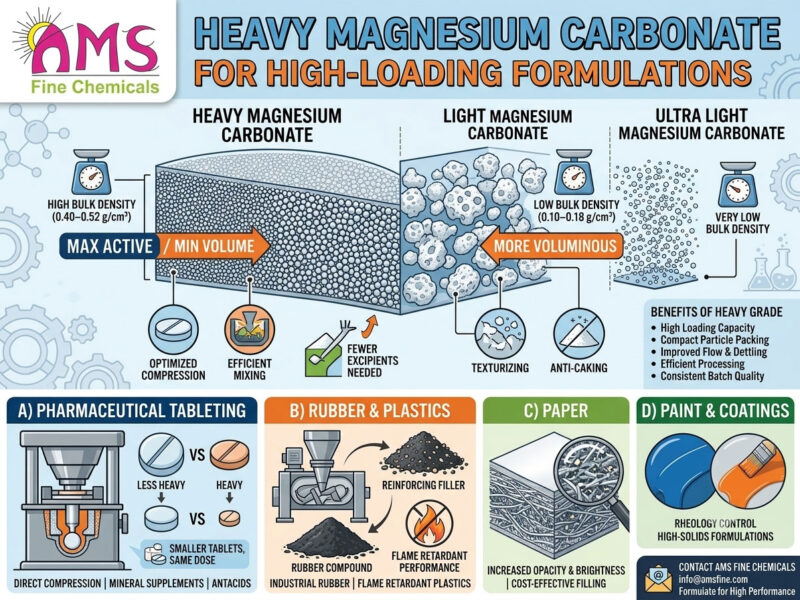
Magnesium carbonate is produced commercially in several grades that differ mainly in physical structure, not in chemical identity. The grades are usually described as Light, Ultra Light and Heavy. The difference is particle morphology: how porous, how bulky and how dense the particles are.
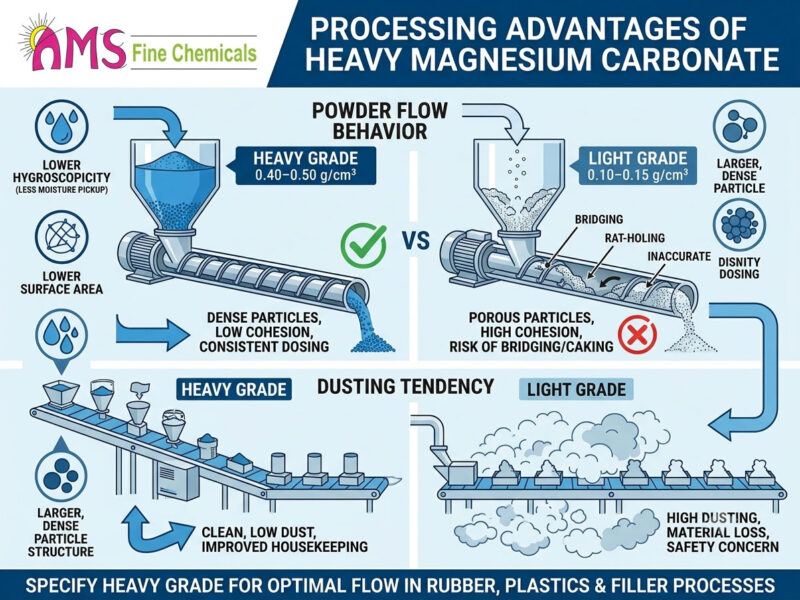
Heavy Magnesium Carbonate sits at the dense end. Its particles pack tightly, so it has a higher bulk density, lower porosity and lower liquid absorption than the lighter grades. Those traits make it easier to handle and easier to load into liquid and paste systems. Our article on how magnesium carbonate particle morphology influences industrial performance explains why particle structure matters so much, and our post on heavy magnesium carbonate and powder flow covers the handling side.
For adhesive manufacturers, this combination is attractive. The grade behaves predictably during mixing, does not soak up excessive amounts of resin or solvent, and lets formulators build solids content without viscosity running out of control. You can see the full range on our Magnesium Carbonate page, and the grade itself on the Heavy Magnesium Carbonate product page.
Why Fillers Matter So Much in Adhesive Formulations
Many people outside the industry assume fillers are cheap bulk added to lower cost. Cost reduction is one reason to use them, but it is rarely the only one. In a well-designed adhesive, the filler contributes to nearly every property that matters in production and in use:
- Rheology: viscosity, thixotropy and sag resistance
- Application behaviour: spreadability, open time and gap-filling
- Mechanical performance: cohesive strength, hardness and shrinkage
- Fire and thermal behaviour: flame spread, smoke and heat resistance
- Appearance: whiteness, opacity and colour consistency
- Storage stability: settling, skinning and shelf life
- Economics: cost per unit of volume and solids content
A filler that is wrongly chosen can raise viscosity beyond what the equipment can pump, absorb plasticiser and make the cured bond brittle, or react with other components and shorten shelf life. A filler that is well chosen helps on several fronts at once. That is why technical teams evaluate fillers as functional ingredients, not as commodity bulk.
Properties of Heavy Magnesium Carbonate That Matter in Adhesives
Dense, Compact Particle Structure
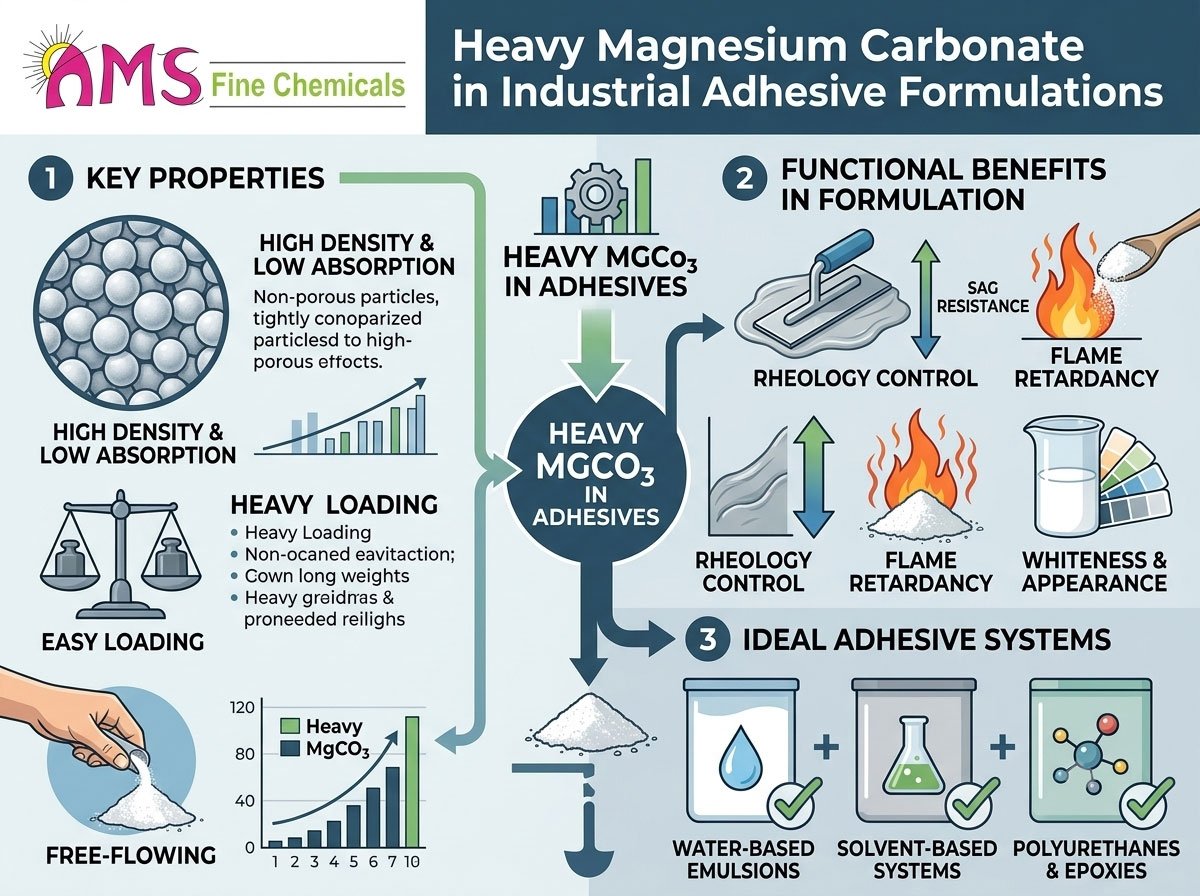
The defining feature of the heavy grade is its dense particle structure. In adhesive terms, this has three consequences.
First, liquid absorption is lower. Porous fillers draw resin, plasticiser or solvent into their pores. That raises viscosity and removes liquid that would otherwise lubricate the system. Dense particles absorb less, so more of the liquid phase stays available as a continuous medium.
Second, loading capacity is better. Because each particle takes up less of the liquid phase, formulators can usually add more filler before viscosity becomes a problem. That is valuable where high solids content is desired.
Third, bulk handling is easier. Dense powders flow more reliably from bags and hoppers, meter more accurately and generate less dust than very light, fluffy materials.
Low Water Solubility
Magnesium carbonate is practically insoluble in water. This matters in water-based adhesives, where a filler that dissolved would release ions into the system and could destabilise an emulsion. Low solubility keeps the filler as a distinct solid phase. Our guide to magnesium carbonate solubility and acid reactivity explains the chemistry in detail, including why a material can be nearly insoluble in water yet reactive with acid.
Mild Alkalinity and Acid Reactivity
The small fraction that does dissolve makes the surrounding water mildly alkaline. In practice, this gives the filler a gentle buffering ability. It also means formulators must remember that magnesium carbonate reacts with acids and releases carbon dioxide. In an adhesive containing acidic components, that reaction can cause foaming, pressure build-up or loss of performance if it is not planned for. We return to this in the formulation section below.
Thermal Decomposition
When heated strongly, magnesium carbonate decomposes, absorbing heat and releasing carbon dioxide and, depending on the form, water vapour, leaving magnesium oxide behind. That endothermic behaviour is the basis of its flame-retardant function. Our article on the thermal decomposition of magnesium carbonate explains the temperature behaviour and why it matters industrially.
Colour and Whiteness
Magnesium carbonate is a white mineral. It supports bright, clean-looking adhesives and sealants and avoids the yellow or grey tint that some other fillers introduce. This matters in adhesives used where the bond line is visible, such as in woodworking, packaging, labelling and decorative laminates.
The Functional Roles of Heavy Magnesium Carbonate in Adhesives
1. Filler and Extender
At the simplest level, heavy magnesium carbonate replaces part of the more expensive polymer or resin while maintaining, or in some cases improving, performance. Because it is dense and has low liquid demand, it can be loaded at meaningful levels without making the adhesive impractical to process. This gives manufacturers more control over cost per kilogram and cost per cured volume.
2. Rheology and Viscosity Control
Adhesive rheology is a balancing act. The product must flow enough to be pumped, spread or dispensed, then resist running or sagging once applied. Fillers shape this behaviour.
Dense fillers such as heavy magnesium carbonate generally raise viscosity less steeply than lightweight, high-absorption grades. That makes them suitable where a formulator wants to build solids and body without the sharp viscosity rise that very porous fillers cause. For systems that need more pronounced thickening or thixotropy, lighter grades or other additives may be used in combination. Our post on ultra light magnesium carbonate for high-absorption industrial applications explains where the opposite end of the range is useful.
3. Gap-Filling and Sag Resistance
Adhesives used on uneven or porous substrates, or on vertical surfaces, must fill small gaps and hold their position. A well-dispersed mineral filler contributes body and structure to the adhesive film, helping it bridge small irregularities and resist slumping before cure. The practical result is a more forgiving product on real-world substrates, not just on smooth laboratory test panels.
4. Flame Retardancy and Smoke Suppression
Fire performance is a growing concern in construction, transport and electronics, and adhesives are part of the fire load of many assemblies. Magnesium carbonate helps in three ways:
- Its decomposition absorbs heat, slowing temperature rise in the burning material.
- The carbon dioxide and water vapour released dilute flammable gases near the surface.
- The residual magnesium oxide forms a protective, insulating layer.
Because it is a halogen-free approach, it also avoids the corrosive and toxic gases that some halogenated flame retardants release. Magnesium carbonate is usually part of a broader flame-retardant package and is not a standalone solution. Its decomposition begins at relatively moderate temperatures compared with some other mineral fillers, so formulators need to match the filler to the processing and service temperature of the adhesive. Magnesium hydroxide is often considered alongside it, and our article on why magnesium hydroxide provides controlled alkalinity explains how that neighbouring compound behaves. You can also review our Magnesium Hydroxide and Heavy Magnesium Hydroxide product pages for comparison.
5. pH Buffering and Mild Acid Scavenging
Some adhesive systems generate or contain traces of acid. Examples include residual acidity from polymerisation, hydrolysis of certain polymers over time, and acidic additives. A mildly alkaline, low-solubility filler can help neutralise small amounts of acid gradually, protecting substrates, metal packaging and the adhesive itself. This is a supporting benefit, not a replacement for dedicated acid acceptors used in some chemistries.
6. Whiteness, Opacity and Appearance
For adhesives where appearance matters, magnesium carbonate helps deliver a clean white colour and contributes to opacity. Combined with other pigments, it supports consistent colour batch to batch.
Where Heavy Magnesium Carbonate Fits Across Adhesive Systems
Adhesive chemistries differ widely, and so do their filler requirements. The notes below describe general fit. As always, laboratory trials with your own resin and process are the final test.
Water-Based Emulsion Adhesives
Polyvinyl acetate (PVAc), acrylic and similar emulsion adhesives are widely used in woodworking, paper, packaging and construction. The low water solubility of magnesium carbonate makes it a practical filler here. It should be dispersed carefully, since the emulsion’s stability depends on its surfactant system, and any filler must be compatible with it. Moisture content and pH of the final system should be checked after addition.
Solvent-Based Adhesives
In solvent-borne contact and construction adhesives, a dense, low-absorption filler helps because it does not soak up large volumes of solvent. That keeps viscosity workable and helps maintain predictable drying behaviour.
Polyurethane Adhesives and Sealants
Polyurethane systems are sensitive to moisture and to acidic or basic contaminants, since isocyanate chemistry is easily disturbed. A filler used in such a system must be properly dried and verified for moisture content. Our article on magnesium carbonate moisture absorption is especially relevant, because uncontrolled moisture in a polyurethane formulation can cause foaming or premature gelling.
Epoxy and Other Reactive Systems
In two-component reactive adhesives, mineral fillers adjust viscosity, reduce shrinkage and control exotherm by adding thermal mass. A dense filler is easier to blend into the resin side, and it does not generally interfere with typical curing chemistries. Compatibility with the specific curing agent should still be confirmed.
Hot-Melt and Construction Adhesives
For systems that are processed hot, the thermal behaviour of the filler matters. Formulators need to confirm that processing temperatures stay below the point where magnesium carbonate begins to decompose. For construction and panel adhesives, the combination of body, cost control and flame-retardant benefit makes it a candidate worth evaluating.
Sealants and Caulks
Though technically distinct from adhesives, sealants share many formulation principles. Fillers contribute to sag resistance, hardness and cost balance, and a white, consistent filler supports clean-looking joints.
Practical Formulation Guidelines
The following points reflect common good practice. Specific loading levels depend on the polymer, other fillers, plasticiser level and target properties, so use them as starting points for trials, not fixed rules.
Start With Laboratory Trials
Prepare a series of small batches with stepped filler levels. Measure viscosity, sag behaviour, open time, bond strength and cured properties at each level. Look for the point where performance peaks, not just where cost falls.
Control Moisture
Magnesium carbonate can pick up moisture from humid air. For water-based systems, this matters less. For moisture-sensitive chemistries such as polyurethanes, dry the filler according to your process requirements and store it in sealed packaging. Our post on magnesium carbonate moisture absorption covers this in more depth.
Watch for Acidic Components
Because the carbonate reacts with acid and releases carbon dioxide, check every ingredient for acidity before combining it with the filler. Acidic catalysts, certain tackifiers and some additives can trigger a reaction. Test small batches and watch for foaming, pressure build-up or viscosity drift on storage.
Disperse Properly
Good dispersion matters for appearance, strength and rheology. Add the filler gradually under adequate shear, and make sure agglomerates are broken down. Wetting agents or dispersants may help, depending on the system. Poorly dispersed filler can cause specks, uneven viscosity and weak spots in the bond.
Mind Processing Temperatures
Check the maximum temperature the adhesive reaches during mixing, application and cure. If it approaches the decomposition range of magnesium carbonate, expect gas release and changes in performance. Consult our article on thermal decomposition when setting limits.
Consider Combining Fillers
Many successful adhesives use more than one filler. A dense grade may provide body and cost control, while a lighter grade or a fumed additive provides thickening. Combining fillers lets formulators tune rheology and cost independently.
Check Storage Stability
Run accelerated ageing and shelf-life tests. Watch for viscosity changes, settling, skinning, colour drift and any signs of reaction between the filler and the binder.
Choosing Between Heavy, Light and Ultra Light Grades
The right grade depends on what the adhesive needs most.
| Priority in the formulation | Grade often considered |
|---|---|
| High loading, easy dispersion, low viscosity impact | Heavy Magnesium Carbonate |
| Moderate bulk with better thickening effect | Light Magnesium Carbonate |
| High absorption and strong thickening or carrying capacity | Ultra Light Magnesium Carbonate |
Heavy grade is generally the first option when the aim is to add solids and body without sharply raising viscosity. Where more thickening or absorption is required, formulators may evaluate Light Magnesium Carbonate or Ultra Light Magnesium Carbonate. For a closer look at how lighter grades behave, read our posts on light magnesium carbonate for improving powder flow and handling and ultra light magnesium carbonate for high-absorption industrial applications. Our broader guide to how to select the right magnesium carbonate grade for your application walks through the decision step by step.
Quality Parameters Adhesive Manufacturers Should Check
Filler quality directly affects batch consistency. When reviewing a supplier’s Certificate of Analysis, adhesive formulators typically look at:
- Assay and purity: confirms the material is what it claims to be
- Particle size distribution: influences dispersion, smoothness and rheology
- Bulk density: a key identifier of grade and a driver of handling behaviour
- Moisture content: critical in moisture-sensitive systems
- Loss on ignition: indicates decomposition behaviour and composition
- Acid-insoluble matter and trace impurities: relevant to consistency and to appearance
- Colour and whiteness: important in visible bond lines
Our guide to magnesium carbonate COA and the most important quality parameters explains how to read each of these and what to question when numbers look unusual.
Batch-to-batch consistency is as important as any single value. An adhesive line tuned to one particle size distribution can behave differently if the next lot shifts, even when assay is unchanged. Ask suppliers how they control consistency and request a representative sample before committing to bulk supply.
Troubleshooting Common Issues
Viscosity is higher than expected. Check whether a lighter, more absorptive grade was used by mistake, whether the filler was added too quickly, and whether moisture pickup has caused agglomeration. Switching to or blending in heavy grade often helps.
Foaming or gas release during mixing or storage. Look for acidic components and for excess moisture in moisture-sensitive systems. The reaction between magnesium carbonate and acid releases carbon dioxide.
Specks or rough texture in the film. This usually points to poor dispersion or oversized agglomerates. Improve shear, wetting and addition rate.
Settling in storage. Dense fillers settle more readily than light ones. Adjust rheology with a suitable thickener or thixotrope, or adjust the particle size and loading.
Loss of bond strength at high filler levels. There is a limit beyond which the filler starves the binder. Reduce the loading, or reconsider the balance of resin, plasticiser and filler.
Unexpected colour or yellowing. Check other ingredients and processing temperature. Magnesium carbonate itself is white, so discolouration usually comes from elsewhere.
Sourcing Heavy Magnesium Carbonate for Adhesives
Technical fit is only half the decision. The other half is whether the supplier can deliver consistent quality, in the right volumes, on time and with proper documentation. Our guide on how to evaluate a magnesium carbonate supplier for bulk procurement lists the questions worth asking, from manufacturing control to packaging and export support. It also helps to understand how the material is made. Our complete guide to the magnesium carbonate manufacturing process explains why process control affects particle structure and consistency.
How AMS Fine Chemicals Supports Adhesive Manufacturers
AMS Fine Chemicals manufactures and exports magnesium compounds from Bhavnagar, Gujarat, including Light, Ultra Light and Heavy Magnesium Carbonate, Magnesium Hydroxide in Light and Heavy grades, and Magnesium Trisilicate. For adhesive customers, we support:
- Grade guidance for matching particle structure to the adhesive system
- Certificates of Analysis to support formulation validation and incoming inspection
- Sample supply so you can run laboratory trials before committing to volume
- Consistent batch quality controlled through in-house testing
- Export-ready supply with documentation for international buyers
Explore our full range on the Products page, see the Industries We Serve and Application pages for more context, and review the Heavy Magnesium Carbonate product page for specifications.
Frequently Asked Questions
Can heavy magnesium carbonate be used as a filler in water-based adhesives?
Yes. Its low water solubility keeps it as a stable solid phase in emulsion systems. Check compatibility with your surfactant package and confirm pH and viscosity after addition.
Why choose the heavy grade over the light or ultra light grades?
The heavy grade is denser and absorbs less liquid, so it generally allows higher loading with a smaller viscosity increase. Lighter grades are chosen where stronger thickening or higher absorption is needed.
Does magnesium carbonate help with flame retardancy in adhesives?
It can contribute. When heated, it decomposes endothermically and releases carbon dioxide and water vapour, which helps slow burning. It is normally one part of a broader flame-retardant package, and its decomposition temperature must suit the application.
Can it be used in polyurethane adhesives?
It can be evaluated, but moisture control is essential because isocyanate chemistry is moisture-sensitive. Dry the filler and verify moisture content before use.
What happens if magnesium carbonate meets an acidic ingredient?
It reacts and releases carbon dioxide gas, which can cause foaming or pressure build-up. Review all acidic components in the formula and run small-scale tests first.
How much heavy magnesium carbonate should I add?
There is no universal figure. Optimum loading depends on the polymer, other fillers and target properties. Run stepped laboratory trials and measure viscosity, sag, bond strength and storage stability.
Does it affect the colour of the adhesive?
It is a white mineral and generally supports a bright, clean appearance. Any discolouration usually comes from other ingredients or processing conditions.
Can I request a sample?
Yes. Contact AMS Fine Chemicals through our Contact Us page to request a sample and Certificate of Analysis.
Final Word
Heavy magnesium carbonate earns its place in adhesive formulations because it does several jobs at once. It adds body and solids without punishing viscosity, it supports a bright finish, it offers a halogen-free contribution to fire performance, and it provides mild buffering. It also demands respect: it reacts with acids, it needs moisture control in sensitive systems, and it must be matched to processing temperatures.
Formulators who treat it as a functional ingredient, test it properly and source it from a supplier with consistent quality control get the most from it. Whether you are developing a new adhesive or reformulating an existing one for cost, performance or fire safety, AMS Fine Chemicals can help you evaluate whether heavy magnesium carbonate fits your system.
To request a sample, Certificate of Analysis or technical guidance, visit the Heavy Magnesium Carbonate page or reach out through Contact Us.
Related Reading
- Heavy Magnesium Carbonate and Powder Flow: Understanding the Processing Advantage
- How Magnesium Carbonate Particle Morphology Influences Industrial Performance
- Magnesium Carbonate Solubility and Acid Reactivity Explained
- Understanding the Thermal Decomposition of Magnesium Carbonate
- How to Select the Right Magnesium Carbonate Grade for Your Application