Heat a sample of Magnesium Carbonate past a few hundred degrees Celsius, and it stops being Magnesium Carbonate. It loses carbon dioxide, sheds its structural water, and reorganizes into magnesium oxide — a transformation that is simple to write as a chemical equation but genuinely consequential for anyone who manufactures, tests, or formulates with the material. Loss on Ignition testing, calcination processing, refractory manufacturing, and even basic quality control all depend on understanding exactly what happens as Magnesium Carbonate is heated, at what temperatures, and why the decomposition pathway matters as much as the final products.
This guide walks through the thermal decomposition chemistry of Magnesium Carbonate in technical detail — the reaction stages, the thermodynamics behind them, how commercial basic magnesium carbonate decomposes differently from pure mineral magnesite, and why this chemistry underpins several of the analytical tests and industrial processes buyers and formulators rely on every day.
The Basic Decomposition Reaction
At its simplest, thermal decomposition of Magnesium Carbonate follows this reaction:
MgCO₃ (s) → MgO (s) + CO₂ (g)
This is a classic endothermic decomposition reaction — it requires a continuous input of heat energy to proceed, rather than releasing energy the way a combustion reaction would. The reaction is well documented as requiring the transfer of a defined quantity of thermal energy per mole of Magnesium Carbonate decomposed, consistent with its classification as a strongly endothermic process. Because the reaction consumes heat rather than generating it, thermal decomposition processes involving Magnesium Carbonate require sustained, controlled heat input — an important practical consideration for both laboratory testing and industrial calcination operations.
The onset temperature for this decomposition in pure, well-crystallized magnesite is generally documented in the region of 350°C, though the exact temperature at which measurable decomposition begins depends on particle size, crystallinity, heating rate, and the surrounding atmosphere — all of which affect how readily carbon dioxide can escape the solid matrix and how much thermal energy reaches the reacting material.
Why Commercial Magnesium Carbonate Decomposes in Stages, Not One Step
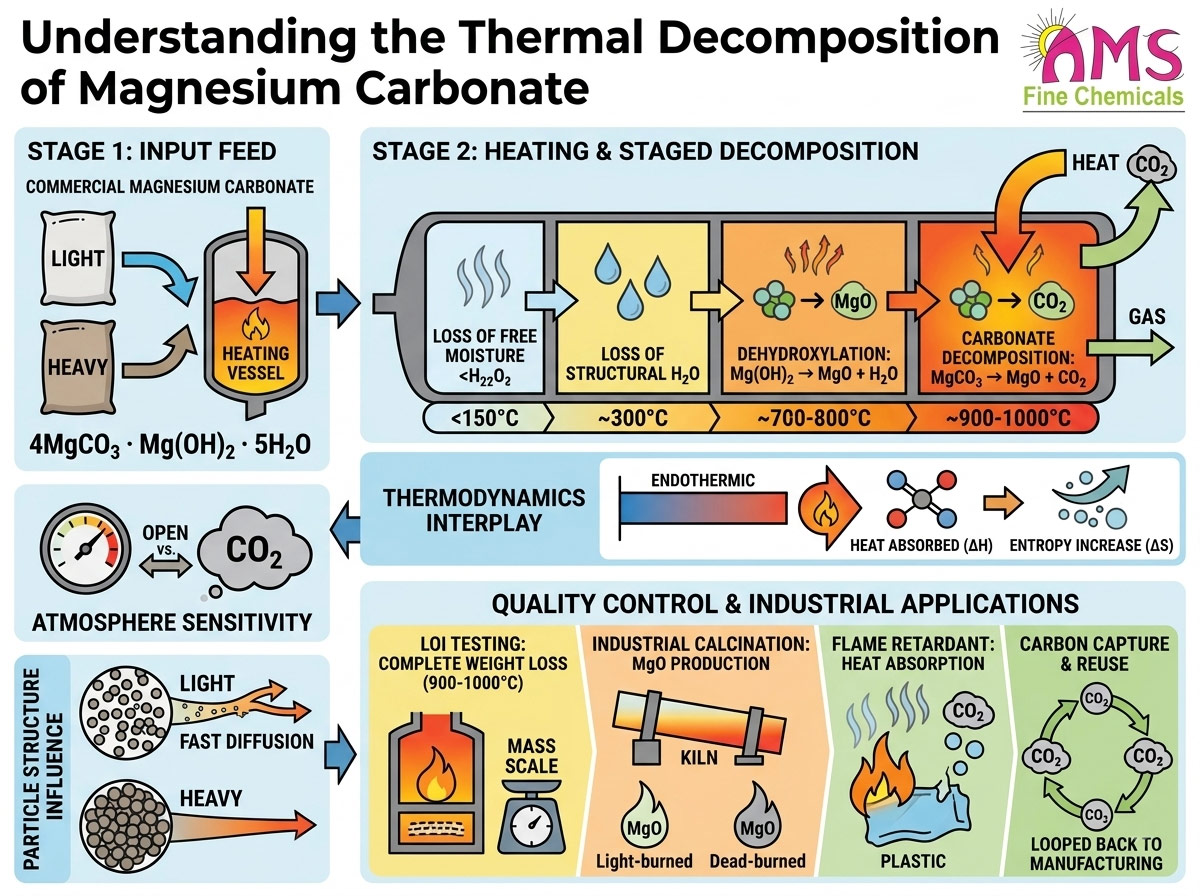
Pure anhydrous magnesite decomposes in essentially a single reaction step. However, most commercial and pharmaceutical-grade Magnesium Carbonate isn’t pure anhydrous MgCO₃ — it’s a basic magnesium carbonate, a hydrated compound incorporating magnesium hydroxide and water of crystallization alongside the carbonate itself, generally represented in reference literature as approximately:
4MgCO₃ · Mg(OH)₂ · 5H₂O
This more complex structure means commercial Magnesium Carbonate typically decomposes through multiple distinct thermal stages as temperature increases, rather than a single clean transformation:
- Loss of free (surface) moisture, occurring at relatively low temperatures, generally below 150°C, representing physically adsorbed water evaporating from the particle surface and pore structure.
- Loss of structural water of crystallization, occurring at somewhat higher temperatures, as the water molecules chemically bound within the crystal lattice are driven off.
- Decomposition of the magnesium hydroxide component, converting Mg(OH)₂ to MgO and releasing additional water vapor, typically occurring in a temperature range overlapping with or just below the main carbonate decomposition stage.
- Decomposition of the carbonate component itself, releasing carbon dioxide gas and completing the conversion to magnesium oxide, generally the dominant mass-loss stage and the one requiring the highest temperature of the sequence.
This multi-stage behaviour is precisely why Loss on Ignition (LOI) testing for Magnesium Carbonate typically specifies a relatively wide acceptable weight-loss range rather than a single precise figure — the total mass lost on heating reflects the combined contribution of all these stages, and the exact proportions can vary somewhat between batches depending on the precise hydration state of the material as manufactured. Our Magnesium Carbonate COA Explained: Important Parameters Buyers Should Check article covers how LOI is tested and interpreted as part of a complete Certificate of Analysis review.
The Thermodynamics Behind the Reaction
Decomposition reactions like this one are governed by the interplay between enthalpy (heat absorbed) and entropy (increase in disorder) as a solid carbonate breaks down into a solid oxide plus a gas. Converting a compact, ordered crystalline solid into a solid product plus a freely expanding gas represents a significant increase in system entropy, which is thermodynamically favourable at sufficiently high temperature — but the reaction also requires substantial energy input to break the carbonate’s chemical bonds, which is thermodynamically unfavourable at lower temperatures.
The practical result is a well-defined decomposition temperature threshold: below it, the carbonate remains thermodynamically stable; above it, decomposition becomes energetically favourable and proceeds, provided sufficient heat is supplied and the carbon dioxide produced is able to escape the reaction environment rather than building up and re-establishing equilibrium with the solid. This last point matters more than it might initially appear.
Why Atmosphere and Gas Pressure Affect Decomposition Temperature
Because the decomposition reaction produces a gas as one of its products, the surrounding atmosphere — specifically, the partial pressure of carbon dioxide already present — directly affects the temperature at which decomposition proceeds:
- In an open system with low ambient CO₂ concentration, carbon dioxide gas readily escapes as it’s produced, allowing the reaction to proceed at its “normal” onset temperature.
- In a closed or CO₂-enriched atmosphere, elevated ambient carbon dioxide partial pressure shifts the reaction equilibrium, requiring a higher temperature before net decomposition proceeds — a principle directly relevant to industrial processes exploring reduced-emission calcination methods.
- Under a reducing atmosphere, such as a methane-containing environment, decomposition behaviour and reaction pathway can shift meaningfully, with research demonstrating that introducing oxygen into such systems can measurably reduce the required reaction temperature by facilitating alternative reaction pathways.
This atmosphere-sensitivity is why standardized Loss on Ignition testing specifies consistent furnace conditions and heating protocols — inconsistent atmosphere control between laboratories or testing runs can introduce measurable variability into LOI results even when testing an identical sample.
Industrial Calcination: Turning Decomposition Into a Manufacturing Process
Thermal decomposition isn’t just an analytical curiosity — it’s the foundation of an entire industrial process category: calcination, used to produce magnesium oxide (MgO) at commercial scale from magnesium carbonate feedstock.
Industrial calcination of magnesium carbonate or magnesite typically involves:
- Controlled, staged heating through rotary kilns or fluidized bed calciners, designed to manage the endothermic heat demand efficiently at production scale.
- Residence time optimization, balancing complete decomposition against energy consumption and, in some processes, controlling the resulting MgO’s reactivity and particle characteristics — since MgO calcined at different temperatures and hold times exhibits different surface area and reactivity, ranging from highly reactive “light-burned” MgO to dense, low-reactivity “dead-burned” MgO used in refractory applications.
- Carbon dioxide capture and reuse, an increasingly important consideration given the substantial CO₂ volume generated by carbonate calcination at industrial scale — some modern facilities implement closed-loop systems that capture the liberated CO₂ and reintroduce it into upstream carbonation stages of magnesium compound manufacturing, reducing the overall process’s net carbon footprint. Our Complete Guide to Magnesium Carbonate Manufacturing Process describes this kind of carbon recycling approach in the broader context of how Magnesium Carbonate itself is manufactured.
Research into more energy-efficient decomposition pathways continues to be an active area of process engineering, including approaches that decompose magnesium carbonate in the presence of biomass or waste plastic feedstocks specifically to reduce net carbon dioxide emissions and, in some experimental configurations, generate valuable hydrogen or syngas byproducts alongside the magnesium oxide.
How Decomposition Temperature Relates to Grade and Particle Structure
The temperature at which a specific batch of Magnesium Carbonate begins measurable decomposition isn’t a fixed universal constant — it varies meaningfully with the material’s particle size, morphology, and crystallinity:
- Finer, higher-surface-area particles — characteristic of Light Magnesium Carbonate and Ultra Light Magnesium Carbonate — generally allow gas to escape more readily during decomposition, since shorter internal diffusion paths mean carbon dioxide produced deep within a particle has less distance to travel before reaching the particle surface and escaping. This can result in slightly lower apparent onset temperatures and more complete decomposition at a given hold time compared to coarser material.
- Denser, lower-surface-area particles — characteristic of Heavy Magnesium Carbonate — can exhibit somewhat different decomposition kinetics, since gas diffusion through a denser particle structure proceeds more slowly, potentially requiring longer hold times to achieve equivalent completeness of decomposition at a comparable temperature.
- Crystal structure and morphology more broadly influence decomposition behaviour, since the internal architecture that governs gas diffusion pathways is itself a function of the particle’s crystal habit — a connection explored in more depth in our article on How Magnesium Carbonate Particle Morphology Influences Industrial Performance.
This is one of several reasons why particle size and morphology specifications matter beyond their more commonly discussed roles in flowability and surface reactivity — they also influence how the material behaves under thermal processing, whether that’s a laboratory LOI test or a full industrial calcination run.
Comparing Decomposition Behaviour Across Related Magnesium Compounds
Formulators and process engineers working across multiple magnesium-based materials benefit from understanding how Magnesium Carbonate’s decomposition compares to related compounds in the same product family:
- Magnesium Hydroxide (Mg(OH)₂) decomposes through a single-stage dehydroxylation reaction, releasing water vapor to form magnesium oxide, typically at a somewhat lower onset temperature than the carbonate decomposition stage of Magnesium Carbonate. This lower decomposition temperature is part of why Magnesium Hydroxide is often favoured as a flame retardant additive in applications where earlier heat absorption during a fire event is desirable — a distinction covered in our Magnesium Hydroxide as Eco-Friendly Flame Retardant in Plastics, Rubber, and Wire/Cable Compounds article.
- Magnesium Trisilicate, a hydrated magnesium silicate rather than a carbonate, follows a different thermal behaviour entirely — its loss on ignition reflects loss of adsorbed and structurally bound water rather than a true decomposition reaction with gas evolution from a carbonate group, since silicates don’t carry the same carbonate-to-oxide transformation pathway. Our Magnesium Trisilicate BP vs. USP: Understanding Pharmaceutical Grade Specifications guide discusses how loss on ignition is interpreted differently for this related but chemically distinct compound.
- Dolomite (CaMg(CO₃)₂), a mixed calcium-magnesium carbonate mineral, typically decomposes in two distinct temperature stages, with the magnesium carbonate component decomposing at a lower temperature than the calcium carbonate component — a well-documented thermal behaviour that differs meaningfully from the single-cation decomposition profile of pure Magnesium Carbonate.
Recognizing these differences matters for formulators selecting between related magnesium compounds specifically for their thermal behaviour, such as in flame retardant system design, where the temperature at which heat-absorbing decomposition occurs needs to align with the specific fire-response profile the application requires.
Practical Implications for Testing and Quality Control
Understanding thermal decomposition chemistry directly informs how several standard quality control tests should be interpreted:
- Loss on Ignition (LOI): Reflects the combined mass loss from all decomposition stages — free moisture, structural water, hydroxide decomposition, and carbonate decomposition — heated to a standardized high temperature, typically in the 900–1000°C range, well above the point where all stages are complete.
- Thermogravimetric Analysis (TGA): Provides a far more granular picture than a single LOI figure, tracking weight loss continuously as temperature rises and allowing each individual decomposition stage to be identified and quantified separately — valuable for troubleshooting unexpected LOI results or characterizing a material’s precise hydration state.
- Differential Scanning Calorimetry (DSC): Measures the heat flow associated with each decomposition stage, confirming the endothermic nature of the reactions and providing additional structural confirmation alongside TGA weight-loss data.
For buyers and quality teams who see an LOI result that seems unusually high or low relative to typical values, TGA data — showing exactly where in the heating profile the mass loss occurs — is often the fastest way to distinguish between a genuine quality issue and a normal batch-to-batch variation in hydration state.
Common Interpretation Errors When Reading Decomposition Data
Even experienced quality control teams occasionally misinterpret thermal decomposition test results. A few recurring errors worth flagging:
- Assuming a single LOI figure tells the whole story. Because LOI aggregates multiple decomposition stages into one number, two batches with identical LOI results can still have meaningfully different moisture-versus-carbonate content ratios — a distinction only TGA data can reveal, and one that matters when the specific balance of free moisture versus bound carbonate affects downstream processing behaviour.
- Comparing LOI results tested under different furnace conditions. Because atmosphere and heating protocol measurably affect decomposition completeness, LOI figures from laboratories using different testing standards or equipment aren’t always directly comparable without confirming both used equivalent methodology.
- Treating decomposition onset temperature as a fixed constant. As covered above, onset temperature shifts with particle size, atmosphere, and heating rate — a decomposition threshold quoted from one reference source may not directly apply to a specific batch’s particle characteristics or testing conditions without qualification.
- Overlooking hold time in calcination process design. Reaching the correct temperature doesn’t guarantee complete decomposition if the material isn’t held at that temperature long enough for gas diffusion to complete throughout the particle bed, particularly relevant for denser, larger-particle material processed at industrial scale.
Avoiding these interpretation errors is particularly important when troubleshooting an unexpected batch result or qualifying a new supplier, since a genuine process or quality issue can be masked — or a normal variation misdiagnosed as a defect — if decomposition data isn’t interpreted with these nuances in mind.
Relevance to Downstream Applications
Thermal decomposition behaviour isn’t purely an analytical or manufacturing concern — it has direct relevance to several of Magnesium Carbonate’s end-use applications:
- Flame retardancy in polymers and rubber: Magnesium Carbonate’s endothermic decomposition, which absorbs heat and releases non-flammable carbon dioxide and water vapor, contributes to its function as a flame retardant and smoke suppressant additive in polymer and rubber formulations — the decomposition reaction itself actively works against combustion by absorbing thermal energy from the fire and diluting flammable gases with the CO₂ and water vapor released.
- Refractory and ceramic manufacturing: Understanding decomposition kinetics and the resulting MgO reactivity is essential for producing refractory-grade material with the correct density and thermal stability characteristics for high-temperature industrial applications.
- Pharmaceutical and industrial process design: Any manufacturing step involving elevated temperature — spray drying, certain sterilization processes, or thermal processing steps in downstream formulation — needs to account for the possibility of at least partial decomposition if process temperatures approach the material’s decomposition threshold.
Frequently Asked Questions
At what exact temperature does Magnesium Carbonate fully decompose? Pure magnesite typically shows measurable decomposition onset in the region of 350°C, but full, complete decomposition to magnesium oxide generally requires sustained heating well above that threshold — commercial LOI testing standardizes on temperatures in the 900–1000°C range specifically to ensure complete decomposition across all stages for consistent, comparable results.
Why does commercial Magnesium Carbonate lose more weight on ignition than pure MgCO₃ would? Because most commercial material is a basic (hydrated) carbonate incorporating magnesium hydroxide and water of crystallization alongside the carbonate component, all of which contribute additional weight loss during heating beyond what pure anhydrous MgCO₃ decomposition alone would produce.
Does thermal decomposition happen instantly once the threshold temperature is reached? No — decomposition proceeds at a rate governed by heat transfer into the material and gas diffusion out of it, meaning both temperature and hold time (residence time at temperature) affect how complete the reaction is, particularly for larger or denser particles where internal gas diffusion is the rate-limiting factor.
Is the carbon dioxide released during decomposition captured, or simply emitted? It depends on the process. Standard laboratory LOI testing simply releases the CO₂ to atmosphere as part of the analytical procedure. Industrial-scale calcination processes increasingly implement CO₂ capture and reuse systems, particularly closed-loop approaches that route captured carbon dioxide back into upstream carbonation stages of magnesium compound manufacturing.
Why does decomposition temperature matter for flame retardant applications? The temperature at which Magnesium Carbonate begins releasing CO₂ and water vapor needs to align with the temperature range at which the host polymer or rubber compound is actually exposed to fire conditions — decomposition that occurs too early or too late relative to the combustion process reduces its effectiveness as a flame retardant additive.
How AMS Fine Chemicals Applies This Chemistry in Quality Control
At AMS Fine Chemicals, our Bhavnagar, Gujarat facility applies standardized Loss on Ignition testing as part of every batch release protocol for our Light, Ultra Light, and Heavy Magnesium Carbonate grades, using consistent furnace conditions to ensure LOI results are comparable across batches and reliably reflect the material’s true hydration and carbonate content. This same thermal chemistry understanding informs how we characterize and differentiate our grades for applications ranging from flame-retardant polymer fillers to pharmaceutical excipients.
Explore full technical specifications on our Magnesium Carbonate, Light Magnesium Carbonate, Ultra Light Magnesium Carbonate, and Heavy Magnesium Carbonate product pages, or browse our complete range of magnesium compounds — including Magnesium Hydroxide and Magnesium Trisilicate — on the Products page.
Final Word
Thermal decomposition is the reaction that quietly underpins how Magnesium Carbonate is tested, manufactured, and applied across dramatically different industries — from the Loss on Ignition figure on a routine Certificate of Analysis, to the industrial calcination processes that produce magnesium oxide at scale, to the heat-absorbing chemistry that makes Magnesium Carbonate useful as a flame retardant additive. Understanding the staged, multi-step nature of this decomposition — and how particle structure, atmosphere, and temperature interact to govern it — gives buyers, formulators, and process engineers a genuinely deeper basis for interpreting test results and troubleshooting unexpected thermal behaviour, rather than treating “MgCO₃ → MgO + CO₂” as a simple textbook equation with no practical nuance.
To request technical specifications, Loss on Ignition data, or a sample batch of any Magnesium Carbonate grade, visit our Magnesium Carbonate product page or reach out through our Contact Us page.