Every Certificate of Analysis tells you two things: what was measured, and what the result was. What it doesn’t tell you — at least not directly — is how to interpret those numbers, which ones deserve the closest attention for your specific application, and how to spot when a document that looks complete is actually hiding a gap. Our earlier article, Magnesium Carbonate COA Explained: Important Parameters Buyers Should Check, walks through the full parameter checklist itself. This guide picks up where that leaves off — focused specifically on interpretation: how to read Magnesium Carbonate COA data critically, prioritize which numbers matter most for your application, and recognize the difference between a document that inspires confidence and one that merely looks complete.
Reading a COA Is a Different Skill Than Checking a COA
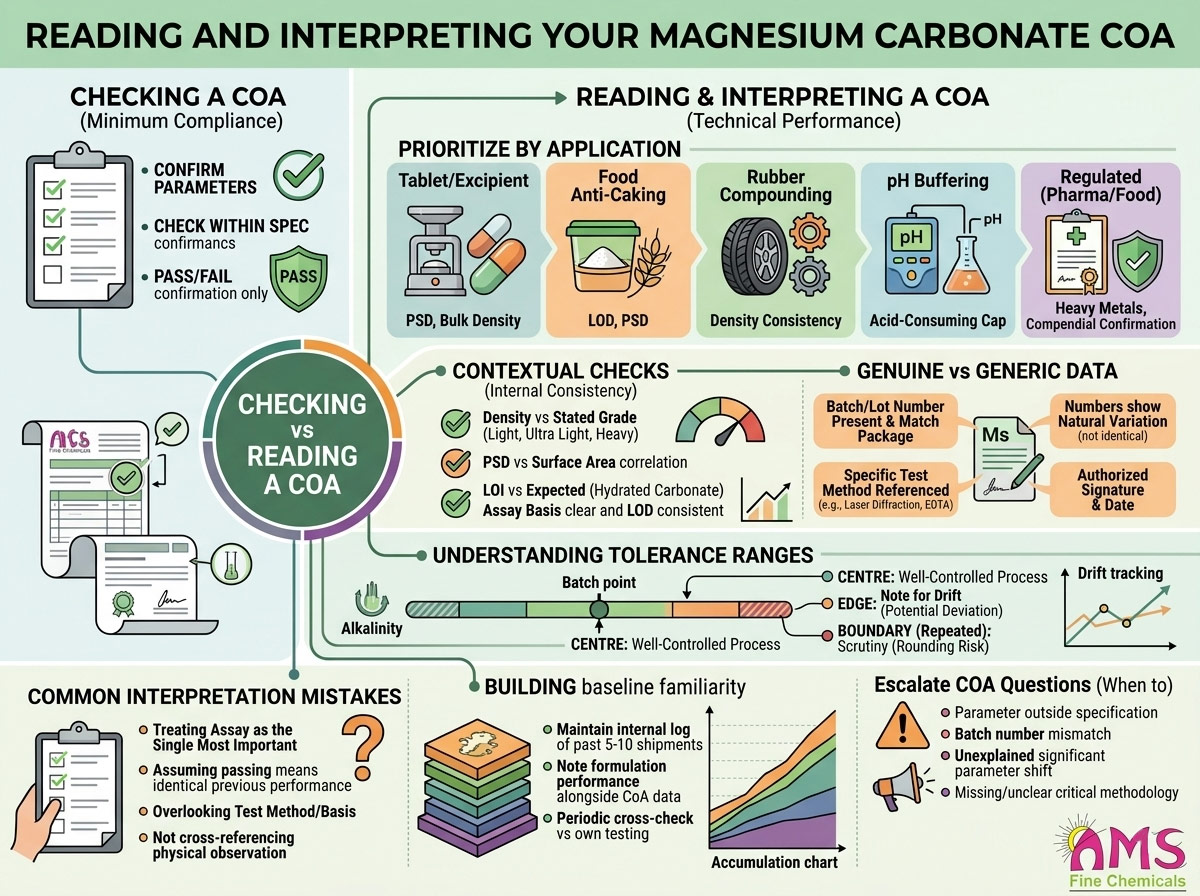
Checking a Certificate of Analysis means confirming every required parameter is present and within specification. Reading one — genuinely interpreting it — means understanding what the numbers together are telling you about the batch: whether it’s a typical, well-controlled result or an edge case worth a follow-up question, whether the parameters are internally consistent with each other, and whether anything about the document itself suggests it might not be fully trustworthy.
This distinction matters because a batch can pass every individual specification line and still represent a meaningfully different material than what a formulator’s process was validated against — a gap that only becomes visible when the numbers are read in context rather than checked one at a time in isolation.
Prioritizing Parameters by Application: Not Every Number Matters Equally to You
A complete Magnesium Carbonate CoA typically reports ten or more distinct parameters, but which ones deserve your closest scrutiny depends heavily on your specific application. Treating every line with equal weight wastes review time on parameters that don’t actually drive your formulation’s performance, while potentially under-scrutinizing the ones that do.
If you’re formulating a tablet or capsule excipient application: Particle size distribution (D10/D50/D90) and bulk density deserve your closest attention, since these directly govern die-fill consistency and compaction behaviour — more so than assay, which is more likely to be reliably within range across reputable suppliers. Our Magnesium Carbonate Particle Size Distribution and Its Impact on Formulation article explains why the full D10/D50/D90 profile, not just a single average figure, is what you should actually be reading here.
If you’re using it as a food anti-caking agent: Loss on Drying and particle size distribution matter most, since these two parameters most directly predict real-world moisture-absorption performance — a batch can pass assay comfortably while still underperforming functionally if its particle structure has drifted from what your formulation depends on.
If you’re using it in rubber or polymer compounding: Bulk density consistency across successive shipments matters more than any single batch’s individual reading, since your dosing equipment calibration depends on that consistency holding steady over time, not on any one batch’s value in isolation.
If you’re using it for pH buffering or antacid reactivity: Acid-consuming capacity (where reported) and particle size distribution together tell you more about real-world reactivity than assay alone, since reaction rate depends on surface area as much as chemical purity.
If you’re evaluating for a regulated pharmaceutical, food, or cosmetic use: Heavy metal and elemental impurity data, along with confirmation of the specific compendial standard tested against, deserve the most careful review, since these carry direct regulatory and safety implications beyond functional performance.
Reading Numbers in Context: Internal Consistency Checks
A CoA’s individual numbers become far more meaningful when read against each other rather than in isolation. A few practical internal consistency checks worth applying:
Does bulk density align with the stated grade? If a Certificate of Analysis reports a batch as “Light Magnesium Carbonate” but the bulk density figure sits closer to Heavy grade’s typical range, that’s an internal inconsistency worth questioning before accepting the shipment — either a labeling error or a genuine process deviation, and either warrants a supplier conversation before the material enters production. Our Magnesium Carbonate Bulk Density: Why It Matters in Industrial Processing article covers the expected ranges for each grade in detail.
Does particle size distribution roughly track with reported surface area, where both are given? Finer particle size distributions generally correlate with higher surface area, all else equal — a batch reporting an unusually fine D50 alongside an unexpectedly low surface area figure (or vice versa) may indicate a morphology difference worth investigating further, a relationship covered in our How Magnesium Carbonate Particle Morphology Influences Industrial Performance article.
Does Loss on Ignition fall within the expected range for a basic (hydrated) carbonate, rather than looking like pure anhydrous MgCO₃ data? Most commercial material is a basic carbonate incorporating magnesium hydroxide and water of crystallization, and its LOI should reflect that combined structure — an LOI reading that looks unusually low for the stated product type is worth a follow-up question. Our Understanding the Thermal Decomposition of Magnesium Carbonate article explains what a typical multi-stage LOI profile should look like.
Is the reported assay basis (as-is vs. ignited) clearly stated, and does it make sense relative to the reported Loss on Drying? A batch with meaningfully elevated Loss on Drying but an assay figure that doesn’t seem to account for that moisture content may indicate the two figures were tested on different bases without clear labeling — worth clarifying before comparing this batch against your historical reference data.
Recognizing the Difference Between Batch-Specific and Generic Data
One of the most important interpretive skills in reading a Magnesium Carbonate CoA is distinguishing genuine batch-specific test data from a generic “typical values” specification sheet dressed up to look like a Certificate of Analysis. A few signals to check:
- Does the document reference a specific batch or lot number, and does that number match what’s printed on the physical packaging you received? A CoA without a batch number, or with a batch number that doesn’t correspond to your actual shipment, isn’t telling you anything about the material you’re actually holding.
- Do the numbers show natural variation from previous shipments, or are they suspiciously identical across multiple different batches? Real analytical testing produces some natural batch-to-batch variation within specification range; a document reporting identical results across many consecutive shipments is more likely a static reference sheet than genuine per-batch testing.
- Is a specific test method referenced for each parameter (e.g., EDTA titration for assay, laser diffraction for particle size), or are results presented without any methodology context? Genuine analytical reports typically reference their test methods, since this supports result interpretation and comparability.
- Is there a signature, date, and responsible quality control officer identified? A document missing this basic authentication information provides less assurance of genuine, reviewed testing than one that includes it.
Understanding Tolerance Ranges: What “Within Specification” Actually Means
Nearly every parameter on a Magnesium Carbonate CoA is reported against a tolerance range rather than a single fixed target — and understanding where within that range a given result falls provides more insight than simply confirming pass/fail status.
A result sitting comfortably in the middle of its specification range generally indicates a well-controlled process producing typical, expected material.
A result sitting near the edge of its specification range, while still technically compliant, is worth noting — particularly if you observe a pattern of consecutive batches trending toward one edge of the range over time, which can signal a gradual process drift at the manufacturer worth raising proactively before an actual out-of-specification batch occurs. This kind of longitudinal tracking is covered in more depth in our Magnesium Carbonate Particle Size Distribution and Its Impact on Formulation article, in the context of statistical process control practices.
A result that appears to fall exactly on a specification boundary, repeatedly, deserves particular scrutiny — this pattern can sometimes indicate a supplier rounding or adjusting reported figures to appear compliant rather than reporting the genuine, unadjusted test result.
Common Interpretation Mistakes Buyers Make
Treating assay as the single most important number. For many applications, particle size distribution, bulk density, and moisture content drive functional performance more directly than assay percentage, which tends to be the parameter most reliably within specification across reputable suppliers in the first place — over-indexing on assay while under-reviewing the other parameters is one of the most common CoA-reading mistakes.
Assuming a passing result means identical performance to a previous batch. Two batches can both pass specification while differing meaningfully within their respective tolerance ranges — a formulator relying on a single point-in-time comparison rather than tracking trends across multiple shipments can miss a gradual but functionally significant shift.
Overlooking the test method and basis notation. As covered above, comparing figures reported on different bases (as-is vs. ignited) or tested via different methodologies without accounting for that difference can lead to incorrect conclusions about whether two batches are genuinely comparable.
Not cross-referencing CoA data against physical observation. A CoA reporting acceptable Loss on Drying alongside a physically caked or clumped sample on receipt warrants investigation — the discrepancy might indicate storage-related degradation after testing rather than a CoA error, but either way it’s worth resolving before the material enters production. Our Magnesium Carbonate Storage and Handling: Best Practices for Industrial Buyers guide covers this kind of post-testing degradation risk.
Building a Personal Reference Baseline
The most sophisticated CoA interpretation skill isn’t reading any single document well — it’s building familiarity with what “normal” looks like for your specific supplier and application, so that deviations become immediately visible rather than requiring conscious comparison every time.
Practical steps toward building this baseline:
- Maintain a simple internal log of key parameters (bulk density, D50, assay, Loss on Drying) across successive shipments from the same supplier, even if just in a basic spreadsheet, to make trend visibility effortless rather than requiring manual comparison against old documents each time.
- Note your own formulation’s actual observed performance alongside each batch’s CoA data, building an internal reference for which specific parameter ranges have historically correlated with good versus problematic formulation outcomes in your specific process.
- Periodically cross-check CoA data against your own confirmatory testing, particularly for critical applications, to build confidence in how reliably a specific supplier’s reported data tracks with independently verified results over time.
This kind of accumulated, application-specific familiarity is what allows an experienced buyer to glance at a new CoA and immediately sense whether something looks different from normal — a skill that generic parameter checklists alone can’t fully substitute for.
Why the Same CoA Should Be Read Differently by Different Departments
A single Certificate of Analysis often circulates to more than one team within a buying organization — procurement, quality assurance, and production or formulation — and each reads it through a different lens, prioritizing different questions even when looking at the identical document.
Procurement teams typically focus on confirming the shipment matches the purchase order specification and that pricing and quantity align with what was agreed, often treating the CoA primarily as a compliance confirmation rather than a technical performance document.
Quality assurance teams focus on regulatory and specification compliance in more depth — confirming the correct compendial standard was referenced, verifying impurity limits, and maintaining the documentation trail required for audit readiness, particularly in regulated industries.
Production and formulation teams care most about the parameters that actually predict how the material will behave on their specific line or in their specific formulation — often the particle size, bulk density, and moisture data that procurement and QA review primarily for compliance rather than functional prediction.
Organizations that route CoA review through only one of these lenses — for example, a purely compliance-focused QA check without production team input — risk missing functionally relevant signals that a compliance check alone wouldn’t flag, even though the document technically passed every required review step. Building a review process that incorporates the production or formulation perspective specifically, not just compliance sign-off, closes this gap.
When to Escalate a CoA Question Rather Than Accept and Move Forward
Not every observation on a CoA warrants stopping a shipment or demanding supplier clarification before use — but a few situations genuinely do warrant escalation before the material enters production:
- Any parameter reported outside its stated specification range, even marginally, regardless of how minor the deviation appears, since accepting an out-of-specification batch without formal deviation documentation undermines the entire purpose of specification-based quality control.
- A batch number mismatch between the CoA and the physical packaging received, since this invalidates the document’s relevance to the actual material in hand.
- A significant, unexplained shift in a key parameter relative to your established baseline, even if technically within specification, particularly for applications where you’ve previously identified that parameter as functionally critical.
- Missing or unclear methodology for a parameter you specifically depend on for your application, since an ambiguous or unstated test method undermines your ability to properly interpret the reported result.
For lower-stakes deviations — a parameter sitting near, but comfortably within, its normal range — documenting the observation for trend-tracking purposes without necessarily escalating immediately is usually the more proportionate response, reserving formal escalation for the situations above.
How AMS Fine Chemicals Supports Transparent, Interpretable Quality Data
AMS Fine Chemicals, based in Bhavnagar, Gujarat, issues batch-specific Certificates of Analysis for every shipment of Light, Ultra Light, and Heavy Magnesium Carbonate, with results tested in our own NABL-calibrated Physico-Chemical and Microbiology laboratories and referenced against the applicable pharmacopoeial or industry standard for your application. We support buyers building their own longitudinal quality reference by providing consistent, clearly formatted batch data across successive shipments, and our technical team is available to walk through any specific CoA question or unusual result directly.
Explore full technical specifications on our Magnesium Carbonate, Light Magnesium Carbonate, Ultra Light Magnesium Carbonate, and Heavy Magnesium Carbonate product pages, or browse our complete range of magnesium compounds — including Magnesium Hydroxide and Magnesium Trisilicate — on the Products page.
Frequently Asked Questions
If a CoA passes every specification line, is there really any reason to look more closely? Yes, particularly for critical applications — a passing result doesn’t tell you where within the tolerance range a batch falls, whether it’s consistent with your historical supply, or whether internal parameters align sensibly with each other. Passing is the minimum bar, not full confirmation of functional equivalence to previous batches.
How many past batches should I compare a new CoA against to spot a meaningful trend? There’s no universal number, but reviewing at least the last five to ten shipments, where available, generally provides enough data to distinguish normal batch-to-batch variation from a genuine directional drift, rather than reacting to a single unusual reading that may simply be normal variation.
What should I do if I notice an internal inconsistency between two parameters on the same CoA? Raise it directly with your supplier’s technical or quality team before accepting the shipment into production use, particularly for critical applications — a legitimate inconsistency usually has a straightforward explanation, but confirming that explanation is far cheaper than discovering a genuine problem downstream.
Is it reasonable to request raw test data or method details beyond the summary CoA? Yes, and reputable suppliers should be willing to provide this on request, particularly for buyers with critical or regulated applications who need deeper documentation to support their own quality systems or regulatory filings.
Does building a personal reference baseline really matter for lower-risk industrial applications, or only for pharmaceutical/food use? It’s valuable across all applications, though the stakes and required rigor scale with application sensitivity — even general industrial buyers benefit from noticing a bulk density trend that might otherwise silently affect dosing equipment calibration over time, well before it becomes an obvious production problem.
Should procurement, quality, and production teams all review the same CoA independently, or is that redundant? It’s not redundant — each team’s review lens catches different risks, and consolidating CoA review into a single department’s sign-off can mean functionally relevant signals visible to production teams never reach the people who could act on them, even when the document has technically passed compliance review.
Final Word
A Certificate of Analysis is only as useful as the interpretation applied to it. Knowing which parameters matter most for your specific application, reading numbers in context against each other rather than in isolation, recognizing genuine batch-specific data versus generic reference sheets, and building familiarity with what “normal” looks like for your supply chain together turn a document you check into one you can genuinely read — catching a developing issue before it becomes a production problem, rather than only confirming, after the fact, that a batch technically passed.
To request detailed Certificate of Analysis data, historical batch reference information, or a sample batch of any Magnesium Carbonate grade, visit our Magnesium Carbonate product page or reach out through our Contact Us page.