Acid-relief products look simple from the outside. A tablet, a chewable or a suspension is meant to calm stomach acid, and the label usually names one or two active ingredients. Inside the formulation lab, the story is more demanding. The neutralizing agent has to react at the right speed, stay physically stable in the dosage form, taste acceptable, and behave the same way from one batch to the next.
Magnesium trisilicate has been part of this conversation for a long time because it does something most antacid agents do not: it acts slowly and steadily rather than all at once. For formulators designing acid-relief products, understanding that behaviour in technical detail is what separates a well-built product from one that only looks good on paper.
This overview, from the technical team at AMS Fine Chemicals, a manufacturer and exporter of magnesium compounds based in Bhavnagar, Gujarat, covers the chemistry of magnesium trisilicate, how it behaves in the stomach, how it compares with other antacid ingredients, and what formulators and buyers should check before specifying it. If you want the shorter, chemistry-focused view first, read our earlier guide on how magnesium trisilicate works as an antacid ingredient.
This article is written for formulators and procurement teams. It is technical information, not medical advice. Regulatory requirements, permitted claims and dosage limits vary by country, so always confirm them for your own market.
What Magnesium Trisilicate Is
Magnesium trisilicate is an inorganic compound commonly represented by the formula 2MgO·3SiO₂·nH₂O. In practice it is a fine, white, odorless and tasteless powder. The “n” in the formula matters: the compound is hydrated, and the amount of bound water varies, which is one reason that moisture-related quality parameters are worth checking on every batch.
Structurally, it is a magnesium silicate with a layered, high-surface-area character. That structure explains the two properties that make it useful in acid-relief products:
- Slow, sustained acid neutralization, because the material reacts gradually rather than dissolving instantly.
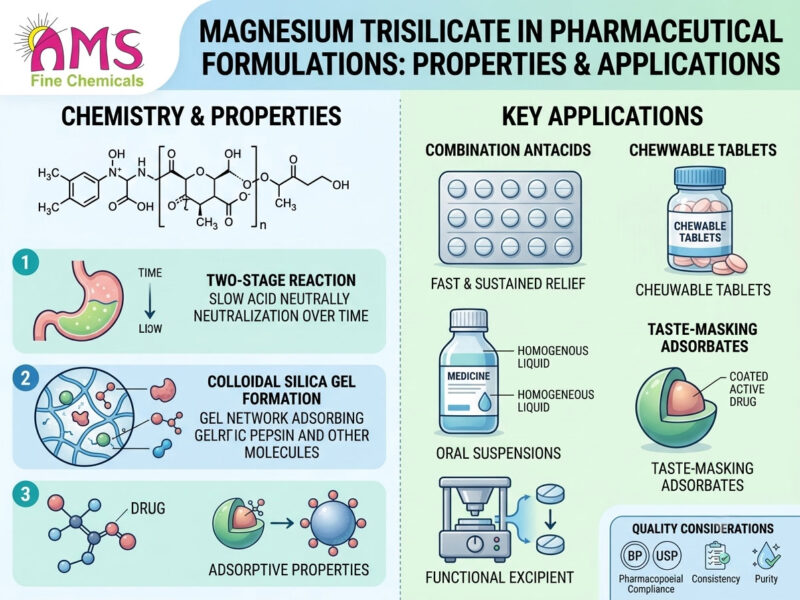
- Adsorptive behaviour, because its surface can take up certain substances and can help form a protective coating-like effect in the upper digestive tract.
You can see the full product profile, available grades and packaging details on our Magnesium Trisilicate product page.
The Chemistry of Acid Neutralization
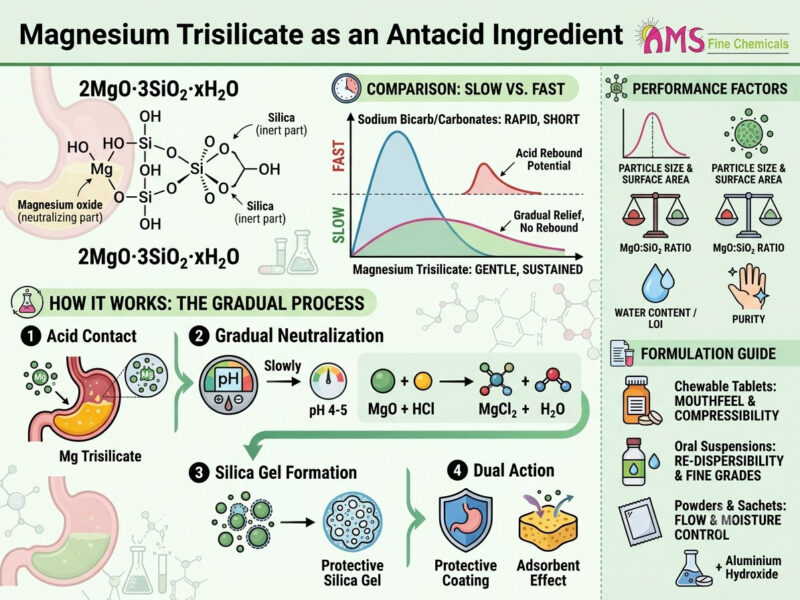
Stomach acid is mainly hydrochloric acid. When magnesium trisilicate meets it, the magnesium portion reacts with the acid to form magnesium chloride and water, while the silicate portion is released as hydrated silica, often described as a silica gel.
Two points follow from this reaction.
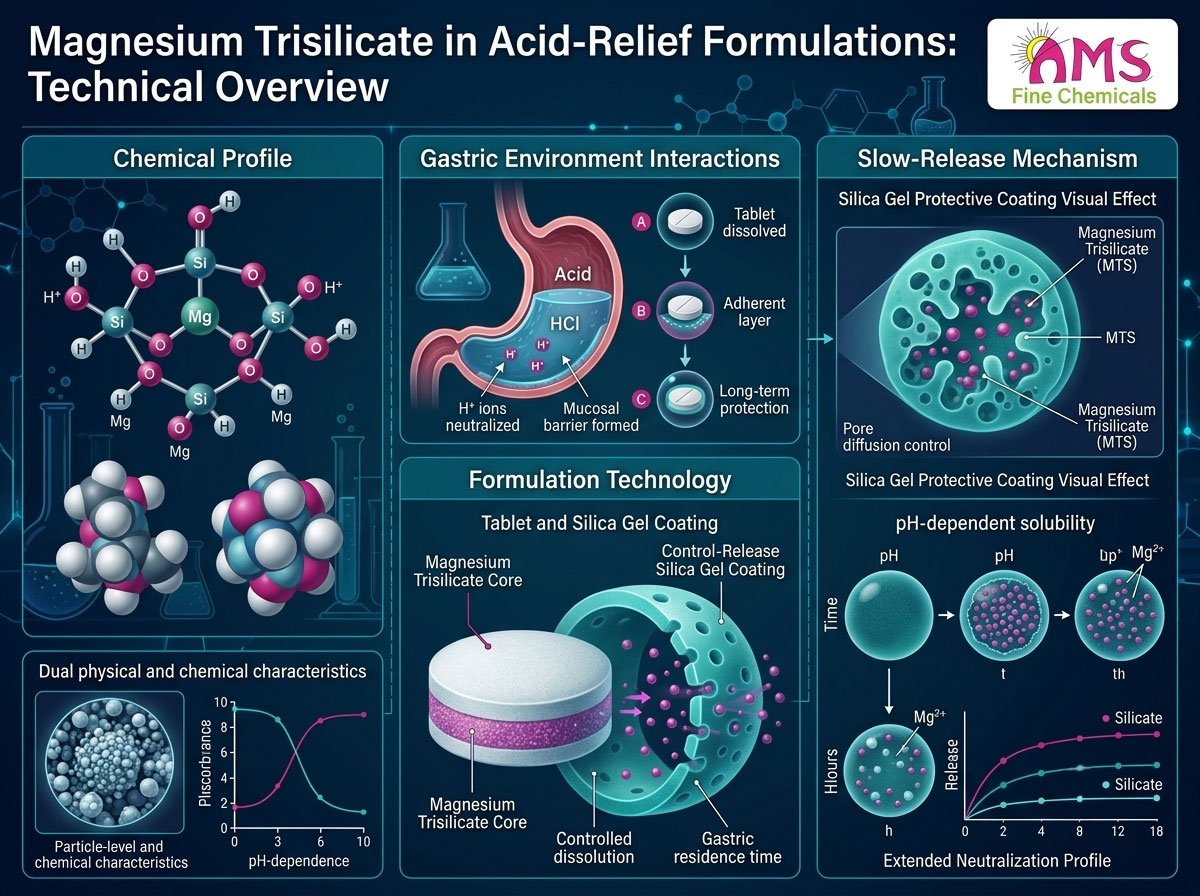
First, the reaction is not instantaneous. Because magnesium trisilicate is a poorly soluble solid, the acid has to attack the particle surface and work inward. This is the reason the antacid effect builds over time and tends to last longer than that of fast-acting agents. Formulators sometimes describe it as “slow-onset, long-duration” neutralization.
Second, the silica gel by-product is part of the story. The hydrated silica that forms is the basis for the adsorptive and coating-type behaviour often linked to magnesium trisilicate. Its practical contribution to symptom relief in a finished product depends on dose, dosage form and the rest of the formulation, so it should be assessed in development rather than assumed.
Because magnesium-based antacids contribute magnesium ions, they are also associated with a mild laxative tendency at higher doses. This is one reason many acid-relief products combine magnesium agents with others, which we cover below.
Onset, Duration and Why Speed Is Not Everything
When people compare antacid ingredients, they often rank them by how quickly they raise stomach pH. That is a reasonable first question, but it can mislead.
Fast-acting agents, such as sodium bicarbonate, raise pH quickly but their effect can fade quickly too. Gas generation can also cause discomfort. Slower agents like magnesium trisilicate trade some speed for duration. In a real-world product, the best answer is often a balance:
- A fast component that gives the patient an early sense of relief.
- A sustained component that keeps acid under control for longer.
Magnesium trisilicate fits naturally into the second role. It is rarely chosen to be the only agent when quick relief is the primary selling point, but it is a strong partner in combination products and in formulations where lasting action matters, such as products aimed at heartburn after meals or at bedtime.
Acid-Neutralizing Capacity: The Number Formulators Care About
Acid-neutralizing capacity, usually abbreviated ANC, is the standard way to describe how much acid a given amount of antacid can neutralize. Pharmacopoeial methods typically measure it by reacting the sample with a known excess of hydrochloric acid under defined conditions and then determining how much acid remains, usually by back-titration.
For magnesium trisilicate, three practical points are worth keeping in mind:
- ANC depends on the material, not just the name. Particle size, surface area, hydration level and the magnesium-to-silica ratio all influence how much acid a gram of powder can neutralize and how quickly. Two lots that both carry the same chemical name can behave differently.
- ANC should be confirmed on the raw material and the finished product. Excipients, granulation, compression force and even tablet hardness can influence how quickly the active component is exposed to acid in the dissolution medium.
- Batch-to-batch consistency is the real goal. A single good result matters less than reliable, repeatable performance across production lots.
At AMS Fine Chemicals, consistency in acid-neutralizing capacity, adsorption behaviour and particle size distribution is a core quality objective, supported by in-house physico-chemical and microbiology laboratories. For a broader look at how to read quality documents, see our guide on what buyers should check on a Certificate of Analysis. Although that article uses magnesium carbonate as the example, the same discipline applies when you review documentation for any magnesium compound.
Where Magnesium Trisilicate Fits Among Antacid Ingredients
No antacid ingredient does everything. Formulators choose based on the profile they want. The comparison below is a simplified guide.
| Ingredient | Typical onset | Typical duration | Main formulation considerations |
|---|---|---|---|
| Magnesium trisilicate | Slow | Prolonged | Sustained action, adsorptive character, mild laxative tendency at higher doses |
| Magnesium hydroxide | Moderate to fast | Moderate | Strong neutralizing capacity, widely used in suspensions and chewables |
| Calcium carbonate | Fast | Moderate | High neutralizing capacity, can cause constipation, possible acid rebound |
| Sodium bicarbonate | Very fast | Short | Gas generation, adds sodium to the formulation |
| Aluminium compounds | Slow | Prolonged | Often paired with magnesium to balance bowel effects |
The practical lesson is that magnesium trisilicate and magnesium hydroxide are often complementary rather than competing. Magnesium hydroxide offers strong, relatively quick neutralization, while magnesium trisilicate adds the sustained, gentle component. If you are working on a liquid product, our formulation guide on light magnesium hydroxide in oral suspension stability explains the physical stability challenges that apply to magnesium-based suspensions. For the manufacturing side of the hydroxide story, read Light Magnesium Hydroxide as an Antacid Ingredient: Manufacturing Perspective, and explore our Magnesium Hydroxide and Light Magnesium Hydroxide product pages.
Why Controlled Neutralization Matters
One of the quiet advantages of slower-acting, poorly soluble antacids is controlled behaviour. A strongly basic, highly soluble agent can push stomach pH up sharply. Gentler agents tend to move pH toward a moderate range without overshooting. This idea of controlled alkalinity is not unique to pharmaceuticals; it applies across chemistry wherever a base needs to correct acidity without creating a new problem. Our article on why magnesium hydroxide provides controlled alkalinity compared with strong bases explains the principle in an industrial context, and the same logic helps explain why magnesium-based antacids are designed the way they are.
Explore related technical articles under our Magnesium Trisilicate and Magnesium Hydroxide blog categories.
Combination Products: Building a Balanced Formulation
Many successful acid-relief products combine ingredients so that each one covers the weakness of another. Common design goals include:
- Balancing bowel effects. Magnesium agents tend to loosen stools, while some other agents tend to firm them. Combinations can be designed to offset each other, with the exact ratio defined during development.
- Combining fast and slow onset. A quick-acting agent provides early relief while magnesium trisilicate extends the effect.
- Managing dose volume. Using more than one agent can reduce the amount of any single ingredient needed, which helps tablet size and palatability.
- Adding supportive ingredients. Some products add alginates or simethicone-type ingredients for reflux barrier or gas-related symptoms. These choices belong to the product’s therapeutic design and regulatory strategy.
When magnesium trisilicate is part of a multi-ingredient system, compatibility testing is essential. The physical and chemical interactions between agents, buffers, flavors, binders and preservatives can affect both stability and performance.
Dosage Form Considerations
Magnesium trisilicate is used across several dosage forms, and each one brings its own technical questions.
Tablets and chewables. Magnesium trisilicate can be used in tablets, and the product page notes its use as a diluent or binder in tablet formulations because of its physical properties. In chewable antacid tablets, particle size and texture influence mouthfeel. A powder that is too coarse feels gritty, while a very fine powder may affect flow and compaction. Fine powder handling is also affected by moisture, which is discussed below.
Suspensions and liquids. In liquid products, sedimentation, redispersibility and viscosity become central. The solid must stay evenly distributed long enough to deliver a consistent dose. Particle size distribution, suspending agents and the overall ionic environment all matter.
Powders and sachets. Dry powder formats depend on flow and anti-caking behaviour. Magnesium trisilicate also functions as an anti-caking agent in powdered food products, which shows how its surface properties behave in dry blends.
Whatever the format, development work should include dissolution or acid-neutralization testing in the finished dosage form, not only on the raw ingredient.
Particle Properties, Moisture and Powder Handling
Magnesium trisilicate is a fine, high-surface-area powder, so handling matters.
Moisture. Because the material is hydrated and has an adsorptive surface, it can pick up ambient moisture. Excess moisture can lead to caking, weight variation and changes in flow. We cover the broader science of moisture in magnesium compounds in Magnesium Carbonate Moisture Absorption: What Formulators Need to Know. The mechanisms are different for each compound, but the practical lessons apply: keep packaging sealed, control storage humidity and verify moisture-related parameters on incoming material.
Particle size and morphology. Particle characteristics influence flow, compaction, mouthfeel and surface area, which in turn influence reaction speed with acid. Our article on how magnesium carbonate particle morphology influences industrial performance explains why shape and structure matter, and the same principle holds for magnesium trisilicate.
Flow and processing. Fine powders can bridge in hoppers and resist feeding. For general guidance on solving these problems with magnesium compounds, see Light Magnesium Carbonate for Improving Powder Flow and Handling and Heavy Magnesium Carbonate and Powder Flow.
Interactions and Safety Considerations for Formulators
A responsible technical overview should include the cautions that apply to the whole antacid class.
Adsorption of other substances. The same adsorptive surface that is useful in an antacid can also bind other substances. Antacids in general can affect the absorption of some medicines when taken at the same time. Product labelling and patient information usually advise spacing doses accordingly. Regulatory and medical guidance determines the exact wording for each market.
Magnesium load and kidney function. Magnesium is cleared by the kidneys, so magnesium-containing products require particular care in people with impaired kidney function. Labelling and use restrictions are a regulatory and clinical matter.
Sodium content in combination products. If a formulation pairs magnesium trisilicate with sodium bicarbonate, total sodium content should be considered, since some patient groups need to limit sodium intake.
Long-term use. Antacids are generally positioned for occasional symptom relief. Persistent symptoms call for medical evaluation rather than continued self-treatment.
These points do not reduce the value of magnesium trisilicate as an ingredient. They are the kind of considerations that your regulatory, quality and medical teams will build into the product’s design, claims and labelling.
Quality Parameters to Verify Before You Specify
Selecting a supplier is as much about documentation and consistency as it is about price. For a magnesium trisilicate used in acid-relief formulations, a practical checklist includes:
- Chemical composition. Magnesium and silica content, along with the relationship between them, as stated in the relevant specification.
- Acid-neutralizing capacity. Confirm the test method and the reported result for the lot.
- Moisture and loss on drying. Important for flow, assay interpretation and stability.
- Particle size distribution. Affects mouthfeel, compaction, suspension behaviour and reaction speed.
- Impurity profile. Heavy metals and other limits as required by your target market and pharmacopoeia.
- Microbiological quality. Particularly important for oral products. AMS Fine Chemicals tests in an in-house microbiology laboratory alongside its physico-chemical laboratory.
- Documentation. Certificate of Analysis, safety data sheet, technical datasheet and any other documents your quality system requires.
- Batch-to-batch consistency. Ask how the supplier monitors and controls variation between lots.
For a deeper look at how to assess a manufacturer, our guide on how to evaluate a magnesium carbonate supplier for bulk procurement lays out a supplier evaluation framework that works for other magnesium compounds as well. If you are still deciding which magnesium compound suits your process, How to Select the Right Magnesium Carbonate Grade for Your Manufacturing Process shows the kind of grade-selection thinking that helps buyers avoid costly mismatches.
Beyond Antacids: Other Uses of Magnesium Trisilicate
Although acid relief is its best-known role, magnesium trisilicate has other applications, which is useful to know when you are consolidating suppliers across product lines.
- Pharmaceutical adsorbent. Used in some formulations to adsorb toxins, gases or excess fluid in the digestive tract.
- Tablet excipient. Can serve as a diluent or binder.
- Food industry. Functions as an anti-caking agent in powdered foods and can be used as a filter aid in some food processing applications.
- Cosmetics and personal care. Used as an absorbent in dusting powders and some cosmetic formulations.
- Industrial uses. Used as an adsorbent in filtration or purification and as a functional filler in specialized products.
You can browse the full list of industry uses on our Application page and see which sectors we supply on the Industries We Serve page.
Storage, Packaging and Shelf Life
Good ingredient performance can be lost through poor storage. For magnesium trisilicate from AMS Fine Chemicals, the guidance is straightforward:
- Shelf life: 5 years when stored correctly.
- Standard packing: 25 kg HDPE bag with an inner LDPE liner, loaded on ISPM-standard euro pallets that are fumigated and shrink wrapped. Jumbo and custom packing is available for bulk quantities.
- Storage: Keep the seal intact, store in a cool place away from humidity, preferably in a shed protected from adverse weather.
- After opening: Use the material as soon as practical or keep the container tightly closed.
These practices protect moisture content, flow and consistency, which are the same properties that influence acid-neutralizing performance once the powder is in your formulation.
Working With AMS Fine Chemicals
AMS Fine Chemicals is a manufacturer and exporter of inorganic and fine chemicals based in Bhavnagar, Gujarat, India, with more than 20 years of experience in magnesium compounds. For magnesium trisilicate, our offering includes:
- Grades: Food/FCC, food supplement and cosmetic grades. Contact us to confirm availability and documentation for your specific application and market.
- Testing: In-house physico-chemical and microbiology laboratories, with testing instruments calibrated by a NABL-accredited laboratory.
- Capacity: Installed annual capacity of 500 to 700 metric tons of magnesium trisilicate.
- Logistics: Dispatch through Mundra and Pipavav ports. Typical dispatch time is 10 to 15 days after receipt of a confirmed purchase order, depending on quantity and packing.
- Commercial terms: LC, TT, D/P, D/A and other negotiable payment modes.
- Documents on request: Technical specifications, COA, MSDS/SDS, packaging photographs and other supporting documents.
We also manufacture a complete range of related magnesium compounds. Explore our Products page to see magnesium carbonate and magnesium hydroxide grades alongside magnesium trisilicate, which is useful if you are formulating multi-ingredient acid-relief systems and want a single, consistent source.
Frequently Asked Questions
Is magnesium trisilicate a fast-acting or slow-acting antacid ingredient? It is generally regarded as slow-acting with a prolonged effect, because it is poorly soluble and reacts with acid gradually. This is why it is often combined with faster-acting ingredients.
What happens when magnesium trisilicate reacts with stomach acid? The magnesium portion reacts with hydrochloric acid to form magnesium chloride and water, and the silicate portion is released as hydrated silica.
Can magnesium trisilicate be used alone in an antacid product? It can be, but many formulators combine it with other agents to balance onset, duration and bowel effects. The right design depends on your product goals and regulatory requirements.
What dosage forms can use magnesium trisilicate? It is used in tablets, chewables, suspensions and powders. Each dosage form needs its own testing for acid-neutralizing performance, physical stability and palatability.
How should magnesium trisilicate be stored? Keep it in sealed original packaging, in a cool place away from humidity. Once the package is opened, use the material promptly or keep the container tightly closed.
What grades does AMS Fine Chemicals offer? Food/FCC, food supplement and cosmetic grades. Contact our team to discuss documentation and specifications for your application.
How can I request a sample, COA or technical datasheet? Email info@amsfine.com or message us on WhatsApp at +91 70433 38890, or use the Contact Us page.
Final Thoughts
Magnesium trisilicate earns its place in acid-relief formulations through a combination of slow, sustained neutralization, adsorptive behaviour and useful physical properties. It is not a one-size-fits-all solution, and it does not need to be. Its value shows up when it is chosen for the right job, combined sensibly with complementary ingredients, tested in the real dosage form, and sourced from a manufacturer that treats consistency as a requirement rather than a promise.
For formulators, the practical steps are clear: define the onset and duration profile you want, verify acid-neutralizing capacity and particle properties on every lot, test the finished product rather than relying on raw material data alone, and protect the material through proper storage and handling.
If you are developing or reformulating an acid-relief product and want technical specifications, documentation or a sample, our team is ready to help. Visit the Magnesium Trisilicate product page or reach out through our Contact Us page to start the conversation with AMS Fine Chemicals.