Formulators rarely get to choose an ingredient in isolation. Every raw material has to earn its place inside a formulation that already has other constraints attached to it — a target tablet size, a maximum batch weight, a compression limit, a viscosity ceiling. When the requirement is to pack as much active ingredient or functional filler as possible into the smallest practical volume, the physical form of the raw material stops being a minor detail and becomes the deciding factor.
This is exactly the situation where Heavy Magnesium Carbonate earns its keep. Unlike its lighter counterparts, Heavy Magnesium Carbonate is engineered for density, not fluffiness — and that single physical distinction is what makes it the preferred choice across high-loading tablet formulations, rubber compounding, plastics, paper, and several other industrial processes where “more material, same footprint” is the whole point of the exercise.
This guide looks at what actually makes a magnesium carbonate grade suitable for high-loading work, where Heavy Magnesium Carbonate is used in practice, and how to evaluate whether it’s the right fit for your own formulation.
What Makes a Magnesium Carbonate Grade “Heavy”?
Magnesium carbonate (MgCO₃) doesn’t exist in just one physical form. The chemistry stays the same across grades — it’s still an alkaline, thermally stable, low-solubility salt — but the particle architecture changes dramatically depending on how the material is precipitated and dried during manufacturing.
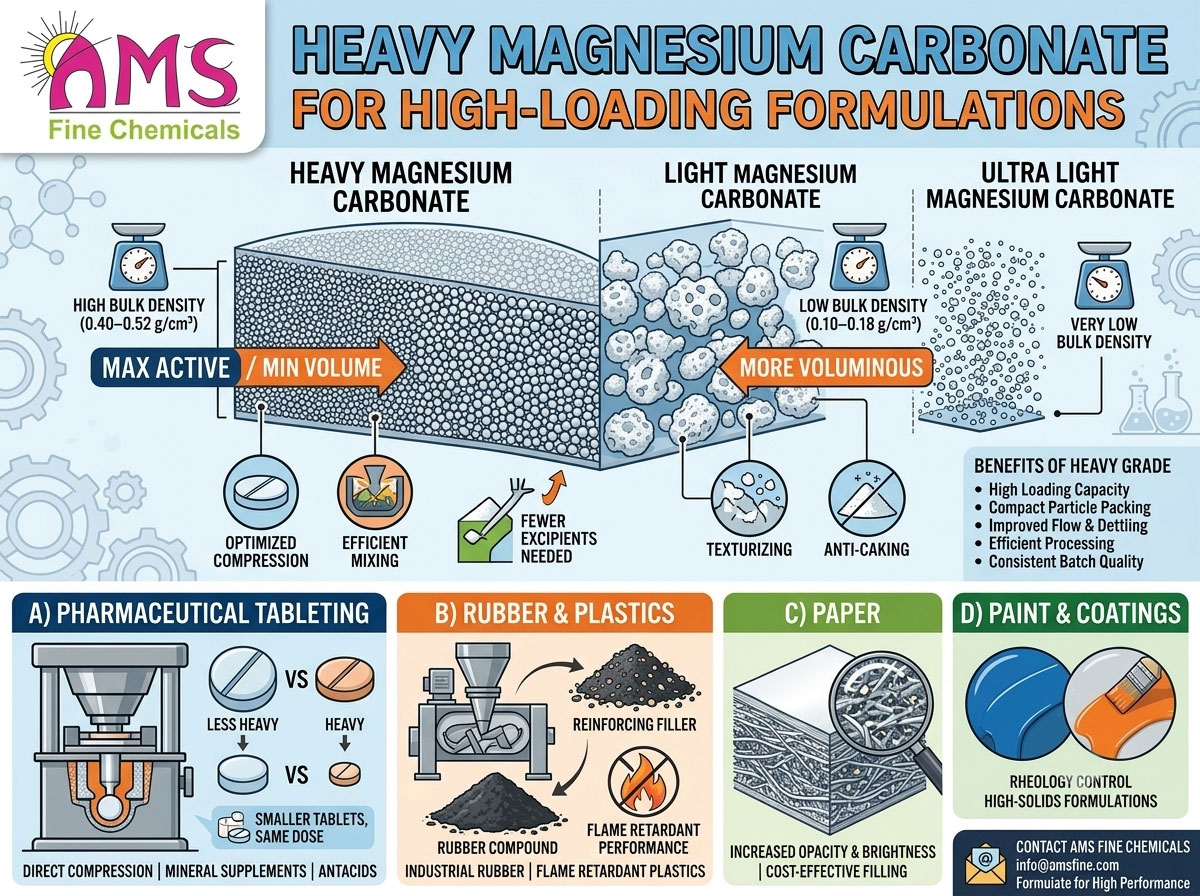
Heavy Magnesium Carbonate is produced to have a higher bulk density and a comparatively lower surface area than the light and ultra light grades. In practical terms, that means:
- More mass per unit volume. A given tablet die, mixing vessel, or storage container holds significantly more Heavy Magnesium Carbonate by weight than it would Light Magnesium Carbonate.
- Lower porosity. The particles pack more tightly against each other, which changes how the material behaves under compression.
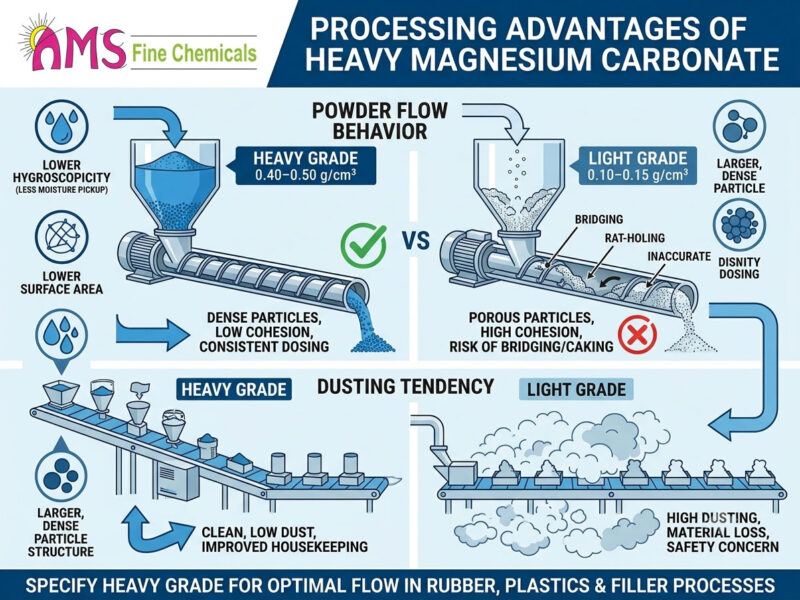
- Reduced fluffiness during handling. It flows and settles differently on production lines, which matters for high-speed tableting and compounding equipment.
For contrast, our Light Magnesium Carbonate and Ultra Light Magnesium Carbonate grades are built for the opposite priority — low bulk density and very high surface area, which makes them better absorbents and texturizers but far less suited to high-loading, weight-constrained formulations. We’ve written separately about what actually separates the light and ultra light grades from each other, in case your team is deciding between those two instead: What Makes Ultra Light Magnesium Carbonate Different From Conventional Light Grade?
If Heavy Magnesium Carbonate isn’t the fit for your project, it’s worth reading our broader overview of where magnesium carbonate is used across 15 industries to confirm which grade actually matches your process before committing to a purchase order.
Why Bulk Density Is the Real Story in High-Loading Work
“High-loading” means different things in different industries, but the underlying engineering problem is always the same: you need to fit a large quantity of one component into a formulation without blowing past a size, weight, or viscosity limit.
In pharmaceutical tableting, that limit is the tablet itself — patients won’t tolerate swallowing an oversized tablet, and packaging lines are built around standard tablet dimensions. In rubber compounding, the limit is often the mixing capacity of the Banbury mixer or the target hardness and density of the finished compound. In paper and paint manufacturing, the limit is viscosity and coating weight.
Bulk density solves this problem almost mechanically. A heavier, denser powder occupies less volume for the same mass, which means:
- More active ingredient or filler fits into the same die cavity, mixing chamber, or coating layer.
- Fewer excipients or diluents are needed to “bulk up” the formulation to a workable volume, which in turn reduces formulation complexity and cost.
- Compression and compaction behavior improves, because dense, low-porosity particles rearrange and bond more predictably under mechanical pressure than light, high-surface-area particles do.
This is why Heavy Magnesium Carbonate consistently outperforms lighter grades whenever the brief is “get as much of this into the smallest space possible” — and why it shows up so often in tablet formulations that need a high concentration of active magnesium per unit dose.
Heavy Magnesium Carbonate in Pharmaceutical Tableting
Pharmaceutical tableting is probably the clearest real-world example of a high-loading formulation challenge, and it’s where the case for Heavy Magnesium Carbonate is strongest.
Direct Compression Advantages
Tablet manufacturers using direct compression — skipping wet or dry granulation steps entirely — depend heavily on how a powder behaves under a punch and die. Heavy Magnesium Carbonate compresses into a coherent, mechanically stable tablet at higher fill weights than the light grade would allow for the same die size, because its particles are already dense and low-porosity going into the compression step. That translates into:
- Smaller tablets for the same magnesium dose, or higher magnesium dose in a standard-size tablet — both outcomes matter depending on whether the priority is patient compliance or dosing efficiency.
- Better tablet hardness and reduced friability, since dense particles resist the crumbling that can occur when high-surface-area powders are compacted at high loading levels.
- More consistent weight uniformity across a production run, because Heavy Magnesium Carbonate’s flow behavior on high-speed rotary tablet presses is more predictable than a light, aerated powder’s.
Antacid and Mineral Supplement Formulations
Antacid tablets and magnesium supplement products are a direct application of this principle. Because the entire therapeutic value of the tablet comes from delivering a meaningful quantity of magnesium, formulators are constantly fighting the same battle: pack in enough active material without producing a tablet that’s too large to swallow comfortably or too fragile to survive packaging and shipping. Heavy Magnesium Carbonate is frequently the grade of choice here precisely because its density lets formulators hit target dosing without inflating tablet size.
For teams working specifically in pharmaceutical-grade formulations, it’s worth cross-referencing our post on Magnesium Trisilicate in Pharmaceutical Formulations, since trisilicate and heavy carbonate are sometimes evaluated against each other for antacid work, and the two behave quite differently in terms of acid-neutralizing capacity and compression profile.
Excipient Function Beyond the API
Even in formulations where magnesium carbonate isn’t the active ingredient, Heavy Magnesium Carbonate is used as a functional excipient — a directly compressible filler-binder that helps carry other actives through the tableting process without adding excessive bulk. Its low porosity limits how much moisture and oil it absorbs relative to the light grade, which matters when the other actives in the formulation are moisture-sensitive and you don’t want the excipient competing for that moisture.
Heavy Magnesium Carbonate in Rubber and Plastics Compounding
High-loading isn’t only a pharmaceutical concept — it’s arguably even more central to rubber and plastics compounding, where fillers routinely make up a large percentage of the finished compound’s total weight.
Reinforcing Filler at High Loading Levels
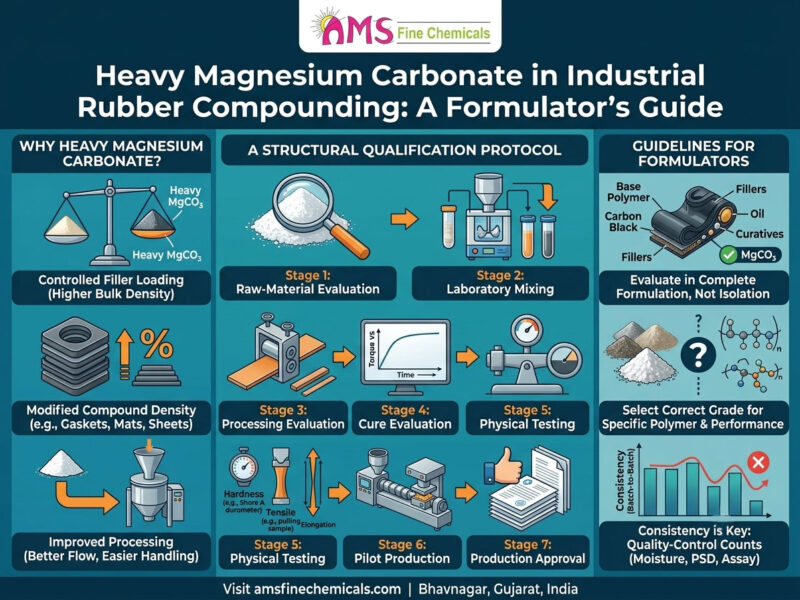
In rubber compounds for tires, conveyor belts, gaskets, and industrial hoses, magnesium carbonate is added as a reinforcing filler that improves tear resistance, tensile strength, and hardness. Because Heavy Magnesium Carbonate is denser and packs more efficiently into the rubber matrix, it allows compounders to reach high filler-loading percentages without the compound becoming too light, too porous, or dimensionally unstable during vulcanization.
We’ve covered this specific application in much more depth in Heavy Magnesium Carbonate in Industrial Rubber Compounding: A Formulator’s Guide, which walks through mixing sequence, loading percentages, and how heavy grade compares to light grade in actual compound performance — worth a read if rubber is your specific application.
Flame Retardant Loading in Engineering Plastics
Plastics formulated for flame retardancy — cable sheathing, structural components, and similar applications — rely on magnesium carbonate’s endothermic decomposition behavior. When heated, it releases water vapor and carbon dioxide, which dilutes combustible gases and suppresses smoke. The catch is that flame-retardant performance scales with loading percentage: a formulation needs enough magnesium carbonate present to generate a meaningful volume of decomposition gas during a fire event. Heavy Magnesium Carbonate’s density allows compounders to hit those higher loading targets while keeping the plastic’s processing viscosity and mechanical properties within acceptable limits.
Heavy Magnesium Carbonate in Paper, Paint, and Coatings
High loading also matters in coating and filler applications where the goal is maximum opacity, brightness, or rheological control per unit of coating weight.
Paper Coating and Filler Applications
In paper manufacturing, filler loading directly affects opacity, brightness, and print quality. Heavy Magnesium Carbonate’s compact particle structure allows paper producers to load more filler into the base sheet or coating layer without disproportionately increasing sheet thickness or weight — a meaningful cost consideration at industrial paper-mill volumes.
Rheology Control in High-Solids Paint Formulations
Paint and coatings formulators working with high-solids formulations — where the goal is to minimize solvent content while maintaining coverage and finish — face a similar density-versus-volume tradeoff. Heavy Magnesium Carbonate’s lower surface area means it demands less liquid binder to wet out the same mass of filler compared to the light grade, which is a meaningful advantage when a formulation is already solvent-constrained.
Comparing the Three Grades at a Glance
| Property | Heavy Magnesium Carbonate | Light Magnesium Carbonate | Ultra Light Magnesium Carbonate |
|---|---|---|---|
| Bulk density | 0.40–0.52 g/cm³ | 0.10–0.18 g/cm³ | Lower than Light grade |
| Surface area | Lower | High | Very high |
| Best suited for | High-loading tablets, rubber/plastic filler, paper/paint filler | Absorbency, anti-caking, texturizing | Maximum absorbency, ultra-fine texture applications |
| Compression behavior | Excellent for direct compression at high fill weights | Prone to lower tablet density at high loading | Not typically used for tableting |
| Typical grades available | Food/FCC, Pharmaceutical (USP/EP), Technical | Food/FCC, Pharmaceutical (USP/EP), Technical | Technical / specialty |
(Figures are representative ranges — always confirm against the current Certificate of Analysis for your specific order.)
If you want the full technical specification breakdown across all three grades — assay, heavy metals, iron content, and soluble salts limits — that’s laid out in detail in our Industrial Applications of Magnesium Carbonate Across 15 Industries guide.
How to Evaluate Whether Heavy Magnesium Carbonate Is Right for Your Formulation
Not every “high-loading” problem is actually solved by switching to the heavy grade. Before committing, it’s worth running through a short checklist:
1. Is your constraint volume, weight, or both? If your primary constraint is fitting more material into a fixed volume (a tablet die, a mixing chamber, a coating thickness), Heavy Magnesium Carbonate is almost always the better starting point. If your constraint is actually about absorbency or surface interaction — moisture control, oil absorption, fragrance retention — the light or ultra light grades will usually outperform heavy grade even at lower loading levels, because the mechanism of action is different. Our post on Light Magnesium Carbonate for Oil Absorption goes into that mechanism if you’re unsure which category your formulation falls into.
2. What does your compression or mixing equipment actually require? High-speed rotary tablet presses, Banbury mixers, and high-shear paint dispersers all have their own tolerances for powder flow and density. It’s worth running small-batch trials with both grades before finalizing a large purchase order — a heavy grade that behaves perfectly in lab-scale trials can occasionally reveal flow or dusting issues at full production speed, and vice versa.
3. What grade specification does your end product require? Food, pharmaceutical, and technical grades of Heavy Magnesium Carbonate carry different purity thresholds for assay, heavy metals, and iron content. A formulation destined for an oral dosage form has a much stricter compliance bar (USP/EP) than one destined for industrial rubber compounding. Confirm the required grade early, since it affects both pricing and lead time.
4. Have you reviewed the supplier’s QA documentation? Bulk density and particle behavior can vary batch-to-batch if a supplier’s manufacturing process isn’t tightly controlled. We wrote a dedicated guide on this exact issue — How to Evaluate a Magnesium Carbonate Supplier for Bulk Procurement — that covers what to ask for before placing a large order, including COA review. If you want to understand what’s actually inside a Certificate of Analysis and which parameters matter most for your application, Magnesium Carbonate COA: Understanding the Most Important Quality Parameters breaks that down parameter by parameter.
5. Do you understand how the grade is actually manufactured? The heavy/light distinction isn’t arbitrary — it comes directly from precipitation and drying conditions during manufacturing. If you want the underlying process explanation (useful for technical audits or supplier qualification questionnaires), see our Complete Guide to Magnesium Carbonate Manufacturing Process.
Working With AMS Fine Chemicals on High-Loading Formulations
AMS Fine Chemicals manufactures Heavy Magnesium Carbonate alongside our Light and Ultra Light grades from our facility in Bhavnagar, Gujarat, meeting Food/FCC, USP/EP pharmaceutical, and industrial/technical specifications depending on end use.
A few things formulators evaluating us as a supplier typically ask about:
- Customizable bulk density and particle size. Because high-loading formulations are sensitive to exact density and particle-size distribution, we can adjust these parameters within a batch run to match a specific target rather than shipping a generic “heavy grade” specification.
- In-house testing on every batch. Our physico-chemical and microbiology labs test each production lot down to parts-per-million levels, which matters when a formulation’s compression behavior depends on tight batch-to-batch consistency.
- Flexible order volumes. We don’t impose rigid minimum order quantities, and we offer Less than Container Load (LCL) shipping for smaller trial orders — useful if you’re still running compression or compounding trials before committing to a full container.
- Export infrastructure. Our Bhavnagar facility sits close to Pipavav Port (120 km) and Mundra Port (350 km), and we’ve shipped to more than 15 countries since 2009.
If your formulation work spans multiple magnesium compounds — for example, combining Heavy Magnesium Carbonate with Magnesium Hydroxide for a combination antacid, or with Heavy Magnesium Hydroxide for a wastewater or flame-retardant application — it’s worth browsing our full product range and our overview of the industries we serve to see where else these compounds might solve a problem you weren’t specifically looking to solve.
Frequently Asked Questions
Is Heavy Magnesium Carbonate the same chemical as Light Magnesium Carbonate? Yes — the underlying chemistry (MgCO₃) is identical. The difference is entirely physical: bulk density, particle size, and surface area, which come from differences in the precipitation and drying stages of manufacturing.
Can Heavy Magnesium Carbonate be used in food applications? Yes, in Food/FCC grade, it’s approved as anti-caking agent E504 and can be used anywhere that specification is required, though the light grade is more commonly chosen for anti-caking work specifically because of its higher surface area.
What’s the typical bulk density range for Heavy Magnesium Carbonate? Roughly 0.40–0.50 g/cm³ for food-grade and pharmaceutical-grade material, and up to about 0.52 g/cm³ for technical grade — though it’s always best to confirm against the specific Certificate of Analysis for your order, since ranges can shift slightly between production lots.
Does higher bulk density mean higher purity? No — bulk density and purity are separate parameters. A heavy grade and a light grade can both meet the same assay and heavy-metals specification; density is purely a function of particle structure, not chemical purity.
How do I get a sample to test in my own formulation before ordering in bulk? Contact our technical sales team directly through our Contact Us page or at info@amsfine.com. We can provide technical datasheets, MSDS, Certificates of Analysis, and product samples for formulation trials.
Final Thoughts
High-loading formulation work almost always comes down to the same underlying question: how much of this material can you fit into a fixed space without breaking something else in the process — tablet size, compound density, coating viscosity, or mechanical performance. Heavy Magnesium Carbonate answers that question well precisely because its density and low porosity are engineered for exactly that scenario, whether the “space” in question is a tablet die, a rubber compound, or a coating layer.
If you’re currently evaluating grades for a high-loading formulation, our technical team at AMS Fine Chemicals can walk through your specific density, compression, or filler-loading requirements and recommend a grade — or a custom particle-size specification — that fits. Reach out at info@amsfine.com or through our Contact Us page to request a technical datasheet or sample.