Ask any formulator who has switched grades of Magnesium Carbonate mid-project, and they will tell you the same thing: the label says “Magnesium Carbonate” on every bag, but the material inside behaves nothing alike. Swap Heavy Magnesium Carbonate for a light grade and a formulation that once flowed cleanly through a hopper suddenly compacts. Swap a light grade for Ultra Light Magnesium Carbonate, and the difference is even more dramatic — a spoonful looks like a small cloud, absorption jumps, and dosing calculations that worked on a weight basis stop making sense unless volume is accounted for.
At the center of nearly every one of these behavioral shifts is one physical property: surface area. Of all the grades of MgCO3 produced commercially, Ultra Light Magnesium Carbonate carries the highest surface area to weight ratio, and that single characteristic is responsible for most of what makes it valuable — and most of what makes it tricky to work with if you don’t understand it. This article looks closely at what surface area actually means for this material, why Ultra Light Magnesium Carbonate develops so much of it, and how formulators across pharmaceuticals, cosmetics, food, and industrial manufacturing put that property to work.
What “Surface Area” Actually Means for a Powder
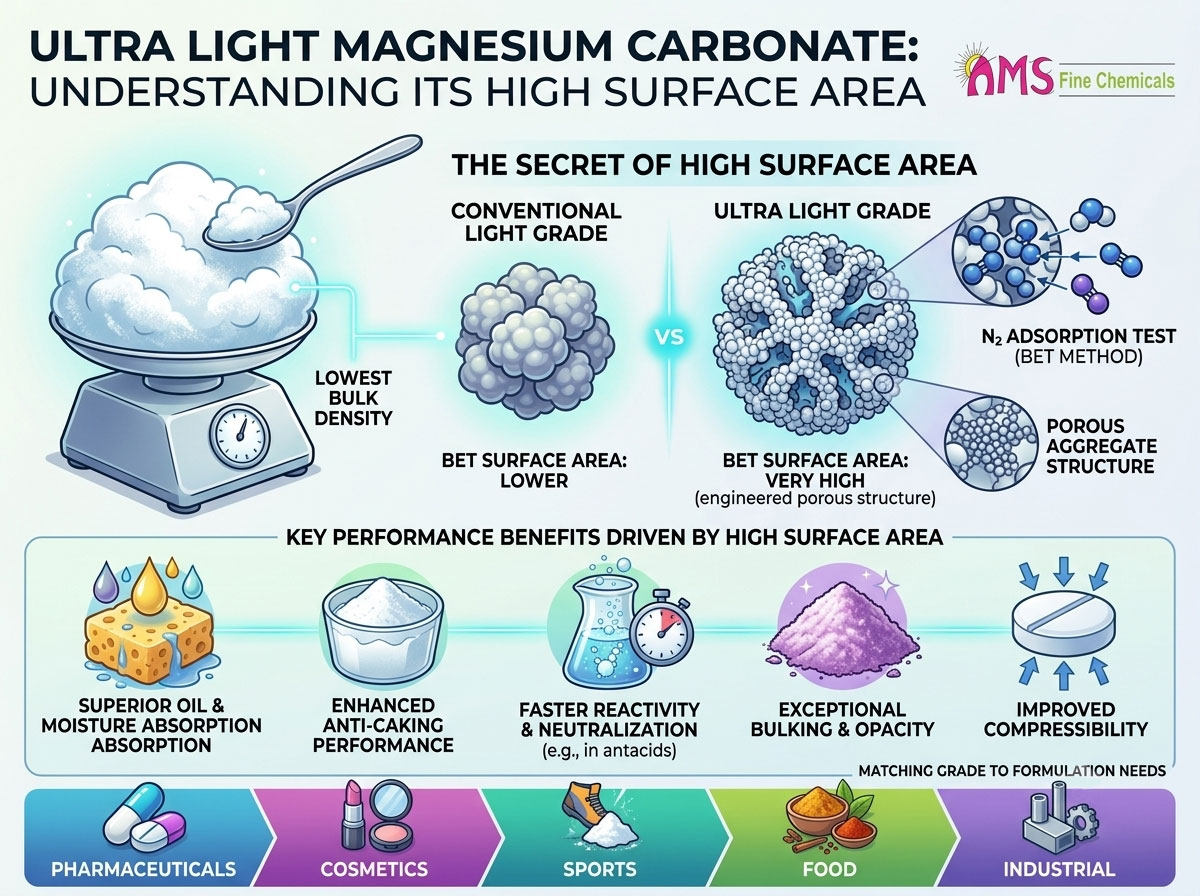
When people talk about the surface area of a powder, they are not talking about the visible, touchable surface of the bag or even a single visible particle. They are talking about the total internal and external area of every particle in a given mass of material, usually expressed in square meters per gram (m²/g). This is measured using gas adsorption techniques — most commonly the BET (Brunauer–Emmett–Teller) method, which calculates surface area based on how much nitrogen gas physically adsorbs onto the powder’s surface at controlled temperature and pressure.
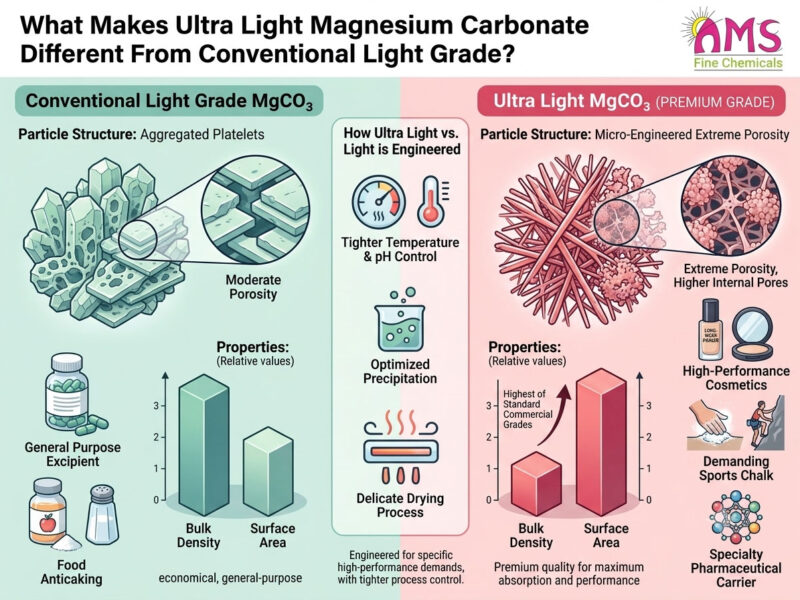
Two samples of Magnesium Carbonate can have identical chemical purity and pass the same pharmacopoeial assay, yet behave completely differently in a formulation because one has two or three times the surface area of the other. That is precisely the gap between conventional Light Magnesium Carbonate and its Ultra Light counterpart. If you’re unfamiliar with how the two light grades diverge in the first place, our earlier post on what makes Ultra Light Magnesium Carbonate different from conventional light grade walks through the distinction in more depth. In short, “light” and “ultra light” are not marketing adjectives — they describe measurably different bulk densities and, consequently, different surface characteristics.
Why Ultra Light Magnesium Carbonate Develops Such High Surface Area
Surface area in precipitated Magnesium Carbonate is not an accident of grinding — it is engineered during synthesis. The material is produced through a controlled precipitation reaction, typically starting from a magnesium salt solution reacted with a carbonate or bicarbonate source under carefully managed conditions of temperature, concentration, pH, and agitation. These parameters determine how the resulting crystals nucleate and grow, and that, in turn, determines the final particle morphology.
A few structural factors combine to give Ultra Light Magnesium Carbonate its exceptional surface area:
- Fine primary particle size. The precipitation conditions used for the ultra light grade are tuned to favor a very large number of very small nuclei rather than fewer, larger crystals. Smaller particles have a much higher surface-to-volume ratio, and this alone accounts for a substantial share of the surface area gain.
- Loosely aggregated, porous secondary structure. Individual fine crystals do not remain isolated; they cluster into secondary aggregates. In the ultra light grade, this clustering is deliberately loose and open rather than dense, leaving networks of internal voids and channels. Nitrogen molecules used in BET testing can penetrate these internal pores, and each pore wall adds to the measured surface area.
- Very low bulk density. Because the aggregate structure traps so much air and empty space between particles, a given weight of Ultra Light Magnesium Carbonate occupies dramatically more volume than the same weight of a denser grade. Low bulk density and high surface area tend to move together — both are downstream consequences of the same porous, loosely packed particle architecture. We explored this relationship in detail in our post on how surface area influences Light Magnesium Carbonate performance, and the same underlying mechanism applies even more strongly to the ultra light grade.
- Controlled drying. How the precipitate is dried matters as much as how it is formed. Aggressive, high-heat drying can collapse fine pore structures and fuse particles together, reducing surface area. Producing a genuinely high-surface-area ultra light grade requires drying conditions gentle enough to preserve the porous skeleton built during precipitation.
The result is a fine, white, almost fluffy powder in which a single gram may present several times more reactive surface than the same gram of Heavy Magnesium Carbonate, whose dense, compact crystal structure was formed under very different — and much less porosity-favoring — conditions.
Surface Area, Particle Size, and Bulk Density Are Related but Not Identical
It’s worth pausing on a common point of confusion. Particle size, bulk density, and surface area are closely linked in Magnesium Carbonate, but they are not the same measurement, and a formulator evaluating a Certificate of Analysis should understand the difference.
- Particle size describes the physical dimension of individual particles or agglomerates, usually reported as a mean or a distribution (D10, D50, D90) in microns.
- Bulk density describes how much a given volume of the loose powder weighs — a proxy for how much air is trapped between and within particles.
- Surface area describes the total exposed area available for physical or chemical interaction, including internal porosity that particle-size measurement alone cannot capture.
Two materials can share a similar median particle size yet have very different surface areas if one is more porous internally than the other. This is why suppliers who report only particle size, without BET surface area, are giving an incomplete picture — especially for a grade whose entire value proposition rests on that internal porosity. If you regularly review supplier documentation, our guide on understanding the most important quality parameters on a Magnesium Carbonate COA explains which figures actually matter and how to read them together rather than in isolation.
How High Surface Area Translates into Functional Performance
None of this porosity and fine structure would matter commercially if it didn’t change how the material performs. High surface area drives several specific, measurable functional advantages that make Ultra Light Magnesium Carbonate the grade of choice for particular applications.
1. Superior Oil and Moisture Absorption
More exposed surface area means more contact points available to adsorb liquids — whether that liquid is atmospheric moisture, free oil in a cosmetic base, or gastric fluid in the stomach. Ultra Light Magnesium Carbonate can absorb a larger volume of oil or water relative to its own weight than denser grades, which is why it performs so well as a carrier and stabilizer in oil-in-powder systems. We’ve covered the mechanism behind this behavior specifically for the light grade in Light Magnesium Carbonate for oil absorption: mechanism and applications; the ultra light grade extends the same principle further, with an even higher absorption ceiling because of its greater porosity.
2. Enhanced Anti-Caking Performance
Caking in powdered products occurs when moisture migrates between particles and forms bridges that solidify on drying. A high-surface-area anti-caking agent interrupts this process more effectively because it has more capacity to intercept and hold that moisture before it can bridge neighboring particles. This is a large part of why Ultra Light Magnesium Carbonate is specified for sensitive powdered products — fine spice blends, milk powders, and instant beverage mixes — where even minor caking is unacceptable to the end consumer.
3. Faster Reactivity and Neutralization
Surface area determines how quickly a solid can react with a liquid or gas, because chemical reactions at a solid-liquid interface happen at the surface, not throughout the bulk of a particle. In antacid applications, this translates directly into faster acid neutralization onset — a fine, high-surface-area particle dissolves and reacts with gastric acid more rapidly than a coarser, denser one of identical chemical purity. This is one reason formulators developing chewable antacid tablets or rapid-relief suspensions often lean toward the ultra light grade over standard light or heavy grades.
4. Exceptional Bulking and Opacity in Low Concentrations
Because so much surface area is packed into so little weight, a small amount of Ultra Light Magnesium Carbonate goes further in terms of visual and textural bulk. In cosmetic powders, this means a soft, cushiony after-feel and effective mattification can be achieved at lower inclusion rates than would be possible with a denser filler, which also helps formulators manage overall product cost and weight without sacrificing performance.
5. Improved Flow and Compressibility in Specific Formats
While extremely low bulk density can complicate handling in some processes (more on that below), the same fine, high-surface-area particle structure can improve compressibility in direct-compression tableting, where a light, porous filler helps distribute compaction force evenly and supports tablet integrity at lower compression forces.
Where This Property Is Put to Work
The high-surface-area profile of Ultra Light Magnesium Carbonate is not a laboratory curiosity — it is the reason this grade is selected, deliberately and specifically, across several industries.
Pharmaceuticals. In antacid tablets and suspensions, the combination of fast-reacting surface area and low bulk density supports rapid, effective acid neutralization in a comfortably sized dose. As an excipient and filler in solid dosage forms, its bulkiness helps formulators hit target tablet or capsule volumes without adding unnecessary weight — a use case we explored in Light Magnesium Carbonate as a functional excipient: what manufacturers should know, where the same surface-area logic applies with even greater effect in the ultra light grade.
Cosmetics and personal care. Dusting powders, setting powders, dry shampoos, and deodorant formulations all rely on high oil and moisture absorption to deliver a soft, non-greasy, long-wearing finish. We covered the underlying moisture-management role of this material family in Light Magnesium Carbonate for moisture control in personal care products — for the ultra light grade specifically, the higher surface area means a noticeably more absorbent, finer-feeling powder base.
Sports and grip applications. Climbing chalk and gymnastics chalk depend entirely on rapid moisture absorption from the skin to maintain grip under load. The porosity that gives Ultra Light Magnesium Carbonate its high surface area is exactly what athletes are relying on when they clap chalk between their hands — a mechanism detailed in Light Magnesium Carbonate in sports chalk: why porosity matters.
Food and beverages. As an anti-caking agent in fine powdered products, and occasionally as a whitening or bulking agent, the fine particle structure keeps sensitive formulations free-flowing through processing and packaging lines, and stable on the shelf.
Specialty industrial uses. In fire-suppression compounds and select low-density insulation applications, the material’s decomposition behavior and light, porous structure are put to specialized technical use where standard mineral fillers would not perform the same role.
Ultra Light vs. Light vs. Heavy: A Surface-Area Perspective
It helps to see the three principal MgCO3 grades side by side through the lens of surface area, since this is ultimately what separates their use cases:
- Heavy Magnesium Carbonate has the lowest surface area of the three, the result of a denser, more compact crystal formation. It suits applications like rubber compounding and general industrial filler use, where high bulk density and manageable flow characteristics matter more than absorption capacity — a use case detailed in our post on Heavy Magnesium Carbonate in industrial rubber compounding.
- Light Magnesium Carbonate sits in the middle — meaningfully more porous and higher in surface area than the heavy grade, and the workhorse choice for many pharmaceutical, cosmetic, and food applications that need moderate absorption and bulk without going to the extreme.
- Ultra Light Magnesium Carbonate sits at the top of the surface-area spectrum among these grades, delivering maximum absorption capacity, the lowest bulk density, and the fastest reactivity — at the cost of being the most challenging grade to handle in bulk-density-sensitive processing equipment, and typically commanding a premium reflecting its more demanding production process.
Choosing between them is rarely about which is “better” in absolute terms — it’s about matching the surface-area profile to what the formulation actually needs. A rubber compounder gains nothing from paying for ultra-light-grade porosity; a climbing-chalk or antacid-suspension formulator gains a great deal from it.
Handling and Processing Considerations
High surface area and low bulk density bring real formulation and processing considerations that are worth planning for rather than discovering mid-batch:
- Dust management. The same fineness that creates high surface area also makes Ultra Light Magnesium Carbonate more prone to becoming airborne during handling. Enclosed transfer systems, appropriate local exhaust, and standard powder-handling PPE are advisable.
- Volumetric dosing changes. Because so much air is trapped in the powder structure, equipment calibrated for a denser material by volume will under-dose the ultra light grade by weight, and vice versa. Recipes and dosing systems should be verified specifically for this grade rather than assumed to transfer directly from a light or heavy grade.
- Moisture sensitivity in storage. A material this good at absorbing moisture from its environment needs to be protected from environmental humidity between manufacture and use — sealed packaging, dry storage, and prompt reclosure of opened containers all help preserve consistent performance batch to batch.
- Compatibility testing. Because of its high reactivity and absorption capacity, it is worth running compatibility and stability checks when introducing this grade into a new formulation, even if a lighter or heavier grade has been used successfully before in a similar system.
Verifying Surface Area and Quality Before You Buy
Because surface area is the defining property of this grade, it deserves the same scrutiny as assay purity or heavy metal limits when qualifying a supplier. A responsible buyer should ask for:
- BET surface area figures, not just particle size distribution, on the Certificate of Analysis
- Batch-to-batch consistency data, since precipitation and drying conditions can drift without careful process control
- Bulk density (both tapped and untapped) as a cross-check against the reported surface area
- Confirmation of the specific grade — food, pharmaceutical (EP/USP), cosmetic, or technical — since surface area targets and impurity limits differ across grades
Our broader post on how to evaluate a Magnesium Carbonate supplier for bulk procurement covers supplier qualification more generally; for the ultra light grade specifically, surface area consistency should sit near the top of that checklist, since it is the property most sensitive to process drift and most directly tied to end-product performance. It’s also useful to understand how Magnesium Carbonate compares against alternative mineral fillers on the properties that matter to your process — a comparison we laid out in Magnesium Carbonate vs. other mineral fillers: key performance considerations.
Ultra Light Magnesium Carbonate from AMS Fine Chemicals
At AMS Fine Chemicals, based in Bhavnagar, Gujarat, our Ultra Light Magnesium Carbonate is manufactured under closely controlled precipitation and drying conditions specifically to preserve the fine, porous particle structure that gives this grade its high surface area and exceptionally low bulk density. We supply it across Food/FCC, Food Supplements/Beverages, EP, USP, Cosmetic, Latex Condoms/Gloves, Rubber, Sports (climbing chalk), and Technical/Industrial grades, backed by in-house physico-chemical and microbiological testing in an NABL-accredited laboratory.
If your formulation depends on rapid absorption, fine dispersion, or maximum bulk from minimum weight, it’s worth comparing the ultra light grade against whatever you’re currently using — the difference is measurable, not marginal. You can browse our complete range on the Magnesium Carbonate products page, which also includes standard Light Magnesium Carbonate and Heavy Magnesium Carbonate for applications where the ultra light grade’s extreme surface area isn’t required.
Frequently Asked Questions
What is a typical surface area range for Ultra Light Magnesium Carbonate? Exact figures vary by manufacturer and production batch, since surface area is highly sensitive to precipitation and drying conditions. As a rule of thumb, ultra light grades sit meaningfully higher on the BET scale than standard light grades, which is precisely why the two should never be treated as interchangeable in a formulation. Always request the actual BET figure on the Certificate of Analysis for the specific batch you intend to use, rather than relying on a general industry range.
Does higher surface area always mean better performance? Not universally — it means better performance specifically for absorption-driven, fast-reacting, or bulking applications. For uses like rubber compounding or applications requiring predictable, denser flow characteristics, a lower-surface-area grade such as Heavy Magnesium Carbonate is the more appropriate — and more cost-effective — choice. Matching surface area to the application’s actual requirement, rather than defaulting to the highest available figure, is the more useful way to think about grade selection.
Can Ultra Light Magnesium Carbonate lose surface area over time? Yes, under certain storage conditions. Prolonged exposure to humidity can cause fine particles to absorb moisture and begin to agglomerate, which reduces effective surface area even though the chemical composition remains unchanged. This is why proper sealed storage, away from humid environments, is emphasized as a handling requirement rather than a mere formality.
How is surface area tested, and can it be verified independently? BET nitrogen adsorption is the standard method used industry-wide, performed using dedicated surface-area analyzers in a physico-chemical testing laboratory. Buyers who want independent verification can request a third-party lab test on a representative sample, or ask their supplier for NABL-accredited (or equivalent) in-house testing documentation alongside the standard Certificate of Analysis.
Is Ultra Light Magnesium Carbonate more expensive because of its surface area? Generally, yes. Achieving and preserving the fine, porous particle structure responsible for high surface area requires tighter process control during precipitation and gentler drying conditions than are needed for light or heavy grades, and this typically carries a cost premium. Formulators should weigh that premium against the performance benefit for their specific application — in absorption-critical uses, the functional gain usually justifies the cost difference; in applications where that extra porosity isn’t being used, it may not.
Conclusion
Surface area is not a secondary specification for Ultra Light Magnesium Carbonate — it is the property that defines the grade. Every advantage this material offers, from rapid antacid action to superior anti-caking performance to exceptional oil absorption in cosmetic powders, traces back to the fine, porous, loosely aggregated particle structure that precipitation and drying conditions are engineered to create. Understanding that connection helps formulators make better grade-selection decisions, read supplier documentation more critically, and troubleshoot performance issues that a purity assay alone can’t explain.
For technical specifications, grade-specific COAs, MSDS/SDS documentation, or packaging details on our Ultra Light Magnesium Carbonate, contact our technical team — we’re glad to help match the right grade to your application.