Every mineral filler on a formulator’s shortlist claims to do roughly the same job — bulk out a formulation, improve handling, and add functional value without dominating cost. But “mineral filler” is a category, not a single ingredient, and the differences between the options inside that category are large enough to determine whether a formulation performs as intended or requires a costly reformulation down the line.
Magnesium Carbonate competes directly with calcium carbonate, talc, precipitated silica, kaolin clay, and mica across pharmaceutical, food, cosmetic, rubber, and industrial applications. This guide compares Magnesium Carbonate against each of these alternatives on the performance dimensions that actually matter to formulators — absorbency, reinforcement, whiteness, reactivity, cost, and regulatory profile — so buyers evaluating a filler choice have a genuine side-by-side reference rather than a single-ingredient sales pitch.
Why Filler Selection Deserves the Same Rigor as Active Ingredient Selection
Fillers are sometimes treated as an afterthought in formulation development — a bulking agent selected on cost and availability rather than functional fit. This is a mistake. A filler’s physical and chemical properties directly shape flow, texture, reactivity, and mechanical performance in the finished product, exactly as covered in our broader discussion of How Magnesium Carbonate Quality Affects Final Product Performance. The same principle applies to filler selection generally, not just to quality control within a single chosen filler.
Magnesium Carbonate vs. Calcium Carbonate
Calcium Carbonate is Magnesium Carbonate’s closest competitor across nearly every application category, given their broadly similar roles as mild alkaline fillers and anti-caking agents.
Where Magnesium Carbonate has an advantage:
- Higher moisture-absorbing capacity in comparable Light-grade forms, generally making it more effective as a dedicated anti-caking agent in high-humidity applications.
- Nutritional contribution: In food and pharmaceutical applications, Magnesium Carbonate contributes elemental magnesium — a nutrient many diets and formulations specifically aim to supplement — where Calcium Carbonate instead contributes calcium, a different nutritional profile that may or may not align with a formulation’s goals.
- Different acid-consuming capacity profile, useful in antacid formulations seeking a specific magnesium-based buffering mechanism rather than a calcium-based one.
Where Calcium Carbonate has an advantage:
- Generally lower raw material cost, given its wider natural abundance and larger-scale global production infrastructure.
- Broader established use in high-volume industrial applications such as paper coating, paint, and plastics, where decades of formulation history exist.
- Higher achievable whiteness in some natural, highly purified grades, valuable in optically sensitive coating applications.
Practical takeaway: For anti-caking and moisture-management applications specifically, Magnesium Carbonate’s higher absorbency often justifies its typically modest cost premium over Calcium Carbonate. For high-volume, cost-sensitive bulk filler applications where moisture management isn’t the primary functional requirement, Calcium Carbonate often remains the more economical default choice.
Magnesium Carbonate vs. Talc
Talc (magnesium silicate hydrate) is a common competing filler in cosmetics, pharmaceuticals, and rubber/plastics applications, prized for its softness and lubricating properties.
Where Magnesium Carbonate has an advantage:
- No fibrous mineral contamination concern. Talc sourced from certain deposits has historically faced scrutiny over potential asbestos-fiber contamination, an issue that has driven increased regulatory testing requirements and, in some markets, consumer hesitancy around talc-containing products. Magnesium Carbonate, as a synthetically precipitated compound rather than a mined mineral, doesn’t carry this contamination risk category.
- Higher moisture absorbency, since talc’s platy, relatively low-surface-area structure makes it a comparatively poor moisture scavenger relative to porous Light Magnesium Carbonate grades.
- Acid reactivity, useful in antacid and buffering applications where talc, being chemically much less reactive, cannot provide equivalent functional benefit.
Where Talc has an advantage:
- Superior lubricity and slip properties, making it the preferred choice in applications specifically requiring a smooth, low-friction glide — certain cosmetic formulations and some tablet coating applications.
- Established use as a tablet lubricant/glidant, a role Magnesium Carbonate can support to some degree but where talc’s platy crystal structure offers particular functional advantages.
Practical takeaway: Formulators increasingly evaluating alternatives to talc — partly driven by the contamination scrutiny mentioned above — often find Magnesium Carbonate a suitable substitute specifically for anti-caking and absorbency functions, though talc’s unique lubricity advantage means it isn’t a universal one-to-one replacement across every application talc traditionally served.
Magnesium Carbonate vs. Precipitated Silica
Precipitated Silica competes most directly with Magnesium Carbonate in anti-caking, rubber reinforcement, and specialty absorbent applications.
Where Magnesium Carbonate has an advantage:
- Generally lower raw material cost in most commercial grades, since precipitated silica production tends to be more energy- and process-intensive.
- Mild alkalinity provides buffering function, whereas silica is essentially chemically inert and cannot provide equivalent pH-buffering or acid-neutralizing performance.
- Broader regulatory history in food and pharmaceutical applications with long-established GRAS and pharmacopoeial precedent.
Where Precipitated Silica has an advantage:
- Higher achievable surface area in specialty engineered grades, sometimes exceeding what even Ultra Light Magnesium Carbonate offers, making it the preferred choice for the most extreme absorbency or reinforcement demands.
- Superior reinforcement performance in certain rubber compounds, particularly in tire tread applications where silica’s specific reinforcing mechanism with silane coupling agents offers performance advantages over carbonate fillers.
- Chemical inertness, valuable in formulations where any reactivity — even mild alkaline buffering — is undesirable.
Practical takeaway: For rubber applications specifically targeting maximum reinforcement performance (particularly tire compounds), precipitated silica often remains the more established, higher-performance choice despite its cost premium. For general anti-caking, buffering, and moderate-performance reinforcement applications, Light or Heavy Magnesium Carbonate typically offers a more cost-effective functional match. Our article on How Magnesium Carbonate Particle Morphology Influences Industrial Performance covers the surface-area and morphology principles relevant to comparing these two fillers’ absorbency and reinforcement mechanisms in more technical depth.
Magnesium Carbonate vs. Kaolin Clay
Kaolin (hydrated aluminum silicate) is a common competing filler in paper coating, cosmetics, ceramics, and some pharmaceutical applications.
Where Magnesium Carbonate has an advantage:
- Higher moisture-absorbing capacity, since kaolin’s platy structure, similar to talc’s, generally offers lower surface area and porosity than porous Magnesium Carbonate grades.
- No aluminum content, relevant to formulators specifically avoiding aluminum-containing ingredients, whether for regulatory, consumer preference, or specific formulation compatibility reasons.
- Acid reactivity and mild alkalinity, again providing a buffering function kaolin cannot replicate given its chemically inert nature.
Where Kaolin has an advantage:
- Established, high-volume use in paper coating and ceramics, industries where kaolin’s specific particle shape and opacity-enhancing properties offer particular advantages developed over decades of industry-specific formulation history.
- Generally very low cost at industrial scale, given kaolin’s extensive natural deposits and mature global mining and processing infrastructure.
Practical takeaway: Kaolin remains difficult to displace in its traditional strongholds (paper coating, ceramics) where its specific properties and cost structure are well-optimized for those industries. In cosmetic and pharmaceutical anti-caking and absorbency applications, Magnesium Carbonate’s higher functional performance often justifies its typical cost premium over kaolin.
Magnesium Carbonate vs. Mica
Mica, valued primarily for its optical shimmer and platy structure, competes with Magnesium Carbonate mainly in cosmetic formulations rather than across the broader industrial application range.
Where Magnesium Carbonate has an advantage:
- Functional absorbency, since mica’s primary value proposition is optical (shimmer, light reflection) rather than functional moisture or oil management, meaning the two fillers often aren’t actually direct substitutes but rather complementary ingredients serving different functions within the same formulation.
- Anti-caking and bulk flow performance, where mica’s platy, low-surface-area structure offers limited functional advantage compared to Magnesium Carbonate’s porous structure.
Where Mica has an advantage:
- Unmatched optical shimmer effect, a function no carbonate-based filler can replicate, making mica essentially irreplaceable in formulations specifically seeking a shimmering or pearlescent visual effect.
Practical takeaway: Magnesium Carbonate and mica are rarely true competitors in the sense of one directly replacing the other — they’re more often complementary ingredients within the same cosmetic formulation, each contributing a distinct functional or aesthetic property.
Magnesium Carbonate vs. Magnesium Hydroxide and Magnesium Trisilicate
Within AMS Fine Chemicals’ own product range, formulators sometimes weigh Magnesium Carbonate against its closest chemical relatives — Magnesium Hydroxide and Magnesium Trisilicate — rather than against an entirely different mineral family, since all three can serve overlapping roles in certain applications.
Magnesium Carbonate vs. Magnesium Hydroxide: Both are magnesium-based, alkaline, and used in antacid, flame-retardant, and industrial pH-buffering roles, but they decompose and react differently. Magnesium Hydroxide neutralizes acid without the carbon dioxide effervescence that accompanies Magnesium Carbonate’s reaction, and its lower thermal decomposition onset makes it a somewhat different fit for flame-retardant polymer applications — a distinction explored in our Understanding the Thermal Decomposition of Magnesium Carbonate article.
Magnesium Carbonate vs. Magnesium Trisilicate: Magnesium Trisilicate combines magnesium oxide with a substantial silica component, giving it a somewhat different adsorbent and gel-forming profile in antacid applications compared to Magnesium Carbonate’s more purely carbonate-driven acid-neutralization mechanism. Our Magnesium Trisilicate BP vs. USP: Understanding Pharmaceutical Grade Specifications guide covers this compound’s distinct pharmacopoeial and functional profile in detail.
Practical takeaway: These aren’t strictly competing products so much as complementary tools within the same magnesium compound family, each suited to slightly different functional emphasis — carbonate for general-purpose buffering and anti-caking, hydroxide for flame retardancy and laxative applications, trisilicate for adsorbent-focused antacid formulations.
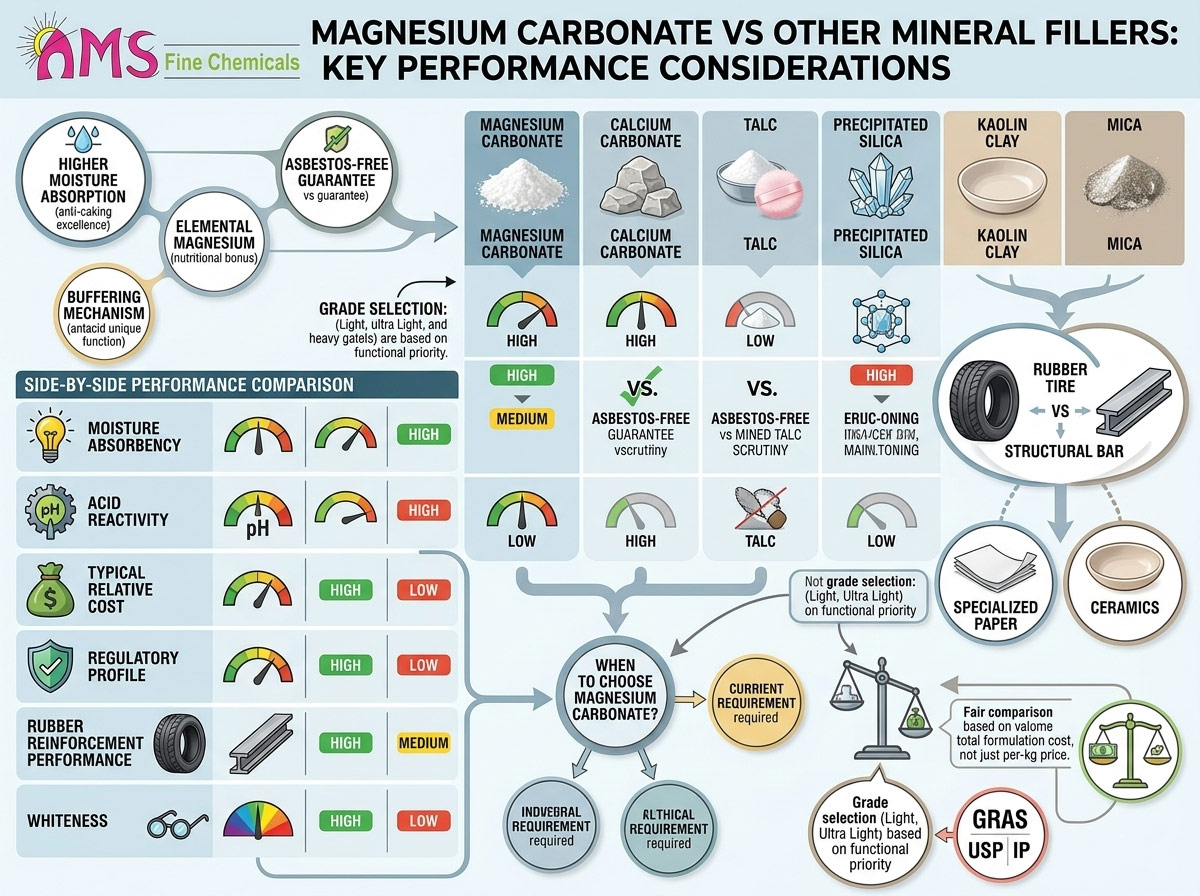
A Side-by-Side Performance Comparison
| Property | Magnesium Carbonate | Calcium Carbonate | Talc | Precipitated Silica | Kaolin |
|---|---|---|---|---|---|
| Moisture absorbency | High (Light/Ultra Light grades) | Moderate | Low | Very high (specialty grades) | Low-moderate |
| Acid reactivity/buffering | Yes, moderate | Yes, moderate | No, inert | No, inert | No, inert |
| Typical relative cost | Moderate | Low | Low-moderate | Moderate-high | Low |
| Contamination/regulatory concerns | Low (synthetic) | Low | Historical fiber contamination scrutiny | Low | Low |
| Nutritional contribution | Magnesium | Calcium | None | None | None |
| Rubber reinforcement performance | Good (Heavy grade) | Good | Moderate | Excellent (specialty grades) | Moderate |
| Optical/whiteness performance | Good | Very good (purified grades) | Good | Good | Good |
This table is a general reference point — actual performance for any specific grade from any specific supplier can vary, and formulation-specific testing remains the only reliable way to confirm a filler choice for a critical application.
Cost Considerations Beyond the Per-Kilogram Price
Comparing mineral fillers purely on per-kilogram price can be misleading, since functional performance differences often mean different fillers require different inclusion rates to achieve equivalent performance in a given formulation. A filler with a lower per-kilogram cost but requiring a meaningfully higher inclusion rate to match another filler’s functional performance may not actually be the more economical choice once total formulation cost is calculated.
Similarly, bulk density differences between fillers affect freight and storage costs independent of the raw material price itself — a consideration covered in detail in our Magnesium Carbonate Bulk Density: Why It Matters in Industrial Processing article, and one that applies equally when comparing Magnesium Carbonate’s logistics profile against denser alternatives like calcium carbonate or kaolin. A genuinely fair cost comparison between filler options accounts for total landed cost and required inclusion rate, not just the quoted price per kilogram.
Regulatory and Certification Comparison
Beyond functional performance, regulatory and certification profile can be a deciding factor in filler selection, particularly for food, pharmaceutical, and cosmetic applications:
- Magnesium Carbonate carries well-established GRAS status, E504 approval in the EU, and pharmacopoeial monographs (USP, BP, IP) supporting its use across food and pharmaceutical applications with a long regulatory track record.
- Calcium Carbonate carries similarly well-established regulatory approval across food, pharmaceutical, and cosmetic applications, generally on comparable footing with Magnesium Carbonate in terms of regulatory acceptance.
- Talc has faced increased regulatory and litigation scrutiny in some markets, particularly the United States, related to potential asbestos-fiber contamination in certain mined deposits, prompting some formulators to proactively seek alternatives even where talc remains technically permitted.
- Precipitated Silica, Kaolin, and Mica each carry established regulatory approval in their respective traditional application areas, generally without the contamination-related scrutiny associated with talc.
For formulators specifically prioritizing regulatory risk minimization alongside functional performance, this consideration can tip a filler decision even when two options otherwise perform similarly.
Decision Framework: When Magnesium Carbonate Is the Right Choice
Based on the comparisons above, Magnesium Carbonate tends to be the stronger choice when a formulation specifically needs:
- Combined moisture management and mild pH buffering in a single ingredient, rather than requiring two separate additives to achieve both functions.
- A magnesium nutritional contribution, relevant in fortified food and dietary supplement applications.
- Avoidance of fibrous mineral contamination concerns, relevant for formulators specifically moving away from mined mineral fillers like talc.
- Cost-effective anti-caking or absorbency performance without requiring the premium performance (and cost) of specialty engineered silica grades.
- Reasonable rubber reinforcement performance at a more moderate cost than precipitated silica, for compounds not specifically targeting tire-tread-level performance demands.
Conversely, other fillers may be the better choice when a formulation specifically needs mica’s optical shimmer, talc’s superior lubricity, silica’s maximum achievable surface area for extreme absorbency demands, or the very lowest possible cost achievable through calcium carbonate or kaolin in high-volume, cost-sensitive bulk applications.
Grade Selection Within Magnesium Carbonate Once It’s the Right Choice
Having selected Magnesium Carbonate as the appropriate filler category, the next decision is grade selection — Light, Ultra Light, or Heavy — matched to the specific functional priority (absorbency versus bulk density and reinforcement). Our detailed guides, How to Select the Right Magnesium Carbonate Grade for Your Manufacturing Process and How to Select the Right Magnesium Carbonate Grade for Your Application, cover this second-stage decision in depth once the broader filler category question has been resolved.
How AMS Fine Chemicals Supports Comparative Filler Evaluation
AMS Fine Chemicals, based in Bhavnagar, Gujarat, manufactures Magnesium Carbonate across Light, Ultra Light, and Heavy grades, supporting formulators evaluating it against alternative mineral fillers with full technical documentation — particle size distribution, bulk density, surface area, and reactivity data — needed to make an informed, apples-to-apples comparison. Our technical team can also support side-by-side sample provision for buyers actively benchmarking Magnesium Carbonate against an incumbent filler in their formulation.
Explore full technical specifications on our Magnesium Carbonate, Light Magnesium Carbonate, Ultra Light Magnesium Carbonate, and Heavy Magnesium Carbonate product pages, or browse our complete range of magnesium compounds — including Magnesium Hydroxide and Magnesium Trisilicate — on the Products page.
Frequently Asked Questions
Is Magnesium Carbonate a direct substitute for talc in cosmetic formulations? For anti-caking and absorbency functions, often yes, and this substitution is increasingly common given regulatory and consumer scrutiny around talc’s fiber contamination history. For applications specifically relying on talc’s superior lubricity, direct substitution may require formulation adjustment rather than a simple one-to-one swap.
Why would I choose Magnesium Carbonate over the generally cheaper Calcium Carbonate? When your formulation specifically needs higher moisture-absorbing capacity, a magnesium nutritional contribution, or a specific magnesium-based buffering mechanism, Magnesium Carbonate’s functional advantages typically justify its modest cost premium over Calcium Carbonate.
Can Magnesium Carbonate match precipitated silica’s performance in tire rubber compounds? Not typically at the highest performance tier — precipitated silica’s specific reinforcing mechanism with silane coupling agents offers particular advantages in tire tread applications that Magnesium Carbonate generally cannot fully match, though Heavy Magnesium Carbonate remains a viable, more cost-effective filler for many other rubber compound applications not targeting tire-tread-level performance.
Should I test multiple filler options before committing to a formulation? For any new or performance-critical formulation, yes — bench-scale comparative testing across the shortlisted filler options remains the most reliable way to confirm which one actually performs best in your specific formulation, since general category comparisons like this guide provide a useful starting point but can’t substitute for formulation-specific validation.
Does switching from one mineral filler to another require full reformulation? Often yes, at least to some degree, since different fillers carry different bulk density, particle size, and reactivity profiles that can affect dosing, processing behaviour, and finished product properties. Treating a filler substitution as a formulation change requiring appropriate validation, rather than a simple like-for-like swap, is generally the safer approach.
How do I fairly compare cost between two mineral fillers with different required inclusion rates? Calculate total formulation cost per finished unit — factoring in each filler’s required inclusion rate to achieve equivalent functional performance — rather than comparing raw per-kilogram price alone, since a cheaper filler requiring a substantially higher inclusion rate can end up costing more per finished unit than a pricier, more functionally efficient alternative.
Final Word
No single mineral filler wins across every performance dimension and every application — Magnesium Carbonate, Calcium Carbonate, Talc, Precipitated Silica, Kaolin, and Mica each carry genuine strengths that make them the right choice in specific circumstances. Magnesium Carbonate’s particular combination of moisture absorbency, mild acid reactivity, nutritional relevance, and freedom from the contamination concerns associated with some mined minerals makes it a strong general-purpose choice across pharmaceutical, food, cosmetic, and industrial applications — but understanding where its competitors genuinely outperform it, rather than assuming universal superiority, is what leads to the right filler decision for any specific formulation.
To request comparative technical data, a sample batch, or a full Certificate of Analysis for any Magnesium Carbonate grade, visit our Magnesium Carbonate product page or reach out through our Contact Us page.