If you had to reduce everything that makes Light Magnesium Carbonate functionally different from Heavy Magnesium Carbonate down to a single number, that number would be specific surface area — the total surface exposed per gram of material, typically measured in square meters per gram via BET gas adsorption analysis. Bulk density, particle size, and morphology all matter, and we’ve covered each in dedicated detail elsewhere on this blog, but surface area is the variable that most directly explains why those other properties translate into the absorbency, reactivity, and reinforcement performance formulators actually care about.
This guide isolates surface area specifically — what it measures, how it’s generated during manufacturing, why it functions as the master variable connecting particle structure to real-world performance, and what buyers should actually request when surface area, not just particle size or bulk density, is the property that determines whether their formulation works.
What Surface Area Actually Measures, and Why It’s Different From Particle Size
Particle size distribution describes the diameter of particles. Surface area describes something related but distinct: the total exposed surface — including internal pore surfaces, not just the outer particle boundary — available per unit mass. Two batches can report an identical D50 particle size while differing enormously in surface area, because surface area depends as much on internal porosity as it does on outer particle dimension.
The measurement itself: Specific surface area is most commonly determined via BET (Brunauer-Emmett-Teller) analysis, a technique that measures the volume of gas (typically nitrogen) adsorbed onto a material’s surface at controlled pressure and temperature, then calculates total surface area from that adsorption data. This method captures internal pore surface area in a way that laser diffraction particle size analysis — which measures external particle dimension — simply cannot.
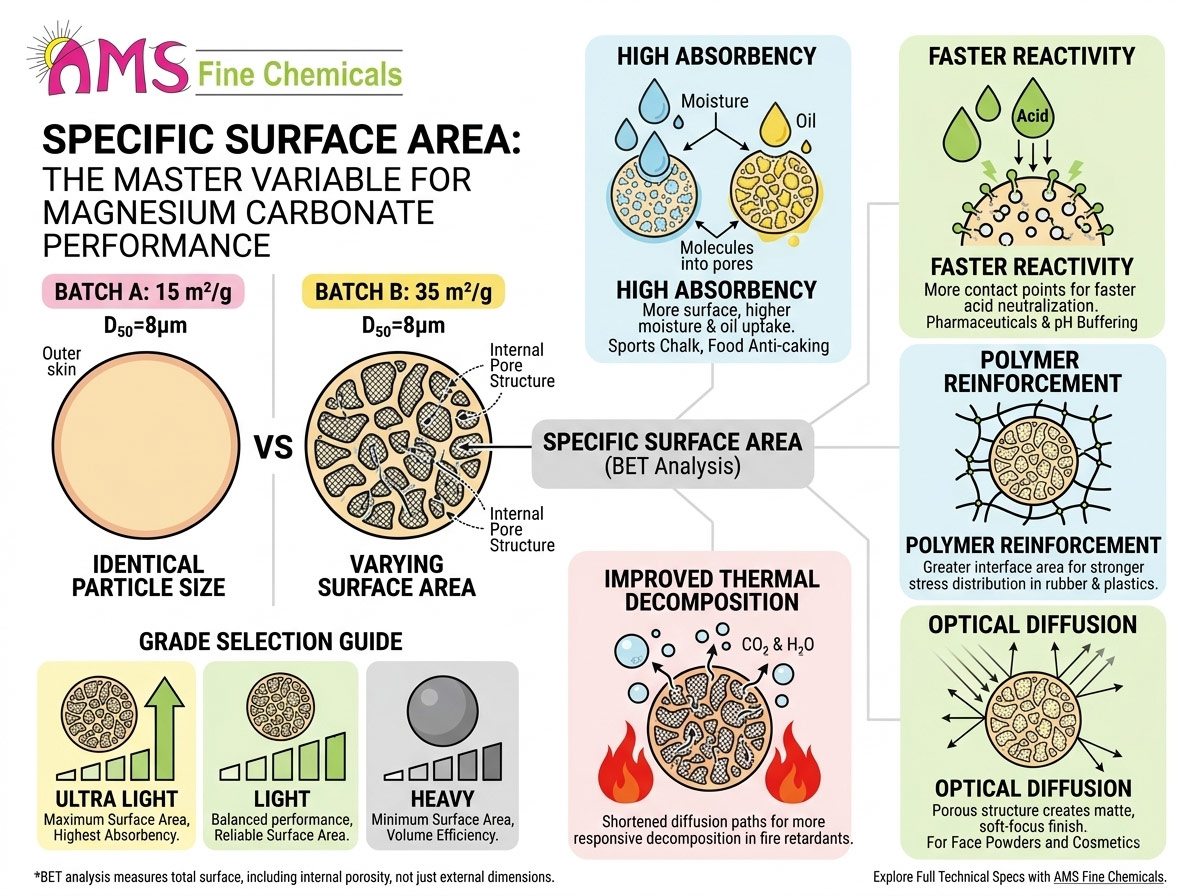
Why this distinction matters practically: A batch of Light Magnesium Carbonate might report a D50 of 8 microns and a BET surface area of 15 m²/g, while another batch with an identical D50 reports a BET surface area of 35 m²/g. Both batches would look identical on a particle size distribution report; only the surface area figure reveals that the second batch has a meaningfully more porous internal structure — and, as this guide covers throughout, that porosity difference is what actually drives most of the functional performance formulators depend on.
How Surface Area Is Generated During Manufacturing
Light Magnesium Carbonate’s characteristic high surface area — typically documented in a range from roughly 10 m²/g up to 70 m²/g or more depending on precipitation conditions, compared to conventional bulk magnesium oxide’s surface area of around 28 m²/g or lower — isn’t an inherent property of the chemical compound itself. It’s engineered during the precipitation stage of manufacturing, covered in process detail in our Complete Guide to Magnesium Carbonate Manufacturing Process.
The precipitation-porosity connection: As magnesium and carbonate ions combine during precipitation, they form loosely aggregated, plate-like crystal clusters rather than dense, solid particles. The specific temperature, pH, and reaction time during this stage directly determine how loosely or tightly these crystal clusters aggregate — looser aggregation traps more void space within and between particles, producing higher measured surface area. This same structural mechanism is explored from the crystal-habit perspective in our How Magnesium Carbonate Particle Morphology Influences Industrial Performance article — morphology and surface area are two measurements of the same underlying structural outcome, viewed through different analytical lenses.
Why this ceiling can’t be exceeded downstream: Because surface area is fundamentally a structural property established during crystal formation, no amount of downstream milling, sieving, or processing can genuinely increase a batch’s surface area beyond what its particle architecture allows — milling can fracture particles and sometimes modestly increase accessible surface area by breaking open previously enclosed pore structures, but it cannot engineer the kind of dramatically higher surface area achievable through properly controlled precipitation chemistry in the first place.
Surface Area as the Driver of Absorbency
Of every property covered across our Magnesium Carbonate content, absorbency correlates most directly and most predictably with surface area, since moisture and oil adsorption is fundamentally a surface phenomenon — molecules bind to and accumulate within accessible pore surfaces, meaning more accessible surface per gram translates almost linearly into greater adsorption capacity.
The direct relationship: Our Magnesium Carbonate Moisture Absorption: What Formulators Need to Know article covers the adsorption mechanism itself in detail; the surface-area-specific point worth emphasizing here is that a formulator troubleshooting underwhelming absorbency performance in an anti-caking, oil-control, or moisture-management application should look first at surface area data, not particle size or bulk density, since it’s the parameter most mechanistically tied to the actual performance outcome.
Where this shows up across applications: In food anti-caking, higher surface area batches intercept ambient moisture more effectively before it can trigger caking in the primary ingredient. In cosmetic mattifying products, higher surface area translates directly into stronger sebum-control performance. In sports chalk, covered in our dedicated Light Magnesium Carbonate in Sports Chalk: Why Porosity Matters article, surface area is quite literally the entire functional basis of the product category. In each case, the underlying performance driver is the same physical property, just applied in a different context.
Surface Area as the Driver of Reactivity
Beyond absorbency, surface area governs how quickly and completely Light Magnesium Carbonate reacts with acid — a property directly relevant to its pharmaceutical antacid function and its role as a mild industrial pH buffer.
The mechanism: Acid-carbonate neutralization, covered in full chemical detail in our Magnesium Carbonate Solubility and Acid Reactivity Explained article, occurs at the solid particle’s surface, where acid molecules physically contact the carbonate structure. A material with higher surface area presents more reactive contact points per gram, generally producing faster, more complete neutralization reactions than an equivalent mass of lower-surface-area material — even when both materials share an identical chemical assay.
Why this matters for pharmaceutical acid-consuming capacity specifically: Pharmacopoeial acid-consuming capacity testing, discussed in our comparative Magnesium Trisilicate BP vs. USP: Understanding Pharmaceutical Grade Specifications article for a related magnesium excipient, is effectively measuring a surface-area-dependent outcome, even though the test itself doesn’t report surface area directly. Two batches with identical assay can show meaningfully different acid-consuming capacity results if their surface area diverges — reinforcing why formulators evaluating reactivity-critical applications benefit from requesting surface area data alongside standard assay figures, rather than assuming assay alone predicts reactive performance.
Surface Area’s Role in Reinforcement and Dispersion Applications
In rubber and polymer compounding, surface area governs how effectively Magnesium Carbonate particles bond with and reinforce the surrounding polymer matrix, since mechanical stress transfer between filler and polymer depends on the contact area available at the particle-polymer interface.
Higher surface area generally supports stronger reinforcement, since more particle surface in contact with the polymer matrix distributes mechanical stress more effectively — though this needs to be balanced against dispersion challenges, since very high-surface-area, high-porosity Light and Ultra Light grades can be more difficult to disperse uniformly under high-shear mixing than denser, lower-surface-area Heavy grade material, a trade-off discussed in bulk density terms in our Magnesium Carbonate Bulk Density: Why It Matters in Industrial Processing article.
Why Heavy grade remains standard for most rubber compounding despite its lower surface area: This is precisely why the industry standard for general rubber filler applications favours Heavy Magnesium Carbonate’s lower surface area, more easily dispersed structure over Light grade’s higher-surface-area but harder-to-disperse-uniformly alternative — surface area alone doesn’t determine the right grade choice; it needs to be weighed against processability for the specific compounding equipment and technique in use.
Surface Area and Optical Properties
Beyond absorbency and reactivity, surface area indirectly influences how a powder scatters light — relevant to whiteness, opacity, and the diffuse “soft-focus” optical effect discussed in our Light Magnesium Carbonate for Face Powders and Loose Powder Formulations article. Higher surface area, porous particle structures tend to scatter light more diffusely than dense, low-surface-area particles of similar external dimension, contributing to the soft, matte visual finish cosmetic formulators specifically engineer for in powder products — an optical consequence of the same structural property driving absorbency and reactivity elsewhere in this guide.
Surface Area and Thermal Behaviour
Surface area also connects to a less obvious but genuinely relevant performance dimension: thermal decomposition behaviour, covered in full chemical detail in our Understanding the Thermal Decomposition of Magnesium Carbonate article. Because thermal decomposition proceeds through gas diffusion out of the solid particle as carbon dioxide and water vapor are released, higher-surface-area, more porous particles generally allow this gas to escape more readily during heating, since internal diffusion pathways are shorter and more numerous than in a dense, low-surface-area particle of equivalent external size.
Practical implication for flame-retardant applications: In rubber and polymer compounds relying on Magnesium Carbonate’s endothermic decomposition for flame-retardant performance, higher surface area can support more complete, more responsive decomposition behaviour during a fire event — though, consistent with the reinforcement discussion above, this needs to be balanced against the dispersion trade-offs of high-surface-area grades in polymer compounding specifically.
Practical implication for Loss on Ignition testing: Surface area can also subtly influence how completely a sample decomposes within a standardized LOI testing protocol, particularly at shorter hold times, since a denser, lower-surface-area sample may require proportionally longer exposure at target temperature to achieve equivalent decomposition completeness compared to a more porous, higher-surface-area sample — a nuance worth considering when comparing LOI results across batches with meaningfully different surface area profiles.
Measuring and Interpreting Surface Area Data
BET analysis is the standard method, measuring gas adsorption at controlled conditions to calculate total accessible surface area, including internal pore surfaces that particle size analysis alone cannot capture. Not every commercial Certificate of Analysis reports BET surface area as a standard parameter — our Magnesium Carbonate COA Explained: Important Parameters Buyers Should Check article covers the broader standard testing panel, and surface area is worth specifically requesting when your application’s performance depends heavily on absorbency or reactivity rather than assuming it’s automatically included.
Interpreting a surface area figure in context: A single BET number is most useful when compared against either a known application benchmark or your own historical batch data, since “good” surface area is entirely application-dependent — a figure that’s excellent for an anti-caking application may be unnecessarily high (and unnecessarily costly) for a general bulking application that doesn’t depend on absorbency at all.
Why surface area should be tracked longitudinally, not just checked per batch: Consistent with the statistical process control principle covered in our Magnesium Carbonate Particle Size Distribution and Its Impact on Formulation article, tracking surface area across successive shipments — rather than checking each batch only against a pass/fail specification threshold — helps buyers catch a gradual manufacturing process drift before it produces a batch with genuinely inadequate functional performance.
The Research Frontier: Engineered Mesoporous Surface Area
At the cutting edge of magnesium carbonate materials science, engineered mesoporous variants — synthesized through specialized routes designed specifically to maximize accessible porosity — have demonstrated surface areas dramatically exceeding conventional commercial grades. Research into amorphous mesoporous magnesium carbonate, produced via carbonation of specially prepared magnesium oxide precursors, has documented surface areas reaching several hundred square meters per gram — many multiples higher than the roughly 10 to 70 m²/g range typical of standard commercial Light and Ultra Light grades, and dramatically higher than the 28 m²/g or lower typical of conventionally calcined bulk magnesium oxide.
These engineered materials are being explored specifically for applications where extreme surface area unlocks fundamentally new performance categories — carbon dioxide capture and adsorption, advanced controlled-release drug delivery carriers, and specialty dehumidification applications — representing a distinct, more specialized product category from standard commercial Magnesium Carbonate grades rather than a direct substitute for mainstream industrial, pharmaceutical, or cosmetic use. For formulators and researchers tracking where this compound’s performance ceiling continues to move, this research direction illustrates just how central surface area is to the entire Magnesium Carbonate performance story — the same underlying property this guide has focused on throughout, pushed to a genuinely different order of magnitude through deliberate synthesis engineering.
Grade Selection Through a Surface Area Lens
Reframing AMS Fine Chemicals’ grade lineup specifically through the surface area lens this guide has focused on:
Ultra Light Magnesium Carbonate delivers the highest surface area in the commercial range, appropriate for applications where maximum absorbency or reactivity genuinely justifies the premium — specialty pharmaceutical carriers, high-performance mattifying cosmetics, and demanding sports chalk formulations among them.
Light Magnesium Carbonate offers strong, reliable surface area suited to the majority of standard absorbency and reactivity applications — general pharmaceutical excipient use, food anti-caking, and standard cosmetic formulations — without the additional cost of Ultra Light grade.
Heavy Magnesium Carbonate offers deliberately lower surface area, appropriate specifically for applications — rubber compounding, industrial bulk filling — where dispersion, handling, and volume efficiency matter more than absorbency or reactivity performance.
Choosing between these grades genuinely comes down to matching required surface area (and the absorbency or reactivity performance it drives) against processability and cost — a decision framework covered more broadly across applications in our How to Select the Right Magnesium Carbonate Grade for Your Application guide.
How AMS Fine Chemicals Engineers and Verifies Surface Area
AMS Fine Chemicals, based in Bhavnagar, Gujarat, controls precipitation temperature, pH, and reaction time during manufacturing specifically to deliver the consistent surface area our Light, Ultra Light, and Heavy Magnesium Carbonate grades depend on for genuine, reliable functional performance — not simply an approximately fine-looking powder. Our technical team can provide BET surface area data alongside standard particle size and bulk density testing for buyers whose application specifically depends on absorbency or reactivity performance.
Explore full technical specifications on our Light Magnesium Carbonate, Ultra Light Magnesium Carbonate, and Heavy Magnesium Carbonate product pages, or browse our complete Magnesium Carbonate range and our broader portfolio of magnesium compounds — including Magnesium Hydroxide and Magnesium Trisilicate — on the Products page.
Frequently Asked Questions
Is surface area the same thing as particle size? No — particle size describes external particle diameter, while surface area (measured via BET analysis) captures total accessible surface including internal pore structure. Two batches can share an identical particle size while differing substantially in surface area.
Why isn’t surface area a standard line item on every Certificate of Analysis? BET testing requires specialized equipment beyond the laser diffraction and basic physical testing most commercial CoAs report by default, so it’s often provided on request rather than as a routine standard parameter — buyers whose application specifically depends on absorbency or reactivity should request it explicitly.
Can I estimate surface area from particle size and bulk density data alone? Only approximately — while finer particle size and lower bulk density generally correlate with higher surface area, the relationship isn’t precise enough to substitute for direct BET measurement when surface area is genuinely critical to your application’s performance.
Does higher surface area always mean better performance? No — it depends entirely on the application. Higher surface area benefits absorbency- and reactivity-dependent applications, but can work against dispersion and handling in applications like rubber compounding, where a lower-surface-area, denser grade often performs better overall.
How much does surface area vary between batches from a well-controlled manufacturer? Some natural variation within specification range is normal, but a well-controlled manufacturing process should keep this variation modest and consistent — significant, unexplained surface area drift between batches is worth raising directly with your supplier, similar to the batch-consistency principles covered in our broader quality content.
Final Word
Surface area is the property that most directly explains why Light Magnesium Carbonate performs the way it does — not simply because it’s “fine” or “light,” but because its engineered internal porosity provides the accessible surface that drives absorbency, reactivity, reinforcement, and even optical performance across every application this compound serves. Particle size and bulk density remain useful, more commonly reported proxies, but for formulators troubleshooting an absorbency or reactivity issue, requesting and tracking BET surface area data directly — rather than relying on particle size alone — is what actually connects raw material specification to real functional outcome.
To request BET surface area data, technical specifications, or sample batches of Light, Ultra Light, or Heavy Magnesium Carbonate, visit our Light Magnesium Carbonate product page or reach out through our Contact Us page.