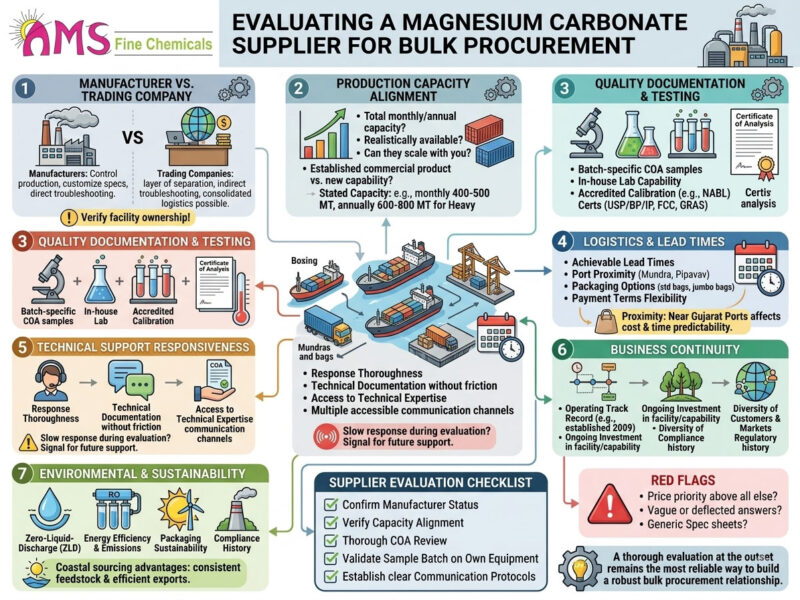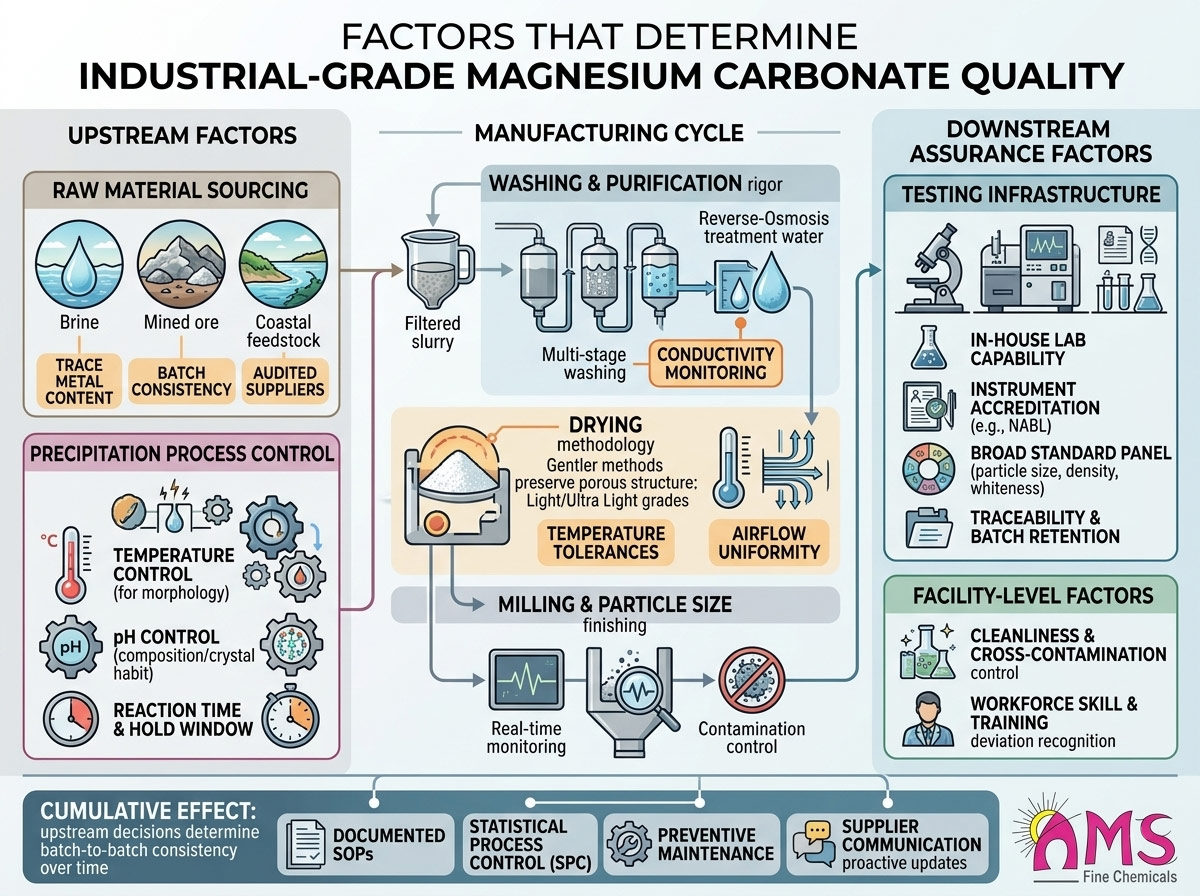
Two manufacturers can start with chemically similar raw materials, follow broadly similar precipitation chemistry, and still produce Magnesium Carbonate that performs meaningfully differently once it reaches a customer’s formulation. The difference isn’t usually a single dramatic process failure — it’s the cumulative effect of a series of upstream decisions: raw material sourcing, precipitation process control, washing and purification rigor, drying methodology, and the depth of the testing infrastructure verifying the final product.
This guide looks at Magnesium Carbonate quality from the manufacturing side — the specific factors, decisions, and process controls that separate a consistently high-quality industrial-grade product from one that merely passes minimum specification on a good day. For buyers, understanding these upstream factors provides a genuinely useful framework for evaluating potential suppliers beyond simply comparing quoted specifications on a data sheet.
Raw Material Sourcing: Where Quality Begins
Every batch of synthetic Magnesium Carbonate begins with a magnesium source — typically magnesium chloride or magnesium sulfate solutions derived from brine, seawater, or mined magnesium ore — reacted with a carbonate or bicarbonate source under controlled conditions. The purity and consistency of this starting raw material directly constrains the maximum achievable purity of the finished product, regardless of how well-controlled the subsequent process steps are.
Key raw material quality factors:
- Trace metal content in the magnesium feedstock, since heavy metals present in the starting solution — iron, lead, arsenic, cadmium — carry through into the finished carbonate unless specifically removed during purification, and no downstream process step can fully compensate for a contaminated starting material.
- Consistency of feedstock concentration and composition between supply batches, since variation in the incoming magnesium solution’s concentration can shift precipitation kinetics and, consequently, the resulting particle morphology even when reaction conditions are otherwise held constant.
- Sourcing from established, quality-audited suppliers for both the magnesium feedstock and the carbonate/bicarbonate reagent, since raw material supplier quality directly propagates into finished product quality — a manufacturer’s own process control can only work with the raw material variability it’s actually given.
Manufacturers with direct access to consistent, high-purity feedstock — such as coastal facilities like AMS Fine Chemicals in Bhavnagar, Gujarat, with proximity to marine-sourced magnesium raw materials — have a structural advantage in maintaining consistent finished product purity compared to manufacturers relying on more variable or lower-purity feedstock sources.
Precipitation Process Control: Where Physical Structure Is Determined
The precipitation reaction stage — where the magnesium and carbonate sources combine to form the basic magnesium carbonate precipitate — is where the finished product’s defining physical characteristics are actually determined, not adjusted afterward. Our Complete Guide to Magnesium Carbonate Manufacturing Process covers this stage in full technical detail; here, the focus is specifically on which process variables most directly drive quality outcomes.
Reaction temperature control: Precise, consistent temperature control during precipitation directly influences crystal nucleation and growth rate, which in turn determines particle size distribution and morphology. Manufacturers with tighter temperature control — through better reactor design, more responsive heating/cooling systems, and rigorous process monitoring — achieve more consistent particle characteristics batch after batch than manufacturers relying on looser temperature tolerances.
pH control during precipitation: Reaction pH influences both the resulting compound’s exact composition (the ratio of carbonate to hydroxide components in the basic carbonate structure) and crystal habit. Manufacturers with real-time pH monitoring and responsive reagent dosing control achieve more consistent, targeted composition than those relying on less precise batch-dosing approaches.
Reaction time and hold duration: Sufficient reaction time is necessary for complete precipitation and crystal development, but excessive hold time can shift particle characteristics away from the intended target, sometimes coarsening particle size beyond specification or altering morphology in unintended ways. Well-controlled processes define and consistently execute an optimal reaction time window rather than treating hold duration loosely.
Our article on How Magnesium Carbonate Particle Morphology Influences Industrial Performance explains why getting this precipitation stage right matters so much — because, as covered there, particle morphology cannot be effectively corrected downstream once it’s been established during precipitation.
Washing and Purification: Removing What Shouldn’t Be There
After precipitation, the raw carbonate slurry contains soluble byproducts — sodium chloride, ammonium compounds, or other reaction salts, depending on which reagents were used — that must be removed through thorough washing before the material is dried into its final powder form.
Key washing-stage quality factors:
- Multi-stage washing with high-purity water, since incomplete washing leaves residual soluble salts (chloride, sulfate) elevated above acceptable limits, a common source of Certificate of Analysis failures on impurity parameters.
- Wash water quality, since washing with water that itself carries trace mineral or microbial contamination can reintroduce the very impurities the washing process is meant to remove — deionized or reverse-osmosis-treated wash water is standard practice among quality-focused manufacturers specifically to avoid this risk.
- Conductivity monitoring as a washing completeness indicator, since measuring the electrical conductivity of the wash water leaving the filter cake provides a real-time, quantitative signal of how completely soluble salts have been removed, rather than relying on a fixed wash cycle count that may over- or under-wash depending on batch-specific variation.
- Filtration equipment and filter cake integrity, since inconsistent or channeling filtration can leave pockets of the filter cake inadequately washed even when the overall batch conductivity reading appears acceptable.
Manufacturers who monitor and document wash water conductivity as an objective completion criterion — rather than a fixed, one-size-fits-all wash cycle — generally achieve more consistent impurity removal across batches, since this approach adapts to natural batch-to-batch variation in initial impurity load.
Drying Methodology: Preserving Structure Without Compromising It
The drying stage converts the washed, moisture-laden filter cake into the final commercial powder, and drying method and conditions significantly affect the finished product’s structural integrity, particle characteristics, and residual moisture content.
Key drying-stage quality factors:
- Drying temperature control, since temperatures set too low leave excess residual moisture (elevated Loss on Drying), while temperatures set too high risk beginning premature thermal decomposition of the carbonate structure before the material even reaches its intended finished form — our Understanding the Thermal Decomposition of Magnesium Carbonate article explains the temperature thresholds relevant to avoiding this risk.
- Drying equipment selection, since different equipment types — flash dryers, fluidized bed dryers, rotary dryers — impose different mechanical stress on the material during processing, with gentler drying methods generally better preserving the delicate, porous particle structure characteristic of Light and Ultra Light grades.
- Drying time and airflow uniformity, since inconsistent drying across a batch — pockets of over-dried or under-dried material within the same production run — undermines the batch-wide consistency buyers depend on.
Manufacturers producing Light and Ultra Light grades specifically need drying equipment and process parameters calibrated to preserve the porous particle structure these grades depend on for their functional performance, since aggressive or poorly controlled drying can inadvertently collapse or fracture this structure, degrading the very properties the grade was engineered to deliver.
Milling and Particle Size Finishing
For applications requiring finer particle size than the as-precipitated and dried material naturally achieves, a milling or micronization step further refines particle size — but this stage introduces its own quality risk if not carefully controlled.
Key milling-stage quality factors:
- Milling equipment selection and calibration, since aggressive milling can fracture particles into an unintentionally broad size distribution or alter particle morphology beyond the intended target, undermining rather than improving batch consistency.
- Process monitoring during milling, since real-time particle size feedback allows operators to stop milling at the intended target rather than relying solely on a fixed milling duration that may over- or under-process depending on natural batch-to-batch material variation.
- Contamination control during milling, since milling equipment wear can introduce trace metal contamination into the finished product if equipment maintenance and material-of-construction selection aren’t carefully managed.
Our Magnesium Carbonate Particle Size Distribution and Its Impact on Formulation article covers why the resulting particle size distribution matters so much downstream — this milling-stage discipline is what determines whether that downstream distribution is actually well-controlled or inadvertently broadened.
Testing Infrastructure: Verifying Quality, Not Assuming It
Even excellent process control needs to be verified through rigorous, comprehensive testing before a batch is released — and the depth and reliability of a manufacturer’s testing infrastructure is itself a determining factor in overall product quality assurance.
Key testing infrastructure factors:
- In-house analytical laboratory capability, since manufacturers with comprehensive in-house testing (rather than relying entirely on periodic third-party testing) can catch and address quality issues in near real-time rather than discovering them after a batch has already shipped.
- Instrument calibration and accreditation, since testing equipment calibrated against accredited standards (such as NABL-accredited calibration in India) provides greater confidence in reported results than uncalibrated or infrequently calibrated instrumentation.
- Breadth of the standard testing panel, since a manufacturer testing only assay and basic impurities provides less quality assurance than one routinely testing particle size distribution, bulk density, whiteness index, and heavy metals via modern ICP-OES methodology as standard practice, as covered in our Magnesium Carbonate COA Explained: Important Parameters Buyers Should Check article.
- Batch retention and traceability systems, since manufacturers who retain reference samples and maintain full batch traceability can support faster, more effective root-cause investigation if a downstream quality question ever arises.
Environmental and Facility Factors
Beyond the direct process steps, broader facility-level factors influence overall product quality consistency:
- Facility cleanliness and cross-contamination control, particularly important for manufacturers producing multiple grades or multiple products in shared facilities, where inadequate segregation and cleaning protocols between production runs risk cross-contamination between different grades or even different chemical products.
- Environmental control in packaging areas, since even a perfectly manufactured, properly dried batch can pick up moisture if packaging occurs in an uncontrolled, high-humidity environment before sealing — a link back to the storage and handling considerations covered in our Magnesium Carbonate Storage and Handling: Best Practices for Industrial Buyers guide.
- Wastewater and process water management, since facilities with robust effluent treatment and water recycling systems (such as zero-liquid-discharge processing) demonstrate broader process discipline that often correlates with overall manufacturing quality consciousness, beyond the specific environmental compliance benefit itself.
Workforce Skill and Training as an Underrated Quality Factor
Process equipment and documented procedures matter, but skilled, well-trained operators remain a critical, sometimes underappreciated quality factor, particularly for process stages that require real-time judgment rather than fully automated control.
- Operator training on process deviation recognition, since an experienced operator who notices an unusual reaction rate, unexpected color change, or atypical filter cake behaviour during precipitation or washing can flag a developing issue well before it would show up in final batch testing, allowing corrective action before an entire batch is compromised.
- Cross-training and succession planning, reducing quality risk associated with over-reliance on a single individual’s institutional knowledge, particularly relevant for smaller manufacturing operations where a narrow base of specialized expertise can become a single point of failure.
- Regular training updates aligned with evolving quality standards, since regulatory and customer quality expectations — particularly in pharmaceutical and food applications — continue to evolve, and manufacturers who invest in ongoing operator training tend to adapt more smoothly to new requirements than those relying on static, one-time training programs.
This human factor is harder to quantify on a specification sheet than equipment capability or testing infrastructure, but it meaningfully influences how consistently a manufacturer executes its documented processes in practice, particularly in catching and correcting deviations before they propagate into a finished, released batch.
Supplier Relationship and Communication as a Quality Factor
A final, often overlooked factor is the quality of communication and collaboration between a manufacturer and its customers, since this relationship directly affects how quickly potential quality issues are identified, understood, and resolved:
- Transparent, proactive communication about process changes, since manufacturers who inform customers in advance of any process or raw material source change — rather than customers discovering a change only through an unexpected batch variation — support better collaborative quality management.
- Responsiveness to customer quality inquiries, since a manufacturer’s willingness to provide detailed technical documentation, additional testing data, or sample batches for independent verification signals genuine confidence in their own quality processes.
- Collaborative problem-solving when issues do arise, since even well-controlled manufacturing processes occasionally produce an out-of-specification result, and how a manufacturer responds — promptly, transparently, and with genuine root-cause investigation — reveals as much about their quality culture as their routine batch performance does.
Consistency Over Time: The Factor That Matters Most for Buyers
Every individual factor discussed above contributes to a single batch’s quality, but for buyers running continuous production, the more operationally important question is whether a manufacturer can reliably reproduce that quality standard batch after batch, month after month. This requires:
- Documented standard operating procedures for every process stage, reducing dependence on individual operator judgment and supporting consistent execution regardless of shift or personnel changes.
- Statistical process control practices, tracking key quality parameters over time to catch gradual process drift before it produces an actual out-of-specification batch — a practice discussed in more detail in our particle size distribution article referenced above.
- Preventive equipment maintenance programs, since gradual equipment wear (in filtration, drying, or milling equipment specifically) can introduce slow, hard-to-notice quality drift if not proactively managed through scheduled maintenance rather than reactive repair after a failure occurs.
- Investment in continuous process improvement, since manufacturers who treat quality control as a static, once-established system rather than an ongoing discipline tend to fall behind evolving customer requirements and industry best practice over time.
How AMS Fine Chemicals Applies These Quality Factors in Practice
AMS Fine Chemicals, established in 2009 and based in Bhavnagar, Gujarat, has built its manufacturing process around the quality factors described throughout this guide — controlled precipitation temperature and pH, multi-stage washing with conductivity-verified completion, drying methodology calibrated to preserve particle structure across our Light, Ultra Light, and Heavy grades, and comprehensive in-house testing through our own Physico-Chemical and Microbiology laboratories, with instruments calibrated by NABL-accredited facilities. Our proximity to Gujarat’s coastal magnesium resources and major seaports supports both consistent raw material access and efficient export logistics for our global customer base.
Explore full technical specifications on our Magnesium Carbonate, Light Magnesium Carbonate, Ultra Light Magnesium Carbonate, and Heavy Magnesium Carbonate product pages, or browse our complete range of magnesium compounds — including Magnesium Hydroxide and Magnesium Trisilicate — on the Products page.
Frequently Asked Questions
Can raw material quality issues be fully corrected through downstream processing? No, not fully — while purification and washing stages can remove some impurities, no downstream process step can fully compensate for a contaminated or highly variable starting raw material. Raw material quality sets the ceiling that subsequent processing can approach but not exceed.
Why do two manufacturers using similar precipitation chemistry produce different quality products? The difference typically comes down to process control precision — temperature, pH, and reaction time consistency — combined with the rigor of washing, drying, and testing practices, rather than the underlying chemistry itself, which is broadly similar across most commercial manufacturers.
How can a buyer evaluate a manufacturer’s process quality without visiting the facility directly? Reviewing historical batch-to-batch consistency data, asking specific questions about testing infrastructure and calibration practices, and requesting documentation of quality certifications provides meaningful insight even without an in-person facility audit, though a facility visit remains the most thorough evaluation method for critical, high-volume sourcing relationships.
Does more expensive Magnesium Carbonate always indicate higher quality? Not necessarily — price reflects a combination of factors including raw material sourcing, process sophistication, testing rigor, and certification level, but isn’t a perfectly reliable proxy for quality on its own. Reviewing actual technical documentation and, where possible, requesting sample batches for independent verification remains more reliable than price alone.
What’s the most important single quality factor for a buyer to prioritize when evaluating a new supplier? Batch-to-batch consistency, more than any single quality ceiling metric, tends to matter most for buyers running continuous production, since a formulation is generally validated against expected, reproducible material characteristics rather than an occasional best-case batch.
How much does raw material sourcing location actually affect finished product quality? It can matter meaningfully, primarily through consistency and access rather than any inherent quality advantage tied to geography — manufacturers with reliable, consistent access to appropriate-purity raw materials generally maintain more consistent finished product quality than those dependent on more variable or distant supply chains, though skilled process control can compensate for moderate raw material variability to a significant degree.
Final Word
Industrial-grade Magnesium Carbonate quality isn’t determined by a single process step or a single test result — it’s the cumulative outcome of raw material sourcing decisions, precipitation process precision, washing and drying rigor, milling control where applicable, and comprehensive testing infrastructure, all sustained consistently over time. Buyers who understand these upstream factors are better positioned to evaluate potential suppliers on genuine process capability rather than specification sheets alone, and to ask the kind of specific, informed questions that reveal whether a manufacturer’s quality claims are backed by real process discipline.
To request technical specifications, manufacturing process documentation, or a sample batch of any Magnesium Carbonate grade, visit our Magnesium Carbonate product page or reach out through our Contact Us page.