A batch of Magnesium Carbonate can leave a manufacturer’s facility in perfect condition — correct assay, ideal particle size, spot-on bulk density — and still arrive at a formulator’s production line compromised, simply because of what happened to it between shipment and use. Storage and handling failures are among the most preventable, and most commonly overlooked, sources of raw material quality problems in industrial chemical procurement.
This guide is a practical reference for warehouse managers, procurement teams, and quality personnel responsible for keeping Magnesium Carbonate in the condition it was tested and certified in, from the moment it arrives at your dock through to the moment it’s incorporated into your formulation. It’s written specifically for industrial buyers managing bulk quantities — pharmaceutical, food, cosmetic, rubber, agricultural, and general industrial operations — rather than laboratory-scale handling.
Why Storage and Handling Deserve Dedicated Attention
Magnesium Carbonate’s most valuable functional properties — its high surface area, moisture-absorbing capacity, and fine particle structure — are precisely the properties that make it vulnerable to storage and handling mistakes. A material engineered to absorb moisture from its surroundings will absorb moisture from a poorly sealed warehouse just as readily as it absorbs moisture from a food product it’s protecting. A material valued for its fine, uniform particle size can have that particle size altered by rough handling before it ever reaches a formulator’s mixing vessel.
Our Magnesium Carbonate Moisture Absorption: What Formulators Need to Know article explains the underlying adsorption mechanism responsible for this vulnerability — this guide focuses specifically on the practical storage and handling protocols that protect against it, and against the other common risks bulk buyers face.
Moisture Control: The Primary Storage Risk
Because commercial Magnesium Carbonate is inherently hygroscopic, moisture exposure during storage is the single most common way material quality degrades before it ever reaches production.
Practical safeguards:
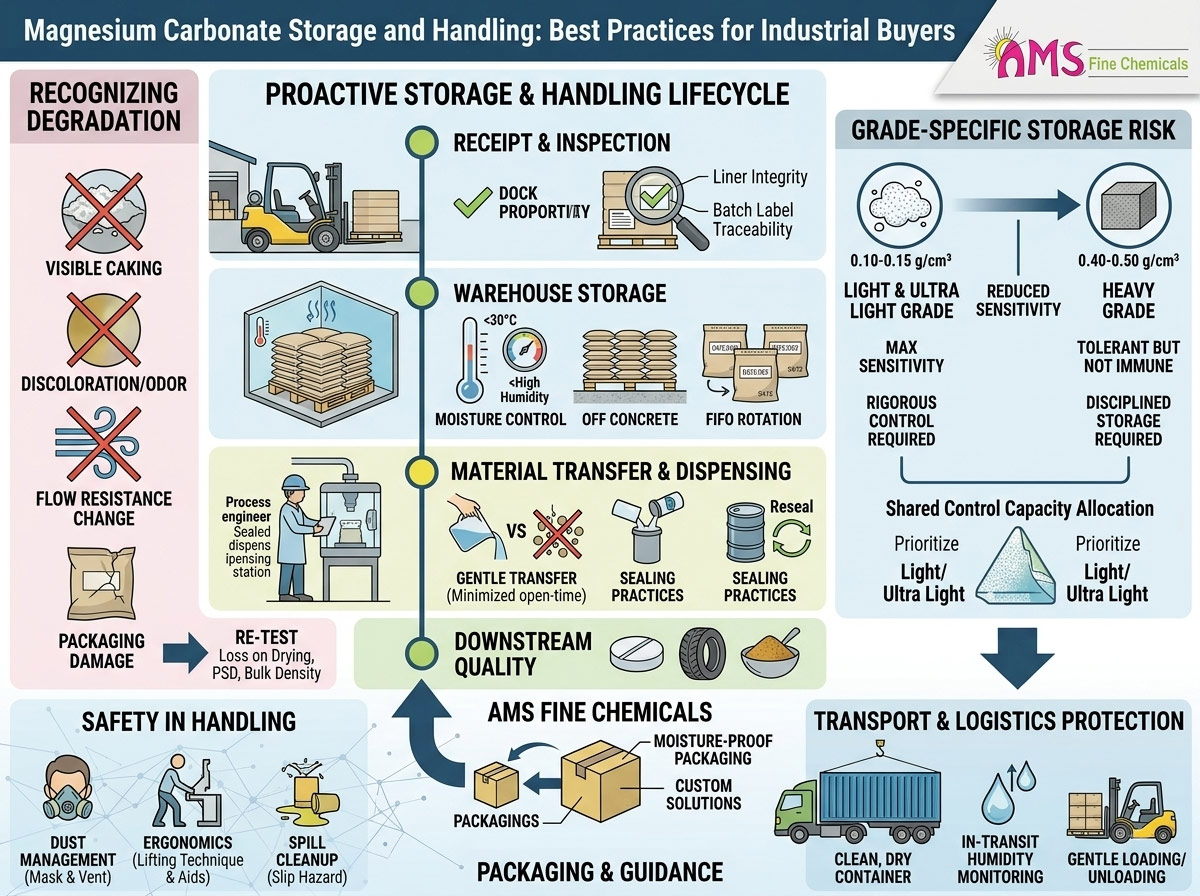
- Sealed, moisture-proof packaging, typically multi-wall paper bags or woven polypropylene bags with an internal polyethylene liner for standard commercial shipments, or fiber drums for smaller or specialty orders. Confirm liner integrity on receipt — a torn or improperly sealed liner defeats the purpose of the outer packaging entirely.
- Climate-controlled warehouse storage, generally maintained below roughly 30°C and away from high-humidity zones within a facility (near loading docks, exterior walls, or areas prone to condensation).
- Elevated storage off bare concrete floors, using pallets, to reduce moisture wicking from floor slabs, particularly relevant in facilities without a fully sealed, moisture-resistant floor coating.
- Minimizing open-container exposure time during dispensing and weighing, since even a properly sealed bag becomes vulnerable to ambient moisture pickup the moment it’s opened for use.
- Prompt resealing of any partially used bag or drum, using appropriate closures rather than loosely folding or taping packaging shut between uses.
For buyers in India and similar humid, monsoon-affected climates, these safeguards deserve particular attention during the monsoon season specifically, when sustained high ambient humidity places extended stress on both packaging integrity and warehouse climate control systems. Bhavnagar and the broader Gujarat coastal industrial corridor, where AMS Fine Chemicals is based, experiences exactly this seasonal humidity pattern, making moisture-proof packaging and storage discipline a year-round rather than occasional consideration for facilities in the region.
Grade-Specific Storage Considerations
Not all Magnesium Carbonate grades carry equal storage risk, since moisture sensitivity correlates directly with surface area:
- Light Magnesium Carbonate and Ultra Light Magnesium Carbonate, with their high surface area and porosity, are the most moisture-sensitive grades and warrant the most rigorous storage discipline — sealed packaging, climate control, and minimized open-container time all matter most for these grades.
- Heavy Magnesium Carbonate, with its lower surface area, is comparatively more storage-tolerant, though it isn’t immune to moisture pickup and shouldn’t be stored with less discipline simply because it’s the less sensitive of the three grades.
Facilities storing multiple grades should avoid assuming a uniform storage protocol suits all of them equally — if warehouse space or climate control capacity is limited, prioritizing the more sensitive Light and Ultra Light grades for the best-controlled storage areas is a reasonable, practical allocation.
Physical Handling: Protecting Particle Structure and Morphology
Beyond moisture, physical handling itself can alter the material’s particle structure before it ever reaches your formulation — a risk less commonly discussed than moisture exposure but equally capable of causing downstream performance problems.
Common sources of particle attrition:
- High-velocity pneumatic conveying, common in facilities that transfer bulk powder between storage silos and processing equipment, can fracture porous aggregate particles through repeated collision with conveying pipe walls and other particles, gradually shifting particle size distribution and bulk density from what was originally received.
- Repeated bag-to-bag or drum-to-drum transfer, particularly using aggressive scooping or pouring techniques, introduces mechanical stress that can degrade particle structure over multiple handling cycles.
- Excessive stacking height and pallet compression, especially over extended storage periods, can compact lower layers of stored material, potentially altering bulk density in the affected bags even before the material is opened for use.
Our article on How Magnesium Carbonate Particle Morphology Influences Industrial Performance covers why this structural degradation matters functionally — the practical takeaway for storage and handling teams is that gentler transfer methods and moderate stacking limits genuinely protect performance, not just packaging aesthetics.
Warehouse Layout and Inventory Rotation
Beyond individual container storage practices, overall warehouse layout and inventory management practices affect Magnesium Carbonate quality at scale:
- First-in, first-out (FIFO) rotation, ensuring older stock is used before newer stock, minimizes the total time any given batch spends in storage and reduces cumulative moisture exposure risk over extended periods.
- Clear batch labeling and traceability, maintaining visible batch numbers on stored containers, supports both FIFO rotation and rapid identification if a specific batch later needs to be traced back for quality investigation purposes.
- Segregated storage zones for different grades and, where applicable, different certification levels (pharmaceutical vs. industrial grade material), reducing the risk of accidental cross-contamination or misidentification during high-volume warehouse operations.
- Regular stock condition inspection, periodically checking stored material — even sealed, unopened containers — for signs of caking, discoloration, or packaging damage that might indicate a developing storage issue before it affects a larger portion of inventory.
Shelf Life and Storage Duration
Properly stored Magnesium Carbonate under appropriate sealed, climate-controlled conditions typically maintains its specified quality for an extended shelf life — often cited in the range of several years — though buyers should confirm the specific shelf-life guidance provided by their supplier rather than assuming a universal figure applies across all grades and packaging formats.
Factors that shorten effective shelf life below the nominal specification:
- Repeated opening and resealing of the same container over an extended period, even under otherwise good storage conditions.
- Storage in facilities without reliable climate control, particularly in consistently high-humidity regions.
- Physical damage to packaging during transport or warehouse handling that isn’t identified and corrected promptly.
- Storage adjacent to strong-odor or volatile chemical sources, since Magnesium Carbonate’s porous structure can, in some cases, adsorb ambient odors from nearby stored materials — a consideration particularly relevant for food and pharmaceutical applications where sensory neutrality matters.
Buyers with long inventory cycles or seasonal demand patterns — common in agricultural and fertilizer applications tied to planting seasons — should factor expected storage duration into their grade and packaging format decisions at the point of ordering, rather than treating storage duration as an afterthought once material has already arrived.
Transport and Logistics Considerations
Storage risk doesn’t begin at the warehouse door — it begins the moment material leaves the manufacturer’s facility, and transport conditions deserve equal attention:
- Container and truck condition, confirming shipping containers and trucks are clean, dry, and free of prior cargo residue that could contaminate or introduce odors to the shipment.
- Humidity exposure during transit, particularly relevant for extended sea-freight routes through humid tropical regions, where in-transit humidity control (or lack thereof) can meaningfully affect material condition on arrival even if packaging was properly sealed at the point of origin.
- Temperature extremes during transport, since prolonged exposure to very high temperatures — for instance, in an un-climate-controlled shipping container sitting on a hot dockside for an extended period — can, in some circumstances, affect packaging integrity even if the Magnesium Carbonate itself remains chemically stable within its normal decomposition temperature threshold.
- Loading and unloading handling practices, since rough handling during container loading or forklift transfer at either end of a shipment can introduce the same physical attrition risks discussed above under warehouse handling.
Buyers sourcing from coastal manufacturing hubs like Bhavnagar, Gujarat — positioned for efficient export via nearby seaports — benefit from working with suppliers who apply the same packaging and handling discipline to export shipments as they do to domestic deliveries, since international transit typically involves longer duration and more handling touchpoints than domestic distribution.
Safety Considerations in Storage and Handling
While Magnesium Carbonate is generally regarded as a low-hazard material compared to many industrial chemicals, basic occupational safety practices remain relevant during storage and handling operations:
- Dust management during transfer and dispensing, since fine powder handling can generate airborne dust that, while not classified as highly hazardous, still warrants standard respiratory protection and adequate ventilation in accordance with general industrial hygiene practice.
- Manual handling ergonomics, particularly relevant for facilities handling standard 25 kg bags or larger, where proper lifting technique and, where volume justifies it, mechanical handling aids reduce workplace injury risk during routine storage and dispensing operations.
- Slip hazard management, since spilled powder on warehouse or production floors can create a slip risk, particularly in facilities with smooth flooring, making prompt cleanup protocols a standard part of good housekeeping practice around bulk powder handling areas.
- Segregation from incompatible materials, avoiding storage immediately adjacent to strong acids or other reactive materials, consistent with general chemical storage best practice, even though Magnesium Carbonate itself doesn’t present significant reactive hazard risk under normal ambient storage conditions.
These practices align with standard good manufacturing and warehousing practice broadly applicable across industrial powder handling, rather than presenting Magnesium Carbonate-specific hazards beyond what any bulk powder ingredient would warrant.
Documentation and Traceability Through the Storage Lifecycle
Beyond the physical safeguards covered above, maintaining proper documentation throughout a batch’s storage lifecycle supports both quality assurance and, where relevant, regulatory compliance:
- Goods receipt documentation, recording batch number, quantity, condition on arrival, and Certificate of Analysis reference at the point of receipt, before material is moved into general storage.
- Storage condition logs, particularly for facilities with formal environmental monitoring requirements (common in pharmaceutical and food GMP environments), documenting warehouse temperature and humidity over time to support later investigation if a quality issue arises.
- Dispensing and usage records, tracking which specific batch was used in which production run, supporting rapid traceability if a downstream quality issue needs to be investigated back to a specific storage period or handling event.
- Periodic stock condition audits, formally documented rather than informal, particularly for slower-turnover inventory categories like agricultural and fertilizer applications with seasonal demand patterns.
This documentation discipline matters most for regulated industries, but even general industrial buyers benefit from basic traceability practices, since they significantly reduce the time and cost involved in root-cause investigation if a storage-related quality issue is later suspected.
Handling Practices for Different Facility Types
Pharmaceutical manufacturing facilities typically require the most rigorous handling protocols, often including controlled-environment dispensing areas, minimized open-container exposure time, and detailed handling records supporting batch traceability requirements under GMP frameworks.
Food processing facilities generally require food-safe handling practices — clean, dedicated equipment for dispensing, protection from cross-contamination with allergens or other ingredients, and storage segregation consistent with food safety management system requirements.
Cosmetic manufacturing facilities typically fall between pharmaceutical and general industrial rigor, with particular attention to preventing contamination that could affect product whiteness or introduce unwanted odors into sensory-sensitive formulations.
Rubber and polymer compounding facilities generally prioritize bulk handling efficiency — proper silo design, pneumatic conveying system calibration, and consistent dosing equipment maintenance — over the more granular dispensing controls relevant to pharmaceutical or cosmetic operations, though moisture control remains important to prevent processing issues during compounding.
Agricultural and fertilizer blending facilities often manage the largest storage volumes and longest storage durations of any category, given seasonal demand patterns, making warehouse climate control and FIFO rotation discipline especially important to prevent quality degradation across an extended storage period between manufacturing and field application.
Recognizing Storage-Related Quality Degradation
Buyers and quality teams should know what to look for when checking stored Magnesium Carbonate for early signs of storage-related degradation:
- Visible caking or clumping within a container, even if the material still passes assay testing, indicates moisture exposure has occurred and should prompt Loss on Drying re-testing before the material is used in a moisture-sensitive application.
- Discoloration or unusual odor, which can indicate either moisture-related degradation, contamination, or adsorption of ambient odors from nearby stored materials.
- Unexpected flow resistance during dispensing, compared to the material’s typical handling behaviour, which can indicate either moisture pickup or physical attrition affecting particle structure.
- Packaging damage — torn liners, compromised seals, or signs of pest intrusion — which should trigger inspection of the material itself even if no other quality indicators are immediately apparent.
Any of these signs warrants pulling a sample for confirmatory testing — bulk density, particle size distribution, and Loss on Drying at minimum — before committing the affected material to a formulation, particularly for pharmaceutical, food, and cosmetic applications where the cost of a downstream quality failure far exceeds the cost of a quick confirmatory test.
How AMS Fine Chemicals Supports Proper Storage and Handling From the Point of Shipment
At AMS Fine Chemicals, our Bhavnagar, Gujarat facility packages every batch of Light, Ultra Light, and Heavy Magnesium Carbonate in moisture-proof packaging appropriate to the grade and destination — multi-wall paper bags or woven polypropylene bags with internal polyethylene liners for standard shipments, with custom packaging formats available for buyers with specific storage or handling requirements. Given our location near major Gujarat seaports, we apply consistent packaging and handling discipline across both domestic and export shipments, recognizing that international transit typically involves longer duration and more handling touchpoints than domestic distribution.
Our technical team can also provide storage and shelf-life guidance specific to your facility’s climate conditions and expected inventory turnover, particularly useful for buyers in humid coastal or monsoon-affected regions planning storage protocols for the first time. Explore full technical specifications on our Magnesium Carbonate, Light Magnesium Carbonate, Ultra Light Magnesium Carbonate, and Heavy Magnesium Carbonate product pages, or browse our complete range of magnesium compounds — including Magnesium Hydroxide and Magnesium Trisilicate — on the Products page.
Frequently Asked Questions
How long can Magnesium Carbonate be stored before it should be re-tested? This depends on the supplier’s specific shelf-life guidance and your storage conditions, but as a general practice, material approaching the end of its stated shelf life — or material stored well beyond typical inventory turnover for your facility — is worth confirmatory re-testing before use, particularly for critical pharmaceutical, food, or cosmetic applications.
Can Magnesium Carbonate be stored in a refrigerated warehouse to extend shelf life? Generally not recommended without careful humidity control — refrigeration can introduce condensation risk during temperature transitions (moving material between refrigerated and ambient conditions), which can actually increase moisture exposure rather than reduce it. A cool, dry, consistently climate-controlled ambient storage environment is typically preferable to refrigeration.
Does opening and resealing a bag multiple times significantly affect quality? Yes, cumulatively — each opening introduces a window of moisture exposure, and frequent opening and resealing over an extended period can meaningfully shorten effective shelf life compared to a container opened once and fully consumed promptly. Minimizing the number of open-reseal cycles, where practical, helps preserve material quality.
What’s the best way to confirm material hasn’t degraded during storage before using it in a critical application? A quick confirmatory test panel — Loss on Drying, bulk density, and particle size distribution at minimum — compared against the original Certificate of Analysis is the most practical way to confirm stored material still meets its original specification before committing it to a sensitive formulation.
Should storage and handling protocols differ significantly between Light and Heavy grades? Yes, meaningfully — Light and Ultra Light grades, given their higher surface area and moisture sensitivity, warrant more rigorous sealed storage and minimized open-container handling than Heavy grade material, which is comparatively more storage-tolerant, though still not immune to moisture-related degradation over time.
Final Word
Storage and handling protocols rarely get the same attention as chemical specification and grade selection during Magnesium Carbonate sourcing decisions, but they determine whether the material that arrives at your dock in perfect condition actually stays that way through to the point of use. Moisture control, careful physical handling to protect particle structure, disciplined inventory rotation, and attention to transport conditions together form a practical framework that protects the raw material investment your quality and procurement teams have already made in selecting the right grade and specification in the first place.
To request storage and handling guidance, packaging specifications, or a sample batch of any Magnesium Carbonate grade, visit our Magnesium Carbonate product page or reach out through our Contact Us page.