Dry powder manufacturing looks simple from the outside — mix a few ingredients, dry them if needed, and pack the result. In practice, it is one of the most demanding areas of formulation science. A powder that clumps on the production line, resists uniform blending, or picks up moisture during storage can bring an entire batch to a halt. This is exactly where Light Magnesium Carbonate earns its place as a trusted processing aid across pharmaceutical, food, cosmetic, and industrial powder manufacturing.
At AMS Fine Chemicals, a Bhavnagar, Gujarat-based manufacturer of magnesium compounds, we supply Light Magnesium Carbonate to formulators who need reliable flow, consistent bulk density, and dependable anti-caking performance in their dry powder lines. This article looks closely at why this material behaves the way it does, where it fits into a typical dry powder manufacturing process, and what a formulator should check before selecting a grade.
What Makes Light Magnesium Carbonate Suitable for Dry Powder Processing?
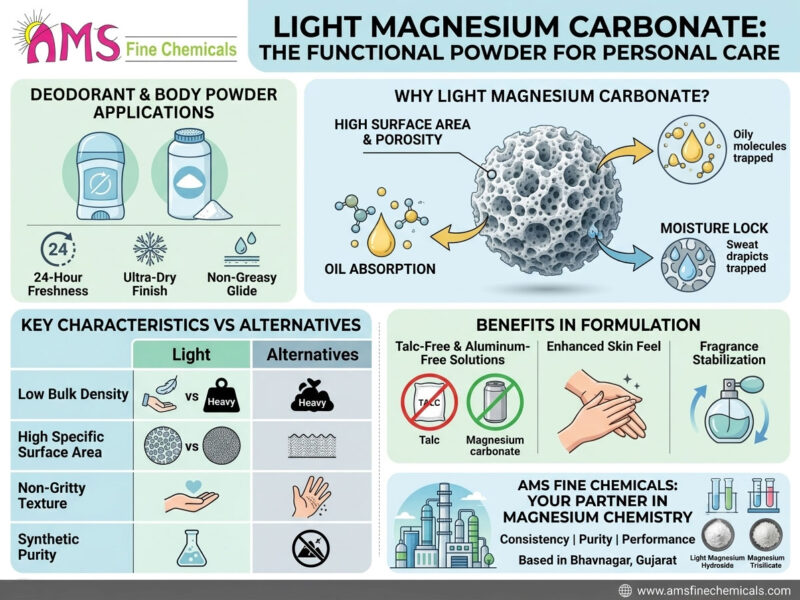
Light Magnesium Carbonate (MgCO₃) is a fine, white, odorless powder characterized by low bulk density and high surface area. These two properties, more than any other, decide how a powder behaves once it enters a blender, a filling line, or a compression press.
Low bulk density means the material occupies more volume per unit weight than denser powders. In dry powder manufacturing, this translates into better bulking action — a small addition of Light Magnesium Carbonate can noticeably improve the overall volume and texture of a formulation without adding significant weight. This is one reason it appears so often as a bulking and carrier agent in powders that need to feel light, fine, and non-compact.
High surface area gives the particles a large amount of exposed surface relative to their size. This is what makes the material such an effective absorbent — it can take up moisture and oils on contact, which is directly useful in two of the biggest challenges dry powder manufacturers face: caking and inconsistent flow. We discussed the mechanics of this property in more depth in How Surface Area Influences Light Magnesium Carbonate Performance, which is worth reading alongside this article if you want to understand the particle-level behavior behind these effects.
Beyond density and surface area, Light Magnesium Carbonate is chemically stable under normal storage and processing conditions, has no taste or odor of its own, and is compatible with a wide range of active ingredients, colorants, and other excipients. That combination of neutrality and functionality is why it shows up in so many different powder categories rather than being confined to a single industry.
The Core Functions Light Magnesium Carbonate Performs in Dry Powder Manufacturing
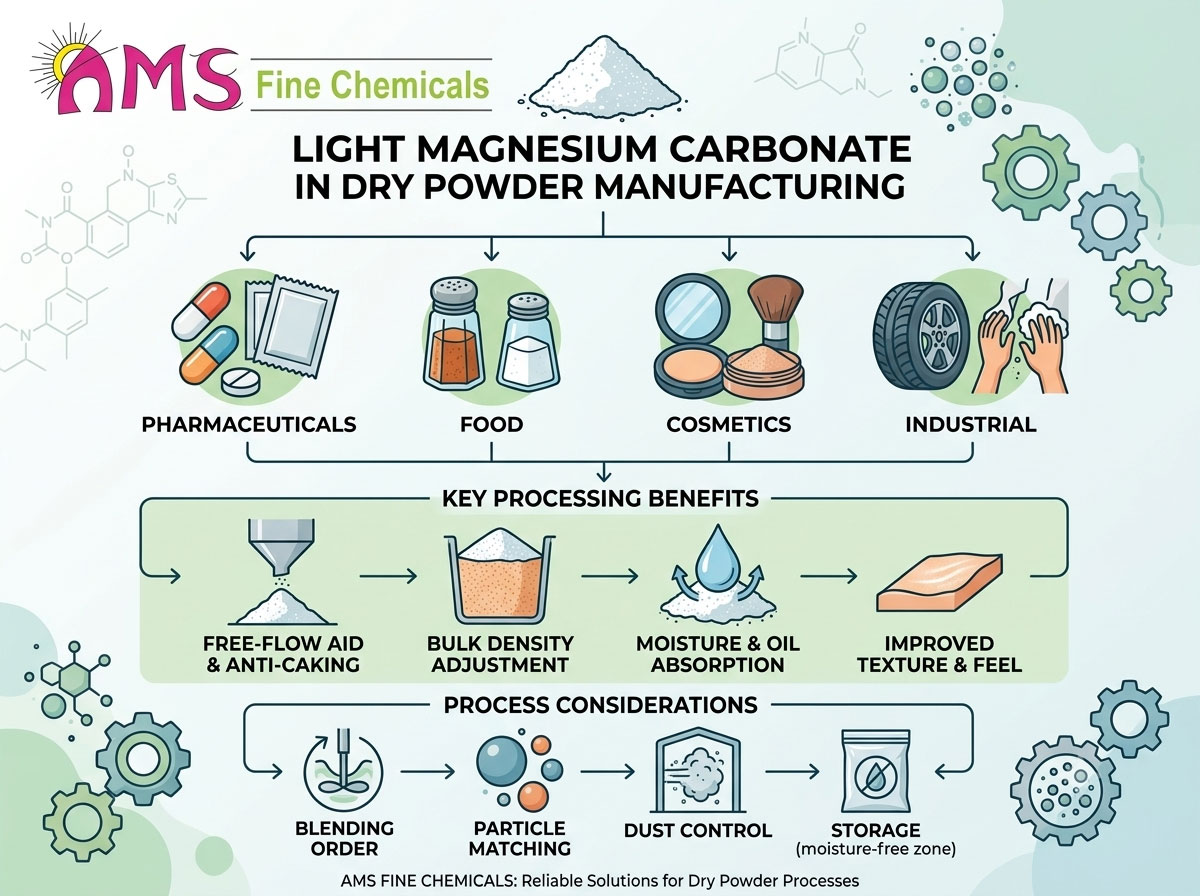
When formulators bring Light Magnesium Carbonate into a dry powder process, they are usually asking it to do one or more of the following jobs.
1. Anti-Caking and Free-Flow Maintenance
Caking happens when individual powder particles pick up ambient moisture, soften at their contact points, and bond together into lumps or a solid mass. Once this happens, the powder no longer flows through hoppers, feeders, or sachets the way it should, and it can jam filling equipment on a production line.
Light Magnesium Carbonate interrupts this process by absorbing surface moisture before it can act as a bonding agent between particles. Its irregular, high-surface-area particle structure also physically separates particles from one another, reducing the points of contact where caking would otherwise start. This is the same principle used in salt, spice blends, and powdered food products, which we cover in detail in Light Magnesium Carbonate as Anticaking Agent in Spices, Salt, and Powdered Foods.
2. Bulk Density Adjustment and Bulking Agent Function
Many dry powder products — from pharmaceutical sachets to cosmetic loose powders — need a specific fill volume and texture rather than a specific weight. Light Magnesium Carbonate’s low bulk density allows formulators to adjust the overall volume of a powder blend without significantly changing its active content. This is particularly useful in low-dose pharmaceutical powders, where the active ingredient alone would be too small a quantity to handle, measure, or fill accurately without a bulking agent.
3. Moisture and Oil Absorption
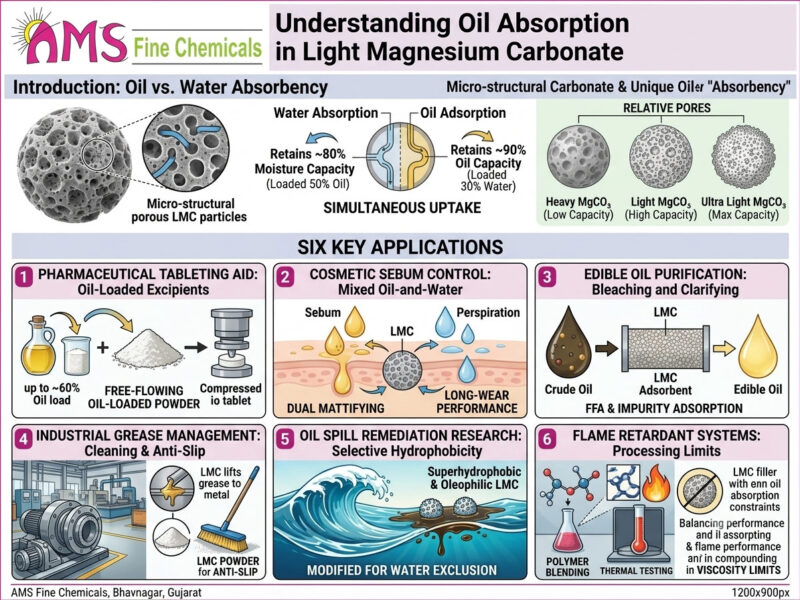
Because of its porous, high-surface-area structure, Light Magnesium Carbonate absorbs both aqueous moisture and oils effectively. In powder manufacturing, this dual absorption capacity is valuable in two distinct ways: it protects the finished powder from humidity pickup during storage and transport, and it can absorb oils either present in the formulation itself or generated by other ingredients (such as botanical extracts or certain active pharmaceutical ingredients). We explored the oil-absorption mechanism specifically in Light Magnesium Carbonate for Oil Absorption: Mechanism and Applications.
4. Flow Aid and Glidant Behavior
In tableting and capsule-filling operations, powders need to flow consistently from the hopper into the die or capsule shell. Poor flow leads to weight variation, capping, and inconsistent dosing. Light Magnesium Carbonate improves flowability by reducing interparticle friction and cohesion, functioning in a manner similar to a glidant even though its primary classification in many formulations is as a filler or excipient. This flow-aid behavior is one of the reasons it is used so widely as a functional excipient in solid-dosage pharmaceutical manufacturing.
5. Texture and Feel in Fine Cosmetic Powders
In cosmetic dry powder manufacturing — face powders, dusting powders, and pressed powders — the tactile “feel” of the finished product matters as much as its functional performance. Light Magnesium Carbonate contributes a soft, silky, non-greasy texture while simultaneously absorbing excess skin oils. This dual role is discussed further in our articles on Light Magnesium Carbonate for Face Powders and Loose Powder Formulations and Light Magnesium Carbonate in Cosmetics: Oil Absorption and Texture Benefits.
Where Light Magnesium Carbonate Fits Across Dry Powder Industries
Pharmaceutical Powder Manufacturing
Pharmaceutical dry powders — oral powders, sachets, effervescent granules, and powder blends destined for tablets or capsules — depend on excipients that are chemically inert, predictable, and compliant with pharmacopoeial standards. Light Magnesium Carbonate is used as an excipient, mild antacid, and bulking/glidant agent in these systems. Because it is available in Food/FCC, EP, and USP grades, it fits directly into regulated pharmaceutical supply chains without requiring reformulation for different markets.
We have written extensively about this application area in Light Magnesium Carbonate in Pharmaceutical Powder Formulations, which walks through how sachet powders, antacid blends, and effervescent granules rely on the material’s flow and absorption properties.
Food Powder Manufacturing
In food processing, powdered spices, powdered salt, instant beverage mixes, and seasoning blends all face the same enemy: humidity-driven caking during storage and transport, especially in warm, humid climates like much of India and Southeast Asia. Light Magnesium Carbonate, used at low inclusion levels and in food-grade or FCC-compliant form, keeps these powders free-flowing from the point of packing to the point of use by consumers or downstream processors.
Cosmetic and Personal Care Powder Manufacturing
Dusting powders, deodorant powders, foundations, and loose face powders are all dry powder products where oil absorption, moisture control, and smooth texture directly determine product quality. Light Magnesium Carbonate performs well here precisely because it combines those three functions in a single ingredient rather than requiring formulators to blend multiple additives. Our article on Light Magnesium Carbonate for Moisture Control in Personal Care Products covers this application in more depth, including how it interacts with talc and other bulking agents commonly used in the same formulations.
Industrial and Specialty Dry Powder Applications
Outside the pharmaceutical, food, and cosmetic space, Light Magnesium Carbonate is used in a number of industrial dry powder contexts:
- Sports chalk and climbing chalk — where high absorbency and low bulk density are used to draw moisture away from the skin. This is examined in Light Magnesium Carbonate in Sports Chalk: Why Porosity Matters.
- Rubber and latex powder compounding — used as a dusting and anti-tack agent to keep rubber sheets, gloves, and condoms from sticking together during manufacturing and storage.
- Paints, printing inks, and paper coatings — where dry powder blends benefit from its filler and rheology-modifying characteristics.
- Flame-retardant powder systems in plastics and PVC compounding, where its decomposition behavior contributes to fire-safety performance, as covered in Flame Retardancy with Light Magnesium Carbonate in Plastics and PVC Compounds.
Process Considerations When Using Light Magnesium Carbonate in Dry Powder Lines
Selecting the right grade is only part of the job. How the material is handled and integrated into a manufacturing process has a direct bearing on the quality of the finished powder.
Blending Order and Homogeneity
Because Light Magnesium Carbonate has such a low bulk density compared to many actives and other excipients, blending order matters. Adding it too early or too aggressively in a high-shear blender can cause segregation or uneven distribution, particularly in low-dose formulations. Many formulators introduce it in stages, using a geometric dilution approach when the active ingredient is present at low concentrations, to ensure uniform distribution throughout the batch.
Particle Size Matching
Dry powder blends perform best when particle sizes of the different components are reasonably matched. A large mismatch between the particle size of Light Magnesium Carbonate and other ingredients can lead to demixing during transport, vibration, or filling, even if the blend appeared uniform immediately after mixing. AMS Fine Chemicals engineers particle size distribution specifically to support this kind of compatibility across different formulation types — a detail we recommend confirming against your specific ingredient set through our technical team.
Dust Control and Handling
The same fine particle size and low density that make Light Magnesium Carbonate effective also make it prone to dusting during transfer and weighing operations. Manufacturing facilities typically manage this with local exhaust ventilation, enclosed transfer systems, and appropriate PPE for operators. From a supply standpoint, packaging in sealed HDPE bags with LDPE liners — the standard packing format we use — helps minimize dust exposure and product loss before the material even reaches the plant.
Moisture Control During Storage
Ironically, a material valued for absorbing moisture from other ingredients must itself be protected from ambient humidity before use. Once a container of Light Magnesium Carbonate is opened, it should be resealed promptly and stored in a cool, dry area away from humid conditions. Left exposed, the material will begin absorbing atmospheric moisture, which can reduce its subsequent effectiveness as an anti-caking or drying agent in the finished powder. Under proper sealed storage, the material carries a shelf life of five years.
Compatibility Testing
Before scaling up a dry powder formulation, it’s good practice to run small-batch compatibility and stability trials with the specific grade of Light Magnesium Carbonate selected. Its mild alkalinity, while generally beneficial (for example, in antacid or pH-buffering applications), should be checked against pH-sensitive actives or flavor systems to rule out any unwanted interaction over the shelf life of the product.
Choosing Between Light, Heavy, and Ultra Light Grades for Dry Powder Manufacturing
Not every dry powder process calls for the same grade of magnesium carbonate, and choosing incorrectly can affect both cost and performance.
- Light Magnesium Carbonate offers the density and surface area profile best suited to most pharmaceutical, cosmetic, and food dry powder applications discussed above — it is the standard choice when free flow, moderate bulking, and good absorption are all required together.
- Ultra Light Magnesium Carbonate takes bulk density even lower and surface area even higher, which suits applications demanding maximum absorbency or the lightest possible texture. The distinctions between the two grades are explained in What Makes Ultra Light Magnesium Carbonate Different From Conventional Light Grade?
- Heavy Magnesium Carbonate, by contrast, is denser and better suited to applications like rubber compounding where bulk and reinforcing filler behavior matter more than fine-powder flow characteristics, as detailed in Heavy Magnesium Carbonate in Industrial Rubber Compounding: A Formulator’s Guide.
For most dry powder manufacturing lines producing pharmaceutical sachets, cosmetic loose powders, or food anti-caking blends, Light Magnesium Carbonate remains the workhorse grade, offering the right balance of cost, availability, and functional performance.
Quality Parameters to Verify Before Sourcing
When qualifying a supplier of Light Magnesium Carbonate for a dry powder manufacturing line, formulators and procurement teams should look closely at:
- Bulk density (loose and tapped) — to confirm consistency batch to batch, since even small variations affect fill volumes and flow behavior on packing lines.
- Particle size distribution — to ensure compatibility with existing blending and filling equipment.
- Loss on drying / moisture content — since excess residual moisture in the incoming material undermines its own anti-caking function.
- Purity and heavy metal limits — particularly important for pharmaceutical, food, and cosmetic grades governed by EP, USP, or FCC specifications.
- Microbiological limits — relevant for food and pharmaceutical applications, verified through appropriate laboratory testing.
- Certificates of Analysis (COA), MSDS/SDS documentation — needed for regulatory filings and internal quality systems.
At AMS Fine Chemicals, every parameter is tested in our in-house Physico-Chemical and Microbiology laboratory, using instruments calibrated by an NABL-accredited lab, so that formulators receive consistent, documented quality with every shipment.
Why Manufacturers Choose AMS Fine Chemicals for Light Magnesium Carbonate
As a Bhavnagar, Gujarat-based manufacturer with an installed capacity of 3,500 to 4,000 MT annually, AMS Fine Chemicals supplies Light Magnesium Carbonate across a wide range of grades — Food/FCC, EP, USP, Cosmetic, Rubber, Sports/Climbing Chalk, Agriculture, Animal Feed, and Technical/Industrial — so dry powder manufacturers in pharmaceuticals, food processing, cosmetics, and industrial sectors can source a single grade tailored precisely to their process rather than compromising on a generic specification.
Our standard packing of 20Kg/25Kg HDPE bags with LDPE liners, loaded on ISPM-compliant pallets and shrink-wrapped, is designed to protect the product’s moisture-sensitive performance from the point of dispatch through to your receiving dock. Dispatch is typically completed within 10–15 days of a confirmed purchase order, with shipments routed through Mundra and Pipavav (Victor) ports.
For a full technical data sheet, MSDS/SDS, or grade-specific COA, reach out to our team directly at info@amsfine.com or via WhatsApp at +91 70433 38890.
Scaling Up: From Lab Trial to Production Batch
Formulators frequently notice that a Light Magnesium Carbonate-based powder blend performs beautifully at bench scale but behaves differently once it moves to a pilot or production-scale blender. This is a common scale-up issue rather than a flaw in the raw material, and it is worth understanding before committing to a full production run.
At small scale, manual or low-shear mixing tends to mask minor differences in particle size or density between ingredients. As batch size increases and mixing equipment shifts to ribbon blenders, V-blenders, or high-shear granulators, those same differences can produce segregation, especially with a low-density material like Light Magnesium Carbonate sitting alongside denser actives or fillers. Running an intermediate pilot batch — even a fraction of full production size — before committing to a large run allows the blend uniformity, flow rate, and fill weight variation to be checked under conditions closer to the real production environment.
It also helps to keep a consistent supplier and grade once a formulation has been validated. Because bulk density and particle size distribution can vary slightly between magnesium carbonate suppliers, switching sources mid-project — even between two products marketed as “Light Magnesium Carbonate” — can quietly shift blend behavior. Working with a single manufacturer that documents these parameters batch to batch, as AMS Fine Chemicals does through its in-house testing laboratory, reduces this risk considerably.
Common Processing Challenges and How Light Magnesium Carbonate Addresses Them
Manufacturers evaluating a new anti-caking or bulking agent for a dry powder line usually arrive with a specific pain point rather than a general interest in the material. A few of the most frequent challenges are worth addressing directly:
“Our powder cakes in storage during the monsoon months.” This is one of the most common complaints from food and pharmaceutical powder manufacturers operating in humid climates. Because Light Magnesium Carbonate actively absorbs ambient moisture at the particle surface before it can bridge between other particles, incorporating even a small percentage into the blend can markedly improve shelf stability without altering taste, odor, or appearance. Packaging still matters — a good anti-caking agent cannot fully compensate for inadequate moisture-barrier packaging — but it significantly widens the margin for error.
“Our tablet weights are inconsistent on the compression line.” Inconsistent fill weight is very often a flow problem rather than a formulation potency problem. Introducing Light Magnesium Carbonate as part of the excipient blend, at an appropriate concentration validated through trial batches, frequently improves powder flow into the die cavity and reduces weight variation, particularly for low-dose or poorly flowing actives.
“Our cosmetic powder feels gritty or oily after a few weeks on the shelf.” This usually points to insufficient oil absorption capacity in the base formulation. Because Light Magnesium Carbonate absorbs both moisture and oils, adjusting its concentration or switching to a finer particle size grade can restore the intended silky texture and prevent the powder from feeling greasy as it ages.
“We need a bulking agent that doesn’t add unwanted weight or bulk cost.” Given its low bulk density, a comparatively small addition of Light Magnesium Carbonate by weight achieves a proportionally larger increase in volume than many alternative bulking agents, which can be a meaningful cost advantage in high-volume powder production.
Regulatory and Documentation Considerations
Dry powder manufacturers operating in regulated categories — pharmaceuticals, food, and cosmetics — need more than a functional raw material; they need one backed by proper documentation. When sourcing Light Magnesium Carbonate for these applications, it is worth confirming in advance:
- Whether the grade supplied complies with the relevant pharmacopoeia (EP, USP) or food standard (FCC) applicable to your target market.
- Availability of a Certificate of Analysis (COA) for every batch, showing the tested values against specification rather than a generic typical-values sheet.
- Access to a current Safety Data Sheet (SDS/MSDS) for internal safety documentation and regulatory filings.
- Traceability of the batch back to raw material and production records, which becomes important in the event of a quality investigation or regulatory audit.
AMS Fine Chemicals provides this documentation on request for every grade of Light Magnesium Carbonate supplied, and our technical team is available to assist with specification alignment for new formulation projects.
Frequently Asked Questions
Is Light Magnesium Carbonate safe for use in food and pharmaceutical dry powders? Yes. When supplied in Food/FCC, EP, or USP grade and used within recognized concentration limits, Light Magnesium Carbonate is widely accepted as a safe excipient, anti-caking agent, and bulking agent in both food and pharmaceutical applications.
How much Light Magnesium Carbonate is typically used in a dry powder formulation? Usage levels vary widely by application and are determined through formulation trials, but anti-caking and flow-aid applications in food and pharmaceutical powders typically use it at relatively low percentages, while its role as a bulking agent in low-dose formulations may call for a higher proportion.
Can Light Magnesium Carbonate replace talc in cosmetic dry powders? In many cosmetic formulations, Light Magnesium Carbonate is used alongside or in place of talc, offering comparable oil-absorption and texture benefits along with anti-caking performance, which is why it appears frequently in loose powder and dusting powder formulations.
Does Light Magnesium Carbonate affect the taste or smell of food powders? No. It is odorless and virtually tasteless at the concentrations typically used, which is why it integrates well into spice blends, powdered salt, and other food powders without altering the sensory profile of the product.
What is the shelf life of Light Magnesium Carbonate, and how should it be stored? Under proper sealed conditions, Light Magnesium Carbonate has a shelf life of five years. It should be stored in a cool, dry area away from humidity, with containers resealed promptly after opening to prevent moisture pickup before use.
Conclusion
Dry powder manufacturing succeeds or fails on details that are easy to overlook until they cause a production problem — flow behavior, moisture pickup, bulk density consistency, and particle-level compatibility between ingredients. Light Magnesium Carbonate addresses each of these challenges directly, which is why it remains a staple excipient and processing aid across pharmaceutical, food, cosmetic, and industrial dry powder lines.
Whether you are formulating a pharmaceutical sachet powder, a food anti-caking blend, a cosmetic loose powder, or an industrial dusting agent, matching the right grade of Light Magnesium Carbonate to your process — and verifying it against the quality parameters outlined above — will go a long way toward keeping your dry powder line running smoothly from blending through to final fill.
To explore the full range of grades or request technical documentation, visit our Light Magnesium Carbonate product page, or browse more formulation insights in our Light Magnesium Carbonate blog category.