A formulation rarely contains just one ingredient, and Magnesium Carbonate rarely works in isolation. It’s blended with active pharmaceutical ingredients, combined with other anti-caking agents in food products, dispersed alongside curing agents in rubber compounds, and mixed with nitrogen and phosphate sources in compound fertilizers. Whether that combination performs as intended — or slowly undermines itself through an unplanned interaction — depends on compatibility, a formulation consideration that gets far less attention than individual raw material specification, but that can matter just as much to final product performance.
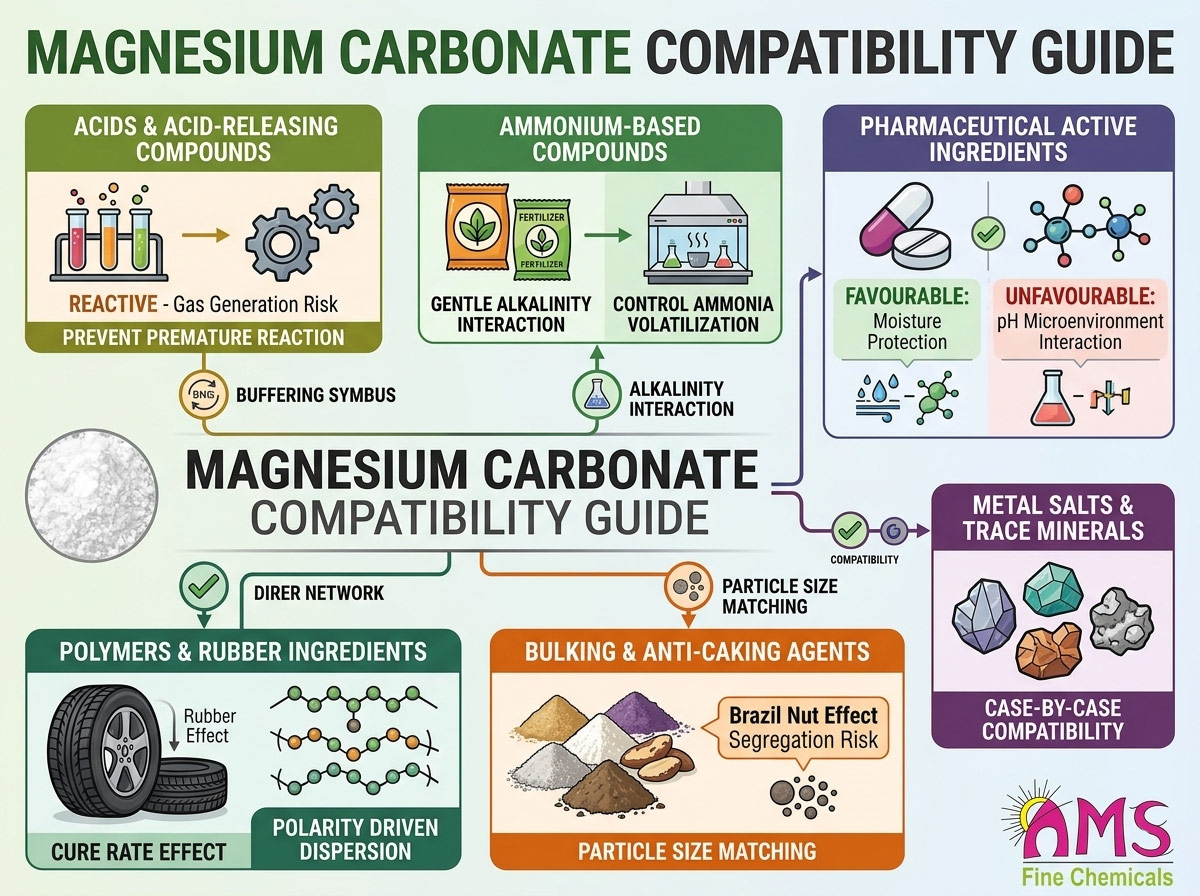
This guide works through Magnesium Carbonate‘s compatibility with the ingredient categories it most commonly appears alongside — acids, ammonium compounds, other fillers and anti-caking agents, active pharmaceutical ingredients, polymers, and metal salts — explaining the underlying chemistry behind each interaction and what formulators should watch for.
Why Compatibility Matters Beyond Individual Ingredient Quality
A formulation can use perfectly specified, high-quality raw materials and still underperform if those ingredients interact with each other in unplanned ways once combined. Magnesium Carbonate’s core chemical properties — mild alkalinity, moisture-adsorbing porosity, and acid reactivity — are exactly the properties most likely to drive an interaction with certain other ingredient classes. Understanding these interactions in advance, during formulation development, is far less costly than discovering them during a stability failure or production run.
Our Magnesium Carbonate Solubility and Acid Reactivity Explained article covers the underlying acid-reaction chemistry in technical detail — this guide focuses specifically on what that chemistry means when Magnesium Carbonate is combined with other common formulation ingredients.
Compatibility With Acids and Acid-Releasing Compounds
The interaction: Magnesium Carbonate reacts readily with acids, releasing carbon dioxide gas, water, and a soluble magnesium salt as products. This is fundamental, unavoidable chemistry — not a defect, but a reaction that needs to be either prevented (in formulations where it’s unwanted) or deliberately harnessed (in formulations where it’s the whole point).
Where this is a problem: Formulations combining Magnesium Carbonate with acidic active ingredients — citric acid, ascorbic acid, certain organic acid preservatives, or acidic APIs — risk premature reaction during storage if moisture and direct contact allow the reaction to proceed before the product reaches its intended point of use. This can alter both ingredients’ functional state, reduce Magnesium Carbonate’s buffering capacity when it’s actually needed, and in severe cases cause visible gas generation or packaging swelling in sealed containers.
Where this is deliberately exploited: Effervescent tablet and powder formulations intentionally combine a carbonate source with an acid, engineering the reaction to occur precisely at the point of use — when the product contacts water — rather than during storage. This requires careful formulation control (typically through granulation or coating strategies) to keep the two components separated until that intended moment.
Practical guidance: Formulators combining Magnesium Carbonate with acidic ingredients in a non-effervescent formulation should control moisture exposure and direct contact time through granulation, coating, or physical separation strategies, and should validate compatibility through accelerated stability testing before finalizing a formulation.
Compatibility With Ammonium-Based Compounds
The interaction: Because Magnesium Carbonate is mildly alkaline, combining it with ammonium-based ingredients — common in fertilizer formulations (ammonium nitrate, ammonium sulfate) and certain industrial applications — can promote ammonia volatilization under certain conditions, since alkaline conditions shift the ammonium-ammonia equilibrium toward the more volatile ammonia gas form.
Where this matters most: Compound fertilizer manufacturers blending Magnesium Carbonate alongside ammonium-based nitrogen sources need to account for this interaction in formulation sequencing and storage conditions, since excessive ammonia volatilization represents both a nutrient loss (reducing the fertilizer’s effective nitrogen content) and, in enclosed storage or blending environments, a potential air quality consideration.
Practical guidance: This interaction is generally manageable through appropriate blending sequence, moisture control, and storage conditions rather than requiring the two ingredient classes to be avoided entirely — many compound fertilizers successfully incorporate both magnesium carbonate and ammonium-based nitrogen sources with appropriate formulation controls. Our Magnesium Carbonate in Fertilizer Formulations: Magnesium Source, Soil Benefits & Applications guide covers this interaction in the specific context of compound fertilizer manufacturing.
Compatibility With Other Anti-Caking and Bulking Agents
The interaction: Magnesium Carbonate is frequently combined with other anti-caking or bulking agents — calcium silicate, silicon dioxide, tricalcium phosphate — in food and pharmaceutical formulations, either to achieve a specific functional blend or because a formulation transitions between suppliers or ingredient sources over time.
Generally low interaction risk: Unlike the acid and ammonium interactions above, combining Magnesium Carbonate with other common anti-caking agents generally presents low direct chemical interaction risk, since most of these materials share similarly low reactivity profiles. The more relevant compatibility consideration here is physical rather than chemical: bulk density and particle size matching between the combined ingredients, to avoid the blend segregation (“Brazil nut effect”) that can occur when powders of meaningfully different density or size are combined without adequate blending controls.
Practical guidance: When combining Magnesium Carbonate with other bulking or anti-caking agents, matching particle size distribution and bulk density between the combined ingredients — or adjusting blending equipment and procedures to counteract segregation tendencies — matters more than any chemical incompatibility concern. Our Magnesium Carbonate Bulk Density: Why It Matters in Industrial Processing article covers this segregation risk in more technical depth.
Compatibility With Pharmaceutical Active Ingredients
The interaction: Beyond the acid-sensitivity concern already covered, Magnesium Carbonate’s moisture-adsorbing properties can interact favourably or unfavourably with active pharmaceutical ingredients depending on the specific API’s own moisture sensitivity and chemical stability profile.
Favourable interaction: For moisture- or hydrolysis-sensitive APIs, Magnesium Carbonate’s moisture-scavenging behaviour can provide a genuine formulation benefit, protecting the active ingredient from degradation by intercepting ambient moisture before it reaches the more sensitive component. Our Magnesium Carbonate Moisture Absorption: What Formulators Need to Know article covers this protective mechanism in detail.
Unfavourable interaction: For APIs sensitive to alkaline pH microenvironments — certain acid-labile compounds that are actually stabilized by a slightly acidic environment, or APIs prone to base-catalyzed degradation — Magnesium Carbonate’s mild alkalinity can accelerate rather than prevent degradation, the opposite of its usual protective role.
Practical guidance: API-excipient compatibility studies, standard practice in pharmaceutical formulation development, should specifically evaluate both moisture interaction and pH-sensitivity interaction when Magnesium Carbonate is being considered as an excipient, since the same material can be either protective or harmful depending on the specific API’s stability profile. Our Magnesium Trisilicate BP vs. USP: Understanding Pharmaceutical Grade Specifications guide covers similar compatibility considerations for a closely related magnesium excipient.
Compatibility With Polymer and Rubber Compounding Ingredients
The interaction: In rubber and polymer compounding, Magnesium Carbonate is combined with a range of other ingredients — curing agents, accelerators, other fillers, plasticizers, and colorants — each with their own compatibility considerations.
Curing systems: Magnesium Carbonate’s mild alkalinity can, in some rubber compounding systems, interact with acidic curing agents or accelerators, potentially affecting cure rate or final compound properties. Formulators working with sulfur-cure or peroxide-cure systems should validate compatibility specifically with their chosen curing chemistry rather than assuming universal compatibility across all rubber formulation types.
Other fillers: Combining Magnesium Carbonate with other common rubber fillers — calcium carbonate, clay, carbon black — generally presents low direct chemical interaction risk, with the more significant compatibility consideration being particle size and bulk density matching for consistent dispersion during compounding, similar to the food/pharmaceutical anti-caking agent discussion above.
Polarity considerations: Magnesium Carbonate’s inherently polar, hydrophilic surface can affect dispersion quality when combined with non-polar polymer systems or non-polar co-fillers, sometimes requiring surface treatment or dispersing agents to achieve uniform blend compatibility. Our Magnesium Carbonate in Modern Chemical Formulations: A Technical Guide for Manufacturers article discusses this polarity-driven compatibility consideration in the broader context of formulation chemistry.
Compatibility With Metal Salts and Trace Minerals
The interaction: In multi-mineral formulations — fortified food products, agricultural micronutrient blends, certain industrial applications — Magnesium Carbonate is sometimes combined with other metal salts (iron, zinc, manganese compounds).
Where interaction risk exists: Some metal salt combinations can present physical or chemical interaction risk depending on the specific salts involved — certain metal salts can catalyze unwanted oxidation reactions in the presence of moisture, or precipitation reactions can occur if soluble metal salts interact with the small dissolved carbonate fraction present even in Magnesium Carbonate’s otherwise low aqueous solubility.
Practical guidance: Multi-mineral formulations combining Magnesium Carbonate with other metal salts benefit from compatibility screening specific to the exact salts involved, since interaction risk varies considerably depending on which specific metal compounds are being combined — a general “metals are compatible” or “metals are incompatible” assumption isn’t reliable enough for formulation decisions in this category.
Compatibility With Coloring Agents and Pigments
The interaction: In cosmetic, food, and coatings applications, Magnesium Carbonate is frequently blended with coloring agents and pigments, either as a bulking base for the color or as a co-ingredient in a broader formulation.
Where interaction risk exists: Certain pigments — particularly those sensitive to alkaline pH or those prone to interaction with trace metal impurities — can show shade shift or stability changes when combined with Magnesium Carbonate, especially under humid storage conditions where the small dissolved carbonate fraction becomes more chemically active. Iron oxide pigments, common in cosmetic formulations, are generally well-tolerated, while certain organic dyes sensitive to alkaline environments may require more careful compatibility screening.
Practical guidance: Whiteness and brightness index data on the Magnesium Carbonate itself, covered in more depth in our Magnesium Carbonate COA Explained: Important Parameters Buyers Should Check article, is a useful starting reference, but pigment-specific compatibility testing remains necessary for any new color formulation, since trace-level interactions aren’t always predictable from bulk chemistry alone.
Compatibility With Preservatives and Antimicrobial Agents
The interaction: Food, pharmaceutical, and cosmetic formulations frequently include preservative systems designed to control microbial growth over the product’s shelf life, and Magnesium Carbonate’s inclusion in these formulations raises a secondary compatibility question beyond the acid-reactivity concern already discussed.
Where this matters: Some preservative systems are pH-dependent in their antimicrobial effectiveness, meaning Magnesium Carbonate’s mild alkalinity — even at the modest level produced by its limited water solubility — can shift a formulation’s effective pH enough to reduce a pH-sensitive preservative’s performance below its validated effective range, even without any direct chemical reaction between the two ingredients occurring.
Practical guidance: Formulators should confirm their chosen preservative system’s effective pH range against the expected pH contribution of the full formulation, including any shift introduced by Magnesium Carbonate’s mild alkalinity, rather than assuming preservative effectiveness validated in isolation will hold true once combined with an alkaline-contributing ingredient.
A Compatibility Quick-Reference Table
| Ingredient Category | General Compatibility | Key Consideration |
|---|---|---|
| Acids / acidic APIs | Reactive — manage carefully | Moisture and contact-time control; deliberate use in effervescent systems |
| Ammonium compounds | Generally compatible with controls | Ammonia volatilization risk under alkaline, moist conditions |
| Other anti-caking agents (silica, calcium silicate) | Generally compatible | Bulk density/particle size matching to avoid segregation |
| Moisture-sensitive APIs | Often favourable | Magnesium Carbonate can protect against hydrolytic degradation |
| pH-sensitive APIs (base-catalyzed degradation) | Potentially unfavourable | Requires specific compatibility study |
| Rubber curing agents/accelerators | Generally compatible, system-dependent | Validate with specific cure chemistry |
| Other rubber fillers (carbon black, clay) | Generally compatible | Particle size/density matching for dispersion |
| Non-polar polymers | May require surface treatment | Hydrophilic surface can limit dispersion without treatment |
| Other metal salts | Variable, salt-specific | Requires case-by-case compatibility screening |
| Coloring agents/pigments | Generally compatible | Some pH-sensitive organic dyes need screening |
| pH-dependent preservatives | Requires validation | Alkalinity can shift effective preservative pH range |
This table provides a starting reference point, not a substitute for formulation-specific compatibility testing — the right answer for any specific combination depends on exact concentrations, moisture exposure, storage conditions, and the specific chemical identity of the other ingredients involved.
How to Conduct a Basic Compatibility Assessment
For formulators evaluating a new ingredient combination involving Magnesium Carbonate, a practical, staged compatibility assessment approach includes:
- Literature and chemistry review, identifying known reactive functional groups (acids, strong reducing or oxidizing agents, ammonium compounds) in the proposed formulation partners before any physical testing begins.
- Binary mixture stress testing, combining Magnesium Carbonate with each individual proposed ingredient at relevant ratios, then subjecting the mixture to accelerated stability conditions (elevated temperature and humidity) to observe any visible reaction, discoloration, or gas generation over a defined period.
- Analytical confirmation, using techniques such as differential scanning calorimetry (DSC) or thermogravimetric analysis (TGA) to detect subtle interactions that might not be visually apparent but could still affect long-term stability.
- Full formulation stability testing, evaluating the complete, multi-ingredient formulation under real or accelerated storage conditions, since interactions observed in isolated binary mixtures don’t always predict behaviour in a full, complex formulation.
This staged approach catches the most significant compatibility risks early, in isolated binary testing, before committing to the time and cost of full formulation stability studies.
Documenting Compatibility Findings for Future Formulation Work
Compatibility testing conducted during one formulation development program often has value well beyond that single project, particularly for manufacturers who work with a recurring set of ingredient combinations across multiple product lines. Maintaining a documented internal compatibility reference — recording which ingredient combinations have been tested, under what conditions, and with what results — reduces the need to repeat basic compatibility screening from scratch for every new formulation that reuses a previously validated ingredient pair.
This is particularly valuable for contract manufacturers and formulators working across multiple client projects, where the same core excipients and fillers, including Magnesium Carbonate, frequently reappear across otherwise unrelated formulations. A well-maintained compatibility reference library can meaningfully shorten formulation development timelines for new products that draw on already-validated ingredient combinations, while still flagging genuinely novel combinations that warrant fresh testing.
How AMS Fine Chemicals Supports Compatibility-Sensitive Formulation
AMS Fine Chemicals, based in Bhavnagar, Gujarat, manufactures Magnesium Carbonate across Light, Ultra Light, and Heavy grades with full technical documentation supporting formulation compatibility assessment — including particle size, bulk density, and reactivity data relevant to predicting interaction behaviour with other common formulation ingredients. Our technical team can also provide guidance on grade selection specifically suited to compatibility-sensitive applications, such as moisture-protective excipient roles or effervescent formulation development.
Explore full technical specifications on our Magnesium Carbonate, Light Magnesium Carbonate, Ultra Light Magnesium Carbonate, and Heavy Magnesium Carbonate product pages, or browse our complete range of magnesium compounds — including Magnesium Hydroxide and Magnesium Trisilicate — on the Products page.
Frequently Asked Questions
Can Magnesium Carbonate be safely combined with vitamin C (ascorbic acid) in a supplement formulation? This combination requires careful formulation control, since ascorbic acid is acidic and will react with Magnesium Carbonate given sufficient moisture and contact time. Many multivitamin formulations successfully combine the two through granulation, coating, or physical separation strategies — direct, uncontrolled blending without these safeguards carries premature reaction risk.
Does Magnesium Carbonate interact with common food preservatives? It depends on the specific preservative’s chemistry — acidic preservatives (such as certain organic acid preservatives) carry the same acid-reactivity consideration discussed throughout this guide, while non-acidic preservatives generally present lower direct interaction risk. Formulation-specific compatibility testing remains the most reliable way to confirm compatibility for any specific preservative system.
Is Magnesium Carbonate compatible with most tablet binders and disintegrants? Generally yes — common pharmaceutical binders and disintegrants typically present low direct chemical interaction risk with Magnesium Carbonate, though as with any multi-ingredient formulation, standard compatibility screening during formulation development remains good practice rather than assuming compatibility without verification.
How can I tell if an unwanted reaction is occurring in my formulation before it becomes a visible problem? Accelerated stability testing under elevated temperature and humidity, combined with periodic analytical testing (assay, related substances, physical appearance) over the testing period, is the standard way to detect a developing incompatibility before it manifests as a visible defect in the finished product or, worse, is discovered only after the product reaches the market.
Should I always avoid combining Magnesium Carbonate with acidic ingredients? Not necessarily — effervescent formulations deliberately and successfully combine the two. The key is whether the reaction is intended (and properly controlled to occur at the right time) or unintended (requiring separation strategies to prevent premature reaction during storage).
Does combining Magnesium Carbonate with multiple other ingredients simultaneously increase interaction risk compared to a simple two-ingredient mixture? Generally yes — multi-ingredient formulations can introduce interaction pathways that aren’t apparent from binary compatibility testing alone, since one ingredient can sometimes catalyze or accelerate an interaction between two others that wouldn’t occur without its presence. This is precisely why full formulation stability testing remains necessary even after individual binary compatibility checks have passed, rather than assuming compatibility is simply additive across all ingredient pairs.
Final Word
Magnesium Carbonate’s compatibility with other formulation ingredients isn’t a single yes-or-no answer — it depends on the specific chemistry of what it’s being combined with, the intended function of that combination, and the storage and processing conditions the finished formulation will actually experience. Acids and ammonium compounds warrant the most deliberate compatibility planning, given Magnesium Carbonate’s inherent reactivity and alkalinity, while most other common fillers, bulking agents, and excipients present comparatively low direct chemical interaction risk, with physical compatibility (particle size and bulk density matching) becoming the more relevant consideration instead.
Building compatibility assessment into formulation development from the start — rather than discovering an incompatibility during stability testing or, worse, after a product has reached the market — remains the most reliable way to ensure a multi-ingredient formulation performs exactly as intended.
To request technical specifications, compatibility data, or a sample batch of any Magnesium Carbonate grade, visit our Magnesium Carbonate product page or reach out through our Contact Us page.