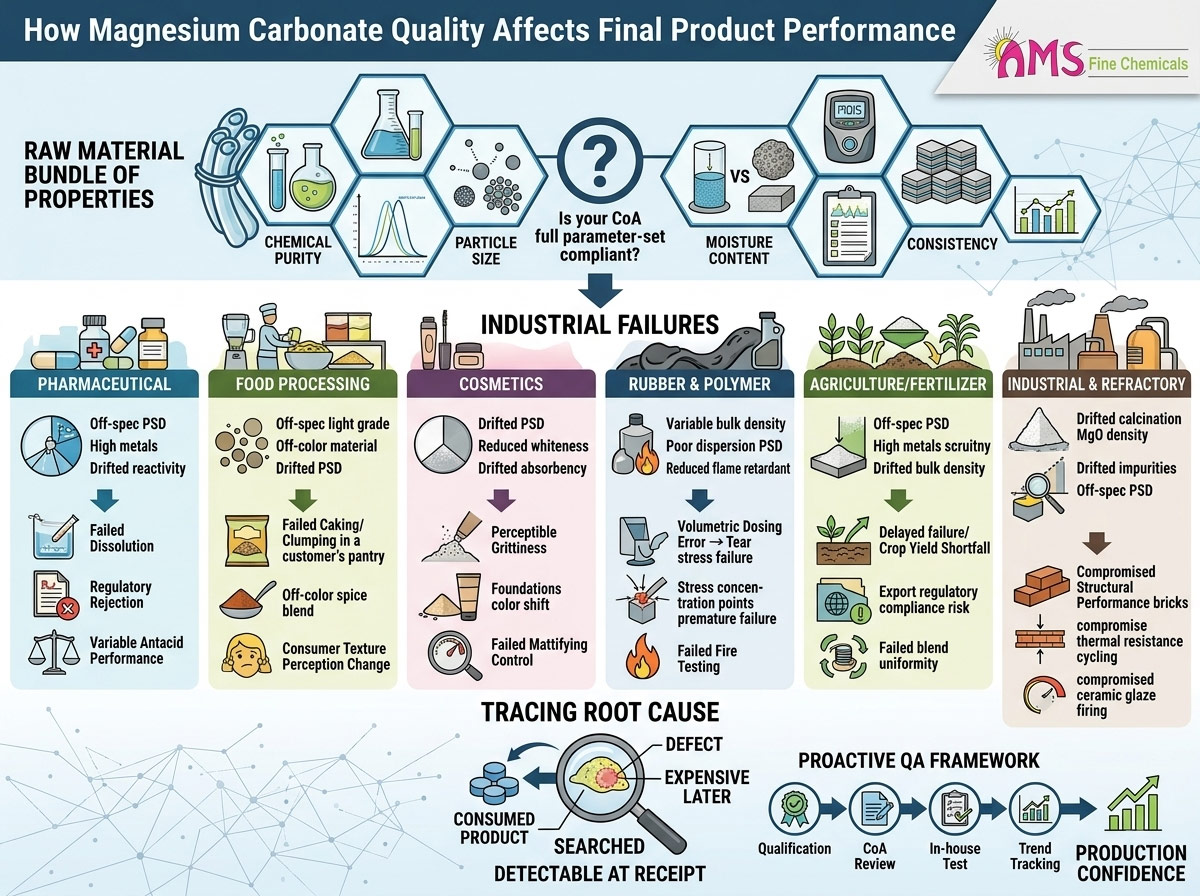
A raw material defect rarely announces itself at the point of receipt. It shows up later — as a tablet batch that fails dissolution testing, a rubber compound that tears under stress it should have withstood, a spice blend that cakes solid in a customer’s pantry, or a fertilizer product that underperforms in the field despite a technically compliant label claim. By the time these failures surface, the Magnesium Carbonate that caused them has long since been consumed into the finished product, and tracing the root cause back to a raw material quality gap becomes far more expensive than catching it would have been at the point of receipt.
This guide traces that cause-and-effect chain directly — how specific quality shortfalls in Magnesium Carbonate translate into specific, measurable failures in finished products across the industries that depend on it, and what that means for how seriously buyers should treat raw material quality control.
Why “Quality” Is a Bundle of Properties, Not a Single Number
When formulators talk about Magnesium Carbonate “quality,” they’re really describing the combined performance of several interrelated properties working together: chemical purity, particle size distribution, bulk density, moisture content, and consistency between batches. A batch can pass a headline assay figure with flying colors while still causing a formulation failure driven by an off-spec particle size, an inconsistent bulk density, or a subtly elevated moisture reading — none of which show up if a buyer only checks the assay line on a Certificate of Analysis. Our Magnesium Carbonate COA Explained: Important Parameters Buyers Should Check article covers the full parameter set worth reviewing — this guide focuses specifically on what happens downstream when one or more of those parameters falls short.
Pharmaceutical Manufacturing: From Raw Material Gap to Patient-Facing Failure
Pharmaceutical formulations carry the tightest tolerances of any industry using Magnesium Carbonate, and quality gaps here translate into consequences that extend beyond a single failed production batch:
- Inconsistent particle size distribution can produce tablets with variable hardness, disintegration time, and dissolution rate — potentially affecting how quickly and completely the active ingredient becomes bioavailable to a patient, a consequence far more serious than a cosmetic defect.
- Elevated heavy metal content, even at levels that might seem trivial in an industrial context, can trigger regulatory rejection under ICH Q3D elemental impurity guidelines, since pharmaceutical impurity limits are set with cumulative, long-term patient exposure in mind rather than single-dose risk alone.
- Inconsistent acid-consuming capacity in antacid formulations directly affects therapeutic performance — a batch with lower-than-expected reactivity may simply fail to relieve the symptoms the product claims to treat, undermining patient trust even when no regulatory limit was technically breached.
- Moisture content drift can accelerate hydrolytic degradation of moisture-sensitive active ingredients formulated alongside Magnesium Carbonate, shortening a product’s actual shelf life below what stability testing on a different, properly-specified batch had established.
Our Magnesium Trisilicate BP vs. USP: Understanding Pharmaceutical Grade Specifications guide covers the compendial framework built specifically to prevent this class of failure for a closely related magnesium excipient — the same logic of matching material specification to therapeutic requirement applies directly here.
Food Processing: When Quality Gaps Become Consumer-Facing
Food applications may carry lower regulatory stakes than pharmaceuticals, but quality shortfalls here are uniquely visible to the end consumer, since anti-caking performance is a directly observable product attribute:
- Insufficient surface area or absorbency — often traced to an unexpectedly dense or coarse batch substituted for a properly specified Light grade — results in exactly the caking and clumping the anti-caking agent was meant to prevent, a failure a consumer notices immediately when opening a container of salt or spice that has solidified into a single mass.
- Off-white or discolored material, often linked to trace iron contamination, can visibly alter the appearance of a light-colored powdered food product, undermining perceived quality even when the underlying chemistry remains technically safe.
- Inconsistent particle size can introduce perceptible texture changes in fine powdered products, an issue especially relevant in premium spice and seasoning blends where texture is part of the product’s sensory identity.
Our Light Magnesium Carbonate as Anticaking Agent in Spices, Salt, and Powdered Foods article covers exactly what “quality” needs to mean for this application to reliably deliver the shelf performance consumers expect batch after batch.
Cosmetics: Quality as a Direct Sensory Experience
In cosmetic powders, Magnesium Carbonate quality shortfalls are arguably the most immediately, personally perceptible of any application covered in this guide, since the end user is applying the product directly to their skin:
- A wider-than-specified particle size distribution, even with an acceptable median particle size, can introduce perceptible grittiness that undermines the smooth “skin feel” a premium cosmetic powder is expected to deliver.
- Reduced whiteness or brightness, again often linked to trace metal contamination, can shift the visual appearance of a foundation or face powder away from its intended shade, a defect obvious to both the formulator during quality control and the consumer during use.
- Inconsistent absorbency between batches can produce a product that performs well in initial testing but underperforms once in the hands of consumers, since mattifying and oil-control performance depends directly on the material’s surface area and porosity remaining consistent from batch to batch.
Rubber and Polymer Manufacturing: Quality Gaps That Fail Under Mechanical Stress
Unlike food or cosmetic applications, quality shortfalls in rubber and polymer compounding often don’t become apparent until the finished product is placed under mechanical stress — sometimes well after it has left the factory and entered service:
- Inconsistent bulk density between batches can cause volumetric dosing equipment to systematically under- or over-dose the filler, producing compound-to-compound variation in mechanical properties that may not surface until a specific batch of finished rubber articles fails a tensile strength or tear resistance test.
- Poor dispersion, often traced to particle morphology or an unexpectedly broad particle size distribution, creates localized stress concentration points within a cured compound — invisible during visual inspection, but a direct contributor to premature mechanical failure under real-world load.
- Reduced flame-retardant performance, relevant in polymer compounds relying partly on Magnesium Carbonate’s endothermic decomposition behaviour, can result from a batch with atypical thermal decomposition characteristics, a failure mode that might only become apparent during fire-safety testing or, worse, an actual fire event.
Our articles on How Magnesium Carbonate Particle Morphology Influences Industrial Performance and Understanding the Thermal Decomposition of Magnesium Carbonate cover the specific mechanisms behind these failure modes in more technical depth.
Agriculture and Fertilizer: Quality Failures That Take Months to Surface
Agricultural applications present a uniquely delayed feedback loop — a raw material quality gap in a fertilizer formulation may not become apparent until an entire growing season has passed and yield or crop health outcomes fall short of expectations:
- Inconsistent particle size, affecting release rate, can cause a compound fertilizer to deliver magnesium too quickly (increasing leaching loss and reducing season-long availability) or too slowly (failing to correct a deficiency within the crop’s actual growth window) relative to what the formulation was designed to deliver.
- Elevated heavy metal content, increasingly scrutinized in fertilizer inputs destined for food crops, can create regulatory compliance risk that may not surface until a shipment is tested at the point of import or by an agricultural regulator, well after the product has already been distributed to farmers.
- Batch-to-batch bulk density inconsistency can introduce blend segregation during granulated compound fertilizer manufacturing, producing an uneven nutrient distribution across a bag or batch that undermines the consistent, predictable application rate farmers depend on.
Our guide, Magnesium Carbonate in Fertilizer Formulations: Magnesium Source, Soil Benefits & Applications, covers the agronomic reasoning behind these quality requirements in more depth.
Industrial and Refractory Applications: Quality Gaps That Compromise Structural Performance
Industrial and refractory applications often involve the longest and most consequential feedback loop of any category covered here, since finished refractory brick or ceramic components are frequently placed into service for years before a raw material quality gap becomes apparent through actual performance degradation:
- Inconsistent calcination behaviour, traced back to unexpected variation in the starting Magnesium Carbonate’s thermal decomposition characteristics, can produce magnesium oxide with inconsistent reactivity and density, directly affecting the structural integrity and thermal performance of finished refractory bricks used in furnace and kiln linings.
- Trace impurity variation, even within nominally acceptable limits, can affect the melting point and thermal cycling resistance of refractory materials, a performance characteristic that may only become apparent after repeated high-temperature service cycles have exposed a weakness that initial testing didn’t reveal.
- Particle size inconsistency in ceramic glaze applications can affect glaze melting behaviour and final fired appearance, producing visible inconsistency across a production run of ceramic ware that traces back to raw material variation rather than any error in the ceramic manufacturing process itself.
Because failures in this category often manifest as gradual performance degradation rather than an immediate, obvious defect, they’re particularly easy to misattribute to normal wear rather than an underlying raw material quality issue — reinforcing the value of consistent supplier quality documentation as a diagnostic reference point when troubleshooting unexpected service-life shortfalls.
The Hidden Cost of Undetected Quality Gaps
Beyond the specific failure modes above, undetected raw material quality gaps carry costs that extend well beyond the immediate production batch:
- Reformulation and revalidation costs, since a quality-driven failure discovered mid-production or post-launch typically requires reformulation, re-testing, and often regulatory re-filing, particularly in pharmaceutical and food contexts.
- Recall and disposal costs, in the worst case, when a quality gap isn’t caught until finished product has already reached distribution or retail.
- Brand and customer trust erosion, which is often the least quantifiable but most lasting cost, particularly for consumer-facing products where a single caking, gritty, or underperforming batch can shape a customer’s perception of an entire product line.
- Regulatory audit risk, since a documented pattern of raw material quality issues can trigger heightened scrutiny in subsequent audits, even for facilities with otherwise strong compliance records.
These costs are precisely why treating raw material quality control as a proactive, ongoing discipline — rather than a one-time supplier qualification checkbox — pays for itself many times over across a production relationship’s lifetime.
Building a Quality Assurance Framework Around Incoming Material
A practical, proactive quality assurance approach to Magnesium Carbonate sourcing generally includes several layers, each catching different categories of potential quality gap:
- Rigorous initial supplier qualification, reviewing manufacturing process controls, historical batch consistency data, and full analytical capability — not just a single sample Certificate of Analysis.
- Batch-specific CoA review on every incoming shipment, checking the complete parameter set relevant to your application, not just the headline assay figure.
- Periodic confirmatory in-house testing, particularly for critical pharmaceutical, food, and cosmetic applications, since even a reliable supplier can experience an occasional process deviation that a batch-specific CoA alone might not fully capture if testing methodology or sampling isn’t perfectly aligned.
- Retained reference samples from each incoming lot, supporting later troubleshooting or dispute resolution if a downstream quality issue is later traced back to a specific batch.
- Trend tracking across batches over time, since gradual process drift at a supplier can sometimes produce a sequence of individually passing batches that nonetheless represents a meaningful shift in typical material characteristics — a pattern only visible when data is reviewed longitudinally rather than one shipment at a time.
- Clear escalation and communication protocols with your supplier, so that when a quality question does arise, root-cause investigation can begin promptly on both sides rather than being delayed by unclear points of contact or ambiguous responsibility — a factor that matters more than it might seem when a suspected raw material issue is actively affecting a live production schedule.
Together, these layers form a system where no single test or check point carries the entire burden of catching every possible quality gap — a design principle that matters because no single test, however thorough, can realistically capture every application-specific failure mode a buyer might encounter.
Quality Consistency vs. Quality Ceiling: An Important Distinction
It’s worth separating two related but distinct ideas that often get conflated under the single word “quality”: the ceiling (how good a batch can be at its best) and consistency (how reliably every batch actually meets that standard). A supplier capable of producing an excellent single batch under ideal conditions isn’t necessarily the same as a supplier capable of reliably reproducing that same standard, batch after batch, at full production scale.
For most formulators, consistency matters more than an occasional exceptional batch, since production processes are generally validated against expected, predictable material characteristics — a formulation validated against a typical, consistent supply is far more valuable than one that happened to be validated against an unusually good, but not reliably reproducible, single reference batch.
How AMS Fine Chemicals Approaches Quality as a Systemic Discipline
At AMS Fine Chemicals, our Bhavnagar, Gujarat manufacturing facility treats raw material and process quality control as a continuous discipline built into every stage of production, not a final inspection step applied only before shipment. Every batch of Light, Ultra Light, and Heavy Magnesium Carbonate undergoes in-house testing covering assay, particle size distribution via laser diffraction, bulk density, loss on ignition and loss on drying, whiteness index, and heavy metal content via ICP-OES, with full Certificates of Analysis issued against the applicable pharmacopoeial or industry standard for your specific application.
This systemic approach to quality is precisely what allows downstream formulators — across pharmaceutical, food, cosmetic, rubber, agricultural, and industrial applications — to build production processes with confidence that the raw material specification validated at the start of a formulation program will still hold true at full commercial scale, batch after batch. Explore full technical specifications on our Magnesium Carbonate, Light Magnesium Carbonate, Ultra Light Magnesium Carbonate, and Heavy Magnesium Carbonate product pages, or browse our complete range of magnesium compounds — including Magnesium Hydroxide and Magnesium Trisilicate — on the Products page.
Frequently Asked Questions
Can a batch pass every standard CoA test and still cause a formulation failure? Yes — this is one of the more frustrating realities of raw material quality control. Standard CoA parameters cover the most common failure modes, but application-specific issues (morphology mismatches, dispersion behaviour, subtle reactivity differences) can occasionally fall outside what a standard test panel captures, which is why periodic confirmatory testing and formulation-level validation remain valuable even with a passing CoA in hand.
How quickly do raw material quality issues typically surface in finished products? It varies enormously by application — cosmetic and food quality issues (texture, caking, appearance) are often immediately apparent, pharmaceutical issues may surface during stability or dissolution testing over weeks to months, and agricultural or long-service-life polymer issues can take an entire season or years to become fully apparent.
Is it worth paying a premium for a supplier with stronger quality documentation? For most applications, yes — the cost difference between a well-documented, consistently quality-controlled supplier and a lower-cost alternative is typically small relative to the potential cost of a reformulation, recall, or brand reputation issue triggered by an undetected quality gap.
What’s the single most cost-effective quality control step a buyer can implement? Consistent, complete Certificate of Analysis review on every incoming batch — not just spot-checking occasional shipments — catches the majority of quality gaps before material enters production, at a fraction of the cost of catching the same issue after it has already affected a finished product.
Does “consistent quality” mean every batch is chemically identical? Not literally identical — natural batch-to-batch variation within specified tolerance ranges is normal and expected from any manufacturing process. “Consistent quality” means that variation stays reliably within the tolerance range your formulation was validated against, not that every batch is chemically indistinguishable from the last.
How do I know if a specific quality gap in my raw material actually caused a finished product failure, or if the problem lies elsewhere in my process? Retained reference samples from the suspect raw material batch, combined with a fresh, complete re-test against the original Certificate of Analysis, is the most direct way to confirm or rule out the raw material as a root cause. If retained samples match the original CoA within normal tolerance, the investigation should generally shift toward process variables in your own facility rather than continuing to focus on the raw material.
Final Word
The relationship between Magnesium Carbonate quality and finished product performance isn’t abstract — it’s a direct, traceable chain from a specific raw material characteristic to a specific downstream outcome, whether that’s a tablet’s dissolution profile, a spice blend’s shelf appearance, a rubber compound’s tensile strength, or a fertilizer’s season-long nutrient delivery. Understanding these cause-and-effect relationships — not just checking that a Certificate of Analysis technically passes — is what separates a reactive quality control approach from a genuinely proactive one, and it’s the difference between catching a problem at the point of raw material receipt versus discovering it in a finished product that has already reached a customer.
To request technical specifications, quality documentation, or a sample batch of any Magnesium Carbonate grade, visit our Magnesium Carbonate product page or reach out through our Contact Us page.