Ask ten different Magnesium Carbonate buyers what “the right grade” means, and you’ll likely get ten different answers — because the right grade genuinely depends on what industry you’re in and what job the material needs to do. A pharmaceutical formulator, a rubber compounder, a fertilizer manufacturer, and a cosmetics brand are all buying Magnesium Carbonate, but they’re rarely buying the same product, even when the chemical name on the invoice looks identical.
This guide takes an application-first approach to grade selection — starting from your industry and end-use, then working toward the specific grade, certification, and specification that fits. If you’re looking for the deeper physical-property framework behind grade selection — bulk density, particle size, surface area — our companion article, How to Select the Right Magnesium Carbonate Grade for Your Manufacturing Process, covers that ground in technical depth. This guide is the practical, industry-by-industry companion to it.
The Three Grades, in Brief
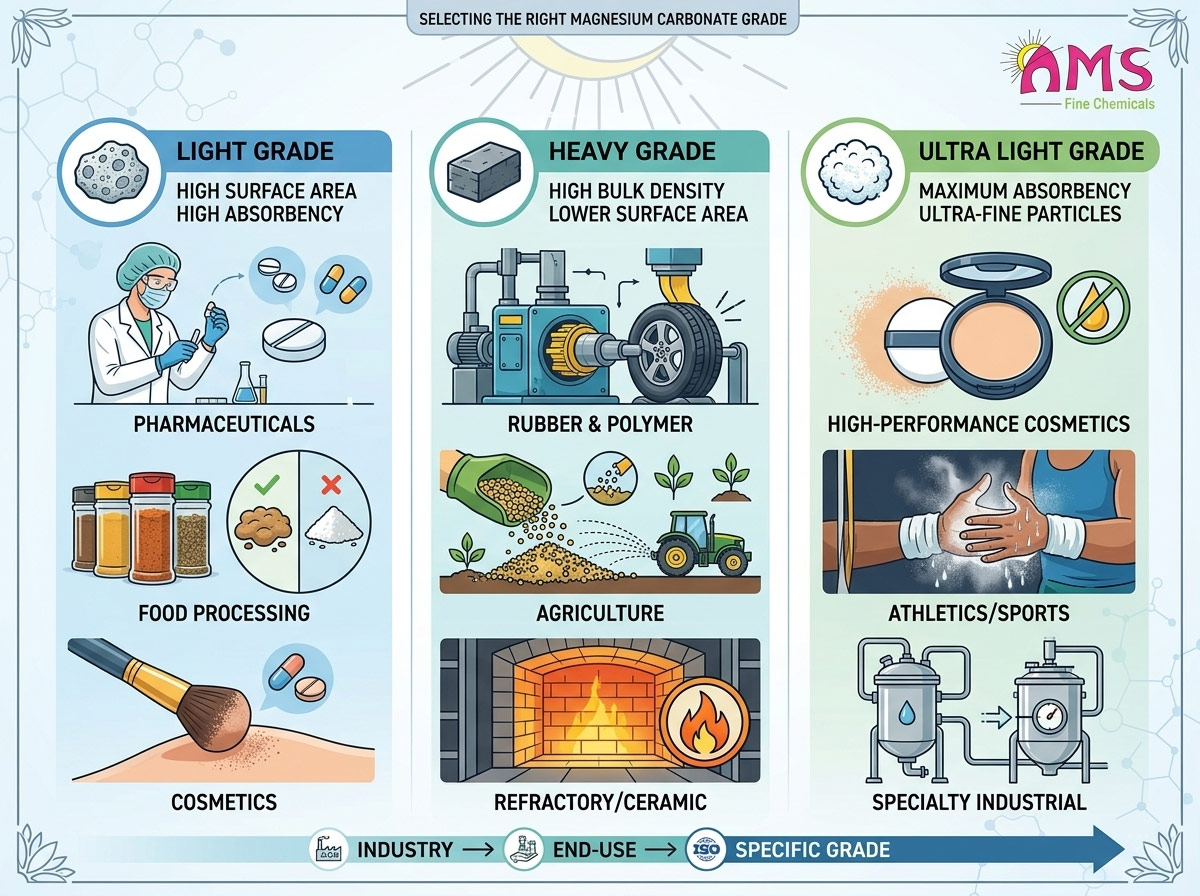
Before diving into industry-specific guidance, a quick refresher on the three core physical grades AMS Fine Chemicals manufactures:
- Light Magnesium Carbonate — low bulk density, high surface area, strong absorbency. The default choice for most pharmaceutical, food, and cosmetic applications.
- Ultra Light Magnesium Carbonate — even lower bulk density and higher surface area than standard Light grade, reserved for applications demanding maximum absorbency.
- Heavy Magnesium Carbonate — higher bulk density, lower surface area, favoured for industrial bulk handling, rubber compounding, and volume-sensitive applications.
With that foundation, here’s how selection actually plays out across the industries that rely on Magnesium Carbonate most heavily.
If You’re in Pharmaceuticals
Typical need: an excipient functioning as a glidant, buffering agent, anti-adherent, or moisture scavenger in tablet and capsule formulations, or as an active antacid ingredient.
Grade guidance: Light Magnesium Carbonate is the standard choice, offering the fine particle size and moderate-to-high surface area that supports both flow consistency during high-speed tableting and effective moisture protection for acid- or hydrolysis-sensitive active ingredients.
What to confirm before ordering:
- Compliance with the applicable compendial standard — USP, BP, or IP — with a batch-specific Certificate of Analysis referencing that standard explicitly.
- Full elemental impurity testing via ICP-OES, aligned with ICH Q3D guidelines, rather than older colorimetric heavy-metal methods.
- Particle size distribution data (D10/D50/D90), since compaction behaviour and content uniformity depend directly on this rather than assay alone.
For a closely related excipient decision — choosing between pharmacopoeial standards for a different magnesium compound — see our Magnesium Trisilicate BP vs. USP: Understanding Pharmaceutical Grade Specifications guide, which walks through the same kind of compendial decision-making relevant here.
If You’re in Food Processing
Typical need: an anti-caking agent for salt, spices, powdered beverage mixes, and other hygroscopic powdered food ingredients.
Grade guidance: Light Magnesium Carbonate remains the standard choice here as well, since its porous, high-surface-area structure is specifically what allows it to absorb ambient moisture before it can trigger caking in the primary food ingredient.
What to confirm before ordering:
- Food Chemicals Codex compliance and, where relevant to your target market, GRAS status or E504 approval.
- Whiteness and absence of taste or odor transfer, since food applications are especially sensitive to any perceptible sensory impact from the anti-caking ingredient.
- Appropriate inclusion rate validated against local regulatory maximum limits for anti-caking agents in your specific food category.
Our detailed guide, Light Magnesium Carbonate as Anticaking Agent in Spices, Salt, and Powdered Foods, covers formulation-level guidance specific to this application, including particle size considerations that protect mouthfeel in fine powdered products.
If You’re in Cosmetics and Personal Care
Typical need: an absorbent, mattifying, and bulking ingredient for face powders, dusting powders, dry shampoos, and deodorants.
Grade guidance: Light or Ultra Light Magnesium Carbonate, depending on how aggressive the oil/moisture absorption requirement is. Ultra Light suits high-performance mattifying products facing significant sebum control demands; standard Light grade is often sufficient for general dusting powders and bulking applications.
What to confirm before ordering:
- Fine, tightly controlled particle size distribution — typically well under 15 microns for D50 — since tactile “skin feel” is a direct, consumer-noticeable quality attribute.
- Whiteness/brightness index data, since visual appearance matters as much as functional performance in a visible cosmetic product.
- Appropriate heavy metal and microbial testing to support regional cosmetic regulatory compliance.
If You’re in Rubber and Polymer Manufacturing
Typical need: a reinforcing filler that improves tensile strength, tear resistance, and heat stability in rubber compounds, or a flame-retardant contributor in polymer formulations.
Grade guidance: Heavy Magnesium Carbonate is the standard choice, given its higher bulk density and better compatibility with volumetric dosing equipment common in rubber compounding lines. Its lower relative surface area compared to Light grade is actually an advantage here, supporting more predictable dispersion and mechanical property consistency at scale.
What to confirm before ordering:
- Consistent bulk density between batches, since compounding equipment calibrated for one density range can under- or over-dose if a batch drifts outside the expected range.
- Particle size distribution appropriate to your specific compound’s mechanical property targets — finer grades generally improve dispersion and reinforcement efficiency in high-performance compounds.
Our article on How Magnesium Carbonate Particle Morphology Influences Industrial Performance goes deeper into how particle shape, not just size, affects reinforcement performance in polymer systems — relevant reading for compounders troubleshooting inconsistent mechanical properties.
If You’re in Agriculture and Fertilizer Manufacturing
Typical need: a slow-release magnesium source and mild soil pH buffer for compound fertilizer blends or direct soil amendment.
Grade guidance: The choice here depends on release-speed requirements: Light grade supports somewhat faster magnesium availability within a compound blend, while coarser, denser material — closer to the Heavy grade profile — extends the release window for long-term soil amendment programs. Bulk density also matters practically for granulation equipment compatibility at production scale.
What to confirm before ordering:
- Documented heavy metal and trace element testing, since fertilizer inputs — particularly for food crop applications — face increasing regulatory scrutiny on cadmium, lead, and arsenic content.
- Consistent particle size and bulk density across batches, since granulation processes are sensitive to raw material variability.
Our full guide, Magnesium Carbonate in Fertilizer Formulations: Magnesium Source, Soil Benefits & Applications, covers application rates, crop-specific considerations, and formulation approaches in far more depth than fits here.
If You’re in Refractory or Ceramic Manufacturing
Typical need: a magnesium oxide precursor for refractory brick and ceramic body manufacturing, or a flux component in ceramic glazes.
Grade guidance: Technical and refractory-grade material generally aligns more closely with the Heavy grade’s density and handling profile, prioritizing thermal stability and consistent particle size over the fine surface-area characteristics that dominate pharmaceutical and cosmetic grade selection.
What to confirm before ordering:
- Consistent calcination behaviour and resulting magnesium oxide reactivity, since refractory performance depends heavily on how the material decomposes and reorganizes under high-temperature processing.
- Particle size distribution appropriate to your specific brick or ceramic body formulation.
Our technical article, Understanding the Thermal Decomposition of Magnesium Carbonate, explains the decomposition chemistry that directly governs performance in these high-temperature applications.
If You’re in Industrial Chemical Manufacturing
Typical need: a mild alkalizing agent for pH correction in process water treatment, an intermediate for magnesium oxide production, or a general-purpose industrial filler.
Grade guidance: This varies more than any other category — pH-correction applications generally favour higher-surface-area Light grade for faster reactivity, while bulk filler and volume-optimization applications favour Heavy grade. Reviewing your specific process’s reactivity and handling requirements against both grades is worthwhile before committing.
What to confirm before ordering:
- Assay and reactivity data relevant to your specific process — a general “industrial grade” specification sheet often isn’t precise enough for process-critical applications.
- Bulk density consistency for any application involving automated dosing or metering equipment.
Our guide, Magnesium Carbonate Solubility and Acid Reactivity Explained, covers the underlying chemistry that governs pH-correction and acid-neutralization performance across industrial applications.
If You’re in Water Treatment and Environmental Applications
Typical need: a mild alkalizing agent for acidic effluent neutralization, or a component in emerging carbon capture and flue gas treatment approaches.
Grade guidance: Higher-surface-area Light grade generally supports faster, more efficient reaction kinetics for pH-correction applications, since the neutralization reaction depends on direct contact between the material’s surface and the acidic stream being treated. For bulk dosing systems handling large effluent volumes, bulk density consistency also becomes an important secondary consideration for dosing equipment calibration.
What to confirm before ordering:
- Reactivity data specific to your effluent’s typical acid concentration and flow characteristics, since generic assay figures don’t always predict real-world neutralization performance.
- Consistent particle size across batches, since dosing equipment calibrated for one particle size profile can under- or over-dose if material characteristics drift between shipments.
If You’re Sourcing for Sports and Athletic Products
Typical need: grip-enhancing chalk for climbing, weightlifting, and gymnastics applications, where the material is applied directly to skin.
Grade guidance: Fine, high-surface-area Light or Ultra Light grade is standard here, since rapid sweat absorption — the entire functional basis of athletic chalk — depends directly on surface area and porosity.
What to confirm before ordering:
- Purity and absence of contaminants appropriate for direct skin contact applications, even though this isn’t a food or pharmaceutical ingestion context.
- Consistent particle size for predictable grip performance and manageable dust generation during use.
If You’re Formulating a Novel or Multi-Function Product
Typical need: a product that draws on more than one of Magnesium Carbonate’s functional roles simultaneously — for example, a specialty coating that needs both moisture management and optical brightness, or a controlled-release carrier application.
Grade guidance: These applications often benefit most from direct technical consultation rather than selecting purely from standard grade descriptions, since the functional priorities can pull in different directions (for example, maximum surface area for absorbency versus maximum whiteness for optical performance, which aren’t always perfectly aligned in a single standard grade).
Our broader technical guide, Magnesium Carbonate in Modern Chemical Formulations: A Technical Guide for Manufacturers, walks through each of Magnesium Carbonate’s functional roles individually, which can help identify which properties matter most for a genuinely novel or hybrid application before finalizing a grade selection.
A Quick Decision Framework
If you only take one thing from this guide, use this three-question framework before finalizing an order:
- What industry and regulatory category does my application fall into? This determines the minimum certification requirement — USP/BP/IP for pharma, Food Chemicals Codex for food, appropriate heavy metal/microbial testing for cosmetics — before grade selection even becomes relevant.
- Does my process prioritize surface area/absorbency, or bulk density/volume efficiency? This is usually the single biggest determinant of Light/Ultra Light versus Heavy grade selection.
- Do I need a sample and pilot trial before committing to full-scale procurement? For any new formulation or first-time supplier relationship, a small validated batch run is almost always worth the extra lead time compared to discovering a mismatch after full-scale procurement.
Cross-Industry Comparison at a Glance
For buyers weighing requirements across multiple applications, or evaluating whether a single grade could serve more than one product line, this quick-reference comparison highlights how priorities shift by industry:
| Industry | Preferred Grade | Primary Priority | Key Certification |
|---|---|---|---|
| Pharmaceuticals | Light | Flow, moisture protection, content uniformity | USP / BP / IP |
| Food Processing | Light | Anti-caking, sensory neutrality | Food Chemicals Codex |
| Cosmetics | Light / Ultra Light | Absorbency, tactile feel, whiteness | Regional cosmetic regulation |
| Rubber & Polymer | Heavy | Reinforcement, dosing consistency | Technical spec, no compendial requirement |
| Agriculture/Fertilizer | Light to Heavy (release-rate dependent) | Slow-release magnesium, granulation compatibility | Regional fertilizer input standards |
| Refractory/Ceramic | Heavy | Thermal stability, calcination behaviour | Technical spec |
| Industrial/Water Treatment | Light (reactivity) or Heavy (bulk dosing) | Reactivity or handling, depending on process | Technical spec |
| Sports/Athletic | Light / Ultra Light | Rapid moisture absorption | Skin-contact safety |
This table is a starting reference point, not a substitute for validating your specific formulation’s requirements against a supplier’s actual batch data — two products in the same industry row can still have meaningfully different specific requirements depending on formulation details.
Common Mistakes Across Industries
- Ordering “Magnesium Carbonate” without specifying a grade or certification. This is the single most common sourcing error across every industry covered above, and it puts the burden of guessing your actual requirement on the supplier rather than your own purchase order.
- Assuming grade names are universally standardized. “Light” and “Heavy” describe relative bulk density categories, but exact specification ranges can vary somewhat between suppliers — always request the specific numeric bulk density and particle size range, not just the grade label.
- Skipping the Certificate of Analysis review. A proper batch-specific CoA review catches mismatches before they become production problems — our Magnesium Carbonate COA Explained: Important Parameters Buyers Should Check article is worth reviewing alongside this guide before finalizing any purchase order.
- Treating price as the primary selection criterion. A lower-cost grade that requires reformulation, causes production downtime, or fails a regulatory audit rarely ends up cheaper once the full cost of the mismatch is accounted for.
How AMS Fine Chemicals Supports Application-Specific Sourcing
AMS Fine Chemicals, based in Bhavnagar, Gujarat, manufactures Magnesium Carbonate across Light, Ultra Light, and Heavy grades, serving pharmaceutical, food, cosmetic, rubber and polymer, agricultural, refractory, and industrial chemical manufacturers with a monthly production capacity in the hundreds of metric tons. Every batch is tested in-house across assay, particle size distribution, bulk density, and heavy metal content via ICP-OES, with full Certificates of Analysis issued against the applicable regulatory or industry standard for your specific application.
For buyers still narrowing down the right grade for a new or first-time application, our technical team can help match your process requirements to the correct specification before you commit to full production volume. Explore full technical specifications on our Magnesium Carbonate, Light Magnesium Carbonate, Ultra Light Magnesium Carbonate, and Heavy Magnesium Carbonate product pages, or browse our complete range of magnesium compounds — including Magnesium Hydroxide and Magnesium Trisilicate — on the Products page.
Frequently Asked Questions
Can the same grade serve two different industries at once? Sometimes, yes — Light Magnesium Carbonate in particular serves pharmaceutical, food, and cosmetic applications with only certification and testing requirements differing, since the underlying physical property needs (fine particle size, high surface area) overlap significantly across those three industries.
How much does it cost to switch grades if my first choice doesn’t perform well? This varies by supplier and order volume, but the more meaningful cost is usually the production downtime and reformulation effort involved in discovering a mismatch mid-production — which is why a small pilot batch before full-scale commitment is almost always worth the modest extra time.
Is there a grade that works for every application? No single grade optimally serves every application, since bulk density and surface area requirements genuinely conflict between, for example, a rubber compounding application (favouring Heavy grade) and a cosmetic powder application (favouring Light or Ultra Light grade).
How do I know if my application needs Ultra Light instead of standard Light grade? Ultra Light is generally reserved for applications facing particularly aggressive absorbency or surface-area demands — high-performance cosmetic mattifying powders or specialty pharmaceutical carriers, for example — where standard Light grade’s surface area isn’t sufficient. For most standard pharmaceutical, food, and cosmetic applications, standard Light grade performs adequately at a more favourable cost point.
What’s the fastest way to confirm a grade will work before committing to a large order? Request a representative sample batch with a full Certificate of Analysis, and run it through a small-scale trial on your actual equipment or formulation before scaling to full production volume — this remains the most reliable validation step regardless of industry.
Do export markets require different documentation than domestic Indian sourcing? Generally yes — international buyers typically require additional documentation such as Certificates of Origin and, depending on destination market regulatory requirements, region-specific compliance declarations beyond what a domestic Indian purchase order would need, so it’s worth confirming documentation requirements with your supplier early in the sourcing process rather than after the order is placed.
Final Word
The “right” Magnesium Carbonate grade isn’t a fixed answer — it’s a function of your industry’s regulatory requirements, your process’s physical and functional demands, and your formulation’s specific performance targets. Pharmaceutical, food, and cosmetic applications tend to converge on Light or Ultra Light grade with rigorous certification requirements; rubber, polymer, and industrial bulk applications tend to favour Heavy grade for its density and handling advantages; agricultural and refractory applications sit somewhere in between, depending on release-rate or thermal-performance priorities.
Starting from your specific industry and application — rather than starting from a generic grade name — remains the most reliable path to a sourcing decision that performs consistently from the first sample batch through full-scale production.
To request technical guidance, a sample batch, or a full Certificate of Analysis for any Magnesium Carbonate grade, visit our Magnesium Carbonate product page or reach out through our Contact Us page.