1. Executive Technical Overview
AMS Fine Chemicals, situated in Bhavnagar, Gujarat, is a global manufacturer, supplier, and exporter of high-purity inorganic magnesium compounds. Operating from a state-of-the-art chemical manufacturing complex in Avania (Bhavnagar district), AMS Fine Chemicals delivers high-grade Magnesium Trisilicate engineered for pharmaceutical, food supplement, cosmetic, and specialized industrial applications.
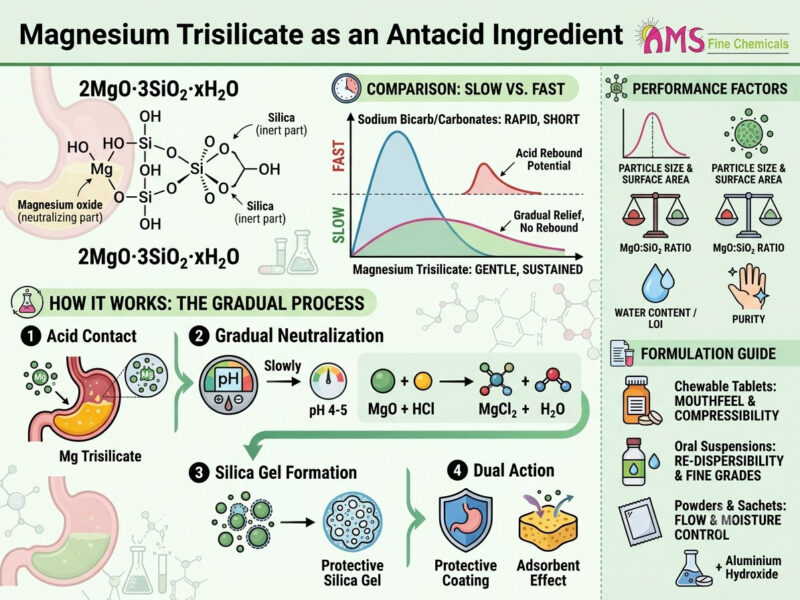
Magnesium Trisilicate (2MgO · 3SiO2 · nH2O) is a fine, odorless, tasteless, white hydrous silicate powder. Known for its high specific surface area, porous amorphous structure, and acid-neutralization capacity, it functions primarily as an antacid, an effective adsorbent, an anti-caking agent, a free-flow additive, and a pharmaceutical tableting excipient.
At AMS Fine Chemicals, the production of Magnesium Trisilicate involves a precision precipitation synthesis process using controlled stoichiometry, optimized reaction kinetics, rigorous washing cycles, flash drying, and ultra-fine micronization.
2. Chemical Identity & Structural Characteristics
Magnesium Trisilicate is an amorphous compound composed of hydrated magnesium silicate with variable hydration numbers. Pharmacopoeial standards mandate specific ratios of Magnesium Oxide (MgO) and Silicon Dioxide (SiO2) to ensure safety, biological activity, and functional efficacy.
Chemical Summary
- Chemical Formula: 2MgO · 3SiO2 · nH2O (Hydrated Magnesium Silicate)
- IUPAC Name: Dimagnesium trisilicate hydrate
- CAS Registry Number: 14987-04-3 / 39365-87-2
- Molecular Weight: Variable (Typically 260.86 g/mol for anhydrous core)
- Assay Limits (Dried Basis):
- Magnesium Oxide (MgO): Minimum 29.0%
- Silicon Dioxide (SiO2): Minimum 65.0%
- SiO2 / MgO Molar Ratio: Approximately 1.5 : 1.0 to 1.8 : 1.0
- Physical Appearance: Fine, white, odorless, non-gritty, free-flowing powder
- Solubility: Insoluble in water and alcohol; decomposes and dissolves in mineral acids
                     Hydration Layers (n H₂O)
           ┌─────────────────────────────────────────┐
           │   [O]─[Si]─[O]─[Si]─[O]─[Si]─[O]        │
           │      │        │        │                │
           │    [Mg²⁺]   [Mg²⁺]   [Mg²⁺]              │
           └─────────────────────────────────────────┘
                 Amorphous High Surface Area Matrix
3. Raw Material Selection & Standardization
The synthetic quality and physical performance (surface area, bulk density, acid absorption rate) of Magnesium Trisilicate depend on raw material purity and Stoichiometric balance. AMS Fine Chemicals enforces stringent raw material standards prior to batch reactor charging:
Key Reactants
- Magnesium Sulfate Hexahydrate / Heptahydrate (MgSO4 · 7H2O):
- Specification: High-purity technical or pharmaceutical grade.
- Control Parameters: Low heavy metal content (Pb, As), controlled chloride levels, and consistent assay (≥ 99.5%).
- Sodium Silicate Solution (Na2O · nSiO2):
- Specification: Liquid sodium silicate with a targeted weight ratio of SiO2 to Na2O (3.2 : 1.0 to 3.4 : 1.0).
- Control Parameters: Specific gravity, viscosity, iron (Fe) contamination limits, and silica clarity.
- Demineralized / Treated Water (H2O):
- Specification: Low conductivity, free from heavy minerals, iron, and microbial contaminants.
4. Detailed Step-by-Step Manufacturing Process
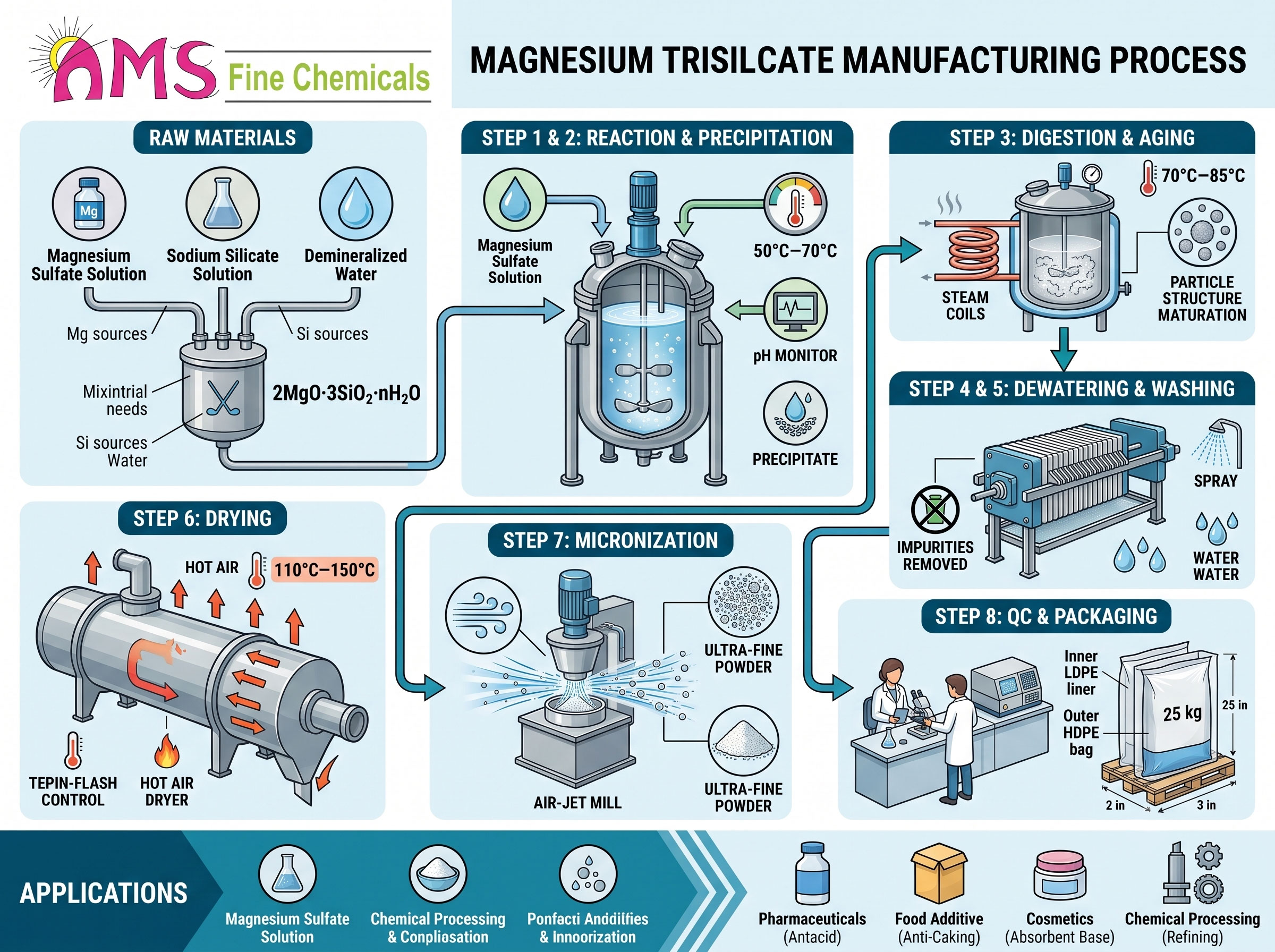
AMS Fine Chemicals manufactures Magnesium Trisilicate via a chemical precipitation route followed by hydrothermal maturation, multi-stage washing, controlled thermal drying, and physical size reduction.
┌─────────────────────────┐      ┌─────────────────────────┐
│ Magnesium Sulfate Soln. │      │  Sodium Silicate Soln.  │
└───────────┬─────────────┘      └───────────┬─────────────┘
            │                                │
            └───────────────┬────────────────┘
                            ▼
            ┌───────────────────────────────┐
            │ Precipitation Synthesis Reactor│
            │ (Controlled pH, Temp & Agitation)
            └───────────────┬───────────────┘
                            ▼
            ┌───────────────────────────────┐
            │   Hydrothermal Digestion      │
            └───────────────┬───────────────┘
                            ▼
            ┌───────────────────────────────┐
            │ Solid-Liquid Separation       │
            │ (Filter Press Dewatering)     │
            └───────────────┬───────────────┘
                            ▼
            ┌───────────────────────────────┐
            │ Multi-Stage Pure Water Washing│
            │ (Sulfate / Chloride Removal)  │
            └───────────────┬───────────────┘
                            ▼
            ┌───────────────────────────────┐
            │ Flash Drying / Thermal Curing │
            └───────────────┬───────────────┘
                            ▼
            ┌───────────────────────────────┐
            │ Air Jet Milling / Micronizing │
            └───────────────┬───────────────┘
                            ▼
            ┌───────────────────────────────┐
            │ Sifting, QC Testing & Packing │
            └───────────────────────────────┘
Reaction Chemistry
The primary precipitation reaction takes place between soluble magnesium ions (Mg2+) and silicate anions (SiO32− / silicate polymers) in an aqueous medium:
2MgSO4 (aq) + 3Na2O · 3.3SiO2 (aq) + nH2O → 2MgO · 3SiO2 · nH2O (s) ↓ + 2Na2SO4 (aq)
Process Breakdown
Step 1: Raw Material Preparation & Solution Dissolution
- Magnesium Sulfate Dissolution: MgSO4 · 7H2O crystals are transferred into glass-lined or high-grade stainless steel (SS316L) dissolution vessels equipped with high-efficiency agitators. Demineralized water is added to achieve a predetermined molar concentration (15–25% w/w). The solution is filtered to remove any suspended particulate matter.
- Sodium Silicate Dilution: Concentrated sodium silicate syrup is diluted with warm demineralized water in a secondary conditioning tank to adjust specific gravity and viscosity, ensuring homogeneous mixing during precipitation.
Step 2: Precipitation Synthesis
- Controlled Dosing: Dilute magnesium sulfate solution is gradually fed into the agitation vessel containing the standardized sodium silicate solution under continuous stirring.
- Temperature & pH Monitoring: The precipitation reaction is maintained at a controlled temperature range (50°C–70°C). The system pH is monitored to ensure complete precipitation of the magnesium silicate complex without forming free silica gel or unreacted magnesium hydroxide.
- Striking Method: A metered strike approach prevents local concentration spikes, yielding uniform pore architecture, optimized particle size distribution, and high specific surface area.
Step 3: Digestion & Aging (Hydrothermal Maturation)
- After complete chemical addition, the slurry undergoes a controlled aging/digestion process at 70°C–85°C for a designated period.
- This aging step facilitates the formation of the desired porous amorphous polymeric framework of hydrated magnesium silicate and enhances acid absorption performance.
Step 4: Dewatering & Primary Separation
- The aged slurry is pumped into high-pressure membrane filter presses.
- Primary Dewatering: Liquid filtrate containing dissolved sodium sulfate (Na2SO4) is separated from the precipitated Magnesium Trisilicate wet filter cake.
Step 5: Multi-Stage Washing
- The filter cake undergoes continuous washing cycles inside the filter press using hot demineralized water (60°C–80°C).
- Impurity Removal: Washing removes soluble byproduct ions, particularly sodium ions (Na+) and sulfate ions (SO42−), until the wash water conductivity drops below specified thresholds.
- Quality Check: Washings are tested for residual sulfates (≤ 0.5%) and water-soluble salts.
Step 6: Thermal Drying
- The washed, dewatered cake is processed through industrial flash dryers or spin-flash dryers under precise thermal profiles (110°C–150°C).
- Moisture Control: Thermal drying reduces free water content while retaining essential structural bound water (H2O) required for pharmacopoeial compliance (17.0%–34.0% Loss on Ignition).
Step 7: Pulverization, Micronization & Classification
- The dried Magnesium Trisilicate lump mass is fed into air-jet mills or pin mills.
- Particle Size Tailoring: Particles are ground to fine, ultra-fine, or micronized powders based on grade requirements (e.g., 100% passing through 200 mesh or 325 mesh).
- Pneumatic air classifiers separate over-sized particles, returning them for secondary grinding to deliver a consistent particle size distribution.
Step 8: Sifting, Quality Assurance & Packaging
- The micronized product is passed through rotary vibrating sieves and inline magnetic separators to eliminate metallic trace contaminants.
- Final Quality Approval: In-house chemical and microbiological laboratories sample each batch for pharmacopoeial parameter testing.
- Packing: Material is packed into 25 kg HDPE bags with inner LDPE liners or customized jumbo bulk bags, followed by palletization and shrink-wrapping.
5. Quality Control, Pharmacopoeial Compliance & Testing
AMS Fine Chemicals operates an in-house Physico-Chemical Laboratory and Microbiology Laboratory equipped with NABL-calibrated testing instrumentation. Every production batch of Magnesium Trisilicate is verified against global pharmacopoeias, including Indian Pharmacopoeia (IP), British Pharmacopoeia (BP), United States Pharmacopeia (USP), European Pharmacopoeia (EP), and Food Chemicals Codex (FCC).
| Parameter / Quality Test | IP / BP / USP Pharmacopoeial Limits | Testing Methodology |
| Identification | Positive for Magnesium & Silicate | Wet Chemical / Flame Photometry |
| Appearance | Fine, white, odorless, non-gritty powder | Visual & Sensory Inspection |
| Assay (MgO Content) | Minimum 29.0% (Dried basis) | Complexometric Titration (EDTA) |
| Assay (SiO2 Content) | Minimum 65.0% (Dried basis) | Gravimetric Analysis |
| Acid Absorption Capacity | Meets pharmacopoeial limit (≥ 28 mL 0.1N HCl/g) | Back-Titration against 0.1N NaOH |
| Heavy Metals (Pb) | Maximum 20 ppm | Atomic Absorption Spectroscopy (AAS) |
| Arsenic (As) | Maximum 3 ppm | Gutzeit Method / AAS |
| Chlorides (Cl−) | Maximum 0.05% | Turbidimetric Limit Test |
| Sulfates (SO42−) | Maximum 0.50% | Turbidimetric Limit Test |
| Water Soluble Salts | Maximum 2.0% | Gravimetric Analysis |
| Alkalinity | Neutral to phenolphthalein | Volumetric Titration |
| Loss on Ignition (LOI) | 17.0% – 34.0% (at 900°C) | Thermogravimetric Analysis / Ignition Furnace |
| Microbial Enumeration (TAMC/TYMC) | Pathogen free (E. coli, Salmonella absent) | Microbiological Plating / Incubation |
6. Industrial & Commercial Applications
AMS Fine Chemicals produces customized grades of Magnesium Trisilicate engineered to satisfy distinct regulatory standards and performance criteria across diverse industries:
1. Pharmaceuticals & Healthcare (Core Application)
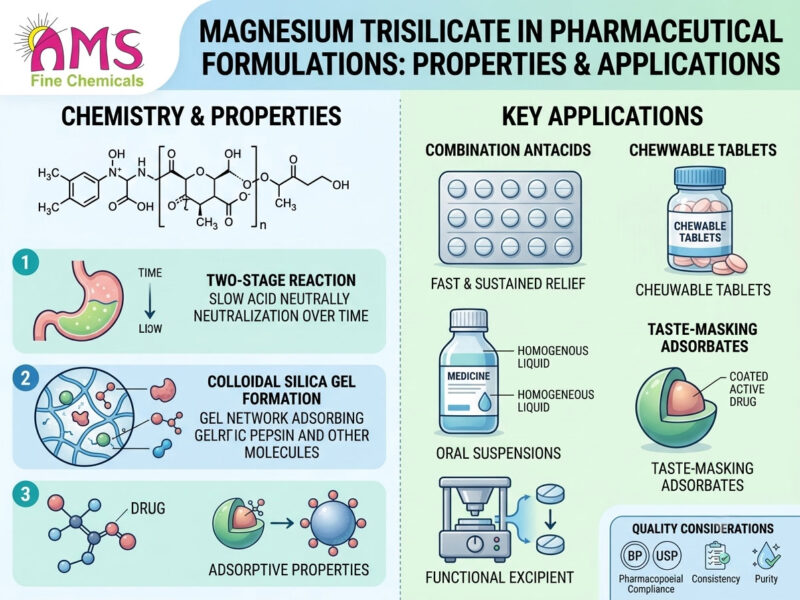
- Antacid Action: Reacts slowly with hydrochloric acid in gastric juice, providing sustained, long-acting acid neutralization without causing acid rebound.
- Gastrointestinal Protective: Hydrated silicon dioxide gel released during stomach acid neutralization coats mucosal walls, offering relief from peptic ulcers, heartburn, and acid reflux.
- Adsorbent Agent: Adsorbs toxins, gases, and excessive metabolic impurities within the gastrointestinal tract.
- Tableting Excipient: Functions as an effective glidant, anti-tacking agent, and disintegrant support in solid oral dosage forms.
2. Food & Nutritional Supplements (FCC Grade)
- Anti-Caking Agent: Prevents moisture agglomeration and maintains free-flowing characteristics in powdered food mixes, spice blends, and nutritional formulas.
- Cooking Oil Purifier: Used as a filtration adsorbent in commercial frying oil systems to remove free fatty acids (FFA), polar compounds, and oxidation products, extending oil life.
3. Cosmetics & Personal Care
- Absorbent Base: Acts as a oil-absorber and texturizer in dusting powders, deodorants, face powders, and cosmetic formulations.
- Opacifying Agent: Provides consistency and texture in skin creams and ointments.
4. Industrial & Chemical Processing
- Decolorizing & Refining Adsorbent: Used in refining polyols, oils, and organic synthesis intermediates to remove color bodies and residual catalysts.
- Rubber & Plastics Filler: Enhances mechanical properties, heat resistance, and surface finish in rubber compounds and specialty polymer resins.
7. Packaging, Storage & Logistics
Packaging Options
- Standard Packaging: 25 kg HDPE woven bags lined with double LDPE inner bags to protect against atmospheric moisture ingress.
- Palletization: ISPM-15 compliant wooden/Euro pallets, shrink-wrapped and strapped for safe maritime and road transit.
- Bulk Packaging: Customized 500 kg to 1000 kg Jumbo Bags available for high-volume industrial buyers.
┌─────────────────────────────────────────────────────────────┐
│                   Standard 25 kg Packing                    │
│  ┌───────────────────────────────────────────────────────┐  │
│  │ Multi-Wall Outer Woven HDPE Bag                       │  │
│  │  ┌─────────────────────────────────────────────────┐  │  │
│  │  │ Inner Hermetically Sealed LDPE Film Liner       │  │  │
│  │  │  ┌───────────────────────────────────────────┐  │  │  │
│  │  │  │ High-Purity Micronized Magnesium          │  │  │  │
│  │  │  │ Trisilicate Powder                        │  │  │  │
│  │  │  └───────────────────────────────────────────┘  │  │  │
│  │  └─────────────────────────────────────────────────┘  │  │
│  └───────────────────────────────────────────────────────┘  │
└─────────────────────────────────────────────────────────────┘
Handling & Storage Recommendations
- Shelf Life: 5 years from the date of manufacturing when stored unopened in original factory packaging.
- Storage Environment: Store in a cool, dry, well-ventilated warehouse away from direct sunlight, ambient moisture, and incompatible acidic fumes.
- Resealing: Keep containers tightly closed after partial use to prevent moisture pickup.
Strategic Advantage & Export Logistics
AMS Fine Chemicals benefits from a favorable supply-chain location in Gujarat, India:
- Factory Location: Survey No-439, Near Modern Salt, Avania Village, Taluka Ghogha, District Bhavnagar, Gujarat – 364002.
- Port Proximity:
- Pipavav Port: ≈ 120 km distance.
- Mundra Port: ≈ 350 km distance.
- Production Capacity: 500 MT to 700 MT annual production capacity for Magnesium Trisilicate.
8. Why Partner with AMS Fine Chemicals?
- Over 15+ Years of Manufacturing Excellence: Established in 2009, bringing deep technical domain expertise in inorganic fine chemical synthesis.
- In-House QC & Microbiology Infrastructure: Modern testing facilities ensure compliance with global pharmacopoeial monographs (IP, BP, USP, EP, FCC).
- Batch-to-Batch Consistency: Automated reaction control systems guarantee uniform particle size, surface area, and bulk density across every batch.
- Tailored Product Engineering: Capability to customize particle size, bulk density, and purity profiles according to specific client requirements.