The global paper and pulp sector is undergoing a massive transformation. Driven by stringent environmental regulations, skyrocketing raw material costs, and a market-wide shift toward sustainable, eco-friendly chemical alternatives, mills are re-engineering their core chemical loops. Among these advancements, the transition from traditional, aggressive alkalis like Caustic Soda (NaOH) to synthetic Magnesium Hydroxide (Mg(OH)₂) stands out as one of the most commercially viable and ecologically sound innovations.
As a premier manufacturer, exporter, and supplier of high-purity inorganic chemicals, AMS Fine Chemicals produces top-tier Magnesium Hydroxide optimized specifically for the pulp and paper market. Operating out of advanced manufacturing plants in Bhavnagar, Gujarat, our technically engineered products empower mills worldwide to enhance pulp yields, improve paper brightness, cut down chemical expenditures, and seamlessly meet zero-liquid-discharge (ZLD) environmental mandates.
In this comprehensive technical guide, we break down the functional, financial, and ecological roles of Magnesium Hydroxide across modern pulp and paper manufacturing lines.
1. Executive Summary: The Chemistry of Mg(OH)₂ in Papermaking
In traditional pulp processing, strong bases like Sodium Hydroxide (NaOH) and Sodium Carbonate (Na₂CO₃) are heavily utilized to manage alkaline conditions during wood chip cooking, oxygen delignification, and multi-stage bleaching sequences. However, these strong alkalis often trigger a phenomenon known as “cellulose degradation” or “peeling reactions,” which ultimately degrades fiber strength and reduces net pulp yields.
Magnesium Hydroxide represents a highly efficient alternative due to its unique, buffered chemical nature:
Mg(OH)₂ ⇌ Mg²⁺ + 2OH⁻
The Power of Buffered Alkalinity
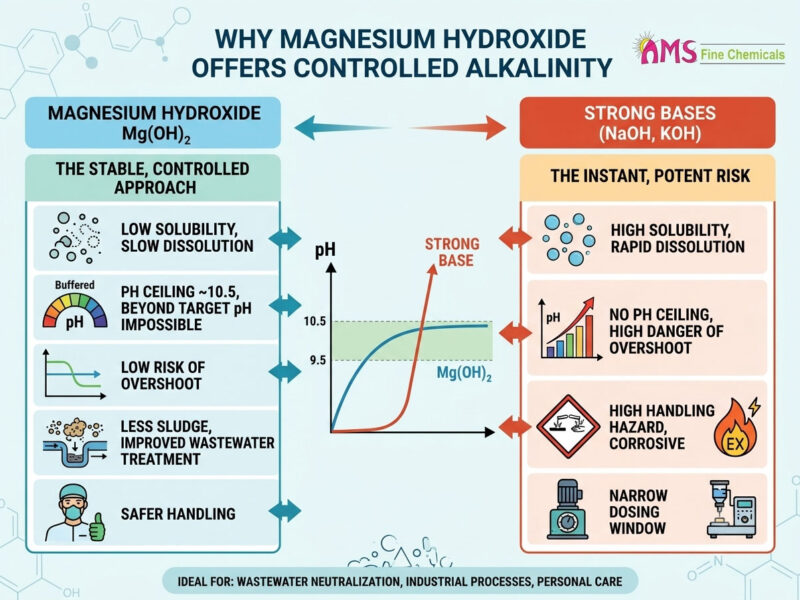
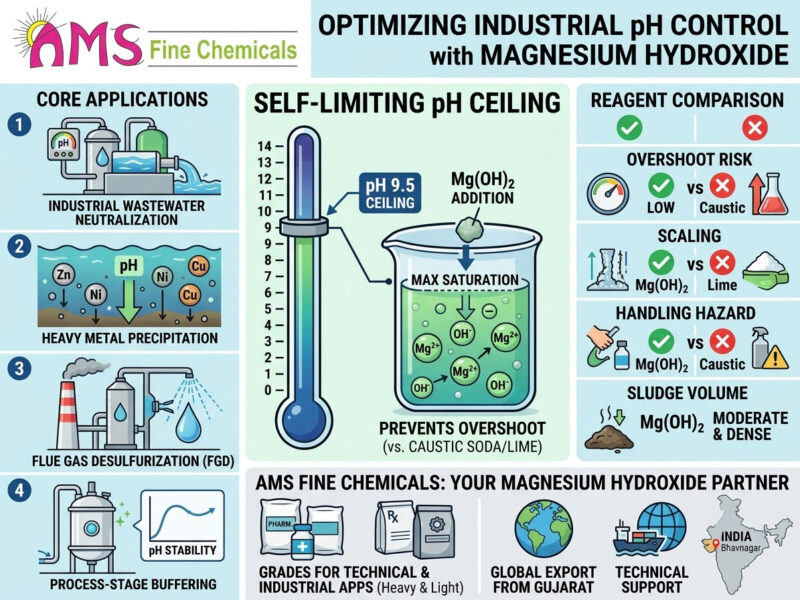
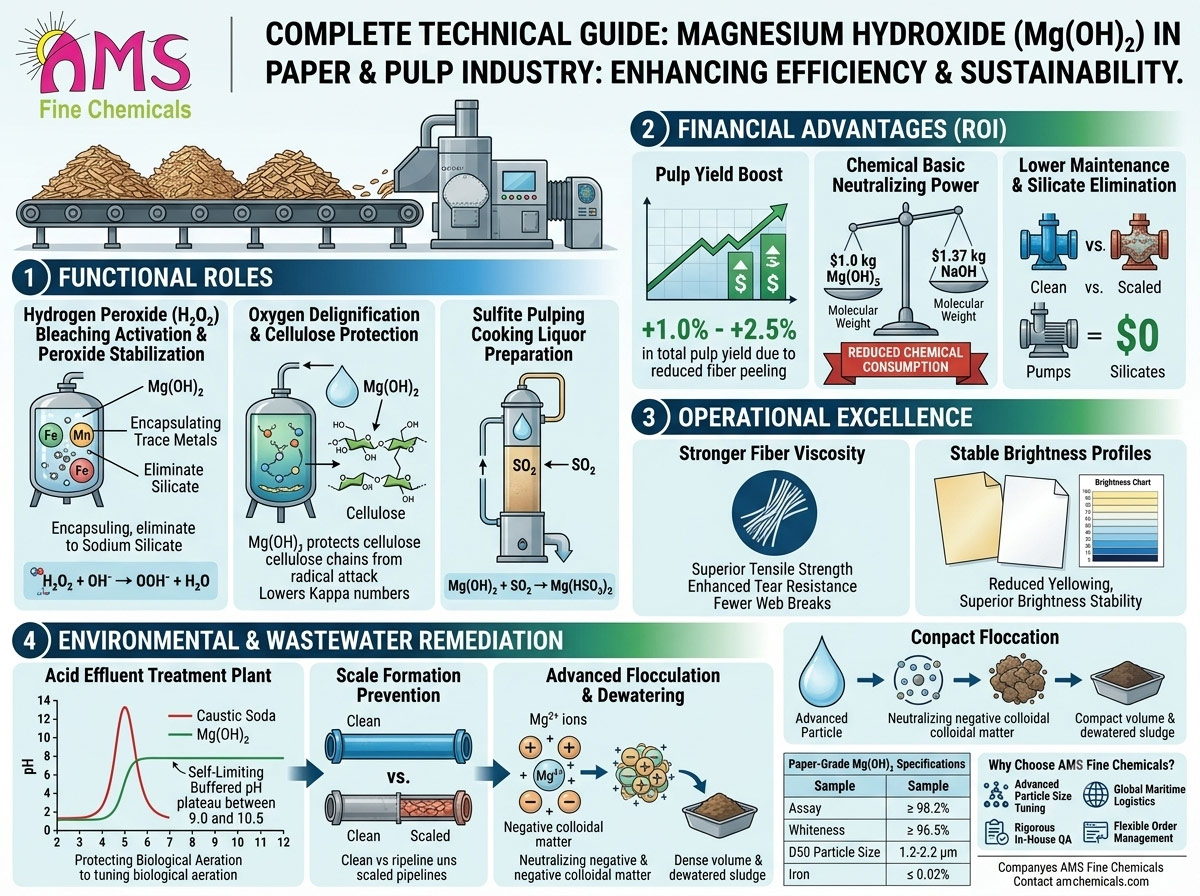
Unlike caustic soda, which completely dissociates in water to create a sharp, high-pH spike (pH > 12), Magnesium Hydroxide has low water solubility. It establishes a steady, self-governing buffered pH plateau between 9.0 and 10.5. This specific alkaline window provides exactly enough hydroxyl ions to dissolve lignin during bleaching and delignification without triggering the aggressive fiber degradation caused by harsher alkalis.
2. Core Operational Advantages of Magnesium Hydroxide over Caustic Soda (NaOH)
For procurement managers and technical directors at modern paper mills, switching to Magnesium Hydroxide derived from AMS Fine Chemicals yields immediate operational benefits:
A. Substantial Gain in Pulp Yield
Because Mg(OH)₂ maintains a mild, buffered pH profile, it minimizes the chemical peeling reactions that break down shorter-chain carbohydrates (hemicellulose and cellulose). Keeping these structural carbohydrates intact inside the pulp slurry directly increases the mill’s total pulp yield by 1.0%–2.5% per batch, adding up to massive cost savings over large-scale production runs.
B. Enhanced Physical Strength of Paper Fibers
The aggressive nature of caustic soda can leave paper fibers brittle and physically weakened. By optimizing chemical processing with a magnesium-based buffer, the resulting fibers retain superior length, high tensile strength, and enhanced tear resistance. This enables mills to run high-speed paper machines with far fewer web breaks.
C. Superior Brightness Stability (Reduced Yellowing)
When pulp is bleached using hydrogen peroxide (H₂O₂) with a caustic soda catalyst, the extreme pH levels can form colored complex structures called chromophores. These chromophores cause paper to yellow over time when exposed to air and light. Magnesium Hydroxide prevents this unwanted side reaction, yielding paper sheets with stable, long-lasting brightness profiles.
3. Key Applications of Magnesium Hydroxide in the Pulping Loop
Wood Chips ➔ [Mechanical / Chemical Pulping] ➔ [Oxygen Delignification (Mg(OH)2 Protection)] ➔ [Peroxide Bleaching (Mg(OH)2 Catalyst)] ➔ Finished Pulp Slurry
1. Hydrogen Peroxide (H₂O₂) Bleaching Sequences
In mechanical pulping, Bleached Chemithermomechanical Pulp (BCTMP), and chemical pulp bleaching loops, hydrogen peroxide requires an alkaline activator to unlock the perhydroxyl anion (OOH⁻), which is the active bleaching agent.
Using Caustic Soda as the activator forces mills to introduce costly silicate-based stabilizers to prevent the peroxide from breaking down into useless water and oxygen. When you substitute Magnesium Hydroxide, the divalent magnesium ions (Mg²⁺) act as natural stabilizers for the peroxide, eliminating the need for silicates and significantly reducing chemical costs.
H₂O₂ + OH⁻ —(Controlled by Mg(OH)₂)→ OOH⁻ + H₂O
2. Oxygen Delignification Processes
During oxygen delignification, the goal is to remove residual lignin from unbleached pulp before it enters the bleach plant. Introducing Magnesium Hydroxide into the pressurized oxygen reactor protects the cellulose chain from dangerous free-radical attacks, preserving excellent fiber viscosity and strength while successfully lowering the pulp’s Kappa number.
3. Sulfite Pulping Chemical Preparation
In sulfite-based pulping mills, high-purity Magnesium Hydroxide slurry is reacted directly with sulfur dioxide gas (SO₂) inside absorption towers to prepare the active cooking liquor, Magnesium Bisulfite (Mg(HSO₃)₂). This chemical system allows mills to operate automated chemical recovery loops, reclaiming both magnesium and sulfur from the spent black liquor.
4. Environmental and Wastewater Remediation in Paper Mills
Pulp and paper manufacturing generates significant volumes of highly complex effluent streams loaded with organic acids, dissolved lignin, and suspended solids. Magnesium Hydroxide functions as an elite chemical agent for treatment plants:
Acidic Effluent ➔ [Effluent Treatment Plant + Mg(OH)2 Slurry] ➔ Self-Limiting pH (~9.5) ➔ Heavy Metal Flocculation ➔ Compact, Dewatered Sludge
Self-Governing pH Control
Traditional neutralization with lime (Ca(OH)₂) or caustic soda can easily cause dangerous pH spikes if over-dosed, killing the beneficial microbes inside secondary biological treatment systems. Because Mg(OH)₂ has a maximum self-limiting pH of around 9.5, over-dosing is virtually impossible. This safeguards biological aeration basins and ensures steady compliance with environmental discharge permits.
Advanced Sludge Flocculation and Dewatering
The divalent magnesium ions (Mg²⁺) carry a strong positive charge that naturally neutralizes the negative surface charges on suspended cellulose fragments and colloidal organic matter. This creates dense, fast-settling flocs that sharply reduce the volume of biological sludge while improving water clarity and filtration speeds in dewatering equipment.
Prevention of Scale Formation
Using lime or calcium-based alkalis often leads to severe calcium carbonate and calcium sulfate scaling inside pipes, pumps, and heat exchangers, resulting in expensive downtime for acid washing. Magnesium salts are significantly more water-soluble, which eliminates scale buildup and keeps plant infrastructure running smoothly.
5. Technical Specification Matrix: Paper-Grade Mg(OH)₂
To ensure trouble-free integration into continuous chemical loops, AMS Fine Chemicals maintains strict quality control over all critical chemical and physical parameters:
| Evaluated Parameter | Premium Paper/Pulp Grade | Technical Slurry Grade |
| Physical Appearance | Ultra-White, Free-Flowing Powder | Milky White Suspension / Fine Powder |
| Assay [as Mg(OH)₂] | ≥ 98.2% | 93.0%–96.5% |
| Whiteness Index (R-457) | ≥ 96.5% | ≥ 90.0% |
| Median Particle Size (D₅₀) | 1.2–2.2 µm | 3.5–7.5 µm |
| Iron Contamination (Fe) | ≤ 0.02% | ≤ 0.15% |
| Calcium Content (Ca) | ≤ 0.15% | ≤ 0.80% |
| Acid Insoluble Matter | ≤ 0.10% | ≤ 0.50% |
6. Financial Analysis: The ROI of Transitioning to Mg(OH)₂
While the per-tonne purchase price of Magnesium Hydroxide can sometimes be higher than raw caustic soda flakes, a look at the overall chemical balance sheet reveals an incredibly strong Return on Investment (ROI):
Equivalent Basicity Savings
On a purely molecular level, Magnesium Hydroxide provides excellent neutralizing power per unit weight. Because the magnesium atom is lighter than sodium and carries a divalent charge, 1.0 kg of high-purity Mg(OH)₂ delivers the equivalent chemical basicity of approximately 1.37 kg of pure Caustic Soda (NaOH). This mass reduction lowers raw chemical consumption volumes, translating directly to reduced shipping and storage expenses.
Summary of Holistic Cost Reductions:
- 100 % Elimination of Sodium Silicate: No longer required as a peroxide stabilizer.
- Reduced Total Peroxide Usage: Improved peroxide stability lowers total chemical dosage needs.
- Lower Maintenance Costs: Eradicates calcium scale formation inside processing lines.
- Lower Sludge Handling Costs: Denser sludge flocs lower volume-based landfill fees.
7. Sustainability & Closed-Loop Green Initiatives
Modern corporate sustainability mandates demand that paper mills actively reduce their chemical footprints. Magnesium Hydroxide fits perfectly into circular economy business models:
- Evaporator Efficiency: Sodium-based black liquors can increase the viscosity of spent liquors during concentration, causing fouling inside massive multi-effect evaporators. Magnesium-based liquors keep viscosity levels much lower, increasing energy efficiency during chemical recovery concentration loops.
- Safer Biomass Recovery: The ash generated from burning sodium-loaded sludge in biomass boilers can cause severe slagging on boiler grates. Switching to magnesium-based alternatives transforms this residue into a high-melting-point ash, protecting thermal recovery systems from damage.
8. Why Choose AMS Fine Chemicals?
Chemical consistency and a dependable supply chain are absolutely vital to keeping automated paper mills running without interruption.
Established in 2009, AMS Fine Chemicals is a leading manufacturer, exporter, and contract supplier of specialized magnesium compounds. Operating out of our advanced chemical production complex in Bhavnagar, Gujarat, we export high-performance Magnesium Hydroxide powders and specialized suspensions to clients across North America, Europe, the Middle East, and Southeast Asia.
The AMS Advantage:
- Advanced Particle Size Tuning: We customize particle sizes (D₅₀) and surface surface areas to guarantee rapid chemical reactivity within your specific pulp bleaching lines.
- Strategic Export Shipping Logistics: Our facility is close to India’s premier deep-water maritime shipping centers, including Pipavav Port (120 km) and Mundra Port (350 km), ensuring reliable global transport.
- Rigorous In-House QA: Our labs utilize advanced testing equipment to ensure trace heavy metal levels stay safely within parts-per-million (ppm) limits.
- Flexible Order Management: We easily manage both large-scale contract deliveries and flexible Less than Container Load (LCL) shipments to suit your mill’s dynamic production schedules.
9. Frequently Asked Questions (FAQs)
Q1: Can I inject Magnesium Hydroxide directly into my existing Caustic Soda chemical lines?
Magnesium Hydroxide is a suspension slurry rather than a fully soluble liquid solution like caustic soda. While the underlying chemical reactions are highly compatible, mills typically install simple slurry handling loops—including specialized chemical pumps and continuous agitation storage tanks—to prevent particle settling inside lines.
Q2: How does Mg(OH)₂ eliminate the need for sodium silicate during peroxide bleaching?
In standard bleaching loops, trace iron and manganese ions coming from wood fibers can accelerate the breakdown of hydrogen peroxide into water and oxygen. The divalent magnesium ions (Mg²⁺) provided by our high-purity chemical matrix physically encapsulate these trace metal impurities, naturally stabilizing the peroxide without forming the hard silicate scales that foul machinery.
Q3: Is Magnesium Hydroxide safe for food-contact paper manufacturing?
Yes. Synthetic Magnesium Hydroxide supplied by AMS Fine Chemicals complies with strict international regulations, making it completely safe for manufacturing food-grade paperboard, wrapping papers, and standard liquid packaging containers.
Optimize Your Mill’s Chemical Efficiency Today
Upgrading your mill’s chemical systems with premium Magnesium Hydroxide lowers production overheads, boosts fiber quality, and simplifies environmental compliance. Partner with AMS Fine Chemicals to secure a world-class chemical supply chain designed for the future of papermaking.
- Company Name: AMS Fine Chemicals
- Official Corporate Website: www.amsfine.com
- Technical Sales Contact: info@amsfine.com
- Manufacturing Complex: Survey No-439, Near Modern Salt, Village – Avania, Taluka-Ghogha, District – Bhavnagar, Gujarat, India.
Contact our technical engineering desk today to request comprehensive material data sheets, batch Certificates of Analysis (COA), or to order customized product samples for mill trials.