Anyone who has shaken a bottle of milk of magnesia knows the basic problem of the oral suspension. The medicine is a dispersion of solid particles in liquid, and gravity is always working against it. If the solids settle into a hard cake, the dose changes from one spoonful to the next. If the pH drifts or microbes grow, the product fails long before its label date. That is why stability is the main quality question in any oral suspension.
For antacid and laxative suspensions built on magnesium hydroxide, the raw material sets most of what happens on the shelf. Particle size, surface area, bulk density and impurity profile all affect how the suspension settles, how it redisperses and how it holds its pH over time. At AMS Fine Chemicals, a manufacturer and exporter of magnesium compounds based in Bhavnagar, Gujarat, we see these questions from formulators regularly. This guide explains how Light Magnesium Hydroxide behaves in oral suspensions and which parameters deserve attention before a formulation reaches scale-up.
If you are new to the ingredient, our article on Light Magnesium Hydroxide as an Antacid Ingredient: Manufacturing Perspective is a useful starting point. This post goes deeper into the stability side.
What “Stability” Means for an Oral Suspension
A suspension can fail in three broad ways, and formulators need to manage all three at once.
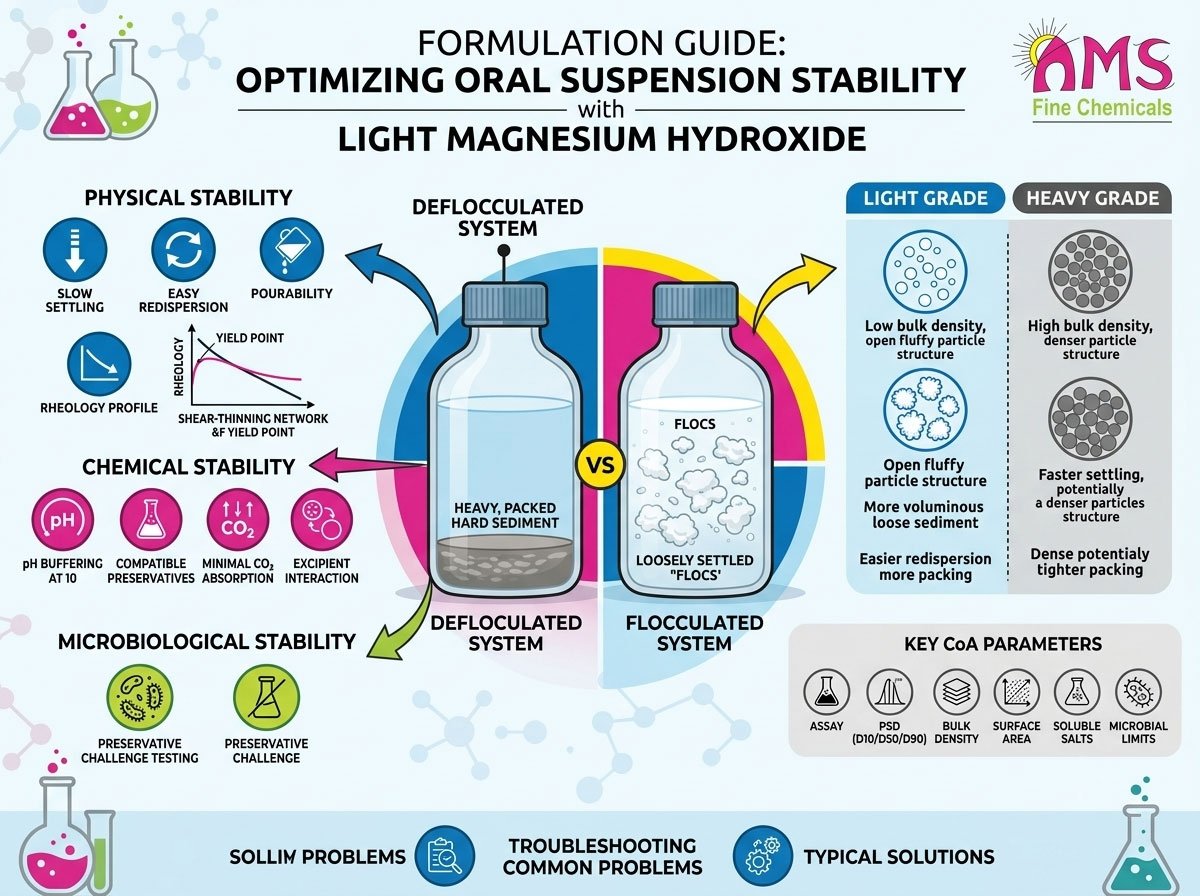
Physical stability covers how the solid phase behaves in the liquid. It includes sedimentation rate, caking, particle growth, ease of redispersion and pourability. A physically stable suspension settles slowly, forms a loose sediment and returns to uniform dispersion after a gentle shake.
Chemical stability covers the integrity of the active ingredient and the excipients, including pH drift, interaction with preservatives or flavors, and absorption of atmospheric carbon dioxide. Magnesium hydroxide is chemically robust, but the surrounding system is not always.
Microbiological stability covers the ability of the formulation to resist contamination during manufacture, storage and in-use handling. Water-based, neutral-to-mildly-alkaline suspensions with sugars and flavors can be favorable environments for microbes if the preservative system is not right.
Light Magnesium Hydroxide influences the first two directly and the third indirectly, through the pH it establishes and its effect on preservative performance.
Why Magnesium Hydroxide Suits Oral Suspensions
Magnesium hydroxide, Mg(OH)₂, is only sparingly soluble in water. That low solubility is what makes it a good suspension ingredient. Very little of the material dissolves, so the solid phase remains a stable population of particles, while the small amount that does dissolve produces a mildly alkaline pH, usually reported in the region of 10 for a saturated system.
This is the same property that makes magnesium hydroxide a controlled alkali rather than a harsh one. We discuss the mechanism in detail in Why Magnesium Hydroxide Provides Controlled Alkalinity Compared With Strong Bases. In a patient, it means acid neutralization proceeds progressively rather than as a sudden spike. In a bottle, it means the pH of the suspension is buffered by the solid phase and is unlikely to swing widely.
Three characteristics of the raw material matter most for suspension behavior: the particle size distribution, the specific surface area, and the bulk density. These are the points where the Light grade differs from the Heavy grade.
Light vs. Heavy Grade: What Changes in a Suspension
AMS Fine Chemicals manufactures both Light Magnesium Hydroxide and Heavy Magnesium Hydroxide, alongside the general Magnesium Hydroxide product range. The grades are distinguished mainly by bulk density and particle structure.
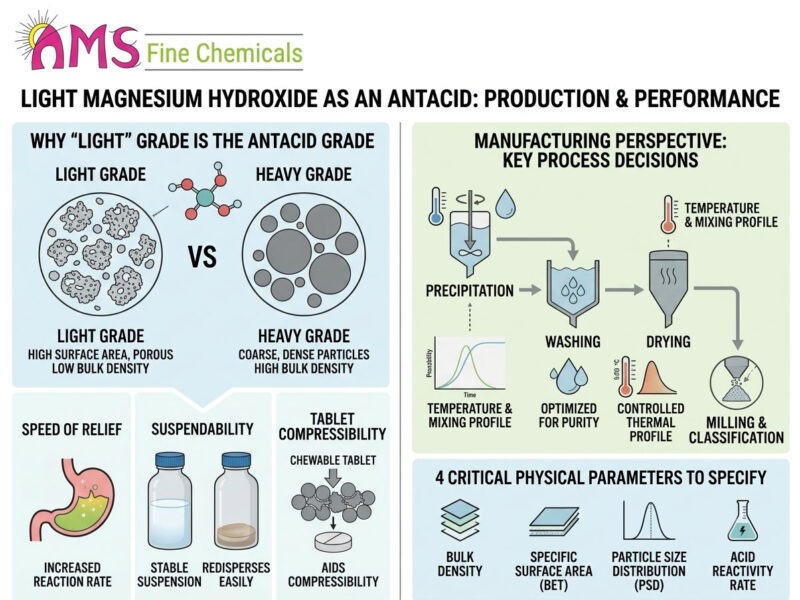
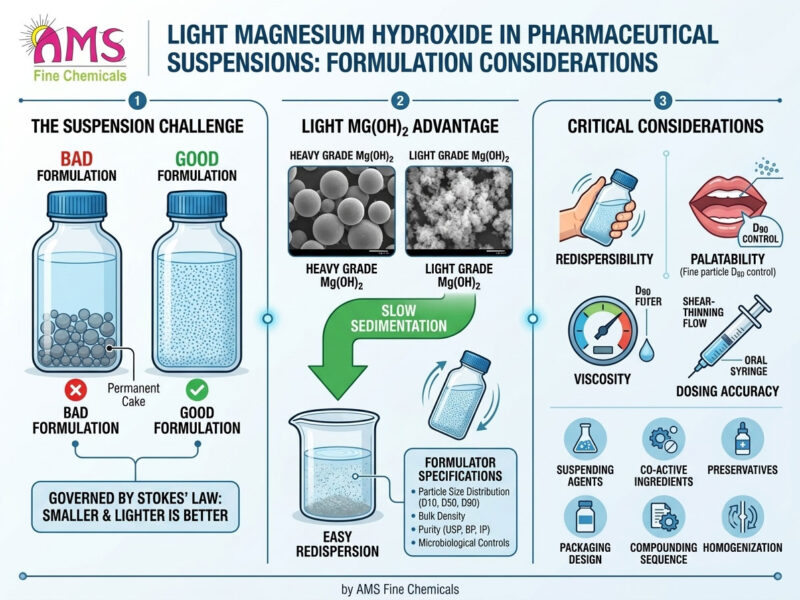
Light grade has a lower bulk density and a more open, fluffy particle structure. In a liquid, this tends to mean a larger volume of loosely packed solid for the same mass, a more voluminous sediment and easier redispersion. That is why Light grade is a natural choice for pharmaceutical oral suspensions, where pourability and re-suspendability matter as much as potency.
Heavy grade has a higher bulk density and denser particles. It handles well as a dry powder and is favored where compact handling or high loading is needed, for example in large-scale chemical treatment systems. In suspensions, dense particles settle faster and tend to pack more tightly if the vehicle is not carefully structured.
Neither grade is “better” in the abstract. The right choice depends on the performance target, and the same principle of working from function back to grade applies here as it does for carbonates, as we explain in How to Select the Right Magnesium Carbonate Grade for Your Manufacturing Process.
Physical Stability: The Sedimentation Problem
The Stokes’ Law Picture
The classic starting point for suspension design is Stokes’ law. It says that the sedimentation velocity of a particle increases with the square of its diameter and with the density difference between particle and medium, and decreases as the viscosity of the medium increases.
In practice this gives formulators three levers:
- Reduce particle size. Smaller particles settle more slowly, but very fine particles can pack into a dense, hard-to-redisperse cake.
- Reduce the density difference. Limited scope in a water-based system, although sugars and polyols in the vehicle raise its density slightly.
- Increase viscosity. Suspending agents raise the viscosity of the continuous phase and slow settling.
Stokes’ law describes idealized, dilute, spherical particles. Real antacid suspensions are concentrated, and particles interact. That is why flocculation behavior matters just as much as the simple settling picture.
Flocculated vs. Deflocculated Systems
In a deflocculated suspension, particles stay separate. They settle slowly, but they end up packed tightly at the bottom. The sediment can form a hard cake that resists shaking, which is the worst outcome for a patient-facing product.
In a flocculated suspension, particles are loosely linked into flocs. Flocs settle faster, but they form a loose, open sediment that redisperses easily with gentle shaking. The supernatant may look clearer for a period, which is why many formulators aim for controlled flocculation, a state in which settling is moderate and redispersion is easy.
The surface charge of magnesium hydroxide particles, the ionic strength of the vehicle and the type and level of suspending agent all influence which state the suspension occupies. Light Magnesium Hydroxide’s open particle structure generally helps form the loose sediment that flocculated systems depend on.
Sedimentation Volume and Redispersibility
Two simple measures track physical stability during development:
- Sedimentation volume ratio (F): the final sediment volume divided by the original suspension volume. A value close to 1 means the sediment fills most of the container, which is generally desirable for uniform dosing.
- Redispersibility: the number of inversions or the shaking effort needed to restore uniformity after storage.
Both should be measured at time zero and after storage at different temperatures. Particle size changes, crystal growth or cake formation typically show up in these two measures before anything else.
Rheology and Suspending Agents
Because the solid particles are the active ingredient, suspending agents have to do the structural work without interfering with the drug. Most magnesium hydroxide suspensions rely on a structured vehicle, and formulators commonly evaluate the following categories:
- Hydrocolloid gums such as xanthan gum, which builds a shear-thinning network. The suspension is viscous at rest and flows easily when poured or shaken.
- Cellulose derivatives such as microcrystalline cellulose with carboxymethylcellulose sodium, or hydroxyethylcellulose.
- Clays such as bentonite or magnesium aluminium silicate, which build a gel structure through platelet interaction.
The ideal rheological profile is shear-thinning with a yield point. A yield point holds particles in place during storage, and shear-thinning behavior lets the product pour cleanly and be measured accurately into a spoon or dosing cup.
Two cautions apply. First, the ionic environment matters. Magnesium hydroxide releases a small amount of Mg²⁺ ions into solution, and some anionic polymers and clays are sensitive to electrolytes, so a system that looks perfect at bench scale can lose viscosity as ionic strength shifts. Second, over-thickening is a real risk. A suspension that suspends beautifully but pours like paste will be rejected by patients and can cause dosing errors.
Particle Size, Surface Area and Their Effect on Stability
Particle size distribution (PSD) controls sedimentation rate, mouthfeel and reactivity. Laser diffraction is the standard tool, and the D10, D50 and D90 values describe the shape of the distribution, not just its average.
Why the tail matters. A suspension with an acceptable D50 but a heavy coarse tail will show faster settling of the largest particles, a gritty mouthfeel and potential dose variation. A tight distribution is often more valuable than a slightly finer average.
Why batch consistency matters. Even within specification, a shift in PSD between batches can change sedimentation behavior and viscosity. Many formulators tighten their incoming acceptance range beyond the pharmacopoeial minimum for exactly this reason. We describe the same pattern for powders in Magnesium Carbonate in Modern Chemical Formulations: A Technical Guide for Manufacturers.
Surface area and reactivity. Higher specific surface area increases the rate at which the solid dissolves and neutralizes acid. It also increases the surface available to adsorb preservatives, flavors or polymer chains, which is a formulation consideration covered below.
Chemical Stability: pH, Carbon Dioxide and Compatibility
pH Behavior
A magnesium hydroxide suspension is inherently alkaline, and the solid phase buffers it. This is generally a stability advantage, but it has two consequences for the rest of the formulation:
- Acid-labile actives. Any co-formulated active that degrades in alkaline conditions needs careful evaluation. Combination antacid products, for instance those pairing magnesium hydroxide with an aluminium compound and simethicone, require compatibility studies.
- Preservative selection. Some preservatives lose efficacy as pH rises. Acid-type preservatives such as benzoates and sorbates work best in acidic to neutral media, so a suspension sitting at an alkaline pH needs a preservative system chosen with that in mind, and its efficacy must be confirmed by preservative challenge testing.
Carbon Dioxide Absorption
Alkaline suspensions can absorb atmospheric carbon dioxide over time, converting a small fraction of hydroxide to carbonate species. In a tightly closed container the effect is minimal. In a poorly sealed or frequently opened bottle, it can shift pH and slightly alter particle surfaces. Good closure design and headspace control are practical protections.
For related background on how carbonate and hydroxide chemistries differ, see our overview of Magnesium Hydroxide pH Control in Industrial Chemical Processes.
Excipient Interactions
- Sugars and polyols such as sucrose, sorbitol and glycerin add viscosity and sweetness, and they reduce water activity, which helps microbial stability.
- Flavors and colors can adsorb onto the large surface of the solid, changing perceived taste or color over time.
- Surfactants used as wetting agents can improve dispersion, but they must be used carefully, because excess surfactant can deflocculate the system and promote caking.
- Electrolytes can shift the flocculation balance, as described above.
Microbiological Stability
Oral suspensions are multi-dose liquid products, and every opening of the bottle is a chance for contamination. The formulation therefore needs three layers of protection:
- Clean raw materials with controlled microbial limits. Incoming magnesium hydroxide should meet the microbial limits required for its intended use, supported by batch documentation.
- A well-designed preservative system that is effective at the actual pH of the finished suspension and is not adsorbed away by the solid phase. Because a large solid surface can bind preservative molecules, the free concentration in the liquid can be lower than the total added. Preservative efficacy testing on the finished product is the only reliable check.
- Hygienic manufacturing and appropriate packaging.
Manufacturing Process Factors
Even ideal raw materials can produce an unstable suspension if the process is poorly controlled. Points that deserve attention:
- Wetting and dispersion. Light, fluffy powders can trap air and float on the surface of the liquid. Adding the powder gradually into a vortex, or pre-wetting with a portion of glycerin or another humectant, helps produce a uniform dispersion.
- Hydration of suspending agents. Gums and clays need adequate hydration time and shear. Incomplete hydration gives a suspension that thickens unpredictably on standing.
- Shear and homogenization. High shear can break up agglomerates and improve uniformity, but excessive shear can degrade polymer structure or reduce particle size beyond what the system was designed for.
- Deaeration. Trapped air affects density, dose uniformity and appearance. Vacuum mixing or a controlled hold period reduces foaming and entrained air.
- Scale-up. Fine, high-surface-area powders can segregate or generate dust during large-batch charging. Validate blending and dispersion at an intermediate scale before committing to full production.
What to Check on the Certificate of Analysis
A CoA is the formulator’s first line of defense. For a magnesium hydroxide intended for oral suspensions, the parameters that most often explain stability behavior include:
| CoA Parameter | Why It Matters for Suspension Stability |
|---|---|
| Assay (Mg(OH)₂ content) | Confirms potency and dose calculations |
| Particle size distribution (D10/D50/D90) | Controls sedimentation, mouthfeel, redispersion |
| Bulk density | Indicates grade and particle structure; affects wetting and sediment volume |
| Specific surface area | Affects reactivity, preservative adsorption, flavor interaction |
| Loss on ignition / moisture | Consistency of active content per gram |
| Soluble salts / chloride / sulfate | Ionic strength effects on flocculation and viscosity |
| Heavy metals and elemental impurities | Patient safety and regulatory compliance |
| Whiteness | Visual quality of the finished suspension |
| Microbial limits | Baseline for preservative system design |
Our guide Magnesium Carbonate COA Explained: Important Parameters Buyers Should Check walks through how to read these parameters, and most of the reasoning applies equally to magnesium hydroxide.
A useful reminder: assay percentage confirms chemical identity, but it does not tell you how a batch will behave in a suspension. Two lots with identical assay can settle very differently if their particle size distribution or surface area differs. When a suspension misbehaves despite a passing CoA, request PSD and surface area data first.
Troubleshooting Common Stability Problems
| Problem | Likely Causes | Practical Actions |
|---|---|---|
| Hard cake at the bottom that won’t redisperse | Deflocculated system, dense or tightly packed particles, insufficient structure in vehicle | Evaluate controlled flocculation, adjust suspending agent type and level, review particle size |
| Rapid settling with clear supernatant | Low viscosity, coarse tail in PSD, weak yield point | Increase structured viscosity, check D90, review hydration of suspending agent |
| Viscosity drops during storage | Electrolyte sensitivity, polymer degradation, microbial activity | Review polymer choice, ionic strength, and preservative efficacy |
| Viscosity too high or gritty texture | Over-thickening, coarse particles, agglomerates | Reduce suspending agent, improve dispersion, tighten PSD |
| pH drift over shelf life | CO₂ ingress, container closure, interaction with excipients | Review packaging and headspace, check compatibility |
| Preservative efficacy failure | Alkaline pH, adsorption onto solid surface, insufficient level | Reselect preservative, confirm with challenge testing on finished product |
| Batch-to-batch variation in settling | PSD or surface area shift between raw material lots | Tighten incoming specifications and compare CoAs |
| Off-taste or color change | Flavor or color adsorption on particles, impurities | Review flavor system and check impurity profile, including iron |
Storage, Packaging and Shelf-Life Considerations
Stability does not end at manufacturing. For oral suspensions, packaging and storage conditions deserve early design attention:
- Closure integrity limits carbon dioxide ingress and moisture loss.
- Container material should not interact with the alkaline suspension or adsorb preservatives.
- Temperature exposure matters. Freeze-thaw cycles and heat can change viscosity, crystal habit and sediment structure, so stability studies should include temperature cycling as well as the standard long-term and accelerated conditions.
- Headspace and fill volume affect shaking efficiency and redispersion in the patient’s hands.
- Labeling. A clear “shake well before use” instruction is part of the stability design, since a well-formulated suspension still depends on user behavior.
Stability protocols should follow the relevant regulatory guidance for the target market, and finished-product shelf life must be established through real-time and accelerated studies on the actual formulation and pack.
Regulatory and Documentation Considerations
Oral suspensions are pharmaceutical products, so the magnesium hydroxide used must be sourced against the appropriate compendial standard, such as USP, BP, IP or Ph. Eur., depending on the target market. Documentation should cover:
- A batch-specific Certificate of Analysis against the relevant monograph
- Elemental impurity data supporting ICH Q3D-aligned risk assessments
- Microbial limit data
- Traceability and change-control commitments from the supplier
The same principle of compendial alignment applies across magnesium-based excipients. Our article on Magnesium Trisilicate BP vs. USP shows how pharmacopoeial differences can affect specifications, which is worth keeping in mind if you are exporting a finished product to multiple markets. Formulators developing multi-ingredient antacids may also want to read How Magnesium Trisilicate Works as an Antacid Ingredient for a complementary view of a related antacid ingredient.
How AMS Fine Chemicals Supports Oral Suspension Formulators
AMS Fine Chemicals, headquartered in Bhavnagar, Gujarat, manufactures and exports a full range of magnesium compounds, including Magnesium Hydroxide in Light and Heavy grades, Magnesium Carbonate and Magnesium Trisilicate. Our batches are tested in-house for assay, loss on ignition, particle size distribution by laser diffraction, bulk density, whiteness and heavy metal content by ICP-OES, and each shipment is supported by a Certificate of Analysis against the applicable pharmacopoeial or industry standard.
When qualifying any supplier, compare CoAs from several recent lots (PSD, bulk density and surface area, not just assay), as outlined in How to Evaluate a Magnesium Carbonate Supplier for Bulk Procurement. For oral suspension formulators, we offer a single technically supported source for the main magnesium-based antacid and excipient materials. You can browse the complete range on our Products page, explore the Applications we support, or learn more about the Industries We Serve. More articles on this ingredient family are collected in our Light Magnesium Hydroxide and Magnesium Hydroxide blog categories.
Frequently Asked Questions
Why is Light Magnesium Hydroxide preferred for oral suspensions? Its lower bulk density and more open particle structure generally give a more voluminous, loosely packed sediment and easier redispersion than a denser grade, which supports pourability and dose uniformity. The final choice should always be confirmed through formulation trials with your own vehicle and suspending system.
Does particle size affect the stability of a magnesium hydroxide suspension? Yes. Particle size distribution influences sedimentation rate, mouthfeel, caking tendency and reactivity. A tight distribution with a controlled coarse tail usually behaves more predictably than a distribution with the same average but a wide spread.
What is controlled flocculation, and why does it matter? Controlled flocculation is a deliberate state in which particles form loose flocs. Settling is moderate and the sediment is open and easy to redisperse, in contrast to a deflocculated system where particles pack into a hard cake.
Why do preservatives sometimes fail in magnesium hydroxide suspensions? Two common causes are the alkaline pH, which reduces the efficacy of some acid-type preservatives, and adsorption of preservative onto the large particle surface, which lowers the free concentration. Preservative efficacy testing on the finished product is the reliable way to confirm protection.
Can carbon dioxide from the air affect the suspension? In poorly sealed or frequently opened containers, atmospheric CO₂ can react with alkaline species and shift pH slightly over time. Good closure design and headspace control reduce this risk.
What should I ask my supplier besides assay? Ask for particle size distribution (D10/D50/D90), bulk density, specific surface area, soluble salt data, elemental impurity results and microbial limits, ideally across several recent batches.
Final Word
A stable oral suspension is not the product of one good ingredient. It is the result of a raw material, a vehicle and a process that have been designed to work together. Light Magnesium Hydroxide brings low solubility, controlled alkalinity and an open particle structure, all of which favor a well-behaved suspension, but only if its particle size, surface area and impurity profile are matched to the system and kept consistent from batch to batch.
The most reliable approach is to work backward from the performance you need, whether that is slow settling, easy redispersion, stable pH or dependable preservative efficacy, and then choose and qualify the grade that delivers it. Test at the actual pH, in the actual vehicle, in the actual pack, and confirm your supplier can repeat the same quality on every lot.
To request specifications, a sample or a Certificate of Analysis for Light Magnesium Hydroxide, visit our Light Magnesium Hydroxide product page or reach out through our Contact Us page. You can also write to info@amsfine.com or call +91 70433 38890.
This article is for general technical information for formulators and manufacturers. Final formulation decisions should be confirmed through your own development, stability and regulatory work.