A Certificate of Analysis (CoA) is the single most important document that arrives with any shipment of industrial or pharmaceutical raw material — and yet it is one of the most frequently skimmed rather than actually read. For buyers of Magnesium Carbonate, that habit can be costly. A CoA that “looks fine” at a glance can still hide a particle size mismatch that ruins a cosmetic formulation, a bulk density outside spec that throws off a rubber compounding batch, or a loss-on-drying figure that quietly signals a moisture problem waiting to happen in transit.
This guide walks through a real Magnesium Carbonate CoA parameter by parameter — what each test measures, why it matters to your specific application, and what numbers should raise a flag rather than a signature. Whether you’re buying for pharmaceuticals, food processing, cosmetics, rubber, or industrial applications, this is the checklist your quality and procurement teams should be running before every shipment is accepted.
What Exactly Is a Certificate of Analysis?
A Certificate of Analysis is a document issued by the manufacturer’s quality control laboratory for a specific production batch or lot. It lists the parameters tested, the method used, the specification range, and the actual result obtained for that lot — not a generic “typical values” sheet copied across every shipment.
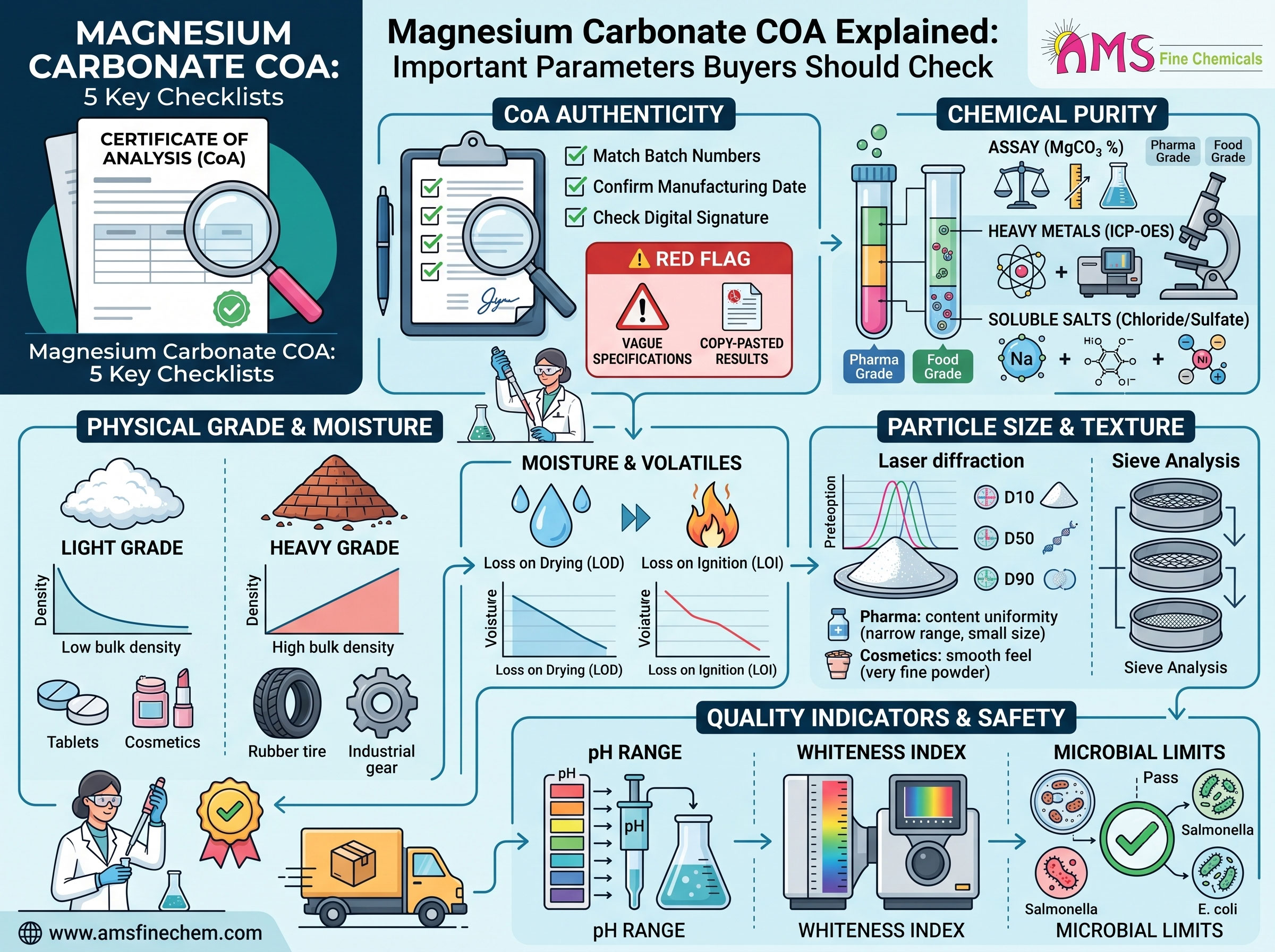
A genuine, batch-specific CoA should always include:
- The batch/lot number, cross-referenced to the packaging labels on the actual delivered material
- The date of manufacture and, where applicable, date of testing
- The specification reference (e.g., in-house spec, USP, BP, IP, Ph. Eur., or Food Chemicals Codex)
- Each tested parameter, its specification limit, and the actual result
- The signature or digital authorization of the responsible quality control officer
If any of these elements are missing — particularly the batch number or a named specification reference — treat the document as incomplete and request a proper CoA before accepting the shipment. For background on why the underlying pharmacopoeial specification matters so much in the first place, see our companion article on Magnesium Trisilicate BP vs. USP: Understanding Pharmaceutical Grade Specifications, which covers the same principle for a related excipient.
Why Magnesium Carbonate CoAs Deserve Extra Scrutiny
Magnesium Carbonate isn’t a single, uniform commodity. It’s supplied in multiple grades — Light Magnesium Carbonate, Ultra Light Magnesium Carbonate, and Heavy Magnesium Carbonate — each defined by very different bulk density, particle size, and surface area targets, even though the underlying chemistry is broadly similar. A CoA that confirms good chemical purity but doesn’t confirm the buyer received the correct physical grade is only telling half the story. Our Complete Guide to Magnesium Carbonate Manufacturing Process explains in more depth how these light and heavy grades diverge structurally during production — which is exactly why the CoA needs to confirm both chemistry and physical form.
Parameter 1: Assay (MgCO₃ Content)
This is the headline purity figure — the percentage of magnesium carbonate (expressed as MgCO₃, or sometimes as MgO on an ignited basis) present in the sample. Pharmacopoeial and food-grade specifications typically require an assay in the region of 40–43% MgO on an ignited basis, though the exact figure depends on which monograph (USP, BP, IP, or Food Chemicals Codex) the buyer has specified.
What to check: Confirm the assay method used — usually complexometric EDTA titration — and confirm the result is reported against the same basis (ignited vs. as-is) that your specification requires. A batch reported on an “as-is” basis can appear to pass when the ignited-basis figure would actually fail.
Parameter 2: Loss on Ignition (LOI)
Loss on Ignition measures the weight lost when the sample is heated to a high temperature (typically 900–1000°C), which drives off both adsorbed moisture and the carbonate’s bound water and CO₂. For basic magnesium carbonate, LOI typically falls in a broad range depending on grade, often between roughly 48% and 60%.
Why it matters: LOI is a proxy for the hydration state and carbonate content of the material. An LOI that’s too low can indicate an over-calcined or degraded batch with reduced reactivity; an LOI that’s too far outside spec on the high side can indicate excess free moisture, which creates downstream caking and flowability problems — precisely the issue our article on Light Magnesium Carbonate as Anticaking Agent in Spices, Salt, and Powdered Foods discusses from the finished-product side.
Parameter 3: Loss on Drying (LOD) / Moisture Content
Distinct from LOI, Loss on Drying measures only the free surface moisture, typically determined by heating the sample at a lower temperature (around 105°C) until constant weight is achieved. Specification limits are usually tight — often 1% or less for pharmaceutical and food grades.
Why it matters: Excess surface moisture is one of the most common causes of caking during transit and storage, particularly across long sea-freight routes and humid monsoon-season shipping windows out of Indian ports. A CoA showing LOD comfortably within spec at the point of manufacture is a good sign, but buyers in humid climates should also confirm the packaging format (see the packaging section below) to ensure that low moisture reading holds through delivery.
Parameter 4: Bulk Density (Loose and Tapped)
Bulk density is arguably the single most application-defining physical parameter for Magnesium Carbonate, which is why it’s the primary differentiator between Light, Ultra Light, and Heavy grades:
| Grade | Typical Loose Bulk Density | Common Applications |
|---|---|---|
| Ultra Light Magnesium Carbonate | Very low (highest surface area) | High-absorbency cosmetic powders, specialty pharma |
| Light Magnesium Carbonate | Low (~0.10–0.15 g/cm³) | Tablet excipients, food anti-caking, cosmetics |
| Heavy Magnesium Carbonate | High (~0.40–0.50 g/cm³) | Rubber compounding, industrial fillers, bulk handling |
What to check: Confirm both loose (untapped) and tapped bulk density are reported, and that the figures match the grade ordered. A shipment labeled “Light Magnesium Carbonate” but showing bulk density in the Heavy Magnesium Carbonate range indicates either a labeling error or a process control failure at the source — either way, a reason to query the supplier before the material enters production.
Parameter 5: Particle Size Distribution (D10, D50, D90)
Particle size distribution, typically measured by laser diffraction, is reported as D10, D50, and D90 — the particle diameters below which 10%, 50%, and 90% of the sample’s volume falls, respectively.
Why it matters for different industries:
- Pharmaceutical tableting: Fine, narrow particle size distributions improve flow uniformity and content uniformity in direct compression formulations.
- Cosmetics: A tightly controlled, small particle size (often D50 well under 15 microns) is essential for the smooth, non-gritty skin feel expected in face powders and dusting powders.
- Rubber and industrial compounding: Coarser, more consistent particle size supports uniform dispersion and reinforcement performance within polymer matrices.
A CoA that reports only a vague “fine powder” description without D10/D50/D90 numbers isn’t giving buyers enough information to validate fit for a sensitive application.
Parameter 6: Whiteness / Brightness Index
For cosmetic, food, and coating applications, visual whiteness is a commercially important — and testable — parameter, usually reported as a brightness or whiteness index against a calibrated reference standard.
Why it matters: Off-white or grey-tinted material is often an early indicator of trace iron or manganese contamination, or of incomplete purification during the precipitation process. Buyers formulating visible end-products — powders, toothpaste, coatings — should treat a below-spec whiteness reading as worth investigating even if the chemical assay otherwise passes.
Parameter 7: pH (10% Aqueous Suspension)
Magnesium Carbonate is mildly alkaline, and pharmacopoeial and food-grade specifications typically define an acceptable pH range for a 5% or 10% aqueous suspension of the material — commonly falling in the range of roughly 8.0 to 10.5, depending on the monograph.
Why it matters: pH directly affects compatibility with pH-sensitive active ingredients, coating systems, and food matrices. A result at the edge of the acceptable range is worth flagging for formulations with tight pH tolerance windows.
Parameter 8: Heavy Metals and Elemental Impurities
This is a non-negotiable safety parameter for pharmaceutical, food, and cosmetic-grade material. Standard CoA testing covers:
- Lead (Pb): typically capped in the low parts-per-million range
- Arsenic (As): typically capped in the single-digit parts-per-million range
- Heavy metals (as Pb), general test: a combined limit covering multiple trace metals
More rigorous suppliers report elemental impurities via ICP-OES or ICP-MS, aligned with ICH Q3D guidelines, rather than older colorimetric wet-chemistry methods — a distinction covered in more depth in our Magnesium Hydroxide for Industrial Wastewater article, where the same analytical principles apply to heavy metal precipitation testing.
What to check: Ask which method was used. ICP-based results carry sub-ppm sensitivity and are considered the modern standard; if your supplier is still relying solely on older sulfide precipitation methods, request confirmatory ICP data for critical applications.
Parameter 9: Chloride and Sulfate (Soluble Salts)
Residual chloride and sulfate are markers of how thoroughly the precipitate was washed during manufacturing, since both ions originate from the raw material salts used in the precipitation reaction. Typical limits sit in the range of a few hundred parts per million for chloride and a small fraction of a percent for sulfate.
Why it matters: Elevated soluble salts can affect tablet stability, promote corrosion in certain industrial applications, and — in food-grade material — subtly affect taste. A CoA showing soluble salts near the upper specification limit across multiple consecutive shipments is worth raising with the supplier, since it can indicate a washing-stage process drift before it becomes an outright failure.
Parameter 10: Loss of Volatile Matter and Sieve Analysis (Mesh Retention)
For industrial and food applications, a simple sieve retention test — reporting the percentage of material retained on a specified mesh size (commonly 100 or 200 mesh) — provides a fast, low-cost cross-check against the more detailed laser diffraction particle size data.
Why it matters: Even when full particle size distribution data is available, a sieve retention spec gives receiving QC teams a fast pass/fail check they can run on-site without laser diffraction equipment, making it a useful secondary verification tool at the point of goods receipt.
Parameter 11: Microbial Limits (Food & Pharma Grades)
For food and pharmaceutical applications specifically, the CoA should include microbial testing results — typically total aerobic microbial count, total yeast and mould count, and absence of specified pathogens such as E. coli and Salmonella — tested against pharmacopoeial or food safety limits.
Why it matters: Microbial contamination is one of the few parameters that can render an otherwise chemically perfect batch completely unsuitable for its intended food or pharmaceutical use. This is a section buyers should never skip, even under time pressure to clear a shipment through customs or into production.
Parameter 12: Iron and Trace Metal Content (Beyond Heavy Metals)
Separate from the regulated heavy-metal panel (lead, arsenic, cadmium, mercury), many CoAs also report iron content specifically, since iron is the most common trace-metal contaminant in magnesium salts and the primary driver of off-white or yellowish discoloration in the finished powder. Specification limits for iron are typically expressed in low parts-per-million ranges.
Why it matters: Iron contamination rarely poses a toxicity concern at the trace levels involved, but it is a strong indicator of raw material quality and process cleanliness upstream. For cosmetic and food-grade buyers in particular, an iron reading trending upward across shipments — even while staying inside the specification limit — is often the earliest measurable sign of a whiteness or brightness issue before it becomes visible to the eye.
Parameter 13: Water-Soluble Matter
Distinct from the chloride and sulfate figures discussed above, “water-soluble matter” is sometimes reported as an aggregate figure — the total percentage of the sample that dissolves into a defined volume of water under standard test conditions, typically capped at a low percentage for pharmaceutical and food-grade material.
Why it matters: This aggregate figure acts as a general-purpose purity cross-check, catching soluble contaminants that might not be individually itemized elsewhere on the CoA. A result trending toward the upper limit, even without any single named impurity being flagged, is worth a follow-up question to the supplier’s QC team.
Reading Units and Basis Correctly — A Frequent Source of Confusion
One of the most common documentation errors buyers encounter isn’t a failed test — it’s a misread one. Two basis conventions show up repeatedly on Magnesium Carbonate CoAs, and confusing them can make a compliant batch look non-compliant, or vice versa:
- “As-is” basis reports the result exactly as measured on the sample received, including its natural moisture content.
- “Ignited” or “anhydrous” basis reports the result after mathematically or physically removing moisture and volatile content, isolating the pure active compound’s contribution.
A specification written on an ignited basis (common in pharmacopoeial monographs) cannot be directly compared to a result reported on an as-is basis without a conversion calculation. Buyers who spot a figure that seems unexpectedly low or high compared to what they’re used to seeing should check this basis distinction before assuming an error in the material itself — it’s just as often an error in how the two documents are being compared.
How to Actually Use a CoA During Goods Receipt
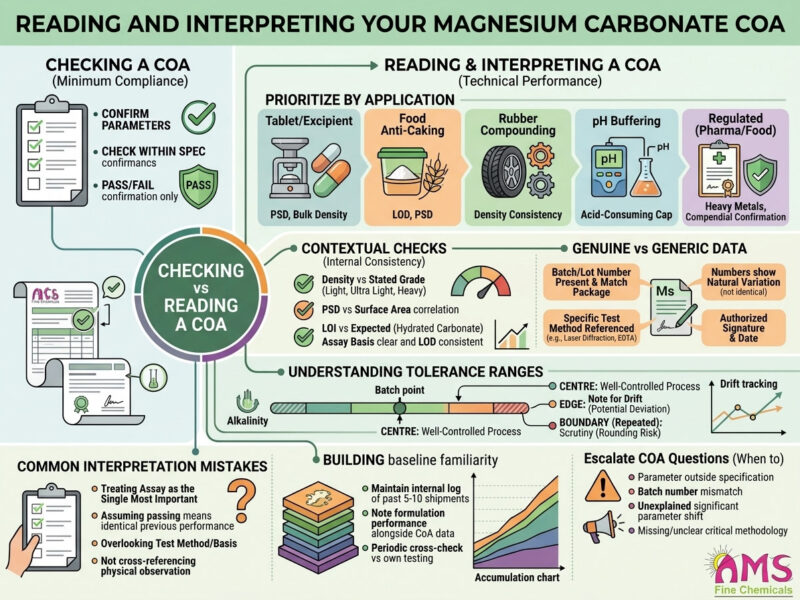
Reading a CoA properly is a five-step process, not a single glance at the bottom-line “Complies” statement:
- Match the batch number on the CoA to the batch number printed on the physical packaging — a mismatch invalidates the entire document.
- Confirm the specification reference named (USP, BP, IP, Food Chemicals Codex, or in-house spec) matches what your purchase order actually specified.
- Scan every parameter, not just the assay line — bulk density and particle size are the two most commonly overlooked figures, yet the two most likely to cause a formulation problem.
- Compare against the previous shipment’s CoA where possible. A sudden shift in any parameter — even one that technically still passes — can be an early warning of a supplier process change worth a phone call.
- Retain a sample from every incoming lot for a defined period, so any in-house confirmatory testing or later dispute resolution has physical material to test against.
Common Red Flags on a Supplier CoA
- A CoA with no batch number, or a batch number that doesn’t match the shipment
- Results reported without a named test method (e.g., “Assay: 42%” with no titration or gravimetric method referenced)
- A specification reference that’s vague or unnamed (“meets pharmaceutical standards”)
- Identical results across multiple different batches — a strong indicator of a copy-pasted, non-batch-specific document
- Missing particle size or bulk density data on a shipment intended for a particle-size-sensitive application
- No microbial data on food or pharmaceutical-grade material
How AMS Fine Chemicals Documents Every Batch
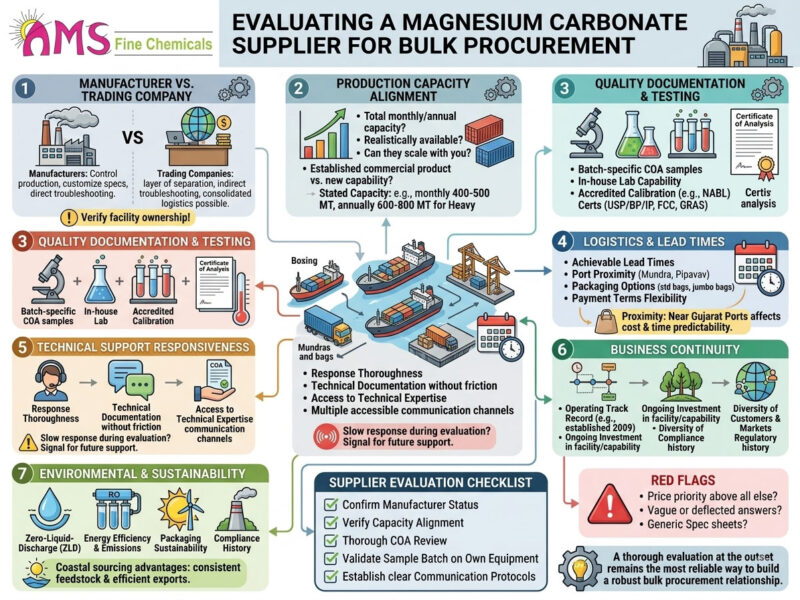
At AMS Fine Chemicals, our Bhavnagar facility runs every batch of Magnesium Carbonate — across Light, Ultra Light, and Heavy grades — through a defined in-house testing sequence before release, covering assay, loss on ignition, loss on drying, bulk density (loose and tapped), particle size distribution via laser diffraction, whiteness index, pH, heavy metals via ICP-OES, chloride and sulfate content, and microbial limits where applicable. Every Certificate of Analysis is issued against the buyer’s specified pharmacopoeial or in-house reference and is traceable to the exact production lot shipped.
We also support buyers with the broader documentation package international shipments typically require — Technical Data Sheets, Certificates of Origin, BSE/TSE-free declarations, and stability data — so quality and regulatory teams aren’t chasing paperwork after the material has already arrived. You can review full technical specifications for each grade on our Magnesium Carbonate, Light Magnesium Carbonate, Ultra Light Magnesium Carbonate, and Heavy Magnesium Carbonate product pages, or browse our complete range on the Products page. Our Magnesium Hydroxide and Magnesium Trisilicate lines follow the same batch-documentation standard, covered respectively in What Is Magnesium Hydroxide? Properties, Grades (Brucite, Precipitated), and Safety Advantages Over Caustic Soda and Magnesium Trisilicate Manufacturing Process.
Frequently Asked Questions
Is a higher assay percentage always better? Not necessarily. What matters is meeting the specification your application requires — an assay significantly above spec isn’t a problem in itself, but a CoA with unusually round or repeated figures across multiple shipments is worth double-checking for authenticity.
How often should I request confirmatory in-house testing rather than trusting the supplier CoA? For critical pharmaceutical or food applications, periodic confirmatory testing — even quarterly, on a sampling basis — is good practice regardless of how reliable a supplier has historically been. For less sensitive industrial applications, a documented, batch-traceable supplier CoA is generally sufficient with occasional spot checks.
What’s the difference between Loss on Ignition and Loss on Drying? Loss on Drying measures only free surface moisture at a relatively low temperature (around 105°C). Loss on Ignition measures total volatile loss at a much higher temperature (900–1000°C), including bound water and carbonate decomposition — the two tests answer different questions and both should appear on a complete CoA.
Can bulk density vary between batches of the same grade? Small batch-to-batch variation is normal and expected within the specification range. Large swings — particularly ones that push a batch toward a different product grade’s typical range — indicate a process control issue worth raising with the manufacturer.
Should I be concerned if the CoA doesn’t list a particle size distribution? For applications where texture, flowability, or dissolution matter — cosmetics, pharmaceuticals, food powders — yes, this is worth flagging. For some bulk industrial uses, particle size may be less critical, but it should still be available on request.
Final Word
A Certificate of Analysis is only useful if it’s read in full, batch by batch, parameter by parameter — not treated as a formality attached to the invoice. For Magnesium Carbonate specifically, the parameters that most often separate a smooth production run from an unexpected quality investigation are the ones buyers tend to skim past fastest: bulk density, particle size distribution, and loss on drying.
Building a habit of checking these figures against both your specification and your previous shipment’s data — rather than just scanning for the word “Complies” — is the simplest way to catch a process drift before it becomes a production problem.
To request a full Certificate of Analysis, Technical Data Sheet, or a sample of any Magnesium Carbonate grade, visit our Magnesium Carbonate product page or reach out through our Contact Us page.