Pick up two bottles of magnesium hydroxide suspension from two different manufacturers and you will often find they pour differently, settle differently and even feel different on the tongue. The active ingredient may be identical, the label claim the same, and yet the physical behaviour is not. In most cases the explanation sits in one parameter that rarely makes the front page of a specification sheet: particle size.
For formulators working with Light Magnesium Hydroxide, particle size is not a cosmetic detail. It decides how fast the solid drops out of suspension, how thick the product feels, how easily it re-mixes after storage, how quickly it neutralises acid and how smooth it is in the mouth. This guide explains how particle size shapes each of these outcomes, how to measure it properly and how to specify it so that your suspension performs consistently from batch to batch.
At AMS Fine Chemicals, a manufacturer and exporter of magnesium compounds based in Bhavnagar, Gujarat, India, particle size is one of the first questions our technical team discusses with suspension manufacturers. What follows is the practical thinking behind those conversations.
Why Particle Size Is the Quiet Variable in Suspension Design
A suspension is a system in which insoluble solid particles are dispersed in a liquid. Unlike a solution, nothing is dissolved. The product remains uniform only because of a balance between gravity, which pulls particles down, and the forces that keep them dispersed: viscosity, particle-particle interactions and the structure built by suspending agents.
Particle size influences every one of these forces. A change in size alters settling speed, surface area available for interaction, packing behaviour of the sediment and the way particles attract or repel each other. That is why a formulation that works well with one grade can behave very differently when a nominally similar grade with a different size distribution is substituted.
This matters commercially as well as technically. A suspension that settles too quickly, cakes at the bottom of the bottle or feels gritty will draw complaints, returns and regulatory questions regardless of how accurate the assay is.
Understanding Light Magnesium Hydroxide
Magnesium hydroxide, Mg(OH)₂, is a sparingly soluble alkaline compound. It is used as an antacid and laxative ingredient, as a controlled alkalinity source in industrial and environmental applications, and as a functional filler in several processes. You can read more about its gentle, self-limiting alkalinity in our article on why magnesium hydroxide provides controlled alkalinity compared with strong bases.
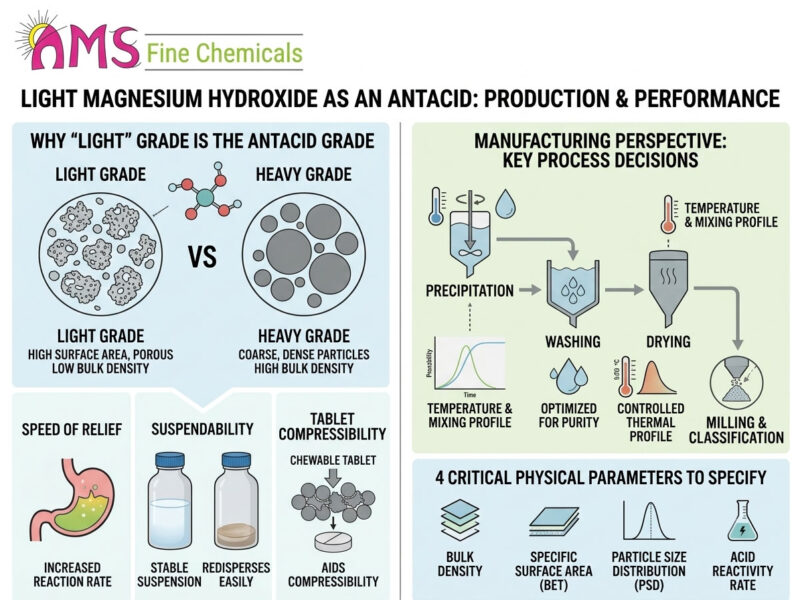
AMS Fine Chemicals offers three grades in this family: Magnesium Hydroxide, Light Magnesium Hydroxide and Heavy Magnesium Hydroxide. The light grade has a low bulk density, meaning the powder occupies a large volume for its weight. It is fluffy, wets and disperses readily and is the usual starting point for liquid and suspension applications. The heavy grade is denser and is typically chosen where handling, settling and throughput matter more, such as acidic effluent treatment.
Bulk density and particle size are related but not identical properties. Two powders can share the same particle size distribution and still differ in bulk density if one is more porous or more loosely aggregated than the other. Our guide on why bulk density matters in industrial processing explains this distinction in the context of magnesium carbonate, and the same principle applies here.
What “Particle Size” Actually Means
A powder does not contain particles of one size. It contains a distribution. When a certificate of analysis says “particle size”, it should really be reporting several numbers.
- d10: 10 percent of the particles by volume are smaller than this value. It describes the fine end.
- d50 (median): half the particles are smaller and half are larger. It is the most commonly quoted figure.
- d90: 90 percent of the particles are smaller than this value. It describes the coarse tail.
- Span: a measure of distribution width, usually calculated as (d90 minus d10) divided by d50. A low span means a narrow, uniform distribution.
For suspension performance, the d90 is often more informative than the d50. A small fraction of coarse particles can dominate sedimentation behaviour and mouthfeel while barely moving the median. Two grades with the same d50 but different d90 values can behave very differently in the bottle.
It is also important to separate primary particles from agglomerates. Magnesium hydroxide crystals tend to cluster. A laser diffraction result may describe agglomerates rather than the individual crystals, depending on how aggressively the sample was dispersed during measurement. In a real suspension, the effective particle size depends on how well the formulation and the processing break up or hold together those clusters. For a comparable discussion on another magnesium compound, see our article on magnesium carbonate particle size distribution and its impact on formulation.
How Particle Size Controls Sedimentation
The most direct effect of particle size is on settling. Stokes’ law describes the terminal settling velocity of a spherical particle in a liquid:
v = d² × (ρparticle − ρliquid) × g / (18 × η)
where d is particle diameter, ρ is density, g is gravitational acceleration and η is the viscosity of the continuous phase.
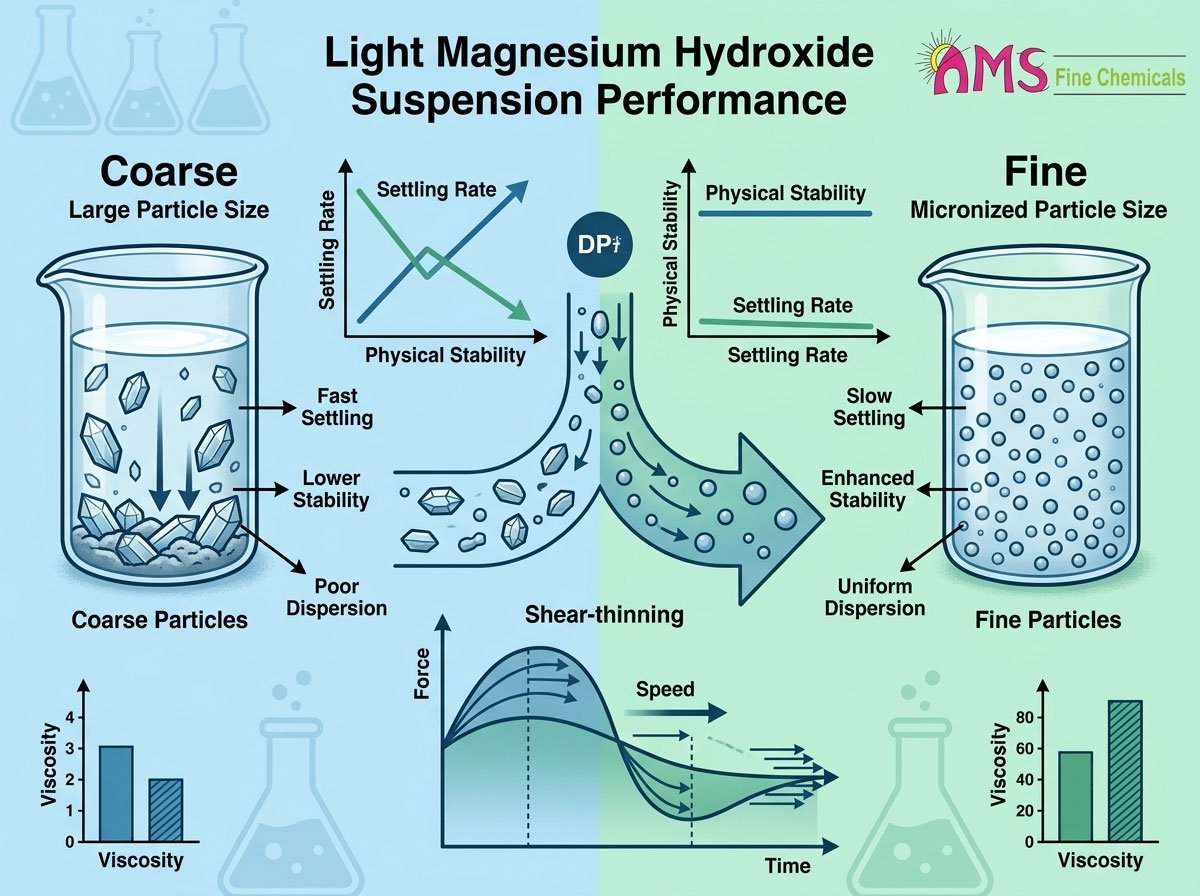
The key point is the square on the diameter. If particle diameter doubles, settling speed rises roughly fourfold. If it increases tenfold, settling is about a hundred times faster. The relationship also shows the two other levers a formulator has: raising the viscosity of the liquid and reducing the density difference between solid and liquid. Since magnesium hydroxide is considerably denser than water, viscosity and particle size are the practical tools.
This has several consequences:
- Finer grades stay suspended longer. For a given vehicle, a finer distribution slows settling and extends the time during which each dose is uniform.
- Coarse outliers matter. A tail of large particles settles first and forms a hard layer, even if the median is fine.
- Real suspensions deviate from Stokes’ law. At the solids loadings used in commercial products, particles hinder each other, and settling is slower than the single-particle equation predicts. The law still gives the correct direction and a useful sense of scale.
It is worth stating clearly that slow settling is not the same as a good suspension. Many successful products settle visibly but re-disperse with a gentle shake. What matters is that the sediment is loose, the supernatant is manageable and the product returns to uniformity quickly, which brings us to flocculation and redispersibility below.
Surface Area, Dissolution and Reaction Rate
Magnesium hydroxide is only slightly soluble in water, so its activity depends on how fast the solid surface dissolves and reacts. The Noyes-Whitney relationship states that dissolution rate is proportional to the surface area exposed to the liquid. Reducing particle size increases surface area dramatically: for the same mass, halving the particle diameter roughly doubles the surface area.
In practice this means a finer grade generally neutralises acid faster. For antacid and pH-control applications, that can be the difference between quick, effective response and a sluggish one. We cover this relationship in detail in our technical comparison of magnesium hydroxide particle size and reaction rate.
For acid-relief products, reactivity is only one part of the picture. Formulators must also consider the other active ingredients in the product and the tolerance of the patient. Our overview of magnesium trisilicate in acid-relief formulations discusses how different magnesium compounds complement each other.
There is a balance to strike. A much finer grade reacts faster but can be harder to wet, may thicken the suspension more and may require more careful dispersion. The best size is the one that meets reactivity, stability and processing needs together, not the smallest one available.
Viscosity and Rheology
Particle size strongly influences how a suspension flows. At a fixed solids concentration, finer particles provide more surface area, more particle-particle contact and more interaction with the liquid, and the suspension becomes thicker. Coarser particles produce a thinner, more mobile product.
Several rheological effects are worth knowing:
- Shear thinning. Well-structured suspensions often thin under shear, such as shaking or pouring, and recover viscosity at rest. This is desirable because it combines easy pouring with good suspension at rest.
- Yield stress. A weak internal network can hold particles in place and prevent settling. Fine particles, particularly in a flocculated state, contribute to this network.
- Solids loading. As concentration increases, the effect of particle size on viscosity grows rapidly. A grade that is comfortable at low loading can become difficult to pump or fill at high loading.
Suspending agents such as cellulose derivatives, xanthan gum, microcrystalline cellulose or clays are normally added to build structure, and their effect interacts with particle size. A formulation tuned for one particle size distribution may need adjustment if the size changes. This is a principal reason to treat particle size as a controlled specification rather than a loose descriptor. Additional guidance on the formulation side is available in our formulation guide to light magnesium hydroxide in oral suspension stability.
Flocculation, Deflocculation and Redispersibility
Classical suspension theory distinguishes two states.
In a deflocculated suspension, particles remain separate. Settling is slow because individual particles are small, but they eventually pack into a dense, compact sediment that can be very difficult to redisperse. This is the notorious problem known as caking.
In a flocculated suspension, particles form loose clusters held together by weak forces. The clusters settle faster, but the sediment is voluminous and fluffy, and a gentle shake restores uniformity. Many successful products are deliberately controlled flocculated systems.
Particle size interacts with both states. Very fine particles, with strong surface forces relative to their weight, are more prone to forming tight agglomerates or compact cakes if the surface chemistry is not managed. Very coarse particles settle fast and may pack densely under their own weight. A moderate, narrow distribution with controlled surface charge gives the best balance.
Surface charge is characterised by zeta potential, which depends on pH, ionic strength and the presence of dispersants or electrolytes. The formulator can adjust zeta potential to move the system toward controlled flocculation or toward stable dispersion. The point for buyers is that the particle size distribution of the incoming powder is the starting condition for all of this chemistry, and consistency in that starting point makes formulation far easier to control.
Mouthfeel, Taste and Patient Acceptability
For oral suspensions, particle size is felt directly. Particles above a certain size are perceived as grit, and a gritty product is less acceptable, especially for children and for products taken regularly. A tight distribution with a controlled d90 is the most reliable way to avoid this.
Finer particles also tend to give a smoother, creamier body. At the same time, they may increase perceived chalkiness for some patients, and flavouring and sweetening must be developed with the final texture in mind. Sensory evaluation should be part of formulation development, not an afterthought.
Physical Stability Over Shelf Life
Particle size can change after manufacture. The most common causes are:
- Agglomeration during storage, especially if the dispersion was marginal at the time of manufacture.
- Temperature cycling, which changes viscosity and can promote particle growth or sediment compaction.
- Ostwald ripening, the slow growth of larger particles at the expense of smaller ones through dissolution and redeposition. Because magnesium hydroxide is so sparingly soluble, this effect is usually minor compared with agglomeration, but it should still be considered in long-term stability studies.
- Microbial and chemical changes in the vehicle that alter viscosity and therefore settling.
A robust stability programme measures particle size, sedimentation volume, redispersibility, viscosity and pH at defined time points and storage conditions. A starting powder with a narrow, well-characterised distribution makes stability results more predictable and reproducible.
Manufacturing and Processing Effects
The particle size of the powder is not the only size that matters. What counts is the size in the finished suspension, which depends on processing.
- Wetting and dispersion. Light magnesium hydroxide has low bulk density and traps air, so powder addition rate and mixer design matter. Slow, steady addition into a vortex or through an eductor helps prevent lumps.
- High-shear mixing and homogenisation. Shear can break up soft agglomerates and reduce the effective particle size. It does not necessarily fracture primary crystals, so there is a limit to what processing can achieve.
- Wet milling. For demanding applications, wet milling can reduce size further, but it adds cost, heat and the risk of contamination, and can raise viscosity.
- Order of addition. Adding the suspending agent before or after the magnesium hydroxide changes the final structure. This should be fixed in the process and validated.
- Air incorporation. Excessive aeration produces foam and unstable density. Deaeration steps are often needed for light powders.
Because processing can only do so much, starting with a suitable particle size distribution is more reliable than trying to correct a mismatched grade in the plant.
Measuring Particle Size Correctly
Laser diffraction is the standard technique for powders in this range. It is fast and reproducible, but it is sensitive to method details. Results can vary between laboratories if the method is not defined.
Key points for a reliable method:
- Dispersion medium. Specify whether measurement is in water or another liquid, and whether a dispersant is used.
- Sonication. State whether ultrasound is applied, for how long and at what power. Sonication can break agglomerates and change results significantly.
- Stirring and pump speed. These affect both dispersion and the risk of particle breakage.
- Optical model. Refractive index and absorption settings should be recorded.
- Reporting. Report d10, d50 and d90, and ideally the span, not just the median.
Laser diffraction can be complemented by microscopy to confirm shape and degree of agglomeration, and by sedimentation or rheology tests that measure what actually matters to performance. A result is only useful for comparison if the method is the same, which is why the method should be written into the purchase specification.
Other certificate of analysis parameters also provide context. Our article on Magnesium Carbonate COA parameters that buyers should check explains how to read a COA critically, and the same discipline applies to magnesium hydroxide: look at particle size, bulk density, moisture and impurity data together, not in isolation.
Particle Size in Applications Beyond Oral Suspensions
The same principles apply wherever magnesium hydroxide is handled as a slurry.
- Pharmaceutical and nutraceutical liquids: stability, dose uniformity and palatability depend on size.
- Water and effluent treatment: slurry pumpability, feed accuracy and neutralisation rate depend on size and solids loading. Heavier grades are often favoured here, as described in our acidic effluent treatment guide.
- Industrial processes: controlled alkalinity and pH buffering benefit from predictable dissolution behaviour.
You can explore how our magnesium compounds fit different sectors on our Application and Industries We Serve pages.
A Practical Guide to Specifying Particle Size
Buyers frequently order by grade name alone. A better approach is to define the requirement in terms of the parameters that actually drive performance.
| Parameter | What to specify |
|---|---|
| d50 | Target value and acceptable range |
| d90 | Maximum value, to control grit and settling |
| d10 / span | Optional, to control the fine fraction and width |
| Bulk density | Loose and tapped values for the light grade |
| Test method | Dispersion medium, sonication and instrument settings |
| Batch reporting | Particle size data on every batch COA |
The suitable target depends on the product. Suspension manufacturers should determine it through development work, balancing sedimentation, viscosity, reactivity and sensory results. A supplier can recommend a starting point, but the final specification should be confirmed against your own process and regulatory requirements.
Troubleshooting Common Problems
The suspension settles too quickly. Check d90 and the coarse fraction. Consider a finer grade, higher viscosity from the suspending system or better dispersion at the manufacturing stage.
The sediment becomes hard and cannot be redispersed. This points to caking in a deflocculated system. Review electrolyte and surface-active additives to introduce controlled flocculation, and check for excess fines.
The product is too thick to pour or fill. Fine particle content or solids loading may be too high. Evaluate a coarser grade, adjust the suspending agent level or reduce solids.
The product feels gritty. Examine the coarse tail. A reduced d90, better dispersion or wet milling may be required.
Batch-to-batch variation in behaviour. Compare particle size distribution, bulk density and moisture between batches. Confirm that the measurement method is consistent. Tighter incoming specifications usually solve this at source.
Foaming or air entrapment during mixing. Light powders carry a lot of air. Adjust addition method and add a deaeration step.
How AMS Fine Chemicals Supports Suspension Manufacturers
AMS Fine Chemicals manufactures magnesium compounds at our facility in Bhavnagar, Gujarat, with consistent process control and batch-wise quality testing. For magnesium hydroxide customers, our team can discuss grade selection, share technical data, supply samples for trials and review how particle size and bulk density should be specified for your application.
We also supply Magnesium Carbonate and Magnesium Trisilicate, which are used alongside magnesium hydroxide in several formulations. The complete range is available on our Products page. For more reading on this family of materials, browse our Light Magnesium Hydroxide articles and Magnesium Hydroxide articles.
Frequently Asked Questions
Does a smaller particle size always give a better suspension? No. Smaller particles settle more slowly and react faster, but they can raise viscosity, resist wetting and form hard cakes if the system is poorly designed. The goal is a controlled, narrow distribution that matches the formulation.
Which matters more, d50 or d90? Both are useful, but d90 is often more informative for grit, settling and sediment behaviour, because it describes the coarse fraction that dominates those effects.
Why is light magnesium hydroxide used for suspensions? Its low bulk density and ease of dispersion make it convenient to wet and mix into liquid systems. The final performance still depends on particle size distribution and formulation design.
Can processing fix a grade with the wrong particle size? Partly. High-shear mixing can break soft agglomerates and wet milling can reduce size further, but these steps add cost and complexity. Selecting a suitable grade at the start is more reliable.
How should particle size be tested? By laser diffraction with a clearly defined method, covering dispersion medium, sonication, stirring speed and optical settings. Report d10, d50, d90 and span.
Can I request custom specifications? Yes. Contact our team through the Contact Us page to discuss your requirements. Suitability for any application should always be confirmed against your own process and regulatory requirements.
Final Word
Particle size is one of the few parameters that influences nearly every measurable property of a magnesium hydroxide suspension: settling, viscosity, redispersibility, reactivity, texture and shelf-life stability. Treating it as a vague descriptor invites batch-to-batch variation and troubleshooting after the fact. Treating it as a defined, measured and agreed specification, with d50, d90, bulk density and a standard test method, makes suspension performance far more predictable.
To request technical data, samples or a certificate of analysis for Light Magnesium Hydroxide, visit the product page or reach out through our Contact Us page. AMS Fine Chemicals will be glad to help you choose the right grade for your process.