“Magnesium Carbonate” is often treated as a single commodity on a purchase order, but anyone running it through an actual production line knows better. The grade that arrives determines whether a hopper empties cleanly or bridges at 2 a.m., whether a screw feeder doses within tolerance or drifts batch to batch, and whether a mixing line runs dust-free or needs constant housekeeping. Among the three primary physical grades manufactured at AMS Fine Chemicals — Light, Ultra Light, and Heavy — it is Heavy Magnesium Carbonate that consistently earns its place in processes where flow behavior, not surface area, is the deciding factor.
This guide looks specifically at why Heavy Magnesium Carbonate behaves the way it does on a production line, the physical mechanisms behind that behavior, and how to specify and validate it for flow-critical manufacturing processes.
What Is Heavy Magnesium Carbonate?
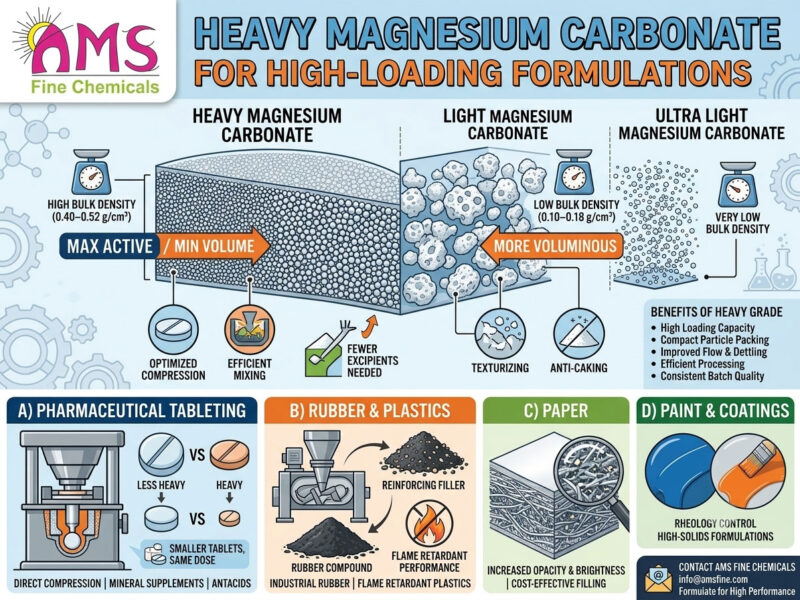
Heavy Magnesium Carbonate is the higher bulk density member of the Magnesium Carbonate family, typically sitting in the 0.40–0.50 g/cm³ range — several times denser than Light Magnesium Carbonate (roughly 0.10–0.15 g/cm³) or Ultra Light Magnesium Carbonate, which pushes density even lower. The underlying chemistry — basic magnesium carbonate hydrate — is broadly the same across all three grades. What differs is how the precipitation, boiling, and drying stages are controlled during manufacturing, which determines the final particle structure, porosity, and packing behavior of the powder.
We’ve covered how these grades perform in high-loading formulations in a previous post, Heavy Magnesium Carbonate for High-Loading Formulations, and how grade selection works as a broader framework in How to Select the Right Magnesium Carbonate Grade for Your Manufacturing Process. This piece goes deeper into one specific dimension of that selection framework: powder flow.
Why Powder Flow Is a Processing Variable, Not a Formulation Afterthought
Flowability determines how a powder behaves in every stage between the storage silo and the finished product — discharge from hoppers, movement through screw feeders and conveyors, dispersion into a mixer, and consistent dosing into a compound. A powder that flows poorly doesn’t just slow production down; it introduces variability that shows up downstream as inconsistent loading, uneven dispersion, or inaccurate dosing, none of which are easy to trace back to the raw material once they’ve already affected a finished batch.
A handful of physical measures describe flow behavior:
- Bulk density (loose and tapped) — how much the powder compacts under its own weight or light vibration
- Hausner ratio and Carr Index — derived from loose vs. tapped density, used as a standard shorthand for flowability
- Angle of repose — the angle a poured pile of powder naturally forms; lower angles generally indicate freer flow
- Particle size distribution — finer particles increase interparticle friction and cohesion, coarser particles generally flow more freely
- Moisture content and hygroscopicity — surface moisture increases cohesion and can cause caking or bridging in storage
These properties interact, which is why a single number like bulk density, taken in isolation, doesn’t fully predict flow performance — but taken together, they explain why Heavy Magnesium Carbonate behaves so differently from the finer, high-surface-area grades in the same family.
The Mechanism: Why Heavy Grade Flows the Way It Does
Lower Surface Area, Lower Cohesion
Light and Ultra Light Magnesium Carbonate are engineered specifically for high surface area and porosity — that’s what makes them effective as absorbents, glidants, and anti-caking agents, as we discussed in Light Magnesium Carbonate for Improving Powder Flow and Handling and Ultra Light Magnesium Carbonate: Understanding Its High Surface Area. But high surface area comes with a trade-off: more particle-to-particle contact area means more Van der Waals attraction, more static cohesion, and a stronger tendency toward bridging and caking under compression.
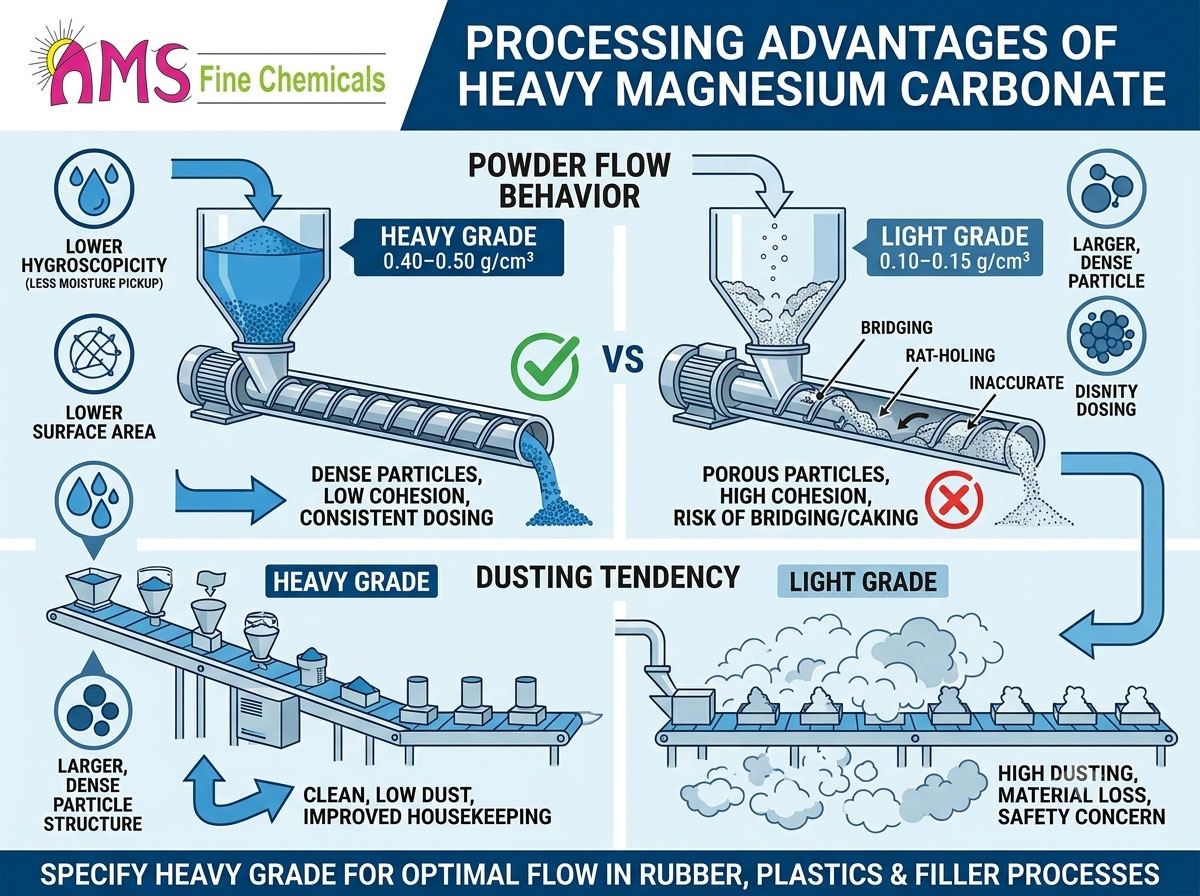
Heavy Magnesium Carbonate’s denser particle structure has proportionally less surface area per unit mass. That translates directly into weaker interparticle cohesive forces — the powder resists forming the kind of cohesive arches that cause bridging in hoppers or clumping in storage bags.
Larger, More Uniform Particle Structure
The precipitation conditions used to produce Heavy grade tend to yield a denser, more granular particle structure compared to the fine, flocculated structure of Light and Ultra Light grades. Larger, denser particles pack more efficiently and slide past one another with less resistance, which is reflected in a lower angle of repose and a more favorable Hausner ratio.
Reduced Air Entrainment
Fine, low-density powders trap significant air within their porous structure, which can cause fluidization, dusting, or inconsistent volumetric measurement during handling. Heavy Magnesium Carbonate’s denser structure entrains far less air, which contributes to more predictable, repeatable volumetric behavior — a point that matters enormously for volumetric dosing equipment discussed further below.
Lower Hygroscopicity
Because Light and Ultra Light grades have such high surface area, they’re inherently more prone to picking up atmospheric moisture, which further increases cohesion and caking risk over time in storage. Heavy Magnesium Carbonate’s lower surface area makes it comparatively less hygroscopic, which helps it maintain consistent flow characteristics over longer storage periods, particularly in humid manufacturing environments.
Where This Processing Advantage Actually Shows Up
Hopper and Silo Discharge
Bridging and rat-holing — where powder forms a stable arch or a narrow discharge channel instead of flowing uniformly — are among the most common and expensive flow failures in bulk powder handling. They cause inconsistent discharge rates, require manual intervention (vibration, rodding, or mechanical agitation), and in worst cases halt a line entirely. Heavy Magnesium Carbonate’s lower cohesion and favorable angle of repose make it substantially less prone to these failure modes compared to finer grades, particularly in mass-flow hopper designs where consistent, gravity-driven discharge is the goal.
Screw Feeding and Conveying
Screw feeders rely on a powder occupying a predictable, consistent volume per screw rotation. A powder that entrains air or compresses unpredictably under the screw’s action will dose inconsistently even when the equipment itself is functioning correctly. Heavy grade’s denser, less-aerated structure supports more consistent volumetric throughput, reducing the dosing drift that’s a common (and frequently misdiagnosed) cause of formulation inconsistency.
Volumetric and Gravimetric Dosing Equipment
This is one of the most underweighted points in grade switching: dosing equipment — whether volumetric augers or gravimetric loss-in-weight feeders — is typically calibrated around the bulk density of the material it was set up for. Switch from a Light grade to a Heavy grade (or vice versa) without recalibrating, and the equipment will systematically over- or under-dose by weight, even though the volumetric setting hasn’t changed. This is a frequent, avoidable source of “supplier quality issues” that are actually calibration issues.
Mixing and Dispersion
In rubber compounding, plastics, and industrial filler applications — the primary markets for Heavy Magnesium Carbonate — the powder needs to disperse into a batch (rubber compound, polymer melt, or liquid system) efficiently without excessive mixing time or energy input. A free-flowing powder feeds into internal mixers or Banbury-type equipment more evenly, reducing the localized clumping that can create weak points or inconsistent reinforcement distribution in the finished compound.
Reduced Dusting and Improved Housekeeping
Finer, more porous powders generate significantly more airborne dust during transfer and mixing — a housekeeping, safety, and material-loss concern in equipment rooms. Heavy grade’s coarser, denser particle structure produces markedly less dust during handling, which translates into cleaner work environments, reduced material loss to dust collection systems, and lower operator exposure during manual handling and charging operations.
Heavy Magnesium Carbonate vs. Light and Ultra Light: A Flow-Focused Comparison
| Property | Heavy Grade | Light Grade | Ultra Light Grade |
|---|---|---|---|
| Bulk density | ~0.40–0.50 g/cm³ | ~0.10–0.15 g/cm³ | Lower than Light |
| Surface area | Low | High | Highest |
| Angle of repose | Lower (freer flow) | Higher (more cohesive) | Highest (most cohesive) |
| Dusting tendency | Low | Moderate–high | Highest |
| Hygroscopicity | Lower | Higher | Highest |
| Best suited for | Rubber compounding, industrial fillers, bulk handling-critical processes | Pharma excipients, cosmetic powders, food anti-caking | Maximum-absorbency applications |
The takeaway isn’t that Heavy grade is universally “better” — it’s that flow-critical, high-volume processes where bulk handling efficiency matters more than absorbency or surface area consistently favor Heavy grade, while absorbency-driven applications favor the opposite end of the density spectrum. This is exactly the property-first selection logic we laid out in the grade selection guide — start with what the process needs the powder to do, not with the grade name.
Industries Where This Advantage Matters Most
Rubber Compounding
Heavy Magnesium Carbonate is a long-standing choice in rubber compounding, where it needs to disperse evenly through a compound during mixing without contributing excessive volume or introducing air. Consistent bulk density supports accurate volumetric dosing across production runs, and low dusting improves conditions on mixing room floors where multiple filler additions happen per batch.
Industrial Filler and Plastics Applications
In plastics compounding, cable and wire insulation compounds, and general industrial filler use, Heavy grade’s flow characteristics support smoother integration into extrusion and compounding lines, where feed consistency directly affects the uniformity of the finished product. Explore the technical specifications on our Magnesium Carbonate and Heavy Magnesium Carbonate product pages, or browse use cases on our Application page.
Adhesives, Sealants, and Coatings
Formulators working with paste and liquid systems benefit from a filler that disperses without introducing excessive air or requiring extended high-shear mixing to break up cohesive clumps — another area where Heavy grade’s lower cohesion translates into a real processing time and energy advantage.
Bulk Chemical Handling and Storage
Any operation storing and transferring Magnesium Carbonate at scale — regardless of end application — benefits from Heavy grade’s reduced tendency to bridge in silos, cake during long storage periods, or generate excessive dust during pneumatic or mechanical conveying.
How to Specify and Verify Flow Performance
A supplier quoting only an assay percentage and a general “Heavy grade” description hasn’t given a procurement or process engineering team enough information to validate flow performance for a specific line. A complete specification should include:
- Loose and tapped bulk density — the foundation for calculating Hausner ratio and Carr Index
- Particle size distribution (D10, D50, D90) — coarser, more uniform distributions generally support better flow, but excessive fines content within an otherwise Heavy-grade batch can undermine flow performance
- Angle of repose data, where available, as a direct flow indicator
- Moisture content, since even Heavy grade can pick up handling-relevant moisture in humid storage conditions
- Batch-specific Certificate of Analysis, not a general “typical values” sheet — as we explained in Magnesium Carbonate COA Explained: Important Parameters Buyers Should Check, typical values represent an average across historical batches, not a guarantee for the lot you’re actually running
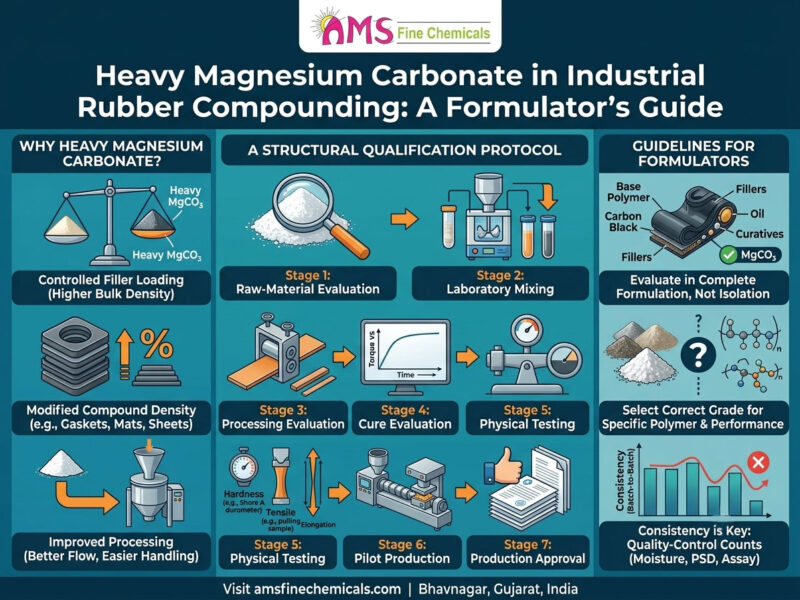
The most reliable validation step remains a pilot-scale trial: run a representative sample through your actual hopper, feeder, and mixing equipment before committing to full-scale procurement, particularly when switching suppliers or when a process is known to be flow-sensitive.
Storage and Handling Considerations
Heavy Magnesium Carbonate’s flow advantage holds up well under storage, but a few practical safeguards help maintain it over time:
- Dry warehousing — while less hygroscopic than Light or Ultra Light grades, Heavy grade still benefits from storage below roughly 30°C in low-humidity conditions to prevent any moisture-driven increase in cohesion
- First-in, first-out rotation — minimizes the risk of long-stored material picking up ambient moisture through repeated container opening and resealing
- Sealed packaging during transit — particularly relevant for humid coastal shipping routes, where even a comparatively low-hygroscopicity material can pick up moisture over an extended sea-freight transit
- Minimizing repeated handling and transfer — every transfer point is an opportunity for compaction or moisture pickup; streamlined material flow from receiving to point-of-use preserves flow characteristics longest
Common Mistakes When Switching to (or from) Heavy Grade
- Assuming a “denser is always better for flow” rule applies to every process. Flow performance is process-specific — a formulation that depends on Light grade’s absorbency won’t benefit from a switch to Heavy grade, and will likely underperform functionally even if it flows better.
- Not recalibrating volumetric dosing equipment. This is the single most common operational issue when switching bulk density between grades, and it’s often misattributed to a supplier quality problem.
- Relying on typical values instead of batch-specific data. Flowability can vary somewhat batch to batch even within a nominal “Heavy grade” specification if particle size distribution isn’t tightly controlled — always validate against the actual CoA.
- Overlooking fines content. A Heavy-grade batch with an elevated fraction of fine particles can flow noticeably worse than the nominal bulk density would suggest — this is exactly why particle size distribution data matters alongside bulk density.
- Skipping a pilot trial when switching suppliers. Bulk density and flow behavior can differ meaningfully between manufacturers even when both are nominally selling “Heavy Magnesium Carbonate,” due to differences in precipitation and drying process control.
How AMS Fine Chemicals Supports Flow-Critical Sourcing
AMS Fine Chemicals manufactures Heavy Magnesium Carbonate from our Bhavnagar, Gujarat facility with controlled bulk density targets specifically for rubber, plastics, and industrial filler applications where flow performance is a production-critical requirement. Every batch is tested in-house for bulk density, particle size distribution via laser diffraction, assay, and moisture content before release, giving procurement and process engineering teams the batch-specific data needed to validate flow performance ahead of scale-up.
If your process is currently working around a flow-related bottleneck — bridging hoppers, inconsistent dosing, excessive dusting — our technical team can help assess whether a grade adjustment addresses the root cause. Explore the full specification sheet on our Heavy Magnesium Carbonate product page, compare it against Light Magnesium Carbonate and Ultra Light Magnesium Carbonate on our Products page, or browse related posts in our Heavy Magnesium Carbonate and Magnesium Carbonate blog categories. For industry-specific applications, visit our Industries We Serve page, or reach out directly through Contact Us to request a sample batch or technical consultation.
Frequently Asked Questions
Does higher bulk density always mean better powder flow?
Generally, yes for cohesion-driven flow problems — denser, larger particles with lower surface area tend to flow more freely because they generate less interparticle cohesive force. But flow also depends on particle size distribution and moisture content, so bulk density alone isn’t a complete predictor.
Can Heavy Magnesium Carbonate replace Light grade in a formulation that’s having flow problems?
Not without revalidation. If the formulation depends on Light grade’s absorbency or surface-area-driven function (as an anti-caking agent or moisture scavenger, for example), switching to Heavy grade will likely compromise that function even while improving raw flow characteristics. Flow problems in a Light-grade-dependent process are usually better solved through particle size optimization or anti-caking additives than through a grade switch.
Why does my dosing equipment under- or over-dose after switching Magnesium Carbonate suppliers?
This is almost always a bulk density calibration issue. Volumetric dosing equipment is calibrated to a specific bulk density; if the new supplier’s material has a different bulk density than the equipment was set up for — even within the same nominal grade — dosing by weight will drift until the equipment is recalibrated.
How do I test powder flow before committing to a full production order?
Request loose and tapped bulk density, particle size distribution, and (where available) angle of repose data from the supplier, then run a representative sample batch through your actual hopper, feeder, and mixing equipment rather than relying on lab-scale flow measurements alone.
Is Heavy Magnesium Carbonate suitable for pharmaceutical or food applications?
It can be, depending on the specific application and required certification, but Heavy grade’s low surface area makes it a poor fit for absorbency-driven pharma and food functions like glidant or anti-caking use — those applications are generally better served by Light or Ultra Light grade, as discussed in the grade selection guide.
Final Word
Powder flow isn’t a secondary characteristic that shows up as an occasional operational nuisance — for high-volume rubber, plastics, and industrial filler processes, it’s a direct driver of throughput, dosing accuracy, and finished product consistency. Heavy Magnesium Carbonate’s lower surface area, denser particle structure, and reduced hygroscopicity give it a real, measurable processing advantage in exactly these flow-critical environments, distinct from the absorbency-focused role that Light and Ultra Light grades play elsewhere in the same product family.
Getting the grade right — and backing that decision with batch-specific bulk density and particle size data rather than nominal grade names alone — remains the simplest way to avoid the bridging, dosing drift, and dusting issues that quietly erode throughput on otherwise well-run production lines.