Walk into any personal care aisle and you’ll find dozens of deodorant sticks, roll-ons, and body powders promising “24-hour freshness” or an “ultra-dry, silky finish.” Behind almost every one of these claims sits a functional powder ingredient doing the quiet, unglamorous work of absorbing moisture, neutralizing odor-causing compounds, and keeping the formulation feeling light rather than pasty on the skin. For a growing number of cosmetic chemists, that ingredient is Light Magnesium Carbonate.
At AMS Fine Chemicals, based in Bhavnagar, Gujarat, we manufacture Light Magnesium Carbonate for exactly this kind of application — where particle architecture, absorption capacity, and skin-feel matter as much as chemical purity. This article looks at why Light Magnesium Carbonate has become a go-to functional powder in deodorant and body powder formulations, how it performs against alternatives like talc and starch, and what formulators should know before specifying it in a new product.
1. Why Deodorants and Body Powders Need a Functional Powder at All
Sweat itself is nearly odorless. The smell most people associate with body odor is actually produced when skin-surface bacteria metabolize compounds in sweat — particularly around the underarms, where apocrine glands secrete a protein- and lipid-rich fluid that bacteria feed on readily.
This means an effective deodorant or body powder formulation has to do at least one, and ideally several, of the following:
- Absorb moisture so the skin surface stays dry, giving bacteria less to work with
- Absorb oils and lipids that also feed bacterial growth
- Provide a smooth, non-greasy after-feel so the product doesn’t feel heavy or tacky
- Carry and stabilize fragrance so scent doesn’t degrade or separate over time
- Resist caking in stick and pressed-powder formats
Traditional formulations have leaned on ingredients like talc, cornstarch, and aluminum-based actives to achieve this. But rising consumer demand for aluminum-free and talc-free formulations has pushed formulators toward mineral alternatives — and this is where Light Magnesium Carbonate earns its place in the formula.
2. What Makes Light Magnesium Carbonate Different
Magnesium carbonate itself is a simple inorganic salt (MgCO₃), but — much like magnesium hydroxide — its performance in a formulation depends heavily on its physical form rather than its chemistry alone. AMS Fine Chemicals produces magnesium carbonate across multiple density grades, including Heavy Magnesium Carbonate, Light Magnesium Carbonate, and Ultra Light Magnesium Carbonate, and each behaves differently once it’s inside a formulation.
Light Magnesium Carbonate is produced through a controlled precipitation process that builds a porous, low-density particle structure. As we’ve explained in more depth in our post on how surface area influences Light Magnesium Carbonate performance, this porosity is the entire point: it’s what gives the powder its exceptional capacity to absorb liquids relative to its own weight.
Key physical characteristics relevant to personal care use:
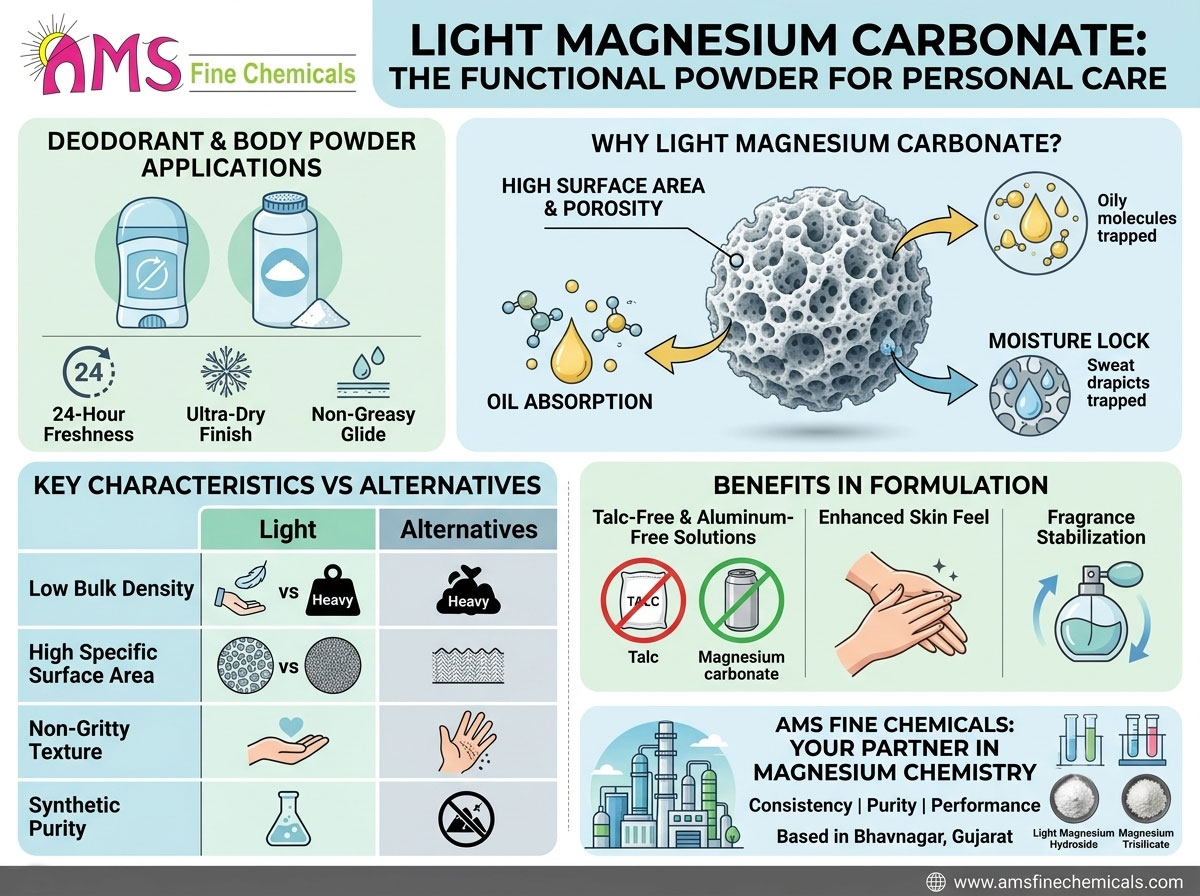
- Low bulk density — a light, voluminous powder that doesn’t feel heavy or compacted on skin
- High specific surface area — more internal and external surface for oil and moisture molecules to bind to
- Fine, soft particle texture — non-gritty, non-abrasive feel against skin
- Bright white color and high opacity — cosmetically desirable in pressed powders and stick formulations
- Chemically inert and non-reactive with most fragrance oils and common excipients
These properties are also why Light Magnesium Carbonate performs so well as a functional excipient more broadly across pharmaceutical and industrial powder systems — the same porosity that helps a tablet excipient bind and flow correctly is what helps a deodorant powder absorb sweat and oil.
3. The Oil and Moisture Absorption Mechanism
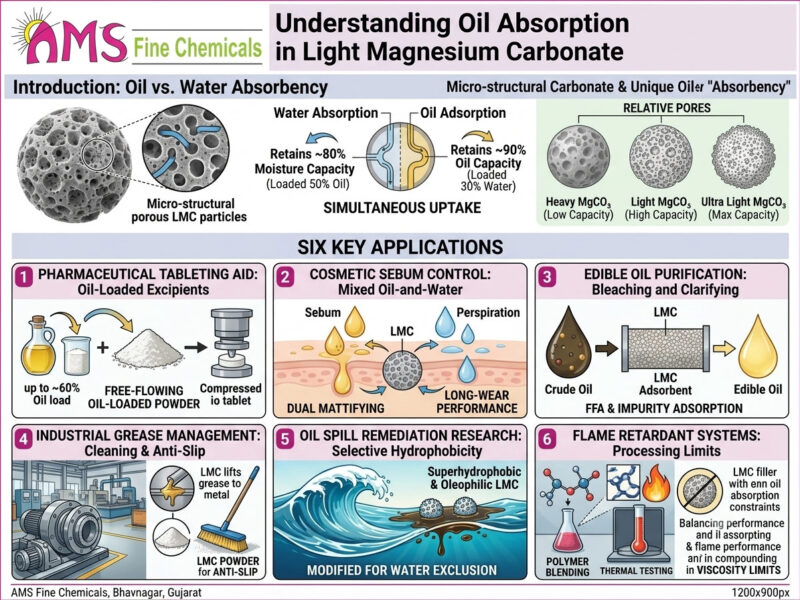
Understanding why Light Magnesium Carbonate absorbs so effectively requires looking at its particle structure rather than just its chemical formula. As we detailed in our dedicated post on Light Magnesium Carbonate for oil absorption, the mechanism comes down to capillary action and surface adsorption operating at a microscopic scale.
Each particle of Light Magnesium Carbonate is not a smooth, solid sphere — it’s a loosely aggregated, porous structure riddled with tiny internal channels and surface irregularities. When this powder comes into contact with a liquid — whether that liquid is underarm perspiration, sebum, or a fragrance oil — three things happen simultaneously:
- Surface adsorption: Liquid molecules adhere to the enormous internal and external surface area of the particle.
- Capillary wicking: Liquid is drawn into the porous channels between and within particles, much like water climbing a paper towel.
- Physical entrapment: Once inside the porous structure, the liquid is held in place rather than migrating back to the skin surface or fabric.
For a deodorant or body powder, this translates into a product that keeps the skin surface feeling dry for longer, because the moisture and oils that would otherwise sit on the skin (feeding bacteria and causing that damp, uncomfortable feeling) are instead locked into the powder structure.
Because Standard and Heavy Magnesium Carbonate grades have a denser, less porous structure, they simply don’t have the same absorption capacity per gram — which is exactly why Light grade, not Heavy grade, is the one formulators reach for in personal care applications.
4. Light Magnesium Carbonate in Deodorant Formulations
A. As a Moisture and Odor Control Agent
In powder-based and stick deodorants, Light Magnesium Carbonate is typically incorporated at low-to-moderate loading levels to absorb underarm moisture throughout the day. Because it’s inert and doesn’t interfere with fragrance chemistry, it pairs well with commonly used odor-neutralizing actives such as sodium bicarbonate, zinc ricinoleate, or various essential oil blends.
B. As an Alternative in Aluminum-Free Formulations
A significant portion of today’s deodorant market is shifting toward aluminum-free formulas, driven by consumer preference rather than any resolved safety concern with aluminum salts. In these formulations, the antiperspirant mechanism (blocking sweat glands) is removed entirely, which puts more pressure on the deodorant mechanism — odor control through absorption and antibacterial action. Light Magnesium Carbonate becomes more important in these formulas precisely because it has to do more of the moisture-management work that aluminum salts previously handled.
C. Texture and Application Feel
In roll-on and stick formats, formulators also use Light Magnesium Carbonate to fine-tune the glide and after-feel of the product. Its low density and fine particle size prevent the chalky, heavy sensation that can occur with coarser mineral fillers, giving the finished product a smoother, more “invisible” application.
5. Light Magnesium Carbonate in Body Powder Formulations
A. A Functional, Talc-Free Alternative
Talc has faced increasing scrutiny in the personal care industry over the past decade, largely due to contamination concerns (specifically the risk of asbestos co-mineralization in poorly sourced talc deposits) and evolving consumer preference for mineral transparency. This has created strong demand for talc-free body powders — and Light Magnesium Carbonate is one of the mineral fillers formulators use to help fill that gap.
Unlike talc, magnesium carbonate does not carry the same geological contamination risk profile, and its synthetic precipitation process (rather than mined extraction) gives manufacturers like AMS Fine Chemicals tighter control over purity and consistency.
B. Moisture Absorption for All-Day Comfort
In body powders applied after bathing or before physical activity, the same absorption mechanism described above helps the powder pull moisture away from the skin surface, reducing chafing and that “sticky” feeling in humid climates. This makes Light Magnesium Carbonate particularly relevant for body powders marketed for hot-climate use, sports/athletic applications, and baby-adjacent (though not baby-specific medical) powder products.
C. Skin Feel and Sensory Properties
Because Light Magnesium Carbonate is soft, non-gritty, and non-abrasive, it contributes a silky, non-tacky after-feel rather than the slightly “sticky-dry” sensation some starch-based powders can leave behind, especially in humid conditions where starches can partially gel.
D. Opacity and Whiteness in Pressed and Loose Powders
Its high whiteness index and light-scattering properties also make Light Magnesium Carbonate cosmetically useful as a mild opacifying and bulking agent in pressed and loose body powder formats, helping maintain a consistent, clean white appearance in the finished product.
6. Light Magnesium Carbonate vs Other Common Body Powder Fillers
Formulators rarely choose a filler in isolation — the decision usually comes down to how Light Magnesium Carbonate compares against the other absorbent powders already sitting in the lab. Here’s a general comparison across the fillers most commonly considered for deodorant and body powder work:
| Filler | Absorption Capacity | Skin Feel | Sourcing Risk | Common Concern |
|---|---|---|---|---|
| Light Magnesium Carbonate | High (porous structure) | Silky, non-gritty | Low (synthetic precipitation) | Can adsorb fragrance oils if not accounted for |
| Talc | Moderate | Smooth, slightly slippery | Higher (mined; asbestos co-mineralization risk if poorly sourced) | Regulatory and consumer scrutiny |
| Cornstarch | Moderate-High | Soft initially, can feel tacky when wet | Low | Can support microbial/fungal growth in humid conditions; may gel with moisture |
| Zinc Oxide | Low-Moderate (primarily a skin protectant, not an absorbent) | Slightly chalky | Low | Higher cost; used more for skin-soothing than pure moisture control |
| Silica | High | Very light, matte | Low | Higher cost at cosmetic-grade purity; some grades raise inhalation concerns |
None of these fillers is a strict “best” choice across every formulation — most commercial deodorant and body powder products actually use a blend of two or more, balancing absorption, cost, and sensory profile. Light Magnesium Carbonate tends to earn its place in these blends specifically where formulators need strong oil/moisture uptake without sacrificing the smooth, non-gritty skin feel that talc traditionally provided.
7. Sourcing and Sustainability Considerations
Beyond performance, procurement teams are increasingly asking sourcing questions before finalizing a personal care filler — particularly for brands marketing “clean” or “mineral-based” formulations. Because Light Magnesium Carbonate from AMS Fine Chemicals is produced through controlled precipitation rather than open-pit mining, it avoids several of the sourcing complications associated with mined mineral fillers like talc, including inconsistent ore quality, geographic supply-chain risk, and the added cost of asbestos-screening protocols required for talc-based supply chains.
This also gives brands a more straightforward sourcing story to communicate to consumers and regulators alike: a synthetically manufactured, batch-tested mineral ingredient with a documented purity profile, rather than a mined material whose composition can vary by deposit.
8. Formulation Considerations: Getting the Loading Level Right
Formulators evaluating Light Magnesium Carbonate for a deodorant or body powder project typically need to balance a few variables:
| Consideration | Why It Matters |
|---|---|
| Particle size (D50) | Finer particles increase surface area and absorption but can reduce flowability without a glidant |
| Loading percentage | Too little reduces absorption benefit; too much can affect texture, compressibility (in pressed powders), or stick hardness |
| Compatibility with fragrance oils | Light Magnesium Carbonate is chemically inert but its high surface area means it can also adsorb fragrance oils, which may require reformulating fragrance load |
| Combination with other fillers | Often blended with starches, silica, or zinc oxide to balance cost, absorption, and skin feel |
| Processing method | Fine, low-density powders can generate more airborne dust during mixing, requiring appropriate handling and dust control during manufacturing |
Because Light Magnesium Carbonate’s performance is so closely tied to its exact particle size distribution and bulk density, working with a supplier who can hold tight, batch-to-batch consistency on these parameters — rather than just meeting a chemical purity spec — is critical for formulation stability at scale.
9. Choosing Between Light, Ultra Light, and Heavy Grades
Not every personal care application calls for the same grade. As we explored in What Makes Ultra Light Magnesium Carbonate Different From Conventional Light Grade?, the “Ultra Light” designation pushes bulk density even lower and surface area even higher than standard Light grade — which can be useful in formulations that demand maximum absorption capacity per gram, though it also comes with handling trade-offs like reduced flowability and higher dusting tendency.
As a general rule for personal care formulators:
- Light Magnesium Carbonate — the standard choice for most deodorant and body powder work, balancing strong absorption with workable flow and processing characteristics.
- Ultra Light Magnesium Carbonate — worth evaluating for premium, high-absorption formulations where maximum oil/moisture uptake per gram is the priority.
- Heavy Magnesium Carbonate — generally unsuitable for cosmetic absorption applications; this denser grade is better suited to industrial uses like rubber compounding, where flowability and cost efficiency matter more than surface area.
If you’re unsure which grade fits your formulation target, our team can help match particle size and bulk density specifications to your product’s performance requirements — see our full Magnesium Carbonate product range and applications overview for more detail.
10. Safety, Regulatory, and Quality Considerations
Magnesium carbonate is widely used across food, pharmaceutical, and cosmetic applications and is generally recognized as a well-established, low-risk mineral ingredient — but formulators should always confirm grade-specific compliance against the regulatory framework relevant to their target market (such as cosmetic ingredient regulations in the EU, US, or other regions) and request full documentation from their supplier, including:
- Certificate of Analysis (CoA) for each batch
- Heavy metal and impurity profiles
- Particle size distribution (PSD) data
- Bulk density and surface area (BET) test results
- Microbiological testing where relevant for personal care use
At AMS Fine Chemicals, every batch of Light Magnesium Carbonate is manufactured with this level of documentation in mind, since consistency in exactly these parameters is what determines whether a formulation performs the same way from batch to batch.
11. Why Formulators Source Light Magnesium Carbonate from AMS Fine Chemicals
Bhavnagar, Gujarat has long been recognized as a hub for marine and mineral-based chemical manufacturing in India, and AMS Fine Chemicals draws directly on that regional expertise in magnesium chemistry. For personal care manufacturers evaluating suppliers, our Light Magnesium Carbonate offers:
- Controlled Precipitation Process — engineered specifically for consistent low bulk density and high surface area, batch after batch.
- Tunable Particle Size — our production process can be adjusted to hit specific D50 targets requested by formulation teams.
- High Purity — synthetic precipitation avoids the impurity risks associated with mined mineral fillers.
- Documentation and Support — full technical data sheets, CoAs, and formulation support for teams new to working with this ingredient.
- Manufacturing Scale — capacity to support everything from small-batch R&D trials to full commercial-scale supply.
We also supply across the broader magnesium compound range — including Light Magnesium Hydroxide, Heavy Magnesium Hydroxide, and Magnesium Trisilicate — for teams working across multiple product lines that span cosmetics, pharmaceuticals, and industrial applications. You can see the industries we currently serve on our Industries We Serve page.
12. Conclusion
Deodorants and body powders live or die on a handful of sensory and functional details: does it feel dry, does it feel smooth, does it actually control odor through the day. Light Magnesium Carbonate earns its place in these formulations not because of any exotic chemistry, but because its porous, low-density particle architecture makes it exceptionally good at the very unglamorous job of absorbing moisture and oil while staying soft and cosmetically elegant on skin.
For formulators moving away from talc, rethinking aluminum-based actives, or simply looking to improve the dry-feel performance of an existing formula, Light Magnesium Carbonate is worth a serious formulation trial — and getting the particle size, bulk density, and purity specifications right is what will determine how well it performs at scale.
If you’re developing a deodorant, body powder, or related personal care formulation, contact AMS Fine Chemicals to request a technical data sheet or sample of our Light Magnesium Carbonate.
Frequently Asked Questions
Is Light Magnesium Carbonate safe for use on skin? Magnesium carbonate is a widely used mineral ingredient across cosmetic, pharmaceutical, and food applications. As with any cosmetic raw material, formulators should confirm compliance with the specific regulations of their target market and review the supplier’s full documentation, including purity and heavy-metal testing data.
How is Light Magnesium Carbonate different from talc in a body powder? Talc is a mined, naturally occurring mineral that has faced scrutiny over potential asbestos co-mineralization in poorly sourced deposits. Light Magnesium Carbonate is synthetically precipitated, giving manufacturers tighter control over purity, and its porous structure gives it strong oil and moisture absorption properties suited to talc-free formulations.
What loading percentage of Light Magnesium Carbonate is typical in a deodorant formula? This varies significantly by formulation type (stick, powder, roll-on) and the overall actives package. It’s best determined through formulation trials, since loading level affects texture, absorption performance, and processing behavior together.
Can Light Magnesium Carbonate be combined with other absorbent powders? Yes. It’s commonly blended with ingredients like starches, silica, or zinc oxide to balance cost, absorption capacity, and skin feel in the finished product.
Where can I get technical data or a sample of Light Magnesium Carbonate? You can contact AMS Fine Chemicals directly to request a Certificate of Analysis, technical data sheet, or sample for formulation trials.
AMS Fine Chemicals is a Bhavnagar, Gujarat-based manufacturer and exporter of magnesium carbonate, magnesium hydroxide, and magnesium trisilicate compounds. Explore our full product range or browse more technical articles in our Light Magnesium Carbonate blog category.