
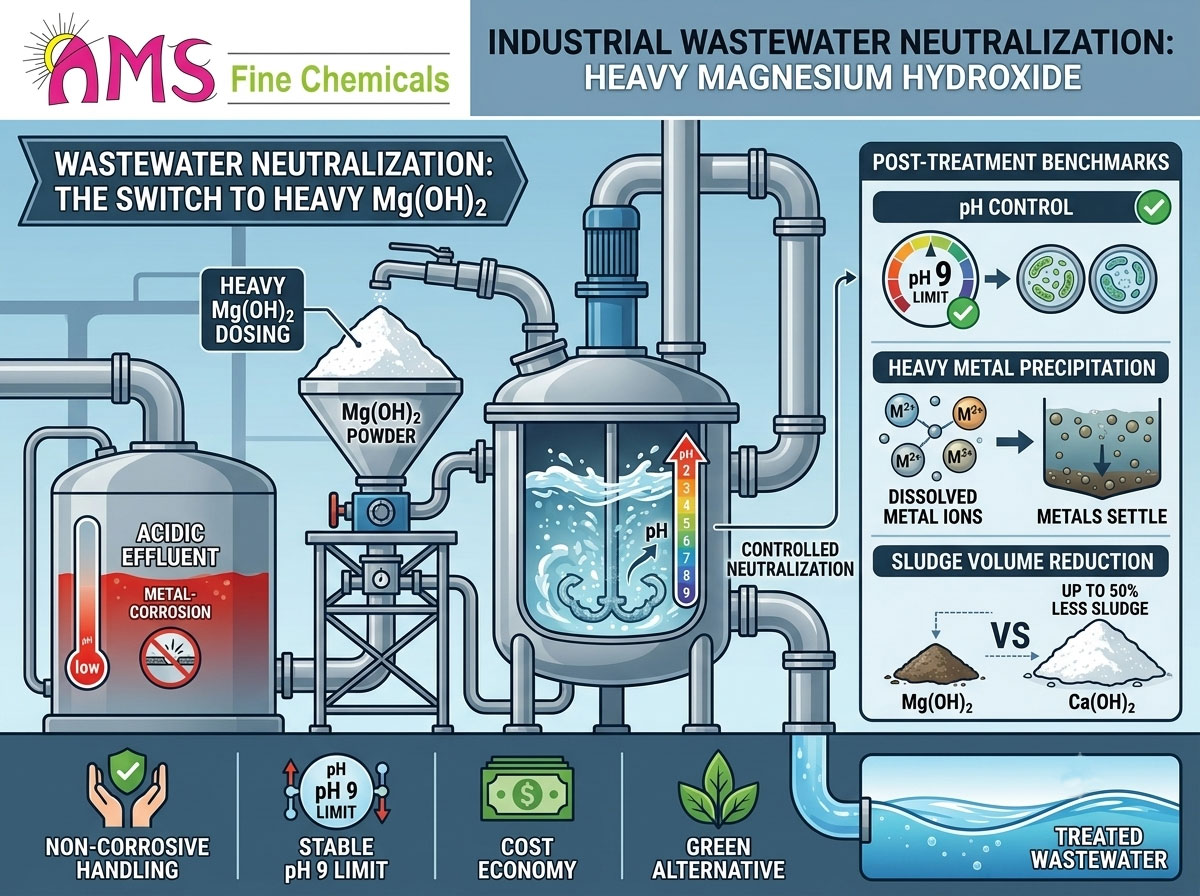
At AMS Fine Chemicals, a Bhavnagar, Gujarat-based manufacturer of magnesium compounds, Heavy Magnesium Hydroxide is one of the most requested grades for exactly this application. This guide takes a technical look at why the heavier, denser grade of Mg(OH)₂ performs so well in industrial wastewater neutralization, how it compares to caustic soda, lime, and lighter Mg(OH)₂ grades, and what process engineers should evaluate before switching a treatment line over to it.
You can review the full technical profile on the Heavy Magnesium Hydroxide product page, or browse the complete Magnesium Hydroxide range for related grades.
1. What Is Heavy Magnesium Hydroxide?
Heavy Magnesium Hydroxide is a specific grade of Mg(OH)₂ distinguished by its higher bulk density and larger, more controlled particle size compared to light or precipitated grades. Chemically, it is identical to any other form of magnesium hydroxide — one magnesium ion bonded to two hydroxide ions, with a molecular weight of approximately 58.32 g/mol. What changes between grades is the physical form: particle size distribution, bulk density, surface area, and flow characteristics.
This physical difference matters more than it might seem. A denser, larger-particle material:
- Handles and doses more predictably in bulk material systems
- Generates less airborne dust during transfer and feeding
- Packs a higher concentration of active Mg(OH)₂ per unit volume
- Settles and disperses differently in slurry tanks than fine, light-grade powders
For a full breakdown of the base chemistry — molecular structure, solubility, and thermal behavior — see AMS Fine Chemicals’ earlier guide, What Is Magnesium Hydroxide? Properties, Grades, and Safety Advantages Over Caustic Soda. All posts covering this compound, including neutralization chemistry and manufacturing, are also indexed under the Magnesium Hydroxide blog category.
2. Why Industrial Wastewater Needs Neutralization in the First Place
Acidic wastewater isn’t just an aesthetic or regulatory problem — it’s an operational one. Untreated acidic effluent can:
- Corrode pipework, tanks, and downstream treatment equipment
- Kill the bacterial populations that biological (activated sludge) treatment stages depend on
- Keep dissolved heavy metals in solution instead of allowing them to precipitate out
- Violate discharge consent limits, triggering fines or plant shutdowns
Most environmental regulations require effluent to be neutralized to a pH range of roughly 6.5–9 before discharge or further biological treatment. The chemical used to get there has a direct effect on operating cost, safety, and downstream sludge handling — which is exactly where Heavy Magnesium Hydroxide starts to outperform traditional alkalis.
3. The Chemistry Behind Heavy Magnesium Hydroxide Neutralization
The neutralization reaction for Mg(OH)₂ is straightforward:
Mg(OH)₂ + 2H⁺ → Mg²⁺ + 2H₂O
Each mole of magnesium hydroxide carries two hydroxide groups, so one mole can theoretically neutralize two moles of hydrogen ions. Expressed on a mass basis:
- Mg(OH)₂ molecular weight ≈ 58.32 g/mol
- Equivalent weight ≈ 29.16 g/equivalent
- Theoretical acid-neutralizing capacity ≈ 1.72 kg CaCO₃ equivalent per kg of pure Mg(OH)₂
For a hydrochloric acid stream specifically, the reaction is:
Mg(OH)₂ + 2HCl → MgCl₂ + 2H₂O
Which works out to roughly 1 kg of pure Mg(OH)₂ neutralizing about 1.25 kg of HCl.
These numbers are identical regardless of whether the grade is heavy, light, or precipitated — the chemistry doesn’t change with particle size. What does change is how efficiently that theoretical capacity gets used in a real tank, because dissolution rate, dispersion, and surface area all depend on the physical grade selected. AMS Fine Chemicals has published a full breakdown of this distinction — theoretical capacity vs. real-world neutralization rate — in Magnesium Hydroxide Neutralization Capacity: Understanding the Chemistry, which is worth reading alongside this article if you’re setting up a dosing calculation.
The practical takeaway for Heavy Magnesium Hydroxide specifically: because its particle size is larger than light grades, it dissolves somewhat more gradually. In continuous-flow neutralization tanks with adequate residence time and mixing, this isn’t a disadvantage — it actually supports the “controlled release” behavior that makes Mg(OH)₂ attractive in the first place, since the alkalinity is delivered as fast as it’s consumed rather than all at once.
4. Heavy vs. Light Magnesium Hydroxide: Which Grade Fits Your Wastewater Line?
Not every wastewater application calls for the same grade. Choosing between Heavy and Light Magnesium Hydroxide comes down to process design rather than which one is “better” in absolute terms.
| Factor | Heavy Magnesium Hydroxide | Light Magnesium Hydroxide |
|---|---|---|
| Bulk density | High | Low |
| Particle size | Larger, controlled | Finer |
| Dusting during handling | Lower | Higher |
| Surface area per unit mass | Lower | Higher |
| Dissolution/reaction rate | More gradual | Faster |
| Best suited for | Bulk dosing systems, longer-residence tanks, continuous large-volume effluent streams | Fast-reacting systems, applications needing rapid dispersion, fine slurry formulations |
Heavy Magnesium Hydroxide tends to be preferred in large-volume industrial effluent lines — mining runoff, metal finishing baths, bulk chemical plant wastewater — where consistent bulk handling, reduced dust generation, and steady dosing matter as much as raw reaction speed. Its higher bulk density also means more active material can be stored and fed per unit volume of hopper or silo space, which is a real consideration for high-throughput treatment plants.
If your process instead needs faster dispersion, finer particle contact, or a lower-density slurry (common in smaller batch-neutralization setups or specialty formulations), the Light Magnesium Hydroxide grade may be the more suitable fit. Many treatment plants actually evaluate both grades side by side during jar testing before committing to one for full-scale dosing.
5. Heavy Magnesium Hydroxide vs. Caustic Soda and Lime
Caustic soda (NaOH) and hydrated lime (Ca(OH)₂) remain common in industrial neutralization, largely due to low unit cost and long-standing familiarity. But both come with operational trade-offs that Heavy Magnesium Hydroxide avoids.
Against Caustic Soda
Caustic soda is fully soluble and a strong base, meaning it dissolves and dissociates almost instantly. That’s useful when a treatment system needs an immediate pH jump — but it’s also the reason “pH overshoot” is such a common operational headache. A minor dosing error with caustic soda can push a waste stream from acidic straight past neutral into a pH of 12–13, which is high enough to kill the biological cultures that downstream treatment stages depend on.
Heavy Magnesium Hydroxide’s low water solubility (roughly 0.0009 g/100 mL) means it can only release hydroxide ions about as fast as the surrounding acid consumes them. In practice, this self-buffering behavior keeps neutralized streams from climbing much past pH 9, even with some dosing variance — a meaningful safety margin for plants running biological treatment downstream. It’s also non-corrosive to store and handle, unlike caustic soda, which causes severe chemical burns on contact and requires stricter PPE and storage protocols.
Against Lime
Hydrated lime is inexpensive and widely available, but it generates a much larger volume of calcium-based sludge than magnesium hydroxide does for the same neutralization job, and that sludge is often harder to dewater. Heavy Magnesium Hydroxide produces a comparatively denser, more compact sludge, which translates directly into lower filtration effort and lower disposal cost — a factor that matters enormously at plants running continuous, high-volume effluent streams.
| Feature | Heavy Magnesium Hydroxide | Caustic Soda (NaOH) | Hydrated Lime |
|---|---|---|---|
| Handling safety | Non-corrosive | Highly corrosive | Moderately caustic |
| pH control behavior | Self-buffering, ~9 max | Rapid, can overshoot to 13+ | Moderate, less controlled than Mg(OH)₂ |
| Sludge volume | Lower, denser | N/A (fully soluble) | Higher, harder to dewater |
| Metals removal | High efficiency | Requires precise control | Effective but bulkier sludge |
| Magnesium source benefit | Yes | No | No |
For more background on this comparison, including the underlying pH chemistry, see What Is Magnesium Hydroxide? Properties, Grades, and Safety Advantages Over Caustic Soda.
6. Heavy Metal Precipitation: A Second Function Beyond Neutralization
Neutralization is only half the value Heavy Magnesium Hydroxide brings to industrial wastewater. As pH rises into the alkaline range, many dissolved heavy metals convert into insoluble metal hydroxides and drop out of solution:
M²⁺ + 2OH⁻ → M(OH)₂ (solid precipitate)
This reaction is central to treating effluent from metal finishing, plating, and mining operations, where dissolved metals such as nickel, copper, zinc, chromium, and lead must be removed before discharge. Because Heavy Magnesium Hydroxide raises pH in a controlled, self-limiting way, it tends to land the solution in the optimal precipitation range for many common metals without the risk of driving pH so high that some metal hydroxides re-dissolve (a real risk with over-dosed caustic soda).
The result is a wastewater treatment reagent that does double duty: it corrects acidity and sets up the chemistry needed for the metals-removal stage that typically follows.
7. Sludge Density, Dewatering, and Total Cost of Ownership
Chemical unit cost is only one line item in a wastewater treatment budget. The bigger, often underestimated cost is what happens after neutralization — specifically, sludge handling.
Because Heavy Magnesium Hydroxide produces a denser precipitate than lime or caustic soda for an equivalent neutralization job, plants typically see:
- Faster settling in clarifiers
- Better filter-press performance and shorter dewatering cycles
- Lower disposal volume, which reduces transport and landfill/disposal costs
- Less risk of sludge carryover into subsequent treatment stages
Over a full year of continuous operation, these downstream savings frequently offset the higher per-kilogram price of Mg(OH)₂ compared to caustic soda or lime — which is why total cost of ownership, not just reagent price, is the right way to evaluate a switch.
8. Industries That Rely on Heavy Magnesium Hydroxide for Wastewater Treatment
Heavy Magnesium Hydroxide shows up across a wide range of acidic effluent-generating sectors:
- Metal finishing and electroplating — neutralizing pickling and plating bath rinse water while precipitating dissolved metals
- Mining and mineral processing — treating acid mine drainage and process water before discharge
- Textile and dye processing — correcting acidic dye-bath effluent
- Chemical and fertilizer manufacturing — neutralizing acidic process streams before further treatment
- Pulp and paper — where magnesium-based alkalis are also used in bleaching and process-water treatment; see AMS Fine Chemicals’ related guide on Magnesium Hydroxide in the Paper & Pulp Industry
- Flue gas desulfurization (FGD) — Heavy Magnesium Hydroxide is also used in wet scrubber systems to convert SO₂ into magnesium sulfite, reducing air pollution alongside water treatment
A broader look at the sectors AMS Fine Chemicals supplies is available on the Industries We Serve page, and a full application-by-application breakdown is on the Application page.
9. Dosing and Process Design: What Engineers Should Evaluate
Switching a treatment line to Heavy Magnesium Hydroxide isn’t a drop-in replacement — it requires the same process rigor as any reagent change. Key considerations include:
Characterize the Waste Stream First
Measure initial pH, total acidity (not just pH — acidity and buffering capacity determine actual reagent demand), temperature, flow rate, and the specific metals present.
Confirm Dosage Through Titration, Not Theory Alone
The theoretical figure of ~1.72 kg CaCO₃ equivalent per kg of pure Mg(OH)₂ is a useful starting point, but real dosing should be confirmed with laboratory titration or pilot testing, since purity, particle size, mixing, and temperature all affect real-world performance. AMS Fine Chemicals covers this calculation process step by step in Magnesium Hydroxide Neutralization Capacity: Understanding the Chemistry.
Size the Reaction Tank for Residence Time
Because Heavy Magnesium Hydroxide’s larger particle size means somewhat slower dissolution than light grades, adequate residence time and mixing energy are more important than they would be with a fully soluble reagent like caustic soda.
Plan the Feed System Around Bulk Density
Heavy Magnesium Hydroxide’s higher bulk density and lower dusting make it well suited to bulk hopper and slurry-mixing systems, but feed equipment should still be sized to the product’s actual flow characteristics rather than assumed from a lighter grade’s datasheet.
Monitor Ongoing Performance
Track outlet pH, chemical consumption per unit of treated volume, sludge volume, and metals-removal efficiency to fine-tune dosing over time.
Avoid Common Dosing Mistakes
A few errors show up repeatedly when plants first switch to Heavy Magnesium Hydroxide:
- Relying on pH alone. Two acidic streams at the same starting pH can have very different total acid loads and buffering capacity, so pH readings alone won’t tell you the correct dose — total acidity testing will.
- Assuming 100% utilization of the theoretical capacity. Poor mixing, short residence time, or particle agglomeration can all reduce real-world reaction efficiency below the stoichiometric ideal.
- Ignoring product assay. A product that is 95% active Mg(OH)₂ needs its dosage adjusted proportionally — treating it as if it were 100% pure will under-dose the system.
- Selecting a grade on price alone. The cheapest grade on a per-kilogram basis isn’t necessarily the cheapest to operate once dispersion, reaction rate, and sludge handling are factored in.
10. Why Choose AMS Fine Chemicals’ Heavy Magnesium Hydroxide
AMS Fine Chemicals manufactures Heavy Magnesium Hydroxide from its facility near Bhavnagar, Gujarat, with an installed annual production capacity of 500–700 MT. A few specifics worth noting for treatment plant buyers:
- Consistent high bulk density — engineered for predictable dosing behavior in bulk material handling systems
- Controlled particle size distribution — supports good flowability and reduced dust generation during transfer and feeding
- Superior purity and quality assurance — every batch is tested in-house through NABL-calibrated Physico-Chemical and Microbiology laboratories
- Non-toxic, non-hazardous profile — a genuinely safer alternative to caustic chemicals for plant personnel
- Reliable export supply chain — proximity to Mundra and Pipavav ports supports both domestic delivery and international export, from LCL to full container loads
- Over 20 years of manufacturing experience in magnesium compounds, backed by an in-house R&D team
Full technical specifications, packaging details, MSDS/SDS documentation, and grade options are available on the Heavy Magnesium Hydroxide product page. For plants also evaluating other magnesium-based reagents, the complete Magnesium Hydroxide and Magnesium Carbonate product lines are worth reviewing side by side.
Frequently Asked Questions
1. What makes Heavy Magnesium Hydroxide different from regular Magnesium Hydroxide? The chemistry (Mg(OH)₂) is identical. The difference is physical: Heavy Magnesium Hydroxide has a higher bulk density and larger, more controlled particle size, which improves flow, reduces dusting, and suits bulk industrial dosing systems.
2. Can Heavy Magnesium Hydroxide fully replace caustic soda in wastewater treatment? In many applications, yes — particularly where controlled, self-buffering pH adjustment and reduced handling risk matter more than instant neutralization. Systems that specifically require a very fast pH jump may still favor caustic soda, so the right choice depends on process requirements.
3. How much Heavy Magnesium Hydroxide is needed to neutralize an acidic waste stream? Theoretically, about 1 kg of pure Mg(OH)₂ neutralizes 1.25 kg of HCl, or provides roughly 1.72 kg CaCO₃-equivalent neutralizing capacity per kg. Actual dosing should always be confirmed with titration, since purity, particle size, mixing, and acid type all affect real-world consumption.
4. Does Heavy Magnesium Hydroxide help with heavy metal removal, or just pH control? Both. As it raises pH, many dissolved metals — nickel, copper, zinc, chromium, and others — convert to insoluble hydroxides and precipitate out, making it useful for combined neutralization and metals-removal treatment stages.
5. Is Heavy Magnesium Hydroxide safe to handle compared to caustic soda? Yes. It is non-corrosive, non-toxic, and non-hazardous, which significantly reduces the safety and PPE requirements associated with handling strong caustic alkalis.
6. Which grade is better for continuous large-volume treatment plants — Heavy or Light Magnesium Hydroxide? Heavy Magnesium Hydroxide is generally preferred for large-volume, continuous bulk dosing systems because of its handling characteristics and lower dusting. Light Magnesium Hydroxide is often selected where faster dispersion or finer particle contact is required. Jar testing with both grades is recommended before committing to full-scale dosing.
Conclusion
Heavy Magnesium Hydroxide offers industrial wastewater treatment plants a genuinely safer, more predictable, and more cost-effective alternative to caustic soda and lime — without sacrificing neutralization performance or metals-removal capability. Its self-buffering chemistry protects downstream biological treatment stages from pH overshoot, its denser sludge lowers dewatering and disposal costs, and its non-corrosive handling profile reduces workplace risk.
For plants evaluating a switch, the right first step is characterizing the waste stream and confirming dosage through titration rather than theory alone — and selecting a grade matched to the actual process design.
AMS Fine Chemicals manufactures and exports Heavy Magnesium Hydroxide from Bhavnagar, Gujarat, backed by in-house quality testing and over two decades of magnesium compound manufacturing experience. Explore the full Heavy Magnesium Hydroxide specifications, or contact the technical team to discuss dosing requirements, request a sample, or obtain a quotation for your treatment plant.
AMS Fine Chemicals — Heavy Magnesium Hydroxide Manufacturer & Exporter from Gujarat, India.