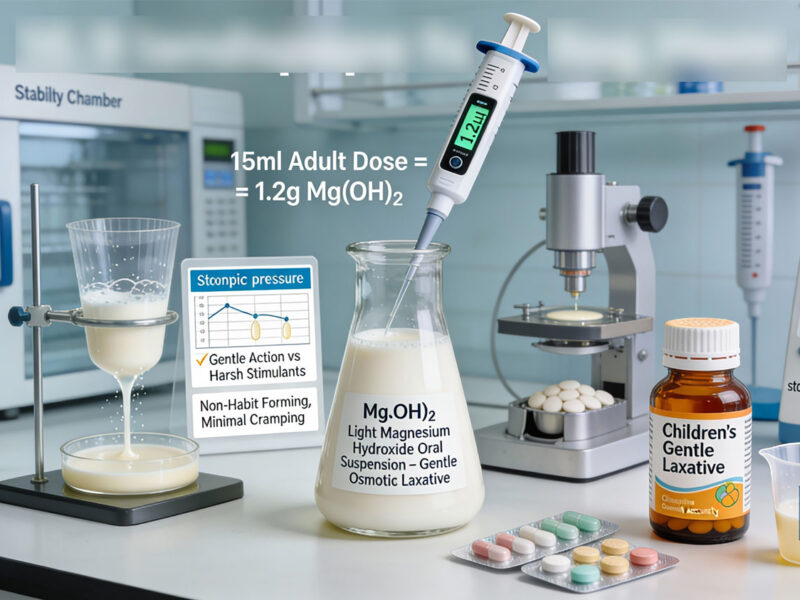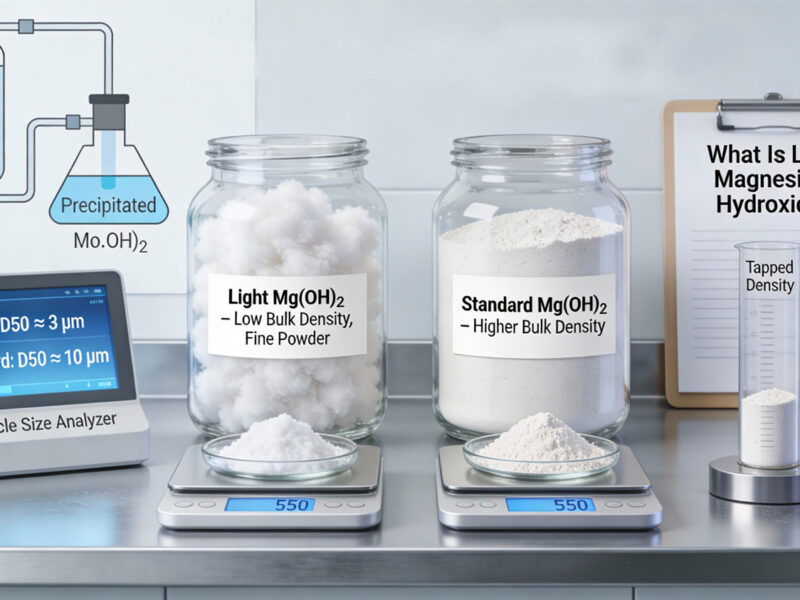
Milk of Magnesia is one of the oldest, most recognizable liquid pharmaceutical products in the world — and it’s also a genuinely difficult formulation to get right. A stable, palatable, accurately-dosed Magnesium Hydroxide suspension depends on a narrow set of physical properties that most formulators only fully appreciate once they’ve watched a poorly specified batch cake solid at the bottom of a bottle. Light Magnesium Hydroxide — the fine, low-bulk-density grade of Mg(OH)₂ — exists specifically to solve this formulation challenge.
This guide covers what actually matters when formulating pharmaceutical suspensions with Light Magnesium Hydroxide: the physical chemistry behind suspension stability, redispersibility, and mouthfeel, how grade selection drives these outcomes, and the practical specification and sourcing considerations formulators should apply before committing to a production-scale batch.
Why Magnesium Hydroxide Suspensions Are a Genuine Formulation Challenge
Magnesium Hydroxide is practically insoluble in water — a property that’s actually central to its therapeutic mechanism as a laxative and antacid, since it works by remaining largely undissolved in the gastrointestinal tract, drawing water osmotically or reacting directly with gastric acid at the particle surface. But that same insolubility is precisely what makes suspension formulation hard: you’re not dissolving an ingredient into a liquid, you’re keeping a genuinely insoluble solid evenly dispersed in one, for the full length of a product’s shelf life, through transport, storage, and repeated consumer use.
Our What Is Magnesium Hydroxide? Properties, Grades (Brucite, Precipitated), and Safety Advantages Over Caustic Soda article covers the broader chemistry and grade landscape of Mg(OH)₂ — this guide focuses specifically on what happens when that material needs to perform inside a liquid suspension rather than as a dry powder or industrial slurry.
The Physics of Sedimentation: Why Particle Size and Density Are Everything
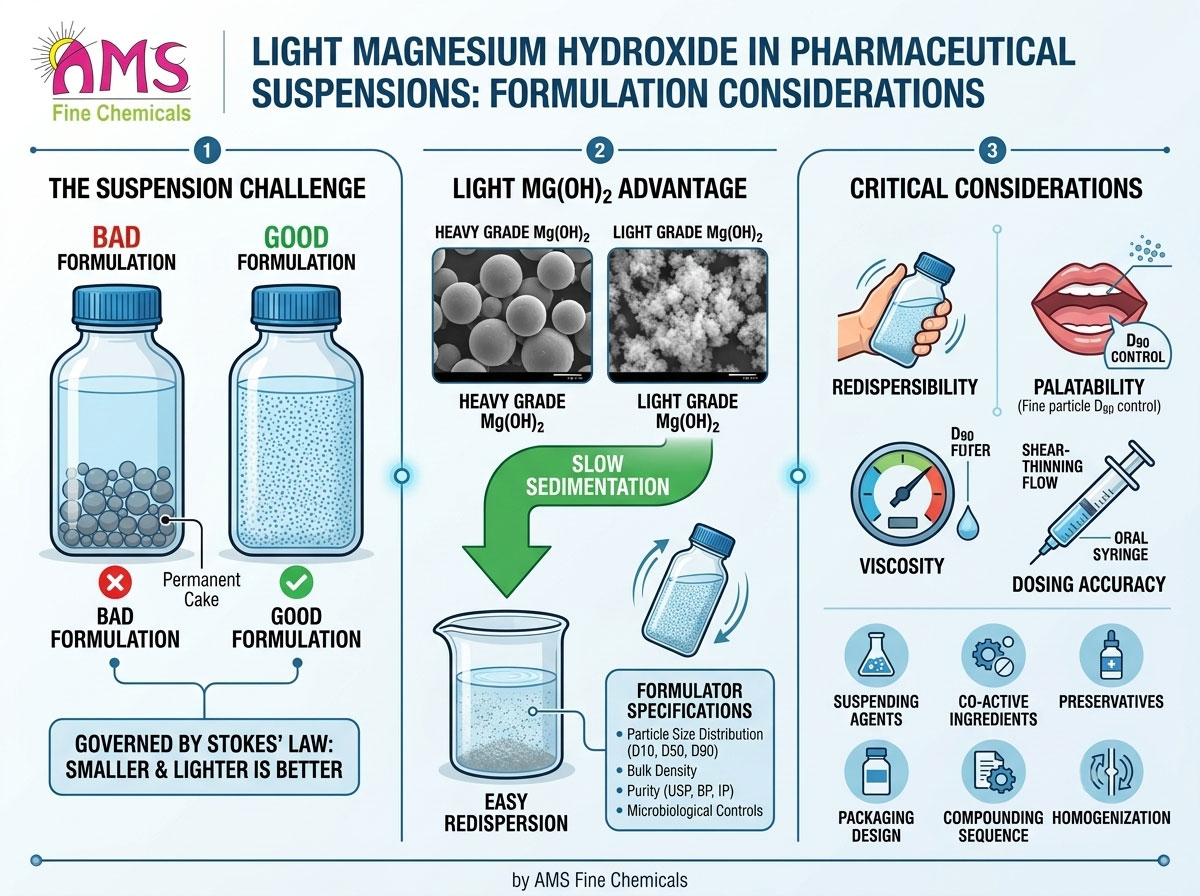
Suspension stability is governed by Stokes’ Law, which describes how quickly a particle settles through a liquid as a function of particle size, particle density, liquid viscosity, and the density difference between particle and liquid. For formulators, the practical takeaway is straightforward: smaller, lighter particles settle more slowly than larger, denser ones — meaning grade selection directly determines how long a suspension stays uniformly mixed before the active ingredient begins separating out.
Why this favors Light grade specifically: Light Magnesium Hydroxide‘s fine particle size and low bulk density — a direct consequence of how it’s precipitated, covered in our What Is Light Magnesium Hydroxide? Particle Size, Bulk Density, and How It Differs from Standard Grade Mg(OH)₂ article — translates directly into slower settling under Stokes’ Law. This is why Light grade, not Heavy grade, is the default choice for liquid suspension formulation: a Heavy grade Mg(OH)₂ suspension would sediment noticeably faster, producing a hard, difficult-to-redisperse cake at the bottom of the bottle far sooner in the product’s shelf life.
Why slower sedimentation still isn’t the whole story: Even Light grade Mg(OH)₂ will eventually settle in a purely aqueous system, since it remains an insoluble solid regardless of particle size. This is why commercial Magnesium Hydroxide suspensions almost never rely on particle size alone — they combine Light grade material with suspending agents (discussed below) that further slow sedimentation and, critically, ensure that whatever does settle can be easily redispersed with simple shaking rather than requiring vigorous agitation or, worse, remaining permanently caked.
Redispersibility: The Property That Actually Matters to Patients
A suspension that sediments slowly but forms an impossible-to-redisperse cake is arguably worse than one that settles faster but redisperses easily with a gentle shake — because the entire therapeutic reliability of a suspension depends on the patient actually getting a uniform, accurately dosed product every time they use it, not just on how the product looks immediately after manufacturing.
What drives good redispersibility:
- Particle morphology, not just size — a porous, appropriately structured Light grade particle redisperses more readily than a denser, more tightly packed sediment structure, a principle explored in more general terms in our How Magnesium Carbonate Particle Morphology Influences Industrial Performance article, which applies the same underlying physics to a related magnesium compound.
- Suspending agent selection, since polymeric suspending agents (cellulose derivatives, xanthan gum, and similar systems) create a loose, weakly flocculated sediment structure specifically designed to break apart easily under gentle mechanical agitation, rather than allowing particles to pack into a dense, difficult-to-disperse cake.
- Avoiding excessive compaction during storage, since prolonged storage at rest, particularly under elevated temperature, can allow even a well-designed suspension’s sediment to gradually compact if the formulation isn’t specifically engineered to resist this over the product’s full shelf life.
Formulators should validate redispersibility specifically — not just settling rate — through accelerated and real-time stability testing that includes a defined shake protocol, confirming the product actually returns to homogeneous suspension within a reasonable, consumer-realistic number of shakes.
Viscosity and Flow Behaviour
Beyond sedimentation, Light Magnesium Hydroxide suspensions need appropriate viscosity and flow characteristics — thick enough to support suspension stability and a pleasant mouthfeel, but thin enough to pour accurately and dose consistently via a measuring cup or oral syringe.
Rheological considerations specific to Mg(OH)₂ suspensions: Most well-formulated Magnesium Hydroxide suspensions exhibit shear-thinning (pseudoplastic) behaviour — appearing thick and gel-like at rest (helping suspend particles) but flowing more readily under the shear stress of pouring or shaking. This behaviour is typically engineered through the suspending agent system rather than the Mg(OH)₂ itself, though the mineral’s own particle size and concentration still influence baseline viscosity and interact with whatever suspending agent system is selected.
Concentration effects: Higher Mg(OH)₂ loading — relevant for concentrated, lower-dose-volume formulations — generally increases baseline viscosity and can complicate suspending agent selection, since a formulation optimized for a standard concentration may behave quite differently at a higher solids loading, requiring re-optimization rather than simple linear scaling of the suspending agent concentration.
Mouthfeel and Palatability
Oral suspensions are judged directly by consumers on taste and texture, and Magnesium Hydroxide suspensions carry a well-known palatability challenge — the classic “chalky” or “gritty” sensation associated with older or poorly formulated antacid and laxative products.
Particle size’s direct sensory role: Consistent with the particle-size-driven texture principles covered in our Magnesium Carbonate Particle Size Distribution and Its Impact on Formulation article — where the same physics applies to a related magnesium compound — D90 (not just median particle size) drives perceived grittiness. A batch with an acceptable median particle size but an unexpectedly coarse tail in its distribution can still produce a noticeably gritty mouthfeel that undermines an otherwise well-formulated product.
Flavoring and masking strategy: Beyond particle size control, most commercial Mg(OH)₂ suspensions rely on flavoring systems (mint, cherry, and similar profiles are common in the antacid category) combined with sweeteners to mask the mineral’s inherently bland, slightly bitter taste profile — though flavoring can’t fully compensate for a genuinely poor particle size specification, reinforcing why particle size control remains the foundational palatability lever, with flavoring as a complementary rather than substitute strategy.
Concentration and Dosing Accuracy
Pharmaceutical suspensions need to deliver a consistent, accurate dose of active ingredient with every measured volume — a requirement that depends on the suspension remaining genuinely homogeneous through the shaking-to-dosing sequence a patient or caregiver actually performs at home, not just under laboratory conditions.
Why this connects back to redispersibility: A suspension that looks adequately mixed after shaking but has any residual concentration gradient — more concentrated near the bottom, less concentrated near the top — will deliver inconsistent doses depending on when in the bottle’s life a given dose is drawn. This is precisely why stability testing protocols for suspensions typically include dose-uniformity testing across the bottle’s full use life, not just an initial homogeneity check immediately after manufacturing.
Neutralizing and laxative capacity considerations: For antacid applications specifically, the suspension’s Mg(OH)₂ concentration needs to align with a validated acid-neutralizing capacity per dose — a concept covered in chemical detail in our companion article on acid-neutralization chemistry, and relevant to confirming that a specific Light Magnesium Hydroxide batch’s reactivity supports the label claim the finished suspension makes.
Grade and Purity Specifications Formulators Should Request
Particle size distribution (D10/D50/D90): As emphasized throughout this guide, the full distribution — not median particle size alone — predicts both sedimentation rate and mouthfeel. Request this data explicitly rather than accepting a single average figure.
Bulk density: A useful cross-check against particle size data, confirming a batch genuinely matches the Light grade profile a suspension formulation was validated against, rather than drifting toward a denser, faster-settling structure.
Assay and impurity profile: Compliance with the applicable pharmacopoeial standard — USP, BP, or IP — with full heavy metal testing via ICP-OES, consistent with the broader pharmaceutical excipient sourcing principles covered in our Magnesium Carbonate COA Explained: Important Parameters Buyers Should Check article, which applies equally to Mg(OH)₂ excipient sourcing.
Microbial testing: Particularly critical for suspensions, since the aqueous environment and any sugar or flavoring content create conditions that could support microbial growth if the raw material itself isn’t adequately controlled at the point of manufacture.
Loss on Drying: Confirms the incoming material’s moisture status, relevant both to accurate potency calculation and to predicting how the material will behave during suspension manufacturing.
Compatibility Considerations With Other Suspension Components
Suspending agents: Most cellulose-derivative and gum-based suspending agents are broadly compatible with Mg(OH)₂’s mild alkalinity, though formulators should confirm compatibility specifically for their chosen system, since some polymeric suspending agents perform differently across a range of pH environments.
Co-active ingredients: Combination antacid products — pairing Magnesium Hydroxide with Aluminum Hydroxide or Simethicone, for example — require careful evaluation of how each component’s particle size and density profile interacts within a shared suspension system, since a formulation optimized for one active alone doesn’t automatically remain optimal once a second solid-phase active is introduced.
Preservative systems: As with any aqueous multi-dose liquid product, preservative effectiveness needs validation within the complete formulation, since Mg(OH)₂’s mild alkalinity can shift a formulation’s effective pH enough to affect certain pH-sensitive preservative systems — a consideration covered in more general terms in our Magnesium Carbonate Compatibility With Common Industrial Ingredients article, where the same principle applies to a related magnesium excipient’s interaction with formulation components.
Comparing Light Magnesium Hydroxide to Light Magnesium Carbonate in Suspension Systems
Formulators sometimes weigh Light Magnesium Hydroxide against Light Magnesium Carbonate for related liquid antacid or reconstitutable applications — our Using Light MgCO3 in Effervescent Tablets and Suspensions for Rapid Acid Neutralization article covers the carbonate side of this comparison in detail. The key distinction: Magnesium Carbonate’s reaction with gastric acid releases CO₂ gas (producing the characteristic effervescent or mildly gas-producing effect), while Magnesium Hydroxide neutralizes acid through direct hydroxide-ion reaction without gas evolution — a smoother, non-effervescent neutralization that’s often preferred in suspension formats specifically because gas generation within a sealed suspension bottle can create packaging and stability complications that a non-gas-generating active ingredient avoids entirely.
Regulatory and Compendial Considerations for Suspension-Grade Material
Pharmaceutical suspensions carry the same compendial compliance expectations as tablet and capsule products, with a few suspension-specific emphases worth flagging separately.
Particle size specification as a compendial parameter: Unlike some solid dosage excipient applications where particle size is a functional but not always compendially mandated parameter, suspension formulations often build particle size distribution directly into the finished product’s own specification and stability protocol, since it’s so directly tied to product performance and shelf life — meaning incoming raw material particle size control isn’t just a formulation nicety but a traceable link back to finished-product release testing.
Stability testing under real packaging and storage conditions: ICH-aligned stability protocols for suspensions typically require testing across the intended storage temperature range and orientation (upright and, in some cases, inverted), since sedimentation and redispersibility behaviour can differ meaningfully depending on how a bottle is actually stored and handled by the end consumer, not just under a single standardized laboratory condition.
Documentation supporting global market registration: Buyers manufacturing suspensions for multiple regulatory markets should confirm their Light Magnesium Hydroxide supplier can provide documentation supporting the specific compendial references each target market requires — USP for the United States, BP for the UK and many Commonwealth markets, IP for India — since a single generic “pharma grade” certification isn’t always sufficient for multi-market regulatory filings.
Packaging Considerations Specific to Suspensions
Beyond the formulation itself, packaging design interacts directly with the suspension properties this guide has covered throughout, and deserves explicit consideration during development rather than being treated as an afterthought once formulation work is complete.
Bottle shape and headspace: Container geometry affects how easily a settled suspension redisperses upon shaking — a bottle with awkward internal geometry or excessive headspace can make achieving full redispersion more difficult for the consumer, even with a well-formulated suspension.
Cap and dosing device design: Oral syringes, dosing cups, and integrated dosing caps all interact with suspension viscosity and homogeneity — a dosing device poorly matched to the formulation’s flow characteristics can introduce dosing inaccuracy independent of how well the suspension itself was formulated.
Tamper-evidence and child-resistant features: Particularly relevant for laxative and antacid suspensions marketed for pediatric or general consumer use, where regulatory packaging requirements intersect with the practical need for consumers to easily access and properly redisperse the product for accurate dosing.
Manufacturing Process Considerations for Suspension Producers
Wetting and dispersion during compounding: Light Magnesium Hydroxide’s fine, high-surface-area particles can be prone to clumping if not properly wetted during initial compounding — proper use of wetting agents and appropriate mixing sequence (typically dispersing the powder into a small volume of vehicle before diluting to final volume) prevents the formation of persistent agglomerates that redispersion later in the process can’t fully break apart.
Homogenization: High-shear homogenization or milling during manufacturing helps ensure uniform particle distribution throughout the batch, though excessive shear can, in some cases, alter particle structure in ways that affect subsequent settling and redispersion behaviour — process parameters should be validated specifically for the chosen raw material grade rather than assumed from a different supplier’s or grade’s process history.
Batch-to-batch consistency: Given how directly particle size and morphology drive suspension performance, consistent incoming raw material specification across production batches matters as much for suspension manufacturing as it does for the tablet and powder applications covered in our broader Magnesium Hydroxide and Magnesium Carbonate content — a principle discussed generally in our Factors That Determine the Quality of Industrial-Grade Magnesium Carbonate article, equally applicable to Mg(OH)₂ sourcing for suspension manufacturing.
How AMS Fine Chemicals Supports Suspension Formulators
AMS Fine Chemicals, based in Bhavnagar, Gujarat, manufactures Light Magnesium Hydroxide specifically engineered for the fine particle size, low bulk density, and high dispersibility pharmaceutical suspension formulators depend on. Full in-house testing — including particle size distribution via laser diffraction, bulk density, assay, and heavy metal testing via ICP-OES — supports compliance with USP, BP, and IP pharmacopoeial standards, with batch-specific Certificates of Analysis available for formulation validation.
Explore full technical specifications on our Light Magnesium Hydroxide and Magnesium Hydroxide product pages, or browse our complete range of magnesium compounds — including Heavy Magnesium Hydroxide, Magnesium Carbonate, and Magnesium Trisilicate — on the Products page.
Frequently Asked Questions
Why does Milk of Magnesia need to be shaken before use? Because Magnesium Hydroxide is practically insoluble in water, it exists as a suspended solid rather than a true solution, meaning it gradually settles over time — shaking redistributes the settled particles evenly throughout the liquid to ensure an accurate, consistent dose.
Can Heavy grade Magnesium Hydroxide be used in liquid suspensions instead of Light grade? It’s technically possible but generally not recommended, since Heavy grade’s larger particle size and higher density lead to faster sedimentation and a harder, more difficult-to-redisperse sediment cake, undermining the formulation’s practical usability and shelf-life stability.
What causes a gritty mouthfeel in Magnesium Hydroxide suspensions? Most commonly, an unexpectedly coarse fraction within the particle size distribution — specifically the D90 value — rather than the median particle size alone, which is why formulators should request the full particle size profile rather than relying on a single average figure.
Does Magnesium Hydroxide react with the suspending agents used in formulation? Generally not significantly, since most cellulose-derivative and gum-based suspending agents are compatible with Mg(OH)₂’s mild alkalinity, though formulators should confirm compatibility specifically for their chosen suspending agent system as part of standard formulation development.
How is suspension stability actually tested during formulation development? Through a combination of accelerated and real-time stability studies that track sedimentation rate, redispersibility (via a defined shake protocol), viscosity, dose uniformity across the bottle’s use life, and microbial and chemical stability over the intended shelf life.
Final Word
Formulating a stable, palatable, accurately-dosed Magnesium Hydroxide suspension is a genuine engineering challenge built on a handful of interlocking physical properties — particle size and density governing sedimentation rate under Stokes’ Law, particle morphology and suspending agent selection governing redispersibility, and particle size distribution (specifically the coarse tail, not just the median) governing mouthfeel. Light Magnesium Hydroxide’s fine, low-bulk-density structure addresses the sedimentation and texture challenges more effectively than denser grades, but grade selection alone doesn’t guarantee a well-performing suspension — formulation design, suspending agent compatibility, and manufacturing process control all need to work together around the raw material’s specific physical profile.
To request technical specifications, particle size data, or sample batches of Light Magnesium Hydroxide for suspension formulation development, visit our Light Magnesium Hydroxide product page or reach out through our Contact Us page.