Watch a gymnast clap chalk from her hands before mounting the uneven bars, or a climber dip into a chalk bag before committing to a crux move, and you’re watching a piece of applied surface chemistry most spectators never think twice about. The white powder is Light Magnesium Carbonate — and the single property that determines whether it actually works, or just makes a mess, is porosity.
This guide is a focused technical look at exactly why porosity — not purity, not whiteness, not even particle size in isolation — is the property that governs sports chalk’s grip-enhancing performance. It covers the sweat-absorption mechanism at a mechanistic level, why porous structure specifically (not just “fine powder”) is what makes the difference, how this compares to alternative grip products, and what chalk manufacturers should actually specify when sourcing raw material.
The Grip Problem Chalk Is Solving
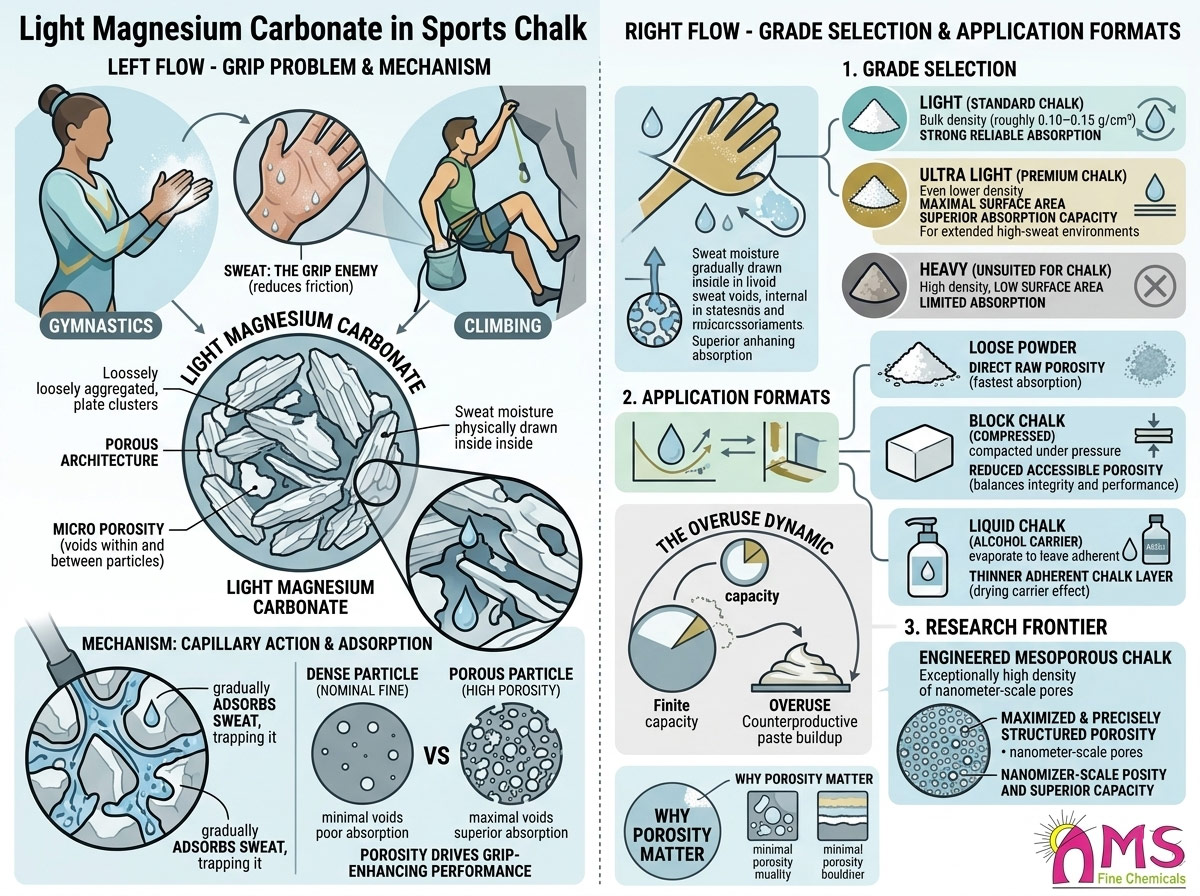
Human skin relies on friction between hand and surface — a bar, a hold, a barbell — to maintain grip under load. Sweat is the primary enemy of that friction: moisture on the skin’s surface creates a thin liquid film that reduces the direct skin-to-surface contact responsible for high friction, effectively lubricating exactly the contact point an athlete depends on. Under the sustained grip demands of gymnastics, climbing, and weightlifting — combined with the physical exertion that reliably produces sweat — this friction loss becomes a genuine performance and safety issue, not merely a comfort concern.
Sports chalk solves this problem not by adding grip directly, but by removing the moisture that destroys grip. This distinction matters: chalk isn’t a tacky or adhesive substance in the way some grip aids are — it works purely by drying the skin surface, restoring the natural friction that sweat had compromised.
Why Porosity, Specifically, Drives Absorption Performance
Here’s the mechanistic core of this guide: Light Magnesium Carbonate’s grip-enhancing performance depends almost entirely on its internal pore structure — the network of microscopic voids within and between its precipitated crystal particles — rather than on its chemical identity alone.
The mechanism: Light Magnesium Carbonate’s particles form during precipitation as loosely aggregated, plate-like crystal clusters containing substantial internal void space — the same porous architecture discussed across our broader Magnesium Carbonate content. When chalk contacts sweaty skin, this pore network physically draws sweat moisture into itself through capillary action and surface adsorption, effectively pulling water away from the skin surface and trapping it within the chalk particle’s own internal structure. Our Magnesium Carbonate Moisture Absorption: What Formulators Need to Know article covers this adsorption mechanism in full technical detail — sports chalk is, functionally, one of the most direct and unmediated real-world demonstrations of that same mechanism in action.
Why “porous” isn’t the same as “fine”: A common misconception is that any sufficiently fine Magnesium Carbonate powder will perform equally well as chalk. This isn’t accurate. Two batches can share a similar particle size while differing substantially in internal porosity and resulting surface area — a distinction explained in detail in our How Magnesium Carbonate Particle Morphology Influences Industrial Performance article. A denser, less porous particle of the same nominal size offers meaningfully less internal void space to actually adsorb moisture into, even if it feels equally fine to the touch and looks visually similar as a powder.
Why this matters for chalk specifically, more than most applications: Sports chalk’s entire performance claim rests on rapid, high-capacity moisture absorption under real-time athletic conditions — there’s no room for a slow-acting or low-capacity material to “catch up” the way there might be in a less time-critical application. This makes porosity, and the resulting surface area it produces, the single most performance-determining property for this specific use case.
Grade Selection for Sports Chalk: Why Light or Ultra Light
Given porosity’s central importance, grade selection is a direct, practical decision for chalk manufacturers:
Light Magnesium Carbonate, with its characteristic low bulk density (roughly 0.10–0.15 g/cm³) and correspondingly high surface area, is the standard commercial grade used across the majority of gym chalk, climbing chalk, and gymnastics chalk products on the market — offering strong, reliable moisture absorption suited to typical athletic sweat exposure.
Ultra Light Magnesium Carbonate, with even lower bulk density and higher surface area than standard Light grade, offers superior absorption capacity for applications facing particularly demanding moisture exposure — high-intensity training environments, extended climbing sessions, or athletes with naturally higher perspiration rates, where maximum absorption performance justifies the grade’s premium over standard Light chalk.
Heavy Magnesium Carbonate, by contrast, is essentially unsuited to sports chalk applications — its lower surface area and reduced porosity offer comparatively limited moisture-absorbing capacity, making it functionally inappropriate for this specific use case regardless of its value in other industrial applications like rubber compounding.
Block Chalk vs. Loose Powder vs. Liquid Chalk: How Porosity Plays Out Differently
Sports chalk is sold in several physical formats, and porosity’s role — while always central — manifests somewhat differently across them.
Loose powder chalk most directly showcases raw particle porosity, since the material is applied essentially as-manufactured, with minimal processing beyond milling and packaging. This format generally offers the fastest, most direct absorption performance, since there’s no binder or compaction limiting access to the material’s internal pore structure.
Block (compressed) chalk is loose chalk powder compacted under pressure into a solid block, offering a less messy, more controlled application format popular in gyms and shared training facilities. Compression inherently reduces some of the material’s accessible surface area and porosity compared to loose powder — chalk manufacturers need to carefully calibrate compression pressure to balance block integrity (so it doesn’t crumble excessively) against retained absorption performance, since over-compression can meaningfully reduce the very porosity the product depends on to function.
Liquid chalk suspends Magnesium Carbonate particles in an alcohol-based or similar liquid carrier, which evaporates after application to leave a thin, adherent chalk layer on skin. This format changes the application mechanism somewhat — the initial grip benefit comes partly from the liquid carrier’s own drying effect, with the residual Magnesium Carbonate layer providing ongoing moisture management similar to traditional chalk, though generally in a thinner, more controlled layer than loose or block application typically produces.
The Overuse Problem: When More Chalk Becomes Counterproductive
An important, less commonly discussed aspect of chalk’s porosity-dependent mechanism is that its moisture-absorbing capacity is finite — once a given quantity of chalk has adsorbed moisture up to or near its capacity, it stops effectively drying the skin and can begin contributing to the opposite problem it was meant to solve.
Why this happens: As chalk particles become progressively saturated with absorbed sweat, continued moisture exposure without fresh chalk reapplication can produce a paste-like buildup on skin or equipment surfaces, which — rather than maintaining dry, high-friction contact — can create a slippery film, particularly on climbing holds or equipment surfaces where chalk residue accumulates over repeated use without cleaning. This is precisely why careful climbers routinely brush chalk residue off frequently-used holds, and why gymnasts and weightlifters periodically reapply fresh chalk rather than relying on a single application to last through an extended training session.
Practical implication for manufacturers: This overuse dynamic reinforces why absorption capacity, not just absorption speed, matters in chalk formulation — a higher-capacity grade (Ultra Light, or specialty engineered mesoporous grades discussed below) extends the effective working window before this saturation-driven counterproductive effect sets in, a genuine performance differentiator for athletes engaged in longer training sessions or competitions without convenient reapplication opportunities.
The Research Frontier: Engineered Mesoporous Chalk
Beyond standard commercial Light and Ultra Light grades, materials science research has pushed sports chalk’s underlying chemistry further through engineered mesoporous magnesium carbonate — a specially synthesized form featuring an exceptionally high density of nanometer-scale pores, achieved through a synthesis method using expanding carbon dioxide gas during production rather than templating molecules.
This engineered material has demonstrated substantially higher moisture adsorption capacity at low relative humidity levels than conventional hygroscopic materials, including outperforming zeolites — a class of materials previously considered among the best available for this kind of humidity-control application. A commercial version of this technology was launched as a climbing chalk ingredient in 2018, recognized at a major international sports equipment exhibition for its innovation in the category.
This research direction illustrates, at the cutting edge, the exact principle this entire guide has been built around: porosity — engineered, maximized, and precisely structured — is the property driving performance, not simply “more magnesium carbonate” or “finer powder” in a generic sense. For chalk manufacturers and brands positioning around premium, high-performance grip products, awareness of this engineered-porosity research direction is relevant to understanding where the category’s performance ceiling continues to move.
The Historical Origin of Chalk in Athletic Grip
Sports chalk’s adoption story is worth understanding, since it illustrates how directly its porosity-driven mechanism translates into real-world athletic performance benefit. Climbing chalk specifically traces to the mid-1950s, when a climber first applied gymnastics-style chalk to rock climbing, recognizing that the same sweat-absorption mechanism already trusted in gymnastics could translate directly to the sweaty, high-friction-demand environment of rock climbing. The material itself — magnesium carbonate derived from magnesite ore — was already established in gymnastics and weightlifting well before climbing adopted it, since the underlying grip problem (sweat destroying hand-to-equipment friction under load) is essentially identical across these disciplines regardless of the specific equipment or surface involved.
This cross-sport adoption pattern reinforces the core theme of this guide: the mechanism doesn’t change based on the sport, because the underlying physics — sweat reducing skin friction, porous Magnesium Carbonate absorbing that sweat — remains constant whether the athlete is gripping a barbell, a set of uneven bars, or a piece of rock. What changes between disciplines is mainly application format (block, loose powder, liquid) and inclusion rate preferences based on each sport’s specific sweat exposure and application convenience needs.
Raw Material Origin: Natural Magnesite vs. Synthetic Precipitation
Sports chalk raw material can originate from two distinct production pathways, each with different implications for the porosity this guide has emphasized throughout:
Natural magnesite-derived chalk starts from mined magnesite ore (naturally occurring MgCO₃), which is calcined to remove iron and other mineral contaminants, then crushed into powder or compressed into blocks. This pathway generally produces a denser, less inherently porous starting material than synthetic precipitation, since natural mineral crystal structure differs from the loosely aggregated, high-void-space structure that precipitation chemistry specifically produces.
Synthetically precipitated Light Magnesium Carbonate, produced through the controlled reaction of a magnesium salt solution with a carbonate source — the same manufacturing pathway covered in our Complete Guide to Magnesium Carbonate Manufacturing Process — generally offers meaningfully higher and more consistent porosity than natural mineral-derived material, since precipitation conditions (temperature, pH, reaction time) can be specifically engineered to maximize the porous crystal structure this guide has identified as the key performance driver.
For chalk manufacturers specifically prioritizing absorption performance, this distinction is worth understanding when evaluating raw material sourcing options — synthetic precipitation generally offers more reliable, engineerable porosity than naturally-sourced alternatives, even though both pathways can technically produce material labeled “magnesium carbonate.”
Sourcing Considerations for Chalk Manufacturers
Surface area and porosity data, not just particle size: Chalk manufacturers evaluating raw material suppliers should specifically request surface area data (typically BET analysis) alongside standard particle size distribution figures, since — as covered throughout this guide — particle size alone doesn’t reliably predict the porosity that actually drives absorption performance.
Purity for direct skin contact: While sports chalk isn’t a food or pharmaceutical product, it is applied directly and repeatedly to skin, warranting appropriate purity and heavy metal testing consistent with direct skin-contact applications, even without the full regulatory framework governing cosmetic or pharmaceutical products specifically.
Consistent particle size for grip feel and manageable dust generation: Beyond pure absorption performance, particle size consistency affects the tactile grip feel athletes experience and the amount of airborne dust generated during application — a practical consideration for gym and training facility air quality, particularly in enclosed indoor climbing and training environments.
Batch-to-batch consistency for brand reliability: Athletes and gyms develop strong preferences and brand loyalty around specific chalk products, making consistent batch-to-batch performance — not just an impressive best-case sample — commercially important for manufacturers building a reliable product reputation, a principle covered in more general terms in our How Magnesium Carbonate Quality Affects Final Product Performance article.
Comparing Magnesium Carbonate Chalk to Alternative Grip Products
Rosin, used in some sports (notably baseball and certain climbing contexts), works through a fundamentally different, tackier adhesive mechanism rather than moisture absorption, producing a genuinely different grip sensation and performance profile than Magnesium Carbonate chalk.
Liquid grip aids without Magnesium Carbonate (some purely alcohol- or resin-based products) rely primarily on their drying or tackifying carrier rather than an ongoing porous-absorption mechanism, generally offering a shorter-duration grip benefit than Magnesium Carbonate-based products, which continue actively absorbing moisture throughout wear rather than providing only an initial application effect.
Calcium carbonate (“blackboard chalk”) is sometimes confused with magnesium carbonate sports chalk by newcomers to grip-dependent sports, but the two are chemically distinct — calcium carbonate lacks Magnesium Carbonate’s characteristic high-porosity precipitated structure and offers meaningfully inferior moisture-absorption performance, which is precisely why the sports and fitness industry standardized specifically on magnesium carbonate rather than the chemically similar but structurally different calcium carbonate.
How AMS Fine Chemicals Supports Sports Chalk Manufacturers
AMS Fine Chemicals, based in Bhavnagar, Gujarat, manufactures Light and Ultra Light Magnesium Carbonate with the high surface area and porous particle structure sports chalk manufacturers depend on for genuine grip-enhancing performance, not simply a fine, visually similar white powder. Full in-house testing — including particle size distribution via laser diffraction and bulk density measurement — supports consistent batch-to-batch quality for manufacturers building reliable, athlete-trusted grip products.
Explore full technical specifications on our Light Magnesium Carbonate and Ultra Light Magnesium Carbonate product pages, or browse our complete Magnesium Carbonate range and our broader portfolio of magnesium compounds — including Magnesium Hydroxide and Magnesium Trisilicate — on the Products page.
Frequently Asked Questions
Is all “Magnesium Carbonate” sold as sports chalk equally effective? No — porosity and resulting surface area, which drive absorption performance, can vary meaningfully between batches and suppliers even when the chemical identity and general particle size appear similar, which is why brand and manufacturing quality genuinely matter for this application despite the underlying chemistry being straightforward.
Why does chalk sometimes feel like it stops working during a long training session? This typically reflects the chalk’s absorption capacity becoming saturated with adsorbed sweat over time, reducing its ongoing effectiveness until fresh chalk is reapplied — a direct consequence of the finite, capacity-limited nature of the porous adsorption mechanism this guide has covered throughout.
Is Ultra Light Magnesium Carbonate worth the extra cost for chalk formulation? For applications specifically targeting extended-duration performance or particularly high sweat exposure — endurance climbing, high-intensity training environments — the additional absorption capacity often justifies the cost premium; for general-purpose, shorter-session use, standard Light grade typically performs adequately.
Does compressing chalk into block form significantly reduce its effectiveness compared to loose powder? To some degree, yes, since compression reduces accessible porosity, though well-calibrated block chalk still performs effectively for most users — the trade-off is primarily one of convenience and reduced mess against a modest reduction in peak absorption performance compared to loose powder.
Is engineered mesoporous magnesium carbonate available as a standard commercial chalk ingredient? It represents a specialty, more recently commercialized category rather than the standard industry material — most commercial sports chalk products continue to use conventional Light or Ultra Light Magnesium Carbonate grades, with engineered mesoporous variants generally positioned as a premium, differentiated ingredient within specific branded products.
Does it matter whether chalk raw material comes from natural magnesite or synthetic precipitation? For absorption performance specifically, yes — synthetically precipitated material generally offers more reliable, engineerable porosity than naturally mined and calcined magnesite, since precipitation conditions can be specifically controlled to maximize the porous crystal structure that drives grip performance, whereas natural mineral processing offers less direct control over that same structural characteristic.
Final Word
Sports chalk’s grip-enhancing performance comes down to a single, well-defined physical property: porosity. The internal void structure built into Light Magnesium Carbonate during precipitation — not simply its chemical identity or a generically fine particle size — is what allows it to rapidly draw sweat away from skin and restore the friction athletes depend on for grip-critical performance. Understanding this mechanism explains not just why chalk works, but why grade selection, manufacturing process (loose, block, or liquid format), and raw material quality all genuinely matter for a product category that might otherwise seem simple on the surface.
To request technical specifications, surface area data, or sample batches of Light or Ultra Light Magnesium Carbonate for sports chalk formulation, visit our Light Magnesium Carbonate product page or reach out through our Contact Us page.