When a formulation scientist or procurement manager writes “Magnesium Trisilicate BP” or “Magnesium Trisilicate USP” on a purchase order, that single letter difference — BP or USP — changes the chemistry of what actually arrives at the factory gate. It changes the assay limits the material must meet, the acid-neutralizing power it must deliver, and even the paperwork a regulatory affairs team needs to file for market approval.
For buyers new to pharmaceutical excipients, this can feel like a technicality. It isn’t. Choosing the wrong pharmacopoeial grade of Magnesium Trisilicate can mean a rejected batch, a failed audit, or a formulation that simply doesn’t neutralize stomach acid the way the label promises.
This guide breaks down exactly what “BP” and “USP” mean for Magnesium Trisilicate, how the two pharmacopoeias diverge on composition and testing, and how manufacturers like AMS Fine Chemicals in Bhavnagar, Gujarat, build a single sourcing strategy that satisfies both.
What Is Magnesium Trisilicate, in Plain Terms?
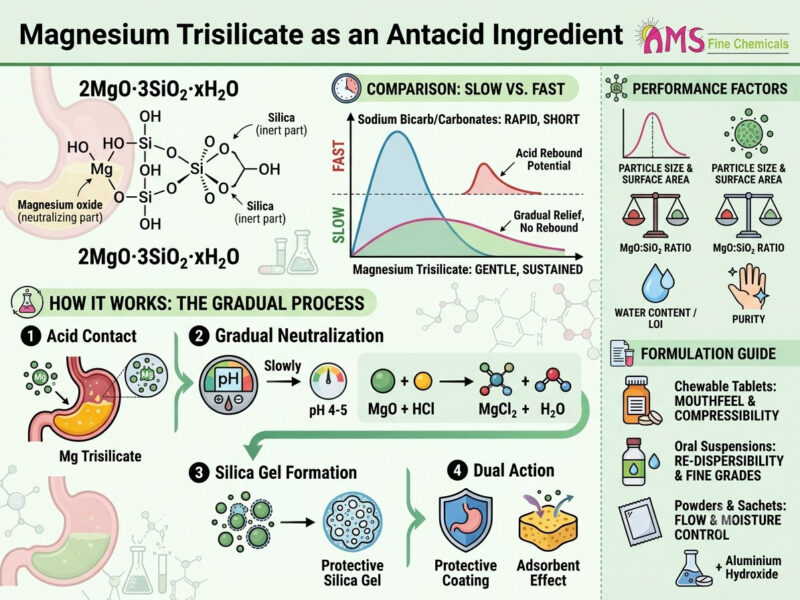
Magnesium Trisilicate is a fine, white, odourless synthetic powder made by precipitating a soluble magnesium salt with sodium silicate under controlled conditions. Chemically, it is best described as a hydrated magnesium silicate — not a single fixed compound but a family of closely related oxide-silica-water combinations, generally represented as:
2MgO · 3SiO₂ · xH₂O
It has been used in medicine for over a century, mainly for two reasons:
- It neutralizes gastric acid slowly and steadily, unlike fast-reacting antacids such as sodium bicarbonate, avoiding the “acid rebound” that can follow rapid neutralization.
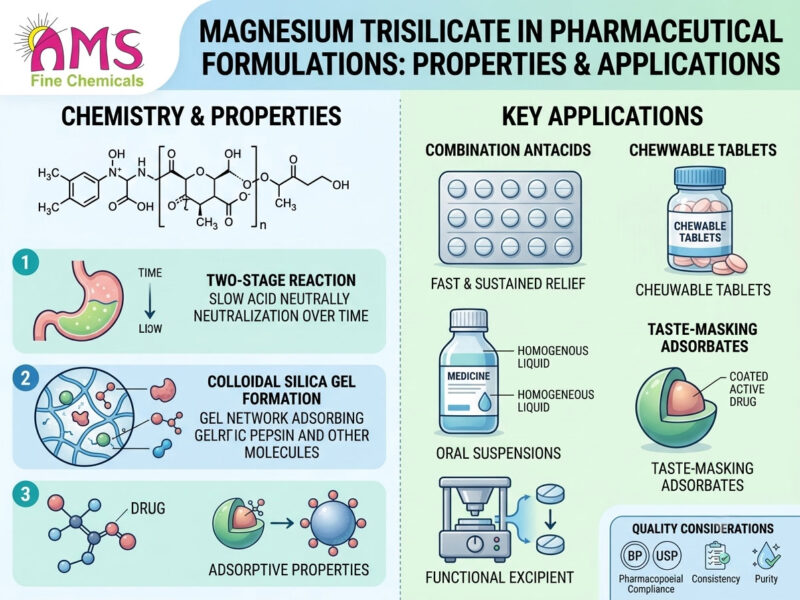
- It forms a protective silica gel when it reacts with hydrochloric acid in the stomach, which coats irritated or ulcerated mucosal tissue and adsorbs excess bile, pepsin, and gas-forming toxins.
Outside the antacid aisle, the same powder is prized in solid-dose manufacturing as a glidant, anti-caking agent, and moisture scavenger — which is why it shows up in tablet formulations that have nothing to do with digestion at all. If you want the full manufacturing story behind how this powder is actually made at industrial scale, our Magnesium Trisilicate Manufacturing Process article walks through the precipitation, washing, and drying stages in detail.
Why Does the Pharmacopoeia Matter at All?
A pharmacopoeia is a legally recognized book of standards. It tells a manufacturer exactly what a substance must contain, what it must not contain, and how each of those claims must be verified in a laboratory. Two pharmacopoeias dominate global trade in excipients like Magnesium Trisilicate:
- British Pharmacopoeia (BP) — published by the UK’s Medicines and Healthcare products Regulatory Agency (MHRA), and the reference standard across the UK, much of the Commonwealth, and — closely mirrored — by the Indian Pharmacopoeia (IP).
- United States Pharmacopeia (USP–NF) — published by the independent, non-profit USP organization, and the compendial standard recognized by the U.S. FDA for any drug or excipient sold in the American market.
Neither standard is “better” than the other — they are simply different legal yardsticks, written by different bodies, for different regulatory jurisdictions. A batch of Magnesium Trisilicate that is perfectly compliant in London can be technically non-compliant on paper in New Jersey, even if both batches came off the same production line, purely because the assay and testing criteria differ.
This is precisely why export-focused manufacturers in Gujarat’s chemical corridor — a hub covered in more depth in our piece on Industrial Applications of Magnesium Carbonate Across 15 Industries — have to design their processes around dual compliance from day one, rather than retrofitting a single-market product later.
The Core Difference: Oxide Content and Molar Ratio
If you remember only one distinction between BP and USP Magnesium Trisilicate, remember this: the two pharmacopoeias define the same compound with different minimum oxide contents and different silica-to-magnesia ratios.
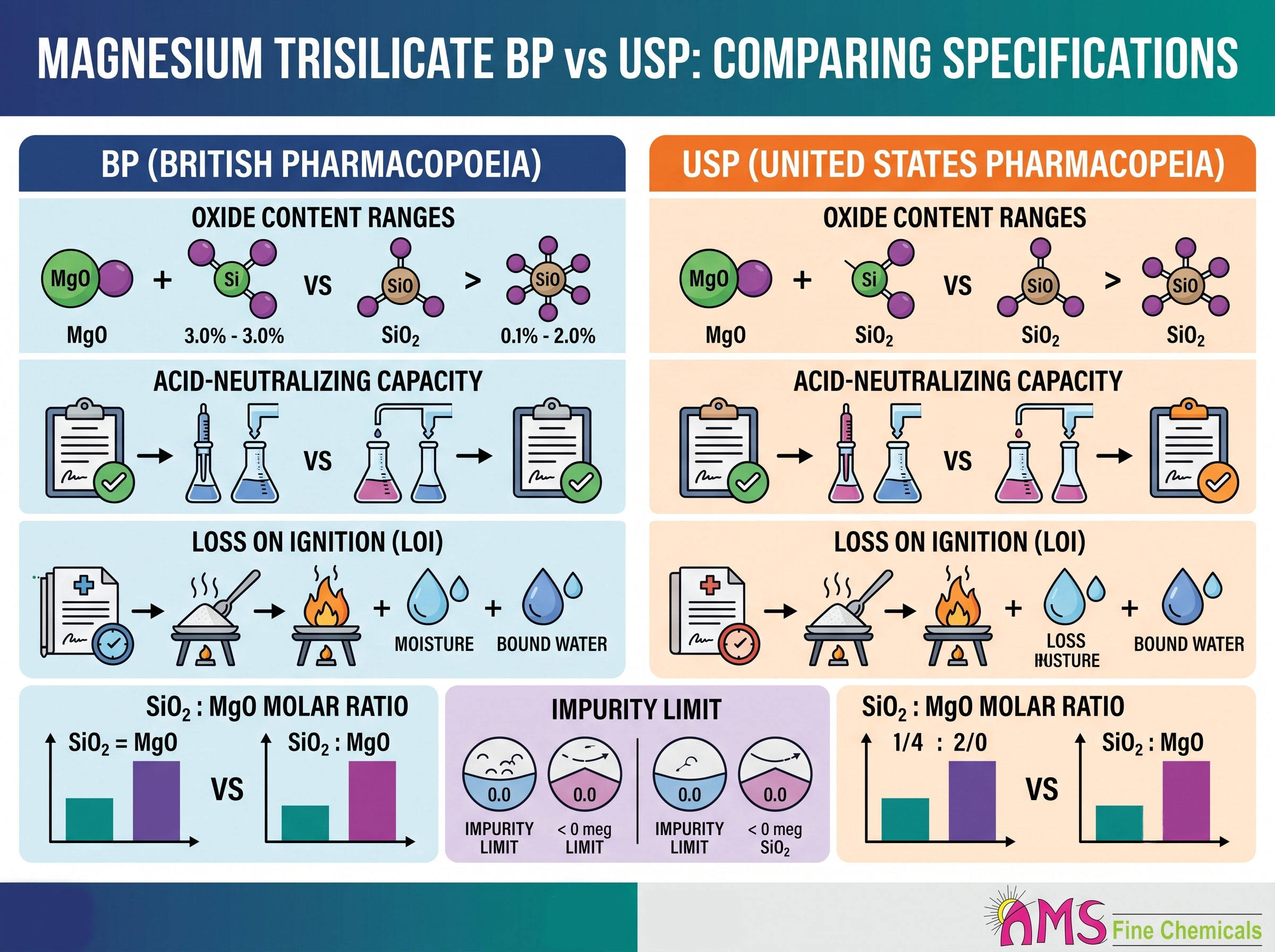
British Pharmacopoeia (BP): BP defines Magnesium Trisilicate as a hydrated silicate containing not less than roughly 29% magnesium oxide (MgO) and not less than about 65% silicon dioxide (SiO₂), calculated on the ignited substance. The ratio of SiO₂ to MgO under BP typically sits in a comparatively narrow band, reflecting a composition weighted more heavily toward magnesium oxide relative to the USP monograph.
United States Pharmacopeia (USP): USP takes a broader compositional window, permitting Magnesium Trisilicate with a lower minimum MgO content (roughly 20%) and a lower minimum SiO₂ content (roughly 45%), but with a wider, higher silica-to-magnesia molar ratio band than BP.
In practical terms: BP-leaning material carries relatively more magnesium oxide per gram, which tends to translate into faster, higher-capacity acid neutralization. USP-leaning material carries a comparatively higher proportion of silica, which supports its role as an adsorbent and gel-forming agent. Neither is superior in absolute terms — the “correct” choice depends entirely on what the finished formulation needs to do.
Acid-Consuming Capacity: The Test That Actually Matters to Patients
Assay percentages are important for compliance, but the test that most directly reflects real-world antacid performance is acid-consuming capacity — a measurement of how much dilute hydrochloric acid one gram of the powder can neutralize.
- Under the BP method, a fixed mass of material is stirred with a measured volume of 0.1 M hydrochloric acid for a set period at body temperature, and the unreacted acid is back-titrated with sodium hydroxide to determine how much acid was actually consumed.
- Under the USP method, the same principle applies but with a different volume threshold, calculated on an ignited (moisture-free) basis, which generally sets a higher minimum acid-consuming requirement per gram of active material.
This single test is why formulators can’t simply substitute one pharmacopoeial grade for another inside an existing tablet or suspension formula without revalidating the dose. A product designed around BP-grade acid-consuming capacity may under- or over-perform if a USP-grade material is dropped in without adjusting the fill weight.
Loss on Ignition, Moisture, and Why It’s Not Just a Number
Both BP and USP specify a loss on ignition (LOI) range, typically falling between roughly 17% and 34% when the sample is heated to temperatures around 900–1000°C. This figure captures two very different things at once:
- Surface moisture — physically adsorbed water that evaporates at relatively low temperatures.
- Structurally bound water and silanol (Si–OH) groups — chemically incorporated into the silicate matrix, which only leave the structure at much higher temperatures.
Why does this matter on the factory floor? Because LOI is really a proxy for the integrity of the silicate matrix itself:
- Too little bound water, and the porous gel structure that gives Magnesium Trisilicate its acid-buffering and adsorbent behaviour partially collapses, reducing reactivity.
- Too much residual moisture, and the powder becomes prone to caking, poor flow, and sticking to tablet punches during high-speed compression — a problem we cover in more general terms in our guide on Complete Guide to Magnesium Hydroxide Manufacturing Process, where moisture control plays a similarly central role.
Impurity Limits: Where BP and USP Actually Agree
Not everything differs. On several impurity parameters, BP and USP converge on very similar limits, because both are ultimately protecting the same patient population from the same categories of contamination:
| Impurity / Parameter | Typical Requirement |
|---|---|
| Chloride | Restricted to a few hundred parts per million |
| Sulfate | Restricted to a small fraction of a percent |
| Heavy metals (as lead) | Capped in the low parts-per-million range |
| Arsenic | Capped in the single-digit parts-per-million range |
| Microbial limits | Must comply with standard pharmacopoeial microbial testing |
Where USP has modernized further is in its adoption of General Chapters <232> and <233>, which move away from older colorimetric heavy-metal tests toward ICP-OES/ICP-MS elemental impurity testing aligned with ICH Q3D guidelines — a more sensitive, element-specific methodology that BP has also been progressively harmonizing toward through Ph. Eur. general chapters.
How Laboratories Actually Verify Compliance
A Certificate of Analysis (CoA) is only as trustworthy as the methodology behind it. Reputable manufacturers verify BP/USP compliance for every batch using a defined analytical sequence:
- MgO Assay — complexometric EDTA titration against a magnesium standard, using an Eriochrome Black T or Methylthymol Blue endpoint indicator.
- SiO₂ Assay — gravimetric determination via acid digestion, ignition to constant mass, then hydrofluoric acid volatilization to isolate pure silica by mass difference.
- Acid-Consuming Capacity — back-titration against standardized hydrochloric acid and sodium hydroxide.
- Elemental Impurities — ICP-OES or ICP-MS screening for lead, arsenic, cadmium, and mercury.
- Particle Size Distribution — laser diffraction analysis reporting D10, D50, and D90 values, since particle size drives flowability, suspension stability, and mouthfeel in chewable dosage forms.
At AMS Fine Chemicals, every production lot of Magnesium Trisilicate moves through this exact sequence before release, and a full Certificate of Analysis covering both BP and USP parameters is issued alongside each shipment.
Reading a Certificate of Analysis Without Getting Misled
Procurement teams frequently ask what to actually check on a supplier’s CoA before signing off on a shipment. A few practical checkpoints:
- Confirm the monograph referenced. A CoA that simply says “complies with pharmacopoeial standards” without naming BP, USP, IP, or Ph. Eur. specifically is a red flag — ask the supplier to specify which monograph was tested against.
- Check the ignited-basis vs as-is basis. Assay and acid-consuming capacity figures are usually reported on an ignited (moisture-free) basis. A CoA that quietly reports on an as-is basis can look more impressive than it really is.
- Cross-check the molar ratio, not just the individual percentages. A material can pass individual MgO and SiO₂ minimums while still falling outside the required SiO₂:MgO ratio band — always ask for the ratio explicitly.
- Ask for batch-specific data, not a generic specification sheet. A true CoA reflects the tested values of that specific lot, not a static “typical values” table copied across shipments.
Choosing Between BP and USP for Your Formulation
There is no universally “correct” grade — the right choice depends on three factors: target market, regulatory pathway, and functional requirement.
By market:
- Selling into the US, or filing an ANDA/NDA with the FDA → USP grade is the compendial reference.
- Selling into the UK, EU, Commonwealth markets, or India → BP grade (or IP, which closely mirrors BP) is the expected reference.
- Selling into multiple regions simultaneously → a dual BP/USP-compliant grade avoids maintaining two separate raw material codes, two separate CoAs, and two separate supplier qualifications.
By function:
- Formulations prioritizing rapid, high-capacity acid neutralization often favour BP-leaning material, given its higher relative MgO content.
- Formulations prioritizing adsorption, moisture scavenging, or anti-caking performance — such as tablet excipient blends — often favour USP-leaning material with its higher relative silica content.
- Liquid suspensions and chewable tablets typically demand a micronized, low-density grade regardless of pharmacopoeia, to control mouthfeel and prevent sedimentation.
Beyond Antacids: Where This Grade Distinction Follows the Material
The BP/USP distinction isn’t confined to the antacid aisle. Because Magnesium Trisilicate also functions as a glidant, anti-caking agent, and moisture-scavenging excipient, the same monograph choice follows the material into:
- Chewable and effervescent antacid tablets, often combined with aluminium hydroxide, calcium carbonate, or sodium alginate to form a “raft” that floats above gastric contents and limits reflux.
- Solid oral dosage excipient blends, where it protects moisture-sensitive actives such as aspirin from hydrolytic degradation.
- Cosmetic and personal care powders, functioning as an oil-absorbing, mattifying agent.
- Edible oil purification, where industrial-grade magnesium silicates adsorb free fatty acids and polar compounds from used frying oil.
This cross-industry role sits alongside our other magnesium-based product lines — including Magnesium Hydroxide, which serves a parallel role as a laxative and flame retardant, as explored in Magnesium Hydroxide as Eco-Friendly Flame Retardant in Plastics, Rubber, and Wire/Cable Compounds and Light Magnesium Hydroxide as a Gentle Laxative: Osmotic Action, Dosing, and Formulation Tips — and our Magnesium Carbonate range, discussed in Complete Guide to Magnesium Carbonate Manufacturing Process.
Common Sourcing Mistakes We See from First-Time Buyers
- Assuming “pharma grade” is a single standard. It isn’t — always specify BP, USP, IP, or Ph. Eur. explicitly in the purchase order.
- Not requesting the molar ratio on the CoA. Individual assay percentages can pass while the ratio quietly fails.
- Ignoring particle size for suspension products. A powder that assays perfectly can still cause sedimentation or grittiness if D90 isn’t controlled.
- Overlooking storage guidance. Magnesium Trisilicate is hygroscopic and mildly reactive with atmospheric carbon dioxide; it should be stored in sealed containers, below roughly 30°C, away from direct sunlight and humidity, with a typical shelf life of around five years unopened.
- Treating BP and USP grades as drop-in substitutes. Switching pharmacopoeial grade mid-production without revalidating acid-consuming capacity and dissolution can silently shift a finished product’s performance.
How AMS Fine Chemicals Engineers for Dual Compliance
Manufacturing a single grade that satisfies both BP and USP simultaneously is not a matter of splitting the difference — it requires tight process control from the very first precipitation step:
- Precise reactant metering during the magnesium salt–sodium silicate precipitation reaction, to land the SiO₂:MgO molar ratio inside both pharmacopoeial bands at once.
- Multi-stage purified-water washing to drive residual chloride and sulfate well below both BP and USP thresholds.
- Controlled drying and micronization, keeping loss on ignition inside the shared 17–34% window while tailoring particle size to the customer’s dosage form.
- Full-panel batch release testing, covering MgO/SiO₂ assay, acid-consuming capacity, elemental impurities via ICP-OES, and laser diffraction particle sizing, before any lot leaves the Bhavnagar facility.
Every shipment leaves with complete documentation support — Certificates of Analysis referencing BP, USP, IP, and Ph. Eur. limits, Technical Data Sheets, BSE/TSE-free declarations, and stability data under ICH-aligned conditions — so regulatory affairs teams can file with confidence in whichever jurisdiction they’re targeting. You can review the full technical and physical specification sheet for our pharmaceutical-grade material on the Magnesium Trisilicate product page, or browse our complete inorganic salts range on the Products page.
A Quick History: Why Two Standards Exist in the First Place
It helps to understand why BP and USP diverged at all. Both pharmacopoeias trace back over a century of independent national drug-quality regulation — the British Pharmacopoeia has been published since 1864 under evolving UK medical authorities, while the United States Pharmacopeia dates to 1820 and has operated as an independent scientific body ever since, later working alongside the FDA once the agency was established. Because each was built to regulate a separate national drug supply, each pharmacopoeia developed its own committee structure, its own reference reagents, and its own historical testing conventions — including, for compounds like Magnesium Trisilicate, different assumptions about acceptable oxide ranges and molar ratios.
Global harmonization efforts, such as the Pharmacopoeial Discussion Group involving USP, Ph. Eur., and the Japanese Pharmacopoeia, have aligned many excipient monographs over the decades. Magnesium Trisilicate, however, remains one of the compounds where BP and USP have retained materially different compositional limits, which is exactly why suppliers and buyers still need to treat the two standards as distinct specifications rather than interchangeable labels.
European Pharmacopoeia (Ph. Eur.) — Where It Fits In
Buyers exporting into the EU will also encounter the European Pharmacopoeia (Ph. Eur.), which maintains its own Magnesium Trisilicate-related monographs and is legally binding across EU member states. In practice, Ph. Eur. limits for oxide content and impurities tend to sit closer to the BP framework than to USP, which is unsurprising given the historical overlap between British and European pharmacopoeial committees. Suppliers targeting European buyers should be prepared to test and certify against Ph. Eur. general chapters — particularly the newer elemental impurity chapters aligned with ICH Q3D — alongside BP and USP data on the same Certificate of Analysis.
A Practical Scenario: Switching Suppliers Mid-Product-Life
Consider a formulator who has been running a chewable antacid tablet for three years using a BP-grade Magnesium Trisilicate, then receives a competitive quote from a new supplier offering “pharma-grade” material at a lower price. Without checking the monograph, the team substitutes it directly into the existing formula. Three outcomes are possible:
- If the new material is genuinely BP-equivalent, tableting and dissolution performance should remain unchanged.
- If the new material is USP-grade but mislabeled as a generic “pharma grade,” the lower relative MgO content can quietly reduce acid-consuming capacity per tablet, potentially pushing finished-product testing outside its validated release specification.
- If the new material’s particle size distribution differs — even within the same pharmacopoeial grade — tablet hardness, disintegration time, and friability can shift enough to trigger an out-of-specification investigation.
This scenario is common enough that experienced procurement teams treat any supplier change, even a like-for-like one, as an event requiring a fresh Certificate of Analysis review and, where budgets allow, confirmatory in-house testing before the material reaches full-scale production.
Frequently Asked Questions
Is USP-grade Magnesium Trisilicate automatically “purer” than BP-grade? No. Purity limits for impurities like heavy metals, chloride, and sulfate are broadly comparable between the two pharmacopoeias. The real difference lies in permitted oxide content ranges and the SiO₂:MgO ratio, not overall purity.
Can one product satisfy both BP and USP monographs at once? Yes, with tight process control. A dual-compliant grade is engineered so its oxide content and molar ratio fall within both pharmacopoeias’ acceptable ranges simultaneously, avoiding the need to stock and qualify two separate raw materials.
Does India’s Pharmacopoeia (IP) align with BP or USP? The Indian Pharmacopoeia’s Magnesium Trisilicate monograph is closely harmonized with the British Pharmacopoeia, which is why manufacturers targeting the Indian domestic market typically default to BP-aligned specifications.
What packaging is standard for pharmaceutical-grade Magnesium Trisilicate? Common formats include 25 kg HDPE bags with food-grade inner PE liners, 500 kg jumbo bags for bulk buyers, and custom fiber drums — all designed to protect the hygroscopic powder during transit and storage.
Why does particle size matter if the chemistry is already compliant? Compliance testing confirms chemical identity and purity, but particle size distribution (D10, D50, D90) independently governs flowability, suspension stability, tablet compressibility, and mouthfeel — none of which the assay or acid-consuming capacity test alone will reveal.
Final Word
BP and USP are not competing quality tiers — they are two legally distinct rulebooks, each governing a different regulatory territory, and each defining Magnesium Trisilicate with its own oxide limits, molar ratio band, and acid-consuming capacity threshold. Getting this right at the sourcing stage saves formulation teams from costly revalidation later, and saves regulatory affairs teams from documentation gaps during audits.
For buyers navigating multi-market filings, working with a manufacturer that tests, documents, and certifies against both pharmacopoeias from a single production line — rather than treating BP and USP as an afterthought — is the simplest way to keep one raw material code compliant everywhere it needs to be.
To request a Certificate of Analysis, Technical Data Sheet, or a sample of dual BP/USP-grade Magnesium Trisilicate, visit our Magnesium Trisilicate product page or get in touch through our Contact Us page.