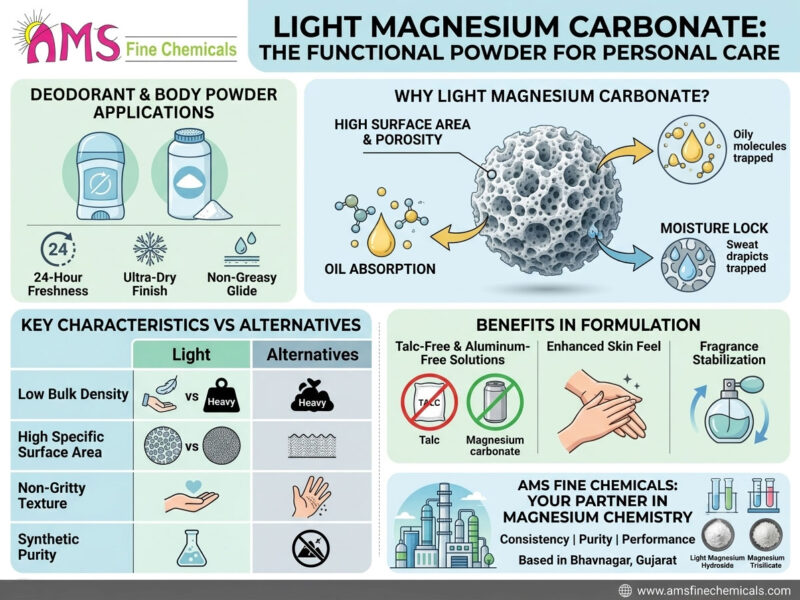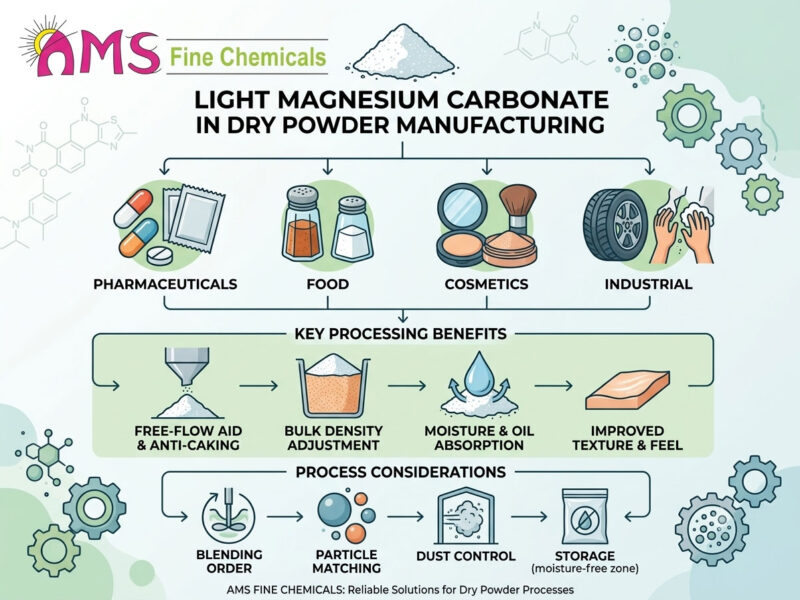
Moisture control is one of personal care formulation’s quietest but most persistent challenges — not the dramatic, headline ingredient claim on a product label, but the unglamorous functional work that determines whether a deodorant actually keeps skin dry, whether a powder-based product stays free-flowing through months of bathroom-shelf humidity exposure, or whether a formulation separates and degrades before its intended shelf life. Light Magnesium Carbonate has become one of the personal care industry’s standard tools for exactly this kind of moisture management, appearing across a far broader range of product categories than its most visible use in face powders might suggest.
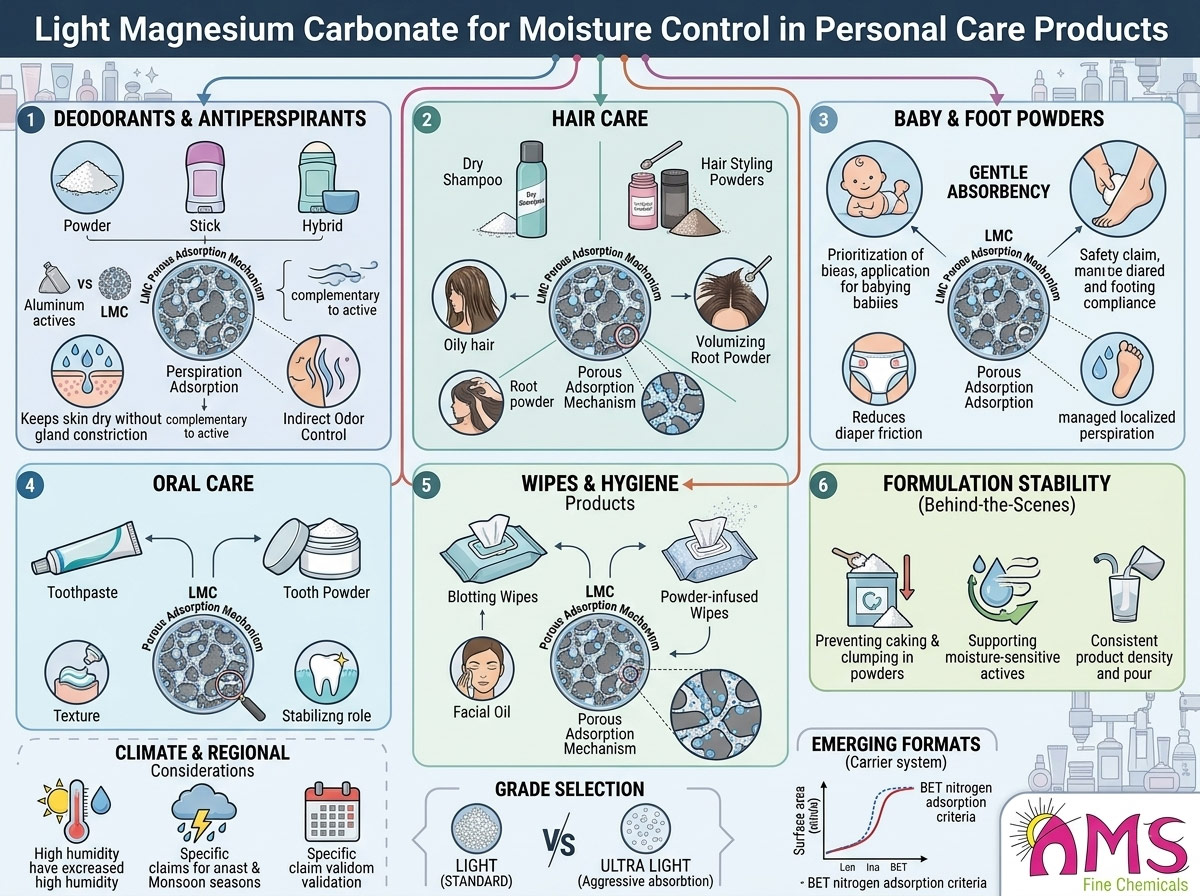
This guide surveys Light Magnesium Carbonate’s moisture-control role across the personal care category — deodorants and antiperspirants, hair care, oral and baby care, wipes and hygiene products, and general skincare stability — with a focus specifically on the moisture-management function itself, distinct from the optical and texture-focused benefits covered in our related cosmetics content.
The Moisture-Control Mechanism, Briefly Revisited
Light Magnesium Carbonate’s moisture-control function across every category in this guide traces back to the same fundamental mechanism: a porous, high-surface-area particle structure that physically adsorbs moisture into its own internal void network, rather than reacting with it chemically. Our Magnesium Carbonate Moisture Absorption: What Formulators Need to Know article covers this adsorption mechanism at a technical level — this guide focuses on how that single mechanism translates into distinct, functionally important benefits across the personal care category’s very different product types.
Deodorants and Antiperspirants: The Category’s Most Direct Moisture-Control Application
Underarm care products represent one of the most demanding moisture-control challenges in personal care, since the product needs to manage sustained perspiration throughout an entire day, often under clothing and body heat that actively works against dryness.
How Light Magnesium Carbonate contributes: In powder-based deodorants, powder-to-cream hybrid formats, and stick formulations incorporating powder components, Light Magnesium Carbonate absorbs underarm perspiration directly, helping maintain a drier, more comfortable feel and reducing the moisture available to support the bacterial activity responsible for body odor — since odor-causing bacteria require moisture to proliferate, moisture reduction indirectly supports odor control alongside its direct comfort benefit.
How this differs from antiperspirant active ingredients: It’s worth distinguishing Light Magnesium Carbonate’s role from that of aluminum-based antiperspirant actives, which work by temporarily constricting sweat glands to physically reduce perspiration output. Light Magnesium Carbonate doesn’t reduce sweat production — it manages the moisture that is produced, making it relevant to both antiperspirant formulations (as a complementary moisture-management ingredient alongside the active) and deodorant-only formulations (which don’t reduce perspiration but still benefit from managing its moisture and odor consequences).
Formulation format considerations: Powder deodorants and certain stick formulations can incorporate Light Magnesium Carbonate at meaningful inclusion rates, while cream and roll-on formats — being predominantly liquid-based — generally use it more sparingly or not at all, since its function depends on having accessible porous structure to adsorb moisture into, a role better suited to powder-dominant formats.
Odor-control considerations beyond moisture management: While Light Magnesium Carbonate’s primary contribution to odor control is indirect — reducing the moisture that odor-causing bacteria depend on to proliferate — its porous structure also offers some direct odor-adsorbing capacity, similar in principle to its documented ability to adsorb ambient odors in storage environments, discussed in our broader Magnesium Carbonate storage content. This dual mechanism (moisture reduction plus some direct odor adsorption) contributes to why powder-based and powder-containing deodorant formulations often achieve effective odor control even without relying entirely on fragrance masking or antimicrobial actives to do the full functional work.
Hair Care: Dry Shampoo and Beyond
Dry shampoo represents one of the more demanding moisture-control applications in hair care specifically, requiring rapid, effective absorption of scalp oil and moisture at the hair root while remaining visually undetectable once brushed through — a combination covered in more depth, alongside grade-selection guidance, in our Light Magnesium Carbonate in Cosmetics: Oil Absorption and Texture Benefits article.
Beyond dry shampoo specifically, Light Magnesium Carbonate’s moisture-management properties extend to a few adjacent hair care applications:
- Hair styling powders designed to add root volume and reduce oiliness between washes rely on the same absorption mechanism as dry shampoo, often at a coarser or differently-formulated particle size depending on the specific volumizing versus absorbing balance targeted.
- Scalp treatment powders, particularly for oily scalp conditions, use similar absorbency principles to manage excess sebum production at the scalp level.
Oral Care: A Less Obvious but Established Application
Oral care products represent a less immediately obvious personal care category for Light Magnesium Carbonate, but it has an established, if narrower, role here:
As a mild abrasive and texturizing agent in certain toothpaste and tooth powder formulations, contributing to the product’s cleaning texture and mouthfeel, generally at modest inclusion levels relative to the primary abrasive and cleaning agents in a typical oral care formulation.
As a moisture and consistency stabilizer in powder-based oral care products specifically, where its moisture-management properties support consistent product texture and flow through a product’s shelf life, similar in principle to its role in other powdered personal care formats.
This oral care role is narrower than its cosmetic and deodorant applications, but reflects the same underlying versatility — a functional ingredient that formulators reach for across a genuinely wide range of product types whenever moisture management or texture consistency is needed, not just in the powder-cosmetics categories most commonly associated with it.
Baby Care and Foot Powders: Traditional Moisture-Control Strongholds
Baby powders and foot powders represent some of the longest-established moisture-control applications for magnesium carbonate-family ingredients in personal care, predating many of the more recently developed cosmetic applications covered elsewhere in this guide.
Baby care powders rely on rapid, gentle moisture absorption to help keep skin dry in diaper-covered areas prone to prolonged moisture exposure and resulting skin irritation — a use case where the material’s low reactivity and established long-term safety profile matter as much as its absorbency performance, given the sensitivity of infant skin and the regulatory scrutiny applied to products intended for this population.
Foot powders target a similarly demanding moisture environment — feet enclosed in shoes for extended periods, generating significant localized perspiration — where Light Magnesium Carbonate’s absorbency helps manage moisture, reduce friction-related discomfort, and support the drier environment less hospitable to the bacterial and fungal activity associated with common foot odor and skin issues.
Both applications benefit from the same porous particle structure discussed throughout this guide, though formulators typically prioritize gentleness and mildness alongside absorbency performance for these specific, sensitive-skin-adjacent use cases.
Wipes and Hygiene Products: An Emerging Application Area
Beyond traditional powder formats, Light Magnesium Carbonate has found a role in some wipe and hygiene product formulations, particularly those targeting oil control or moisture management as a stated product benefit:
- Blotting and oil-control wipes, formulated to remove excess facial oil throughout the day, sometimes incorporate Light Magnesium Carbonate within the wipe’s coating or fiber structure to enhance the oil-absorbing function beyond what the base fiber material alone would achieve.
- Powder-infused hygiene wipes, designed to leave a light, moisture-absorbing residue after use, represent a hybrid format combining wipe convenience with some of the ongoing moisture-management benefit more traditionally associated with standalone powder products.
This represents a smaller, more specialized application area compared to the more established categories covered above, but illustrates the ingredient’s continued relevance as personal care product formats continue to diversify beyond traditional powders, creams, and sticks.
Emerging Formulation Formats: Carrier and Delivery System Applications
Beyond its traditional absorbency role, ongoing formulation research has explored Magnesium Carbonate’s potential as a carrier material for active ingredient delivery in personal care and home care formulations — an application that leverages the same porous structure discussed throughout this guide, but for a functionally different purpose: controlled release of an active ingredient rather than pure moisture absorption.
Patent literature in this space has explored surface-reacted and engineered magnesium carbonate carriers specifically designed for improved loading and release characteristics of active ingredients within personal and home care formulations, using specific surface area as a key engineering parameter — material with specific surface area at or above roughly 25 square meters per gram measured via BET nitrogen adsorption has been identified in this research as supporting improved active ingredient loading and release performance compared to lower-surface-area material.
While this carrier application remains a more specialized, emerging use case compared to the established moisture-control applications covered throughout this guide, it illustrates a broader principle worth noting: the same fundamental property — high, well-controlled surface area — that drives Light Magnesium Carbonate’s moisture-absorption performance in mainstream personal care applications also underlies its potential in more advanced, actively-researched delivery system applications, reinforcing surface area’s position as the single most functionally important physical property across this ingredient’s full range of uses.
Formulation Stability: Moisture Control as a Behind-the-Scenes Function
Beyond its consumer-facing moisture-absorption role, Light Magnesium Carbonate’s moisture-management properties also serve a less visible but formulation-critical function: protecting a product’s own stability and shelf life.
Preventing caking and clumping in powder-based products: As covered in our Magnesium Carbonate Moisture Absorption article, Light Magnesium Carbonate’s inclusion in a broader powder formulation helps intercept ambient moisture before it can trigger caking or clumping in more moisture-sensitive co-ingredients, extending shelf life and maintaining consistent product texture through a product’s full use life.
Supporting stability of moisture-sensitive active ingredients: In formulations incorporating actives sensitive to hydrolytic degradation, Light Magnesium Carbonate’s moisture-scavenging behaviour can provide a genuine stability benefit, protecting the active ingredient’s potency through the product’s shelf life — a formulation consideration covered more broadly in our Magnesium Carbonate Compatibility With Common Industrial Ingredients article.
Maintaining consistent product density and pour behaviour: For powder products packaged in shaker or sprinkle-format containers, consistent moisture content directly affects pour behaviour and dosing consistency — a caked or partially clumped product delivers inconsistent amounts per use, undermining the predictable application experience consumers expect.
Climate and Regional Formulation Considerations
Personal care formulators supplying multiple regional markets should account for how climate affects moisture-control requirements, since a formulation validated under one climate’s conditions doesn’t automatically perform equivalently elsewhere:
- High-humidity, tropical markets — including much of South and Southeast Asia — present sustained environmental moisture load on top of whatever perspiration-related moisture the product itself is meant to manage, generally warranting higher-capacity grades (Light or Ultra Light) and more conservative shelf-life claims than products formulated primarily for temperate or arid markets.
- Monsoon-season variability, relevant to manufacturers based in or supplying regions like western India, introduces a distinct seasonal humidity spike that can affect both raw material storage and finished product performance during peak monsoon months, a consideration covered in more depth in our Magnesium Carbonate Storage and Handling: Best Practices for Industrial Buyers guide.
- Products marketed with specific climate-adapted claims — “tropical formula,” “monsoon-proof,” or similar regional positioning — should be formulated and stability-tested specifically under the target climate’s conditions rather than assuming a formulation validated for a temperate market will perform equivalently.
Manufacturers based in humid coastal regions — including AMS Fine Chemicals’ own location in Bhavnagar, Gujarat — have direct, practical familiarity with formulating and sourcing raw materials suited to exactly these high-humidity performance demands, relevant to formulators developing products for similar climate conditions elsewhere.
Grade Selection Across Personal Care Categories
Consistent with the grade-selection logic covered across our broader Magnesium Carbonate content, personal care formulators should match grade to the specific absorbency demand of their product category:
Light Magnesium Carbonate serves as the standard choice across most personal care applications covered in this guide — deodorants, general hair care, baby and foot powders, and standard oral care formulations — offering reliable absorbency performance suited to typical, moderate moisture exposure.
Ultra Light Magnesium Carbonate is generally reserved for the most absorbency-demanding applications within the category — high-performance antiperspirant-adjacent deodorant formulations, aggressive-formula dry shampoos, or specialty products specifically marketed around maximum moisture-control claims — where its higher surface area justifies the additional cost over standard Light grade.
Regulatory and Safety Considerations Across Categories
Different personal care categories carry different regulatory expectations, and formulators should confirm appropriate documentation for their specific application:
- General cosmetic and personal care applications typically require confirmation of appropriate heavy metal and microbial testing, along with documentation supporting the relevant regional cosmetic regulatory framework.
- Baby care and other sensitive-population products often warrant additional scrutiny and, in some markets, specific regulatory requirements beyond standard adult cosmetic formulations, given the heightened sensitivity of the target population.
- Oral care products may fall under a distinct regulatory category depending on jurisdiction, sometimes overlapping with cosmetic regulation and sometimes with more specific oral care or medical device frameworks depending on product claims.
Our Magnesium Carbonate COA Explained: Important Parameters Buyers Should Check article covers the general testing panel relevant across these applications, though formulators should confirm the specific documentation requirements applicable to their particular product category and target market.
How AMS Fine Chemicals Supports Personal Care Formulators
AMS Fine Chemicals, based in Bhavnagar, Gujarat, manufactures Light and Ultra Light Magnesium Carbonate with the consistent particle size, absorbency, and purity personal care formulators depend on across this full range of product categories — from deodorants and dry shampoo to baby powders and beyond. Full in-house testing, including particle size distribution, whiteness index, and heavy metal content via ICP-OES, supports the documentation needs of formulators working across cosmetic, personal care, and adjacent regulatory categories.
Explore full technical specifications on our Light Magnesium Carbonate and Ultra Light Magnesium Carbonate product pages, or browse our complete Magnesium Carbonate range and our broader portfolio of magnesium compounds — including Magnesium Hydroxide and Magnesium Trisilicate — on the Products page.
Frequently Asked Questions
Can Light Magnesium Carbonate replace aluminum-based antiperspirant actives? No — it manages moisture that’s already been produced rather than reducing perspiration output the way aluminum-based actives do. It can complement an antiperspirant active within a formulation, or serve as the primary moisture-management ingredient in a deodorant-only (non-antiperspirant) product.
Is Light Magnesium Carbonate safe for baby care formulations? It has an established history of use in baby powder formulations, given its low reactivity and long safety track record, though formulators should confirm appropriate testing and documentation specific to their target market’s regulatory requirements for infant and child care products.
How does Light Magnesium Carbonate’s moisture-control role differ between a deodorant and a face powder? The underlying mechanism is identical — porous adsorption of moisture — but formulation context differs: deodorants manage sustained perspiration under different environmental conditions (body heat, clothing coverage) than face powders, which primarily manage sebum and lighter perspiration under more variable, open-air exposure.
Does Light Magnesium Carbonate contribute to a product’s shelf-life stability, or only to its in-use performance? Both — its moisture-scavenging properties protect the formulation itself from caking, clumping, and moisture-related degradation of sensitive co-ingredients during storage and shelf life, in addition to its consumer-facing, in-use moisture-absorption function.
Should oral care formulators use a different grade than deodorant formulators? Not necessarily based on grade alone — both typically use standard Light Magnesium Carbonate, though inclusion rate and particle size specification should be tailored to each product’s specific texture, mouthfeel, or skin-feel requirements rather than assuming a single specification transfers directly across such different product categories.
Does formulating for a humid climate market require a different Magnesium Carbonate specification than a temperate market? Not necessarily a different chemical specification, but formulators should validate stability and performance specifically under the target climate’s humidity conditions, since a formulation’s actual shelf-life and in-use performance can differ meaningfully between climates even when using an identical raw material specification — accelerated stability testing under the target market’s realistic humidity range remains the most reliable way to confirm this rather than assuming performance transfers directly from one climate to another.
Final Word
Light Magnesium Carbonate’s moisture-control role in personal care extends well beyond the face powders most commonly associated with it — the same porous, moisture-adsorbing mechanism supports deodorants and antiperspirants, dry shampoo and hair care, oral care texture, baby and foot powders, and even emerging wipe and hygiene formats, while quietly protecting formulation stability behind the scenes in nearly every powder-based personal care product it touches. For formulators working across this diverse category, understanding moisture control as the unifying functional thread — rather than treating each application as an unrelated use case — supports more informed grade selection and formulation troubleshooting across an entire personal care product portfolio.
To request technical specifications, sample batches, or grade selection guidance for personal care formulation development, visit our Light Magnesium Carbonate product page or reach out through our Contact Us page.