Magnesium Carbonate (MgCO₃) is a versatile inorganic salt with an expansive footprint across industries. From serving as an essential anti-caking agent in food processing and a critical excipient in pharmaceuticals to acting as a reinforcing filler in rubber and a drying agent for athletes, its utility is unmatched.
As a premier manufacturer of high-purity chemicals, AMS Fine Chemicals delivers top-tier magnesium carbonate tailored to stringent industrial standards. In this comprehensive technical guide, we break down the chemistry, raw materials, industrial manufacturing pathways, quality control measures, and environmental considerations involved in producing high-quality magnesium carbonate.
1. Introduction to Magnesium Carbonate
Magnesium carbonate occurs naturally as the mineral magnesite. However, for advanced pharmaceutical, food, and industrial applications, natural magnesite rarely meets the purity criteria due to heavy metal contamination and structural inconsistencies. Consequently, synthetic manufacturing pathways are utilized to produce high-purity Light Magnesium Carbonate and Heavy Magnesium Carbonate.
Chemical Properties & Forms
The exact chemical formulation of commercial magnesium carbonate typically manifests as a hydrated basic salt rather than a pure anhydrous compound. It is generally represented as:
4MgCO₃ · Mg(OH)₂ · 5H₂O
The physical distinction between its two primary commercial forms dictates its industrial applications:
- Light Magnesium Carbonate: Characterized by a low bulk density (around 0.1 to 0.15 g/cm³). It has an incredibly high surface area and is preferred in cosmetics, food processing, and pharmaceuticals.
- Heavy Magnesium Carbonate: Displays a much higher bulk density (around 0.4 to 0.5 g/cm³). It is favored in heavy industrial applications, rubber manufacturing, and compounding where volume optimization is required.
2. Key Raw Materials Used in the Manufacturing Process
The choice of raw materials defines the efficiency, cost, and purity matrix of the final product. At AMS Fine Chemicals, we meticulously select and refine our input channels to eliminate impurities at the foundational stage. The primary raw material matrices include:
Magnesium-Bearing Sources
- Dolomite (CaMg(CO₃)₂): A highly abundant double carbonate mineral. It requires complex separation techniques to isolate magnesium from calcium.
- Magnesite (MgCO₃): Crude natural magnesium carbonate, which is calcined and chemically processed to achieve synthetic purity.
- Bittern / Sea Water Brine: Rich in Magnesium Chloride (MgCl₂) and Magnesium Sulfate (MgSO₂). This is an incredibly sustainable source utilized in precipitation processes.
Reactants and Carbonating Agents
- Carbon Dioxide (CO₂): Usually captured from kiln flue gases or sourced in purified liquid/gas form to drive carbonation.
- Soda Ash (Sodium Carbonate, Na₂CO₃): Used in direct precipitation methods with magnesium salts.
- Ammonium Carbonate / Ammonium Bicarbonate: Frequently used in specialized chemical synthetic routes to ensure high purity and volatile byproducts that are easily removed.
3. Industrial Manufacturing Methods: Step-by-Step
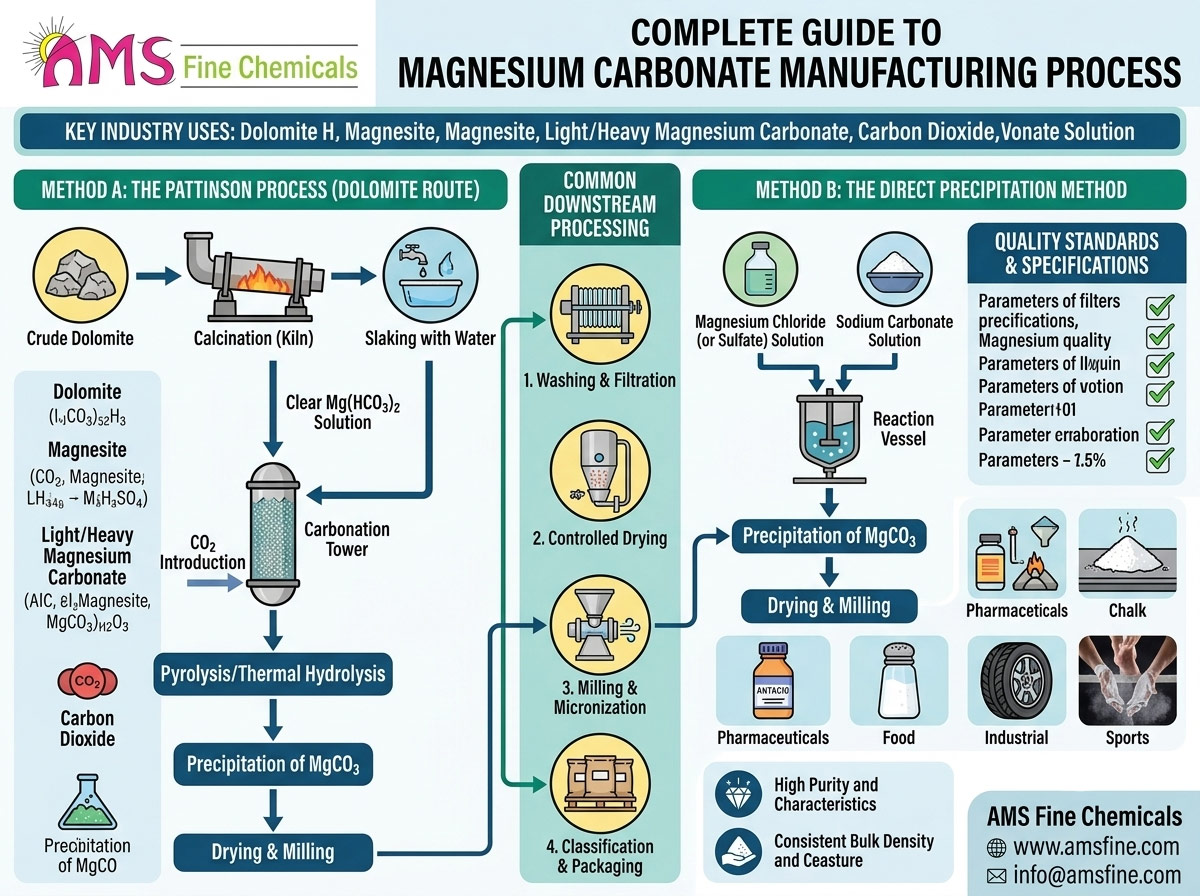
There are two predominant industrial methodologies for manufacturing high-grade synthetic magnesium carbonate: The Pattinson Process (Dolomite Carbonation Method) and the Direct Precipitation Method.
Method A: The Pattinson Process (Dolomite Route)
The Pattinson process is a classic, highly efficient method used to extract pure magnesium carbonate from dolomite while cleanly separating out calcium impurities.
[Crude Dolomite] ➔ [Calcination (Kiln)] ➔ [Slaking with Water]
                        │
                        ▼
[Clear Mg(HCO3)2 Solution] 🔀 [Carbonation Tower (CO2 Introduction)]
                        │
                        ▼
[Pyrolysis/Thermal Hydrolysis] ➔ [Precipitation of MgCO3] ➔ [Drying & Milling]
Step 1: Calcination of Dolomite
Crude dolomite rock is crushed and fed into a vertical or rotary kiln. It is subjected to thermal calcination at temperatures ranging from 800°C to 900°C. This process drives off carbon dioxide, converting the carbonates into oxides:
CaMg(CO₃)₂ —Δ→ CaO · MgO + 2CO₂↑
The resulting mixture is known as calcined dolomite or “dolime.”
Step 2: Slaking (Hydration)
The calcined dolime is cooled and treated with hot water in a slaker. This converts the oxides into their respective hydroxides, forming a thick slurry:
CaO · MgO + 2H₂O → Ca(OH)₂ + Mg(OH)₂
Step 3: Carbonation under Pressure
The slurry is transferred to a carbonation tower. Purified carbon dioxide gas (CO₂) is bubbled through the mixture under controlled pressure (typically 0.2 to 0.4 MPa).
Because Calcium Carbonate (CaCO₃) is highly insoluble, it precipitates out rapidly. Meanwhile, Magnesium Hydroxide reacts further to form highly soluble Magnesium Bicarbonate:
Ca(OH)₂ + Mg(OH)₂ + 3CO₂ → CaCO₃↓ + Mg(HCO₃)₂ + H₂O
Step 4: Separation (Filtration)
The mixture is passed through a high-efficiency filter press. The solid residue—consisting of calcium carbonate and minor iron/silica impurities—is filtered out. The clear, transparent filtrate containing dissolved Mg(HCO₃)₂ is collected for the next stage.
Step 5: Thermal Hydrolysis (Pyrolysis)
The clear magnesium bicarbonate solution is transferred to a reaction vessel and heated using steam to temperatures between 85°C and 95°C. Heating breaks down the soluble bicarbonate, releasing carbon dioxide gas (which is recycled back to the carbonation tower) and precipitating basic magnesium carbonate:
5Mg(HCO₃)₂ + H₂O —Δ→ 4MgCO₃ · Mg(OH)₂ · 5H₂O↓ + 6CO₂↑
The duration and temperature profile of this boiling stage directly influence whether Light or Heavy magnesium carbonate forms.
Method B: The Direct Precipitation Method (Brine / Soda Ash Route)
This method is highly favored when manufacturing ultra-pure pharmaceutical or food-grade magnesium carbonate, as it allows for precise control over ionic impurities.
Step 1: Material Preparation
High-purity Magnesium Chloride (MgCl₂) or Magnesium Sulfate (MgSO₄) derived from purified sea bittern is dissolved in demineralized water. Concurrently, a stoichiometric solution of Sodium Carbonate (Na₂CO₃, Soda Ash) is prepared.
Step 2: Controlled Precipitation
The sodium carbonate solution is slowly added to the magnesium salt solution under vigorous, automated agitation. The reaction occurs instantly:
5MgCl₂ + 5Na₂CO₃ + 6H₂O → 4MgCO₃ · Mg(OH)₂ · 5H₂O↓ + 10NaCl + CO₂↑
- To produce Light Magnesium Carbonate: The reaction is conducted at lower temperatures (20°C–35°C) with dilute solutions, followed by a rapid boil.
- To produce Heavy Magnesium Carbonate: The reaction is executed at elevated temperatures (80°C–90°C) using highly concentrated reactants under continuous, high-shear mixing.
4. Downstream Processing: From Slurry to Finished Product
Regardless of the chemical pathway chosen, the precipitated magnesium carbonate slurry must undergo rigorous downstream processing to achieve its final market-ready powder form.
1. Washing and Filtration
The precipitated slurry contains soluble byproducts such as Sodium Chloride (NaCl) or Ammonium compounds. It is passed through automated rotary vacuum filters or plate-and-frame filter presses. The filter cake is subjected to multiple stages of washing with deionized water until the electrical conductivity of the wash water indicates that all soluble salts have been completely removed.
2. Controlled Drying
The washed filter cake, which still retains significant moisture, is transferred to advanced industrial dryers.
- Flash Dryers or Fluidized Bed Dryers are deployed to preserve the delicate, airy structure required for light magnesium carbonate.
- The drying temperature is maintained precisely between 100°C and 120°C. Exceeding this thermal window threatens to prematurely calcine the material into magnesium oxide (MgO).
3. Milling and Micronization
Once fully dried, the material passes into pulverizers or air-jet mills. Here, the agglomerated particles are broken down to achieve a uniform particle size distribution (PSD). Depending on the target application, the powder can be micronized down to sub-micron or low-micron levels (D₅₀ < 5 µm).
4. Classification and Packaging
The micronized powder is passed through vibratory sifters to eliminate any oversized particles. Finally, it is fed into automated packing lines. Because magnesium carbonate is highly hygroscopic, it is packed in multi-wall moisture-proof paper bags or heavy-duty woven polypropylene bags featuring an internal polyethylene liner.
5. Technical Specification and Quality Standards
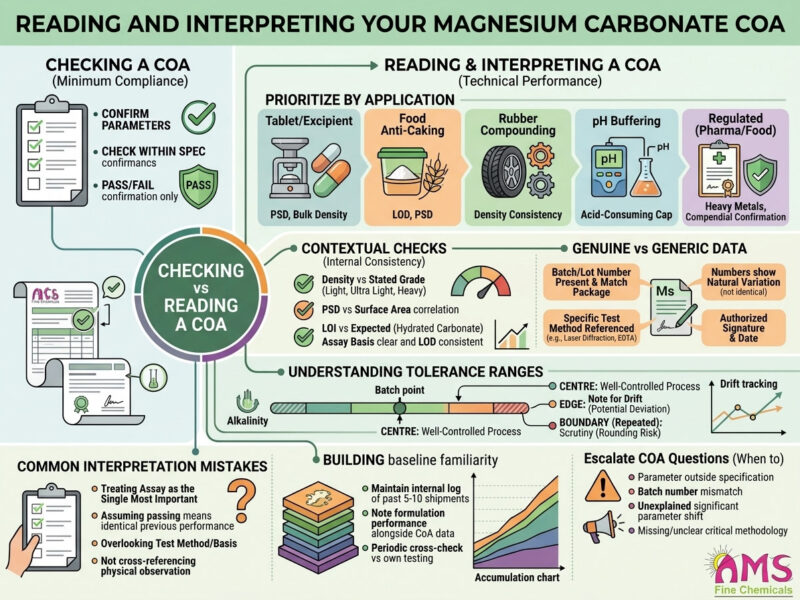
To serve global industries, manufacturing plants must produce magnesium carbonate that aligns cleanly with diverse international quality protocols. At AMS Fine Chemicals, our analytical testing laboratories screen every batch for the following parameters:
| Parameter | Industrial Grade | Food / FCC Grade | Pharmaceutical (IP/BP/USP) Grade |
| Appearance | Fine White Powder | Ultra-White Odorless Powder | Pure White Odorless Powder |
| Assay (as MgO) | 40.0%–43.5% | 40.0%–45.0% | 40.0%–43.5% |
| Soluble Salts | ≤ 1.0% | ≤ 0.4% | ≤ 0.1% |
| Heavy Metals (as Pb) | ≤ 20 ppm | ≤ 5 ppm | ≤ 10 ppm |
| Arsenic (As) | ≤ 3 ppm | ≤ 1 ppm | ≤ 1.5 ppm |
| Iron (Fe) | ≤ 0.1% | ≤ 0.02% | ≤ 0.01% |
| Calcium (Ca) | ≤ 0.75% | ≤ 0.4% | ≤ 0.45% |
| Acid Insoluble Matter | ≤ 0.15% | ≤ 0.05% | ≤ 0.05% |
6. Industrial Applications of Synthetic Magnesium Carbonate
The applications of high-purity synthetic magnesium carbonate span across a massive cross-section of modern industries:
Pharmaceuticals & Nutraceuticals
Magnesium carbonate acts as a highly effective antacid to relieve heartburn and acid indigestion. In solid dosage manufacturing (tablets and capsules), it serves as a highly functional diluent, disintegrant, and glidant. Its excellent oil-absorption capacity makes it ideal for stabilizing oily active pharmaceutical ingredients (APIs).
Food & Cosmetics
Approved globally as a safe food additive (E504), it is widely integrated into table salt, flour, and powdered spices as an anti-caking agent to keep them free-flowing. In cosmetics, its moisture-absorbent properties make it a staple ingredient in face powders, foundation formulations, and high-end talcs.
Industrial & Rubber Manufacturing
In the rubber and plastics industry, heavy magnesium carbonate serves as a reinforcing filler. It enhances the tensile strength, elasticity, and heat resistance of synthesized rubber compounds. It also functions as an effective smoke suppressant and flame retardant in polymer formulations.
Sports and Athletics
Often referred to simply as “chalk,” magnesium carbonate is used extensively by weightlifters, rock climbers, gymnasts, and powerlifters. Applied to the hands, it rapidly absorbs sweat, significantly reduces slippage, and ensures an exceptionally secure grip.
7. Sustainability & Environmental Controls in Manufacturing
Modern chemical engineering dictates that manufacturing must balance efficiency with environmental responsibility. AMS Fine Chemicals is committed to reducing the carbon footprint of our chemical synthesis loops through green engineering initiatives:
- Carbon Recycling Systems: The CO₂ gas liberated during the pyrolysis/thermal hydrolysis stage is collected via closed-loop piping, compressed, purified, and re-routed directly back into the carbonation towers. This significantly reduces our net greenhouse gas emissions.
- Wastewater Optimization: The filtrate generated from washing processes is processed through state-of-the-art Effluent Treatment Plants (ETP) and Reverse Osmosis (RO) systems, ensuring a zero-liquid-discharge (ZLD) footprint wherever possible.
- Thermal Efficiency: Our processing kilns and hot-air dryers utilize heat-recovery exchangers to repurpose exhaust heat, driving down overall fuel consumption.
8. Why Partner with AMS Fine Chemicals?
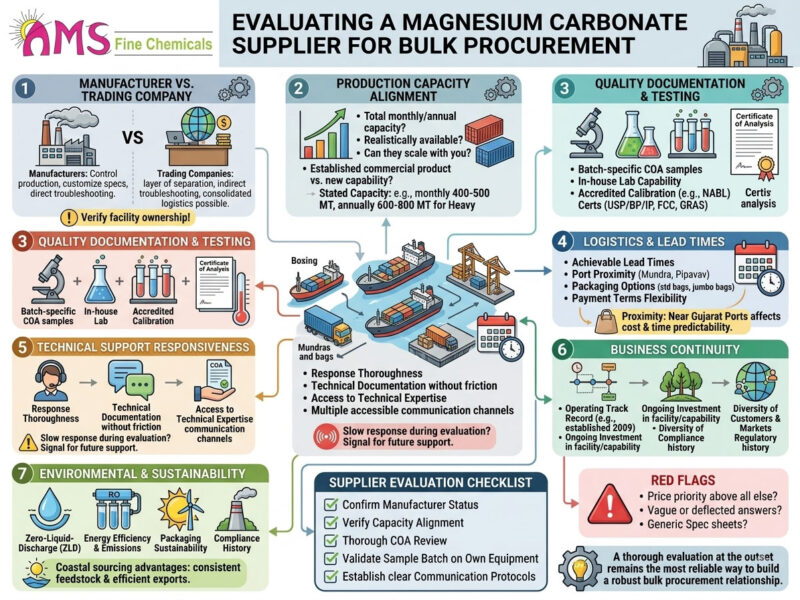
When sourcing high-purity inorganic chemicals, consistency, supply chain reliability, and stringent quality assurance are non-negotiable.
AMS Fine Chemicals is a leading manufacturer and exporter of premium Magnesium Carbonate. Operating from our advanced chemical production facility, we cater to custom particle size configurations, specialized bulk densities, and precise grade certifications (Industrial, Food, Pure, and Pharma).
Our Core Strengths:
- State-of-the-art analytical testing laboratories ensuring trace metal analysis down to parts-per-million (ppm) accuracy.
- Customized processing workflows for tailored bulk density and exceptional whiteness profiles.
- Robust supply logistics delivering material safely to local and global locations.
- Uncompromising commitment to international environmental, health, and safety regulations.
9. Frequently Asked Questions (FAQs)
Q1: What is the primary difference between Light and Heavy Magnesium Carbonate?
The core difference lies in their physical density and particle structure, which are controlled during the precipitation and boiling stages of manufacturing. Light magnesium carbonate has a bulk density of 0.1–0.15 g/cm³, whereas heavy magnesium carbonate exhibits a bulk density of 0.4–0.5 g/cm³.
Q2: Is synthetic magnesium carbonate safe for food consumption?
Yes, synthetic magnesium carbonate manufactured under strict Good Manufacturing Practices (GMP) complies with the Food Chemicals Codex (FCC) and is universally certified as food additive E504. It is completely non-toxic and serves effectively as an anti-caking agent.
Q3: Can AMS Fine Chemicals supply custom particle size distributions?
Absolutely. Our advanced milling and micronization setups enable us to supply customized particle sizes tailored exactly to your specific formulation parameters.
Get in Touch for Bulk Requirements
Are you looking for a reliable manufacturing partner for high-purity Magnesium Carbonate? Let AMS Fine Chemicals optimize your chemical supply chain.
- Company Name: AMS Fine Chemicals
- Official Website: www.amsfine.com
- Corporate Email Contact: info@amsfine.com
Contact our technical sales team today to request data sheets, batch certificates, or custom product samples.