In the demanding world of industrial construction and high-temperature manufacturing, the integrity of materials is often measured by their ability to withstand extreme thermal stress. AMS Fine Chemicals, based in the industrial hub of Bhavnagar, Gujarat, is a premier producer of high-performance Heavy Magnesium Carbonate (MgCO3).
While Magnesium Carbonate is frequently discussed in pharmaceutical or food contexts, its role in Refractory Bricks, Fireproofing Compounds, and Cement-Based Materials is foundational to modern infrastructure. This guide details the chemical mechanics and industrial advantages of using Heavy MgCO3 in these critical sectors.
1. Introduction: The Industrial Heavyweight
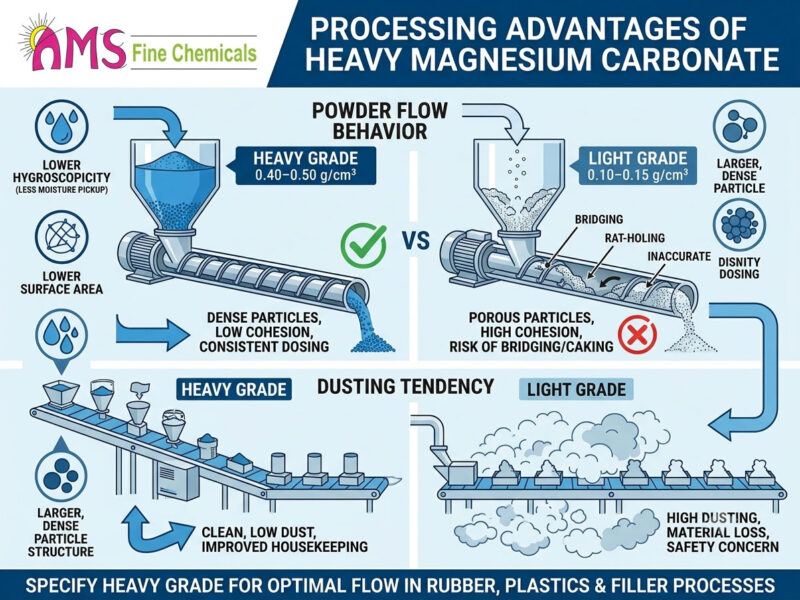
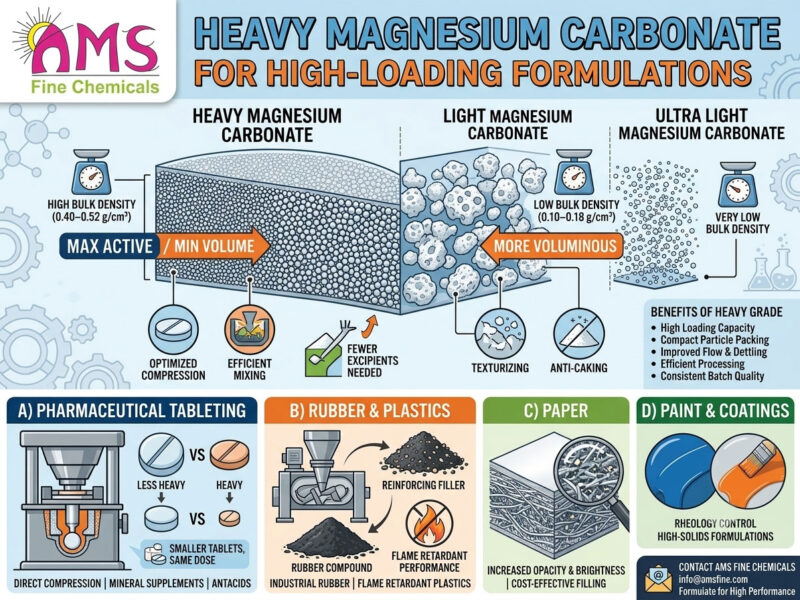
Heavy Magnesium Carbonate is a dense, granular white powder. Unlike its “Light” counterpart, it features a compact crystalline structure and a higher bulk density (typically 0.45 – 0.55 g /ml), which makes it an ideal candidate for heavy-duty industrial applications where volume-to-mass efficiency and thermal stability are paramount.
At AMS Fine Chemicals, we engineer Heavy MgCO3 to serve as a vital precursor to Magnesium Oxide (MgO) and a functional additive that enhances the safety and durability of construction materials.
2. Heavy MgCO3 in Refractory Bricks
Refractories are materials designed to maintain their strength and chemical identity at temperatures exceeding 1500°C. They are the literal “firewall” in steel furnaces, glass kilns, and cement incinerators.
A. Precursor to Dead-Burned Magnesia
The primary role of Heavy Magnesium Carbonate in the refractory industry is its conversion into Magnesium Oxide (MgO).10 Through a process called calcination, MgCO3 is heated to drive off carbon dioxide:
MgCO3 + Heat > MgO + CO2
In refractory brick manufacturing, the use of Heavy MgCO3 from AMS Fine Chemicals ensures a high-density MgO yield. When heated to very high temperatures (sintering), it forms “Dead-Burned Magnesia,” which is virtually unreactive and exceptionally resistant to the corrosive “slag” found in steel furnaces.
B. Thermal Expansion and Shock Resistance
Refractory bricks must survive rapid heating and cooling cycles. Heavy MgCO3 acts as a stabilizing agent:
- Coefficient Match: It helps adjust the thermal expansion coefficient of the brick so that it matches the furnace lining, preventing “spalling” or cracking.
- Bonding Agent: In “green” (unfired) bricks, it serves as a temporary binder, providing the mechanical strength needed to handle the bricks before they are permanently fired in the kiln.
3. Fireproofing Compounds: The Endothermic Shield
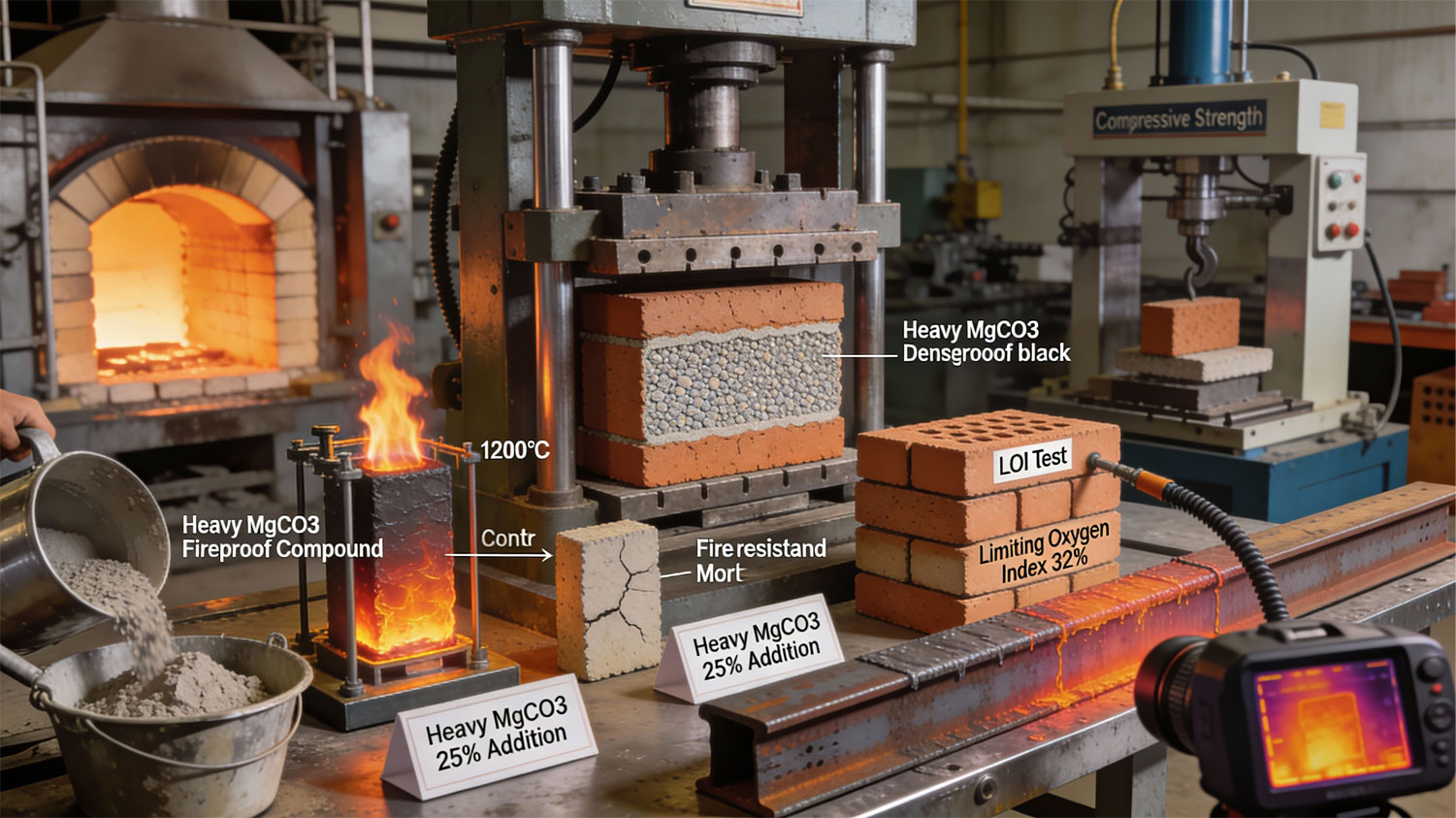
In skyscrapers, tunnels, and chemical plants, structural steel must be protected from the intense heat of a fire, which can cause steel to lose 50% of its strength at just 600°C. Heavy Magnesium Carbonate is a cornerstone of modern intumescent and cementitious fireproofing sprays.
A. The Endothermic Cooling Effect
Heavy MgCO3 is a “chemical heat sink.” When exposed to a fire, it undergoes a decomposition reaction that absorbs a massive amount of thermal energy:
- Heat Absorption: The chemical breakdown of MgCO3 into MgO is an endothermic process. It “sucks” heat away from the structural steel, delaying the time it takes for the metal to reach its critical failure temperature.
- Oxygen Dilution: The CO2 gas released during this process is non-combustible. It forms a heavy gas blanket around the surface, diluting oxygen and suppressing the flame spread.
B. Protective Char Formation
As the MgCO3 decomposes, it leaves behind a layer of MgO. This “residual ash” is a high-performance insulator. In fireproofing coatings, this layer forms a rigid, porous “char” that physically blocks heat from reaching the substrate.
4. Enhancing Cement-Based Materials
The construction industry is increasingly incorporating Magnesium-based additives to improve the performance of traditional Portland Cement and specialized mortars.
A. Early Strength and Setting Time
Recent studies and industrial applications show that adding small percentages (typically <1%) of Magnesium Carbonate to cement paste can accelerate the initial hydration process.
- Ettringite Formation: It promotes the formation of Ettringite crystals, which are responsible for early-stage strength development in concrete.
- Rapid Setting: For emergency road repairs or underwater construction, Heavy MgCO3 can be used to shorten setting times.
B. Carbon Sequestration and “Green” Cement
With the global push for sustainability, AMS Fine Chemicals is supporting the development of Magnesium Oxychloride and Magnesium Oxysulfate cements.
- Unlike traditional cement, which releases vast amounts of CO2 during production, Magnesium-based cements can actually re-absorb CO2 from the atmosphere over time, turning the building itself into a “carbon sink.”
C. Fire-Resistant Concrete
In high-rise construction, “Refractory Concrete” incorporates Heavy MgCO3 to prevent explosive spalling. During a fire, moisture trapped inside concrete can turn to steam and explode. The porous decomposition ofMgCO3 creates micro-channels that allow steam to escape safely while providing a chemical cooling effect.
5. Technical Specifications for Construction Grades
The performance of Heavy MgCO3 in construction depends on its density and chemical purity. At our Bhavnagar facility, we adhere to the following industrial benchmarks:
| Specification | Construction Grade Standard | Benefit |
| Bulk Density | 0.48 – 0.55 g/ml | Ensures compact packing in bricks and mortars. |
| Magnesium Oxide (MgO) Content | 40.0% – 44.0% | High efficiency for refractory conversion. |
| Iron Content (Fe2O3) | < 0.05% | Prevents staining and chemical degradation in cement. |
| Chlorides | < 0.1% | Minimizes corrosion risk for steel reinforcement (rebar). |
| Particle Size | Custom (Granular to Fine) | Tailored for either brick pressing or spray coatings. |
6. The Bhavnagar Advantage: Quality and Logistics
AMS Fine Chemicals leverages the strategic industrial landscape of Bhavnagar, Gujarat, to provide a competitive edge to our clients:
- Marine-Sourced Purity: Our proximity to the Gulf of Khambhat allows us to source high-grade magnesium salts, ensuring our Heavy MgCO3 is free from the heavy clay impurities found in mined magnesite.
- Advanced Calcination Control: We use precision-controlled reactors to ensure the “Heavy” density remains consistent batch-after-batch, which is critical for the automated pressing of refractory bricks.
- Global Export Hub: Located near major seaports like Pipavav and Mundra, we can efficiently supply large-scale infrastructure projects across Asia, the Middle East, and beyond.
7. Conclusion: Building a Safer, Stronger Future
Heavy Magnesium Carbonate is an “invisible architect” in the world of heavy industry. From the refractory linings that enable steel production to the fireproofing layers that protect our cities, its thermal properties are indispensable.
As a trusted partner in the chemical and construction sectors, AMS Fine Chemicals continues to innovate, providing the high-density, high-purity minerals required to build structures that are not only stronger but significantly safer against the threat of fire.