In the fast-evolving pharmaceutical market, the speed of delivery is often as important as the efficacy of the drug itself. For patients suffering from acute gastric distress, every second counts. AMS Fine Chemicals, based in Bhavnagar, Gujarat, has optimized the production of Light Magnesium Carbonate (Light MgCO3) to serve as a critical component in rapid-action formulations.
This technical analysis explores why Light MgCO3 is the preferred choice for effervescent delivery systems and liquid suspensions, focusing on its unique physical chemistry and neutralization kinetics.
1. The Science of Rapid Neutralization
The effectiveness of an antacid is measured by its Acid Neutralizing Capacity (ANC) and its onset of action. Light Magnesium Carbonate excels in both areas due to its high surface-area-to-volume ratio.
A. Surface Area and Reactivity
Unlike the “Heavy” grade, Light MgCO3 consists of porous, needle-like micro-crystals. When these particles enter the stomach, they provide a massive surface area for hydrochloric acid (HCl) to attack.
- The Reaction: MgCO3 + 2HCl → MgCl2 + H2O + CO2
- Result: The reaction occurs almost instantly upon contact, providing immediate symptomatic relief from hyperacidity.
B. The “Buffering” Advantage
Magnesium carbonate does not just “spike” the pH; it buffers it. It maintains the gastric environment at a pH of 3.0 to 4.5, which is high enough to stop the burning sensation but low enough to allow digestive enzymes to continue functioning.
2. Light MgCO3 in Effervescent Tablets
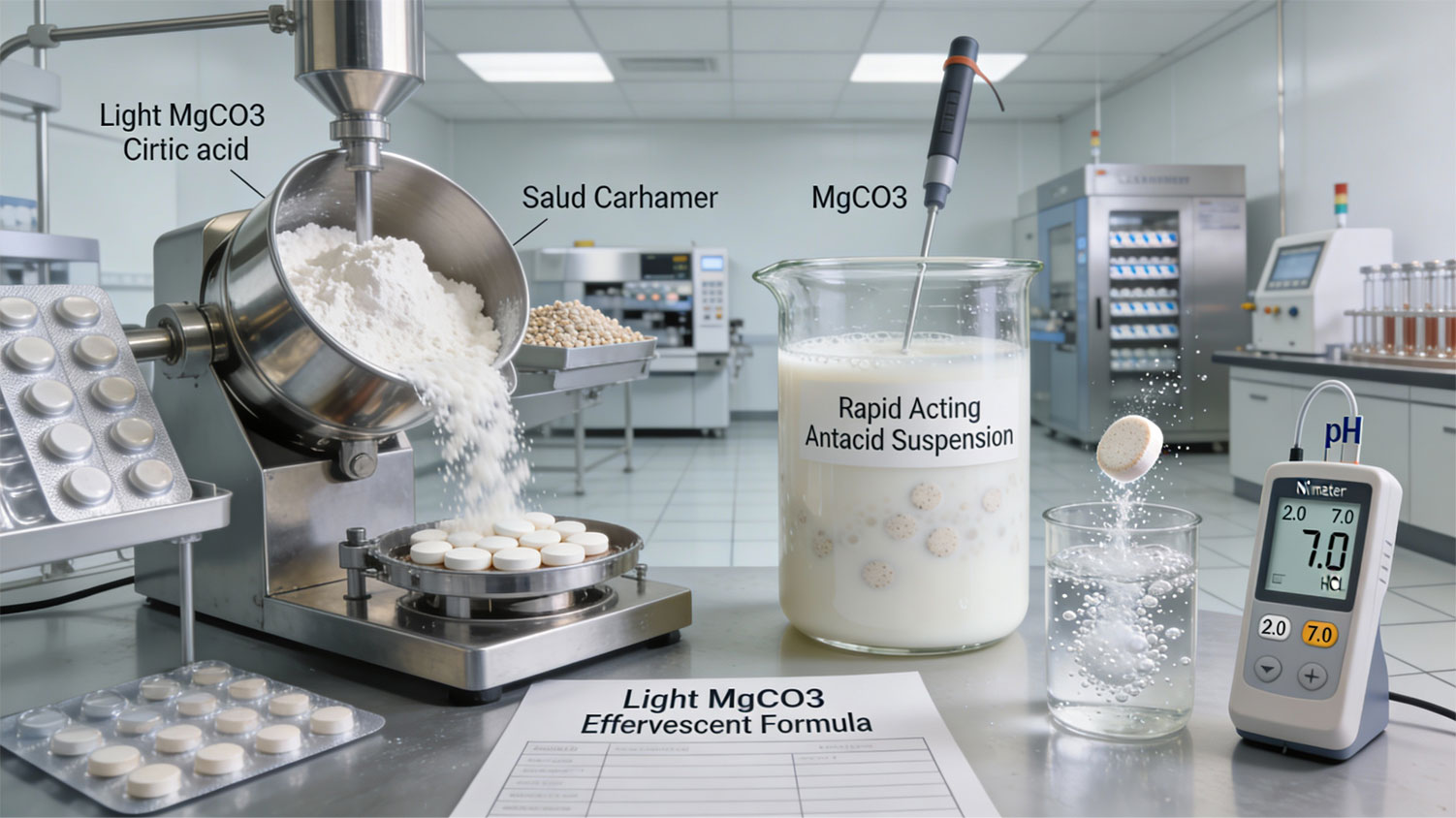
Effervescent tablets are designed to dissolve in water before ingestion, creating a carbonated solution that is easy to swallow and fast to absorb.
A. The Role of CO2 Generation
In an effervescent couple (usually an organic acid like Citric Acid and a carbonate), Light MgCO3 serves a dual purpose. It is both the Active Pharmaceutical Ingredient (API) and a source of carbonation.
- Mechanical Breakup: As the tablet hits water, the reaction between the acid and Light MgCO3 releases CO2 gas.
- Disintegration: This gas release creates internal pressure that shatters the tablet matrix, ensuring the drug is fully dissolved in seconds.
B. Porosity and “Float”
Because Light MgCO3 has a very low bulk density (~0.1 g/ml), it helps the tablet remain buoyant during the initial stages of dissolution, preventing the “dead weight” effect where a tablet sits at the bottom of a glass and dissolves slowly.
3. Formulating Stable Liquid Suspensions
For pediatric and geriatric patients, liquid suspensions are the gold standard. However, keeping a mineral powder suspended in a liquid without it clumping at the bottom is a major engineering challenge.
A. Sedimentation Rates and Stokes’ Law
According to Stokes’ Law, the velocity of a particle settling in a liquid is proportional to its size and density.
- Light vs. Heavy: Light MgCO3 particles are much lighter and have a “fluffy” morphology.
- Result: They stay suspended in the liquid for significantly longer periods compared to Heavy MgCO3. This ensures that when a patient shakes the bottle, the dosage remains uniform from the first spoonful to the last.
B. Mouthfeel and Palatability
A common complaint with liquid antacids is “grittiness.” AMS Fine Chemicals uses advanced air-jet milling to ensure our Light MgCO3 has an ultra-fine particle size (typically <10 microns). This results in a smooth, creamy texture that improves patient compliance.
4. Technical Specifications for Formulators
When sourcing from AMS Fine Chemicals (Bhavnagar), R&D teams should look for these specific parameters optimized for rapid-action products:
| Parameter | Specification for Effervescents | Importance |
| Bulk Density | 0.06 – 0.10 g/ml | Ensures rapid dissolution and buoyancy. |
| Neutralizing Capacity | 35 – 45 mEq/g | Dictates the strength of the antacid. |
| Particle Size (D90) | < 15 Microns | Prevents grittiness in suspensions. |
| Loss on Drying | < 2.0% | Prevents premature effervescence in the package. |
5. The Manufacturing Edge in Gujarat
Bhavnagar has established itself as a hub for inorganic chemistry due to its access to high-quality magnesium salts and a skilled technical workforce. AMS Fine Chemicals leverages this ecosystem to provide:
- Moisture-Controlled Packaging: Since Light MgCO3 is highly hygroscopic, we use multi-layer moisture-barrier bags to ensure the product stays dry until it reaches your production line.
- Batch Consistency: Our automated precipitation tanks ensure that the “Lightness” of the powder is identical across every batch, preventing variations in tablet hardness or suspension viscosity.
6. Safety and Regulatory Compliance
All pharmaceutical-grade Light MgCO3 from AMS Fine Chemicals complies with IP, BP, and USP standards.
- Microbial Purity: We conduct rigorous testing to ensure zero contamination, which is critical for liquid suspensions that can otherwise become breeding grounds for bacteria.
- Low Heavy Metals: Our process minimizes Lead and Arsenic, ensuring safety for long-term chronic use.
7. Conclusion
Light Magnesium Carbonate is more than just a chemical; it is a functional tool that allows pharmaceutical scientists to design faster, more pleasant, and more effective digestive health products. From the “fizz” of an effervescent tablet to the “smoothness” of a suspension, the physical properties of Light MgCO3 make it indispensable.
AMS Fine Chemicals is proud to be a trusted partner to the global pharmaceutical industry, providing the high-quality minerals that power modern health solutions.