Magnesium carbonate (MgCO3) has been a staple in medicine for decades, valued for its safety, efficacy, and dual-action profile. In the modern pharmaceutical landscape, where consumer demand for “natural-origin” and “gentle” ingredients is rising, this compound remains a premier choice for digestive health formulations.
This in-depth guide by AMS Fine Chemicals (Bhavnagar, Gujarat) explores the critical role of pharmaceutical-grade magnesium carbonate as an antacid and laxative, its biochemical mechanisms, and its advantages in modern drug delivery.
1. The Dual Nature: Antacid and Laxative
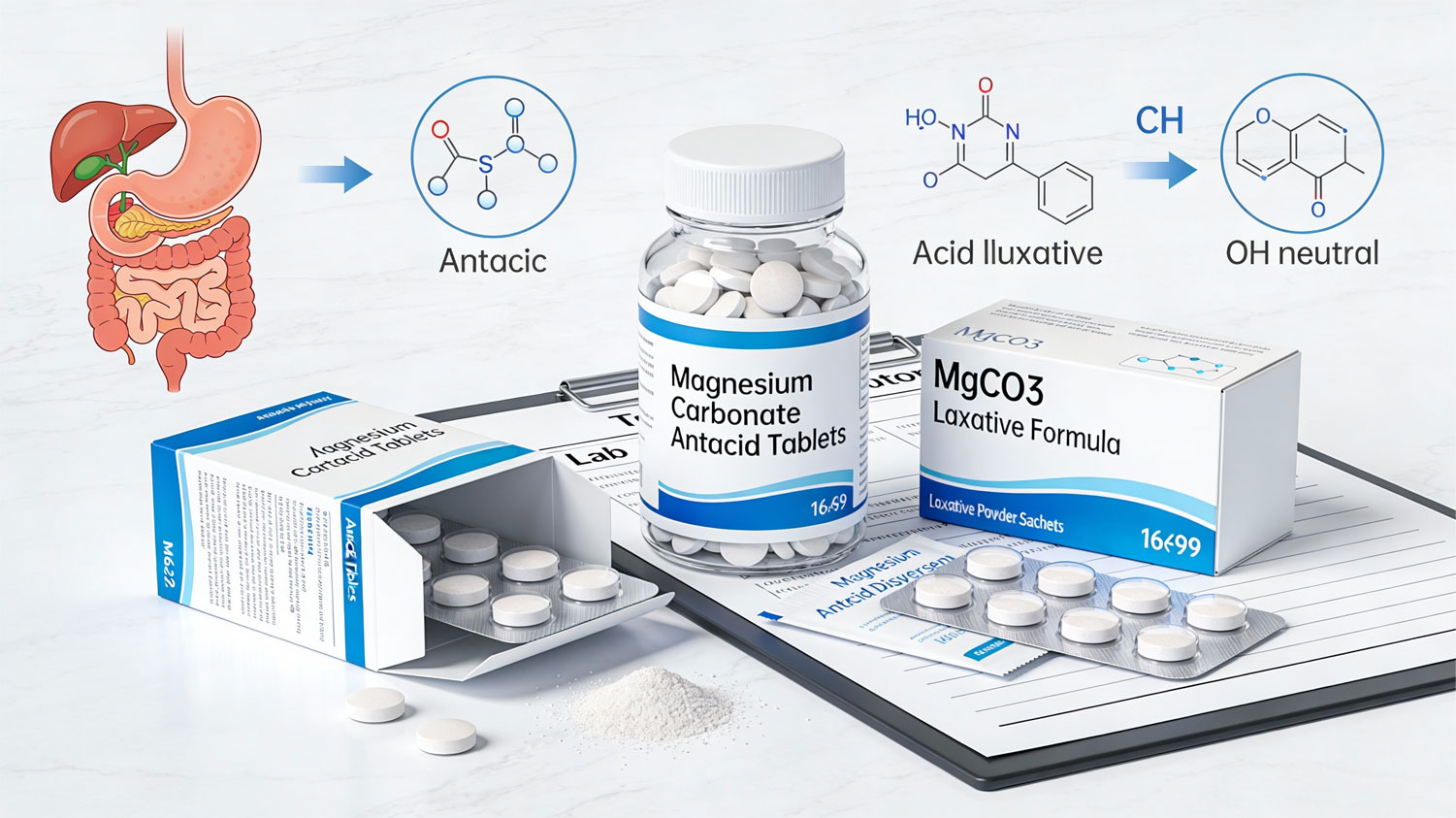
Magnesium carbonate is one of the few inorganic salts that effectively addresses two of the most common digestive complaints: hyperacidity and constipation. While it performs two different functions, the transition between these roles is determined primarily by the dosage and the chemical environment of the digestive tract.
A. Role as an Antacid
As an antacid, magnesium carbonate is used to provide rapid relief from symptoms of heartburn, acid indigestion, and GERD (Gastroesophageal Reflux Disease).
- Neutralization: It acts as a mild base that reacts directly with excess hydrochloric acid (HCl) in the stomach.
- Symptom Relief: By raising the gastric pH, it inhibits the activity of pepsin, the enzyme responsible for protein digestion that can irritate the stomach lining during acid reflux.
B. Role as a Laxative
When administered in higher doses, magnesium carbonate functions as an osmotic laxative.
- Water Retention: It is poorly absorbed by the intestinal walls. Its presence in the colon creates an osmotic gradient that draws water into the intestinal lumen.
- Peristalsis: The increased volume of water softens the stool and distends the colon, which naturally triggers peristaltic waves (bowel movements).
2. Chemical Mechanisms of Action
To understand why magnesium carbonate is so effective, we must look at the chemical reactions that occur inside the body.
The Neutralization Reaction (Stomach)
When you ingest a tablet or suspension containing MgCO3, it encounters gastric acid. The resulting chemical reaction is:
MgCO3 + 2HCl → MgCl2 + H2O + CO2
- Magnesium Chloride (MgCl2): A soluble salt that provides a source of magnesium ions.
- Water (H2O): Neutralizes the acidity.
- Carbon Dioxide (CO2): This gas is released, which sometimes leads to mild belching—a signal that the acid is being neutralized.
The Osmotic Mechanism (Intestines)
In the intestines, the unreacted magnesium carbonate or the resulting magnesium ions (Mg2) remain in the gut. Because the body absorbs magnesium slowly, these ions stay in the stool. Through osmosis, water moves from the body’s tissues into the gut to balance the concentration. This “wetting” effect is what makes it a “saline” or osmotic laxative.
3. Advantages in Modern Formulations
Pharmaceutical manufacturers, including partners of AMS Fine Chemicals, prefer magnesium carbonate over other salts (like magnesium sulfate or sodium bicarbonate) for several reasons:
I. Sustained Buffering Effect
Unlike sodium bicarbonate, which is highly soluble and neutralizes acid almost instantly (often causing “acid rebound”), magnesium carbonate has low solubility. It dissolves gradually as it meets acid, providing a longer-lasting buffering effect that keeps stomach pH at a comfortable level for an extended period.
II. Low Sodium Profile
With the rise in hypertension and heart disease, many patients must avoid “alkalinizing” agents that contain sodium. Magnesium carbonate offers a sodium-free alternative for acid relief, making it safer for long-term management of indigestion in cardiac patients.
III. Superior Tableting Properties
In modern drug manufacturing, the “Heavy” grade of magnesium carbonate produced in our Bhavnagar facility is highly prized.
- Compressibility: It can be compressed into tablets without the need for complex binders.
- Disintegration: It helps tablets break apart quickly in the stomach, ensuring fast onset of action (typically within 15–30 minutes).
4. Comparing Magnesium Carbonate Grades
| Property | Light MgCO3 | Heavy MgCO3 |
| Bulk Density | ~0.1 g/ml | ~0.5 g/ml |
| Best Formulation | Liquid Suspensions | Compressed Tablets |
| Suspension Rate | Stays suspended longer | Settles faster |
| Application | “Milk of Magnesia” styles | Chewable antacid tablets |
5. Dosage and Safety Standards (IP/BP/USP)
At AMS Fine Chemicals, we manufacture magnesium carbonate to meet IP (Indian Pharmacopoeia), BP (British Pharmacopoeia), and USP (United States Pharmacopeia) standards. These grades ensure:
- Lead & Arsenic Limits: Extremely low heavy metal content to prevent toxicity.
- Soluble Salts: Minimized to prevent interference with other medications.
- Acid-Insoluble Substances: Ensuring the powder dissolves completely in gastric juices.
Typical Dosage Guidelines:
- For Antacid Effect: 500 mg to 1000 mg as needed.
- For Laxative Effect: 2,000 mg to 5,000 mg (usually as a single dose at bedtime).
6. Why AMS Fine Chemicals?
Located in Bhavnagar, Gujarat, AMS Fine Chemicals is a strategic leader in the production of high-purity magnesium compounds.
- In-House Testing: Our NABL-calibrated laboratory tests every batch for microbial purity and chemical consistency.
- Customization: We provide “Ultra Light” to “Heavy” grades to suit specific formulation needs—whether it’s a smooth-textured liquid antacid or a high-density tablet.
- Sustainability: Our manufacturing processes are optimized to minimize environmental impact, reflecting our commitment to the “Clean Gujarat” initiative.
Conclusion
Magnesium carbonate continues to be an essential tool in modern gastroenterology. Its ability to provide both immediate acid relief and gentle relief from constipation—without the harsh side effects of stimulant laxatives—makes it a cornerstone of the pharmaceutical industry.