In the world of industrial chemistry, the distinction between two substances with the same chemical formula—MgCO3—can be the difference between a successful formulation and a failed production batch. At AMS Fine Chemicals, located in the manufacturing heart of Bhavnagar, Gujarat, we specialize in the precision engineering of both Light and Heavy Magnesium Carbonate.
This technical guide provides a deep dive into the physical characteristics, morphological differences, and specific industrial applications that separate these two essential forms.
1. Understanding the Physical Polymorphism
Chemically, Light and Heavy Magnesium Carbonate are nearly identical. However, their physical architecture—how the molecules are packed and the size of the resulting particles—creates two entirely different raw materials.
What is Light Magnesium Carbonate?
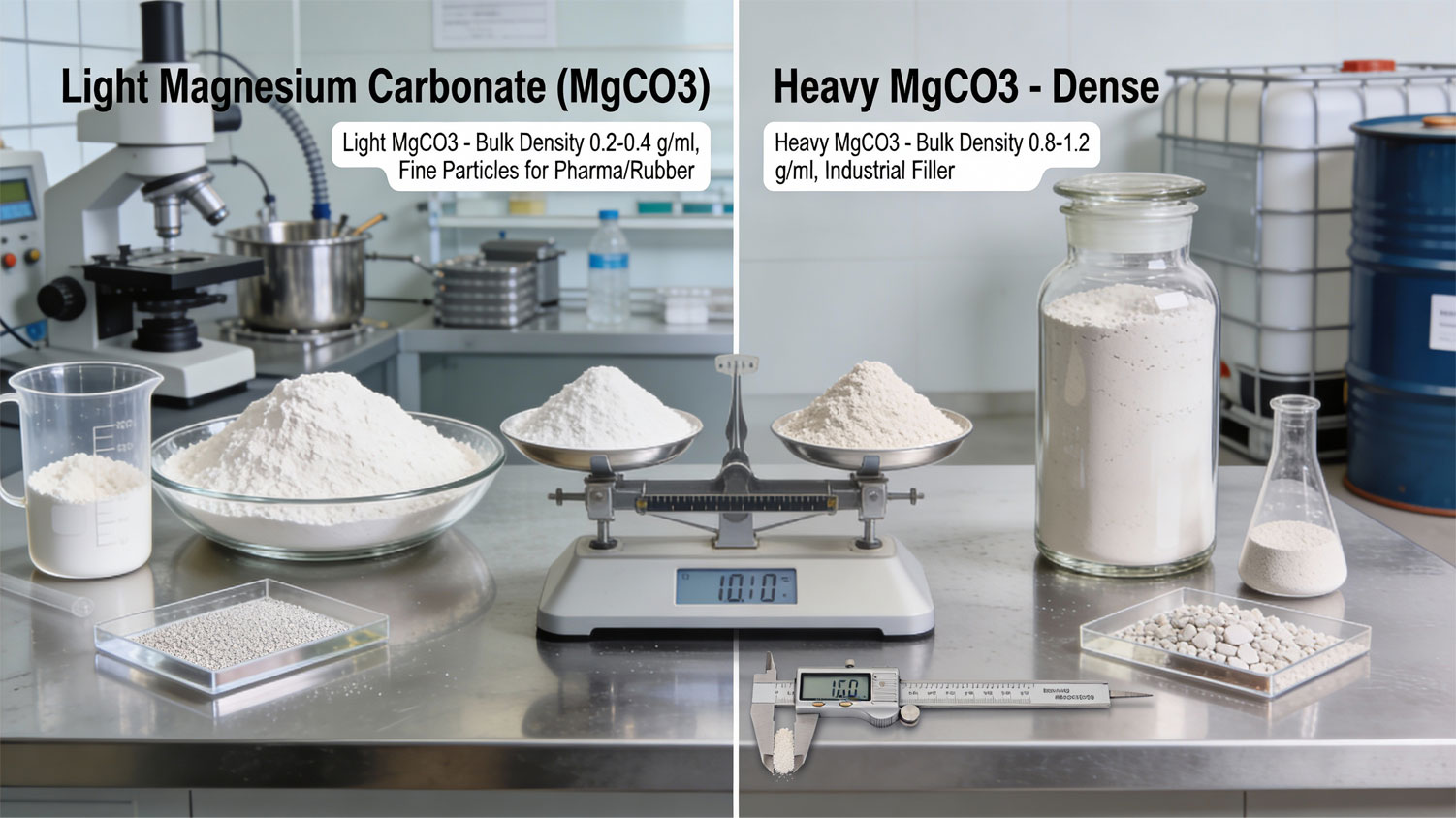
Light Magnesium Carbonate is a very fine, voluminous white powder. It is often a basic carbonate, containing water of hydration. Its hallmark is its incredibly low bulk density, meaning a small weight of the powder occupies a very large volume.
What is Heavy Magnesium Carbonate?
Heavy Magnesium Carbonate is a dense, granular white powder. It is produced through a different precipitation process that yields larger, more compact crystals with minimal air space between them.
2. The Great Divide: Bulk Density and Particle Size
The primary technical metric that industrial buyers use to distinguish these products is Bulk Density. This measurement dictates how the material will flow, how it will be stored, and how it will interact with other ingredients.
A. Bulk Density Comparison
- Light Magnesium Carbonate: Typically ranges from 0.06 g/ml to 0.15 g/ml. To put this in perspective, a 10kg bag of Light Magnesium Carbonate is significantly larger in size than a 10kg bag of the Heavy version.
- Heavy Magnesium Carbonate: Typically ranges from 0.45 g/ml to 0.55 g/ml. It is approximately 4 to 5 times denser than the light version.
B. Particle Size Distribution (PSD)
- Light Grade: Features microscopic, needle-like or plate-like crystals. These particles have a massive surface area, which makes them excellent for absorption.
- Heavy Grade: Features more spherical, compact granules. The lower surface-area-to-volume ratio makes them less reactive in certain environments but much easier to “pour” and “dose” in automated machinery.
3. Application Differences: Which Grade Do You Need?
The choice between Light and Heavy is rarely arbitrary; it is dictated by the manufacturing process and the desired “mouthfeel” or “texture” of the final product.
When to Choose Light Magnesium Carbonate
- Sports Chalk: Because of its high surface area and low density, it is the industry standard for gymnastics and climbing chalk. It absorbs sweat (moisture) and oils rapidly.
- Liquid Suspensions: In the pharmaceutical industry, Light MgCO3 is preferred for liquid antacids (like “Milk of Magnesia” types) because the light particles stay suspended in the liquid longer before settling.
- Cosmetics: Used in face powders and dry shampoos where a “fluffy” texture and high oil absorption are required.
- Rubber Industry: Acts as a reinforcing filler where high surface interaction with polymer chains is necessary.
When to Choose Heavy Magnesium Carbonate
- Tablet Manufacturing: Heavy MgCO3 is the “gold standard” for tableting. Its high density and excellent flow properties allow it to fill tablet dies quickly and evenly, ensuring consistent dosage weight.
- Glass and Ceramics: In high-temperature kilns, the dense nature of Heavy MgCO3 allows for more efficient melting and less dust loss in the furnace.
- Mineral Fortification: Used in dietary supplements where the manufacturer wants to fit a high dose of Magnesium into a small, easy-to-swallow capsule.
- Food Additives: Used in automated food processing lines where free-flowing properties are required to prevent clogging of dispensers.
4. Technical Comparison Table
| Feature | Light Magnesium Carbonate | Heavy Magnesium Carbonate |
| Chemical Formula | MgCO3 \ Mg(OH)2 \ H2O (typical) | MgCO3 (more anhydrous) |
| Appearance | Very fluffy, light powder | Granular, dense powder |
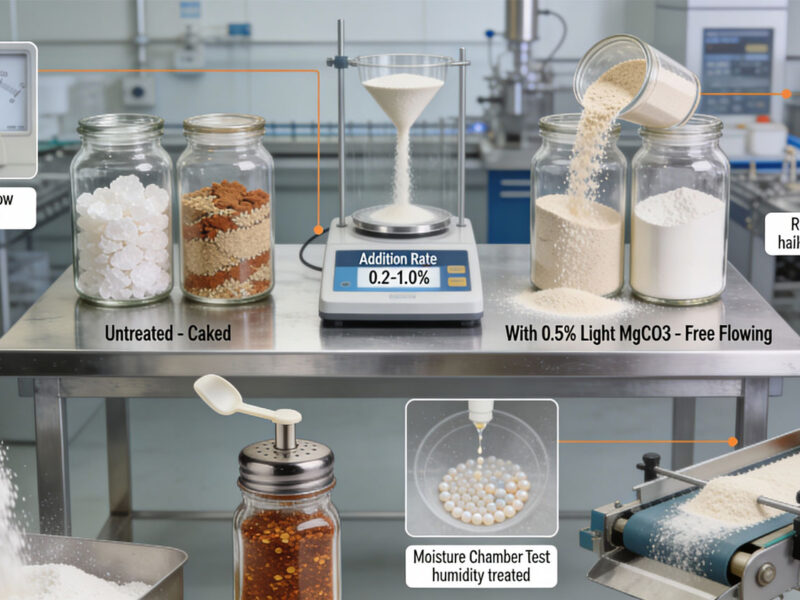
| Flowability | Poor (clumps easily) | Excellent (free-flowing) |
| Absorption Power | Very High | Moderate to Low |
| Sedimentation | Slow (stays in suspension) | Fast (settles quickly) |
| Compressibility | Difficult (requires high force) | Easy (ideal for tableting) |
5. Manufacturing Precision at AMS Fine Chemicals
In our Bhavnagar facility, we utilize advanced precipitation and drying technologies to control these physical parameters.
Quality Control Measures:
- Tapped Density Testing: We measure how much the powder settles under vibration to ensure it meets the specific “Heavy” or “Light” requirements of our clients.
- Sieve Analysis: We ensure that the particle size distribution is consistent, preventing “grittiness” in pharmaceutical and cosmetic applications.
- Whiteness Index: We maintain a high brightness level, essential for the paper, plastic, and paint industries.
6. Storage and Handling Considerations
Due to their different densities, storage requirements vary significantly:
- Light Grade: Requires significant warehouse space. It is also prone to becoming airborne, so dust extraction systems are recommended during handling.
- Heavy Grade: Can be stored in smaller footprints and is much less “dusty,” making it easier to handle in open-air environments.
7. Conclusion
Understanding the difference between Light and Heavy Magnesium Carbonate is essential for optimizing product performance and manufacturing efficiency. Whether you need the high-absorbency of the Light grade for sports and liquids or the high-flowability of the Heavy grade for tablets and glass, AMS Fine Chemicals provides the purity and consistency your industry demands.